Why Are My Cookies Hard?

Hard cookies almost always trace back to one of three things: two extra minutes in the oven, too much flour from a scooped measuring cup, or a sugar mix that leans too far toward white sugar. Those three cover the large majority of hard batches.
The rest come from a tough dough rather than a dry one, which is a different failure with a different fix, or from cookies that were fine on day one and turned hard sitting in the wrong container.
Start with the bake. Our free baking time calculator gives you the right window for your cookie size, pan and oven, and overbaking is the cause that beats every other one combined.
Updated September 2026
Why are my cookies hard? Three kinds of hard, three fixes
Before you change anything, work out which one you have. They look similar on the plate and they are not the same problem.
| The cookie is | It feels like | The cause | The fix |
|---|---|---|---|
| Dry-hard | Snaps cleanly, crumbles to sand in your mouth, pale and dull inside | Overbaked, or not enough moisture-holding sugar and fat | Pull 2 minutes earlier. Shift sugar toward brown |
| Tough-hard | Bends before it breaks, chewy in a leathery way, dense | Too much flour, or the dough was worked after the flour went in | Weigh flour at 125 g a cup. Stop mixing at the last dry streak |
| Stale-hard | Was soft yesterday, hard today, tastes fine | Water evaporated, or starch retrogradation in a leaky container | Airtight container, and the bread slice trick below |
Dry-hard and tough-hard need opposite corrections, which is why guessing costs you a second batch. A dry cookie needs more moisture retained. A tough cookie needs less gluten built.
Cause 1: two extra minutes in the oven
This is the leading cause of hard cookies by a wide margin, and the reason is that cookies look underdone at the exact moment they are done.
Pull cookies when the edges are set and lightly browned and the center still looks puffed, soft and just barely matte. They will not look finished. That is correct.
A baking sheet coming out of a 375°F oven is still above 250°F two minutes later, and the cookies keep cooking on it for another 3 to 5 minutes. If you wait for a cookie to look done in the oven, you have already baked it past the mark, and the carryover finishes the job.
Measure the cost yourself
This is the experiment that convinces people. Weigh one raw dough ball, bake the tray, then weigh the same cookie once it is completely cool.
A 45 g drop cookie usually comes out somewhere between 40 and 42 g, having lost 8 to 12 percent of its weight as water vapor. Bake the identical dough three minutes longer and you'll see that loss climb by several more percent. Every one of those grams was moisture that would have kept the cookie soft.
There is no going back from it. Water that left in the oven is not coming home.
The doneness signs that actually work
- A gold ring 1/4 to 1/2 inch wide around the outside, blending into paler dough in the middle. Even color across the whole surface means you went long.
- A spatula slides cleanly under the edge and the edge holds its shape.
- The center has gone from glossy to matte but still looks soft.
Our full guide to telling when cookies are done has the sign for every cookie type, including the dark doughs where browning is invisible.
Getting them off the pan early is a lever too. Move cookies to a rack after 2 minutes instead of 5 and you cut the carryover short, which is the fastest way to buy back softness with zero recipe changes.
Cause 2: your oven is not the temperature it says
Home ovens routinely run 25 to 50°F away from the dial, and there is no way to know without a separate oven thermometer sitting on the rack.
An oven running 25°F hot bakes the outside of a cookie faster than the inside can catch up. The edges harden while the center is still setting, so you leave the tray in longer to fix the middle, and the edges go from firm to rock.
Symptoms of a hot oven: dark bottoms with pale tops, cookies that spread and then set too fast, and edges that are noticeably harder than centers.
Symptoms of a cool oven: long bake times, pale bottoms, and cookies that dry out slowly across an extended bake rather than setting quickly.
The second one is worse for hardness. A cookie that sits at 325°F for 16 minutes loses far more water than one that sets at 375°F in 10, because time in the oven is what drives evaporation. If your cookies always take longer than the recipe says, your oven is the reason and your cookies are paying for it in moisture.
Our oven temperature converter handles the Fahrenheit, Celsius and gas mark conversions if the recipe came from elsewhere, and which oven rack to use covers position, which matters more than most people think.
Pan material stacks on top of this. Dark and nonstick pans absorb heat and brown bottoms 2 to 3 minutes faster. Drop the oven 25°F if that's what you own. Insulated pans do the opposite and add 2 to 3 minutes. Reusing a hot pan for the second tray starts the spread and the set immediately, which also pushes cookies toward hard, so cool the pan under running water and dry it between batches.
Cause 3: too much flour, and the measuring cup
If the bake was right, this is the next place to look, and the size of the error is bigger than it feels.
A cup of all-purpose flour weighs 125 g spooned in and leveled, and about 145 g if you dip the cup into the bag. That's 20 g per cup, every cup, in the same direction.
Watch what it does to a standard drop cookie. Take a dough with 250 g flour, 227 g butter, 200 g brown sugar and 100 g white sugar.
As written: - Fat to flour: 227 ÷ 250 = 91 percent - Sugar to flour: 300 ÷ 250 = 120 percent
With scooped flour at 290 g: - Fat to flour: 227 ÷ 290 = 78 percent - Sugar to flour: 300 ÷ 290 = 103 percent
You did not make the same cookie with slightly more flour. You made a leaner, drier cookie with less fat and less sugar per unit of structure, which is the exact recipe for a hard one. Fat and sugar are the two ingredients that keep a cookie tender, and you just diluted both by a seventh.
The fix is a scale. If you don't own one, spoon the flour into the cup and level with a knife. Never dip, never tap, never pack. How to measure flour has all three methods with the gram weights, and our ingredient weights chart covers everything else in the bowl.
The same error also causes cookies that refuse to spread, which we cover in why cookies don't spread.
Cause 4: the dough got worked too hard
This is the tough-hard branch, and it feels different in the mouth. A tough cookie bends and resists rather than snapping. It's leathery instead of sandy.
Gluten forms when flour meets liquid and gets agitated. In cookie dough you want just enough to hold the cookie together and no more.
The stop signal: mix only until the last dry streak of flour disappears. In a stand mixer that's roughly 20 to 30 seconds on low after the flour goes in. By hand it's a dozen or so folds with a spatula.
Three habits that build extra gluten without anyone noticing:
- Creaming on high after the flour is in. Creaming belongs before the flour, where it's aerating fat and sugar. Our guide to creaming butter and sugar covers the timing.
- Kneading the dough by hand to bring it together when it looks crumbly. It looks crumbly because it's cold, not because it needs more work. Let it warm for 10 minutes instead. Nut-free versions of short doughs crumble more than most, which snowball cookies without nuts works around.
- Re-rolling cut-out scraps three or four times. Each pass builds more gluten, so the last tray is always tougher than the first. Chill the scraps, re-roll once, and press the rest into a pan as a bar.
What overmixing does to batter explains the mechanism across every mixing method.
Cause 5: the sugar mix is wrong for the texture you want
Sugar is not just sweetness. It's the main thing controlling how much water a cookie holds on to as it cools.
| Sugar | Moisture behavior | Effect on the cookie |
|---|---|---|
| White granulated | Recrystallizes as it cools, holds no extra water | Crisp, snappy, hard when cool |
| Light brown | About 3 to 4 percent molasses, hygroscopic | Softer, chewier, stays soft longer |
| Dark brown | Roughly double the molasses of light | Softest and chewiest, darkest color |
| Honey or corn syrup | Invert sugars, resist crystallizing | Soft and slightly sticky, browns faster |
| Powdered sugar | Contains cornstarch, absorbs moisture | Sandy and short, as in shortbread |
The single most useful lever: shift some of the white sugar to brown. Brown sugar pulls water from the air and holds it, which is why a brown-sugar-heavy cookie is still soft on day three while an all-white-sugar one is a snap cookie by lunchtime.
A dough at 100 g brown and 200 g white will be crisp on purpose. Flip it to 200 g brown and 100 g white and the same dough goes chewy. That is not a small adjustment, it is the adjustment.
Two supporting notes. Hard brown sugar in the bag has already lost its moisture, so it behaves more like white sugar in the bowl. How to soften brown sugar fixes that in about 20 minutes. And if you're out of brown sugar entirely, our brown sugar substitute chart has the molasses ratios that rebuild it.
For the full picture of what sugar does structurally, see what sugar does in baking, and for the tenderness side, what butter does in baking.
Cause 6: not enough fat, or the wrong fat
Fat coats flour proteins and physically blocks gluten from forming long strands. Less fat means more gluten, which means tougher.
Butter is about 80 to 82 percent fat and 16 to 18 percent water. Shortening is 100 percent fat. Low-fat spreads and tub margarine can be 60 percent fat or less, with the rest as water and emulsifiers.
That last one causes a lot of mystery hard batches. Swap a stick of butter for an equal weight of a 60 percent spread and you have quietly removed about a fifth of the fat and added water in its place. More water plus mixing equals more gluten, and the cookie comes out both tougher and flatter.
Weights worth knowing: 1 stick of butter is 113 g, which is 1/2 cup or 8 tablespoons. A full cup of butter is 227 g. Our butter converter handles sticks, cups, grams and tablespoons in both directions.
Egg ratio matters here too. Egg whites are about 88 percent water and set into a firm protein network as they bake, which dries and stiffens a cookie. Yolks are roughly half water and one third fat, and they tenderize. Swapping one whole egg for two yolks in a dough is a standard move toward a softer cookie. Going the other way, adding an extra white, pushes toward crisp and eventually hard.
Cause 7: they were fine, then went hard overnight
If the cookie was soft when it cooled and hard the next day, nothing about the recipe or the bake is wrong. This is a storage problem, and it has two separate mechanisms.
Water leaves. A cookie sitting on a plate or in a loosely closed container gives up moisture to the room until it reaches equilibrium. Dry winter air pulls water out faster than humid summer air, which is why the same recipe behaves differently in January.
Starch retrogrades. Gelatinized starch slowly recrystallizes as it sits, which firms the crumb even in a sealed container. This one is temperature-driven, and it happens fastest in the refrigerator.
| Storage method | Soft cookies last | Notes |
|---|---|---|
| Open plate on the counter | Hours | Fine for crisp cookies, ruinous for soft ones |
| Loosely covered container | 1 to 2 days | Most people's default, and not enough |
| Truly airtight container | 4 to 5 days | The baseline. Check the seal, not the label |
| Airtight plus a bread slice | 5 to 7 days | The bread gives up moisture to the cookies |
| Refrigerator | Do not | Retrogradation runs fastest just above freezing |
| Freezer, airtight, baked | 3 months | Freezing is too cold for retrogradation to progress |
The bread slice trick works and it is not folklore. A slice of plain sandwich bread in a sealed container with soft cookies raises the humidity inside the box, and the cookies absorb what the bread gives up. Swap the slice when it goes hard, usually every day or two.
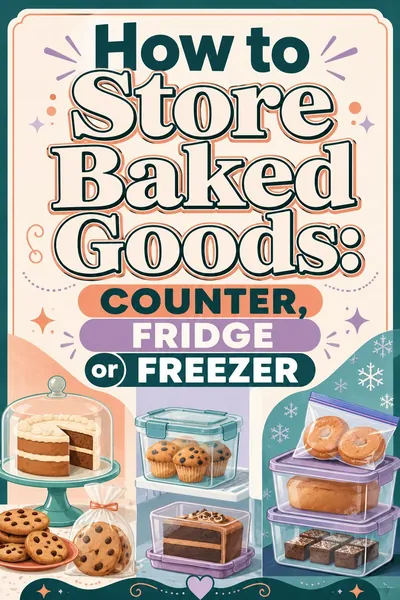
Never store crisp and soft cookies together. The crisp ones will pull moisture from the soft ones and both end up in the middle, which is to say both end up wrong. Our guide to storing baked goods has the container rules for every category.
Can you soften cookies that are already hard?
Sometimes, and it depends on which kind of hard you have.
Stale-hard cookies rehydrate well. Seal them in an airtight container with a slice of bread or a wedge of apple for 12 to 24 hours. They come back noticeably softer. This is the only method that works without heat.
A 10 second microwave with a damp paper towel over the cookie softens it for immediate eating. The effect lasts about five minutes and then it returns harder than before, because you gelatinized more starch and then let it cool again. Good for one cookie right now, bad as a strategy.
A 300°F oven for 4 to 5 minutes restores crispness to a cookie that went soft, which is the opposite problem, but it will not soften a hard one.
Overbaked-hard cookies do not come back. The water is gone. Crumble them into a base for an icebox layer, blitz them into crumbs for a crust, or dunk them in coffee and stop worrying about it.
Worked example: turning a hard batch soft
The batch as baked: scooped flour, all white sugar, 12 minutes at 375°F, left on the pan until fully cool, stored on a covered plate. The cookies snap and taste dry.
Here is each change and what it is worth.
Step 1. Weigh the flour. Scooped 2 1/4 cups at 145 g each is 326 g. Spooned and leveled it should be 2.25 x 125 = 281 g. That is 45 g of extra flour removed, which lifts fat-to-flour from 70 percent back to 81 percent.
Step 2. Split the sugar. 300 g of sugar as 200 g dark brown and 100 g white instead of 300 g white. No change to the total, no change to the sweetness, a large change to how much water the cookie keeps.
Step 3. Trade one egg for two yolks. One large egg is about 50 g shelled. Two yolks are about 36 g, with a much higher fat share and no drying white. Add 10 g of milk back so the dough hydration stays close.
Step 4. Cut the bake to 10 minutes. Pull with the gold ring at the edge and a matte, puffed center.
Step 5. Move them off the pan at 2 minutes, not 5. That trims roughly half the carryover.
Step 6. Store them airtight with a slice of bread once they're completely cool. Warm cookies in a sealed box steam themselves and go soggy on the bottom, so wait until they're at room temperature.
The result. Steps 1, 2 and 4 do most of the work. Steps 3, 5 and 6 are the last 20 percent. If you only want to change one thing, change the bake time, because it is free.
If what you actually want is a deliberately crisp cookie, our guide to chewy versus crispy cookies runs all eight levers in both directions.
Frequently asked questions
Why are my cookies hard as rocks?
That level of hard is nearly always overbaking stacked on top of scooped flour. Both remove moisture, and together they compound. Weigh the flour at 125 g per cup, and pull the tray while the centers still look soft and puffed. Carryover on the hot pan finishes them for another 3 to 5 minutes.
Why do my cookies get hard after they cool?
Because they were done in the oven at the moment they looked done, which is 2 minutes too late. Sugar and fat are liquid at 140°F, so a properly baked cookie feels soft coming out and firms as it cools. If yours feels firm while it's warm, it will be hard when it's cold.
How do you make cookies softer without changing the recipe?
Three things cost you nothing. Bake 2 minutes less, move the cookies off the hot pan after 2 minutes instead of 5, and store them airtight with a slice of bread. Those alone move most hard batches back to soft.
Does brown sugar make cookies softer than white sugar?
Yes, and it's the strongest ingredient lever available. Brown sugar carries 3 to 4 percent molasses, which is hygroscopic and pulls water from the air into the cookie. White sugar recrystallizes as it cools and holds nothing. Shifting the ratio from mostly white to mostly brown changes texture without changing sweetness.
Are hard cookies undercooked or overcooked?
Overcooked, almost always. Undercooked cookies are soft, wet in the middle, and they collapse or tear when you lift them. Hardness comes from water leaving, and water only leaves with heat and time. The exception is a tough, leathery cookie, which points at too much flour or an overworked dough rather than the oven.
Can I fix cookies that came out hard?
If they went hard from sitting, yes. Seal them with a slice of bread for 12 to 24 hours and they soften. If they came out of the oven hard, no, because the moisture is gone for good. Crumble those into a crust or a topping rather than fighting them.
Does too much flour make cookies hard or just dry?
Both, and for two reasons at once. Extra flour lowers the share of fat and sugar in the dough, which are the ingredients that hold moisture. It also brings extra gluten, which adds toughness. That combination is why an over-floured cookie is dry and leathery rather than just dry.
Should cookies be soft when they come out of the oven?
Yes. The centers should look slightly underdone and give under a light touch. They set as the sugars cool and firm up, plus another 3 to 5 minutes of carryover baking on the hot sheet. A cookie that already feels set in the oven has passed the point where it stays soft.
Related guides: How to tell when cookies are done | Chewy vs crispy cookies | How to measure flour | How to store baked goods | Baking time calculator