Why Is It Called Pound Cake?
Free calculator from Baking Resources
Pound Cake Pound-for-Pound Ratio
Pick the size and the ingredient.
Need more? Open the free Ingredient Weight Chart.
More free baking tools



Want more options? Open the full Ingredient Weight Chart.
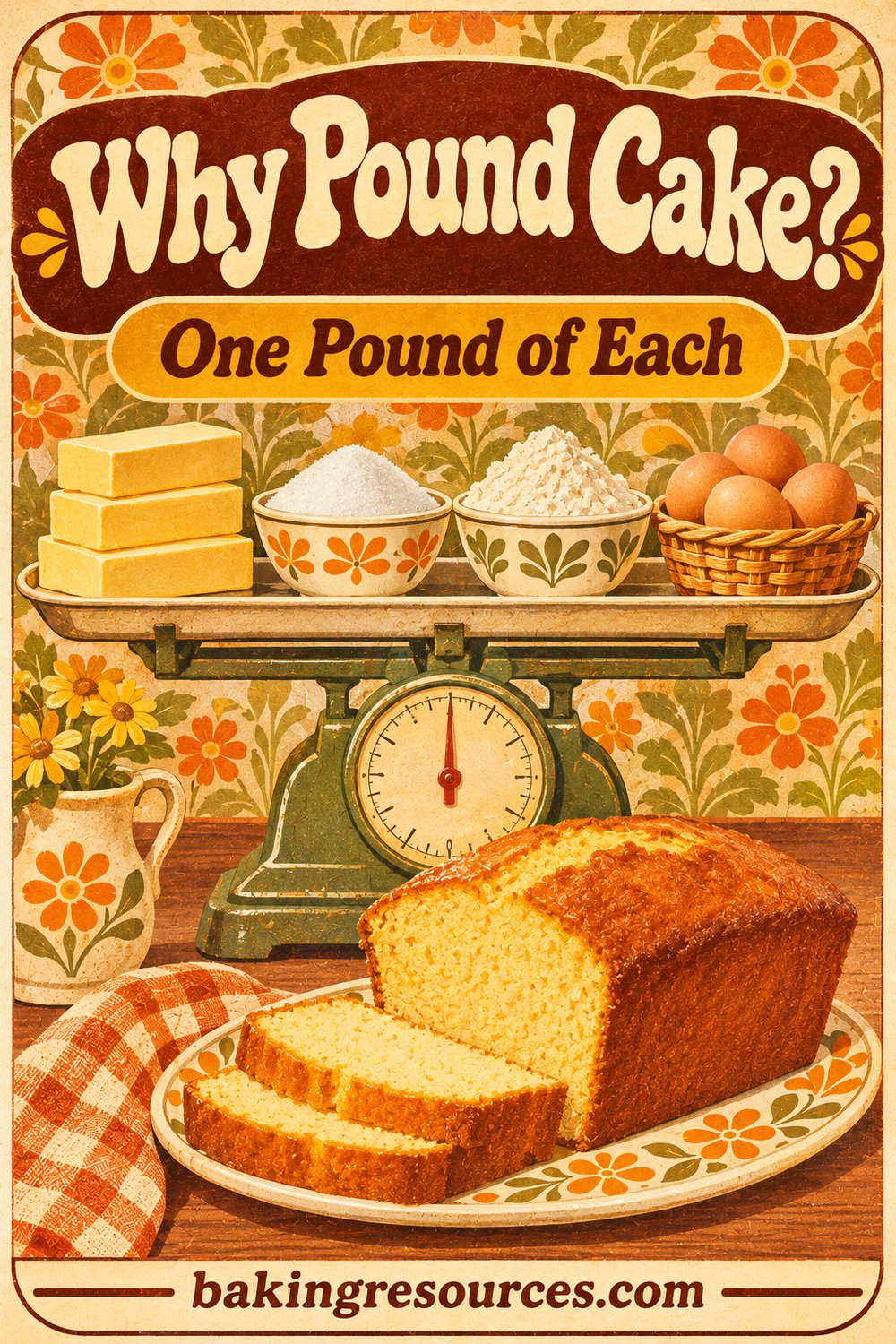
- The name comes from the original recipe: 1 pound each of butter, sugar, flour and eggs.
- That is a 1:1:1:1 ratio by weight, so every ingredient is 100 percent in baker’s math.
- 1 lb = 454 g = 16 oz: 4 sticks of butter, about 2 1/4 cups of sugar, about 3 2/3 cups of flour, about 9 large eggs.
- Printed pound cake recipes go back to the early 1700s in Britain and Ireland.
- A modern loaf-size version uses half a pound of each: 2 sticks (227 g) of butter and 4 or 5 eggs.
- Classic pound cake has no baking powder. Creamed butter and whipped eggs do the lifting.
Why is it called pound cake?
It is called pound cake because the traditional recipe calls for a pound of each main ingredient: 1 pound of butter, 1 pound of sugar, 1 pound of flour and 1 pound of eggs. The name is simply the recipe, written as a weight.
Because every ingredient is the same weight, the cake is easy to remember. You do not need a recipe card, only a scale. Many bakers say this also helped cooks who could not read, although that is a story told about the cake rather than a proven fact. What we do know is that the name stuck, and the same 1:1:1:1 idea is still the base for most pound cakes today.
You can see this in the table. Each ingredient lines up at exactly 1 pound (454 g), but the cups look very different because butter, sugar, flour and eggs have different densities.
| Ingredient | Weight | Grams | Volume |
|---|---|---|---|
| Butter | 1 lb | 454 g | 4 sticks (2 cups) |
| Granulated sugar | 1 lb | 454 g | About 2 1/4 cups |
| All-purpose flour | 1 lb | 454 g | About 3 2/3 cups |
| Large eggs | 1 lb | 454 g | About 9 eggs |
If you like to check these numbers yourself, the ingredient weight chart lists many weights per cup, and the butter converter turns sticks into cups and grams.
Where did pound cake come from?
Pound cake came from Britain and Ireland, and recipes with a pound of each ingredient appear in printed cookbooks from the early 1700s. It spread to the American colonies, where it became a favorite for weddings, holidays and Sunday visits.
The cake belongs to a time before baking powder was invented. Home cooks had no chemical leavening, so they beat air into the butter and eggs to make the cake rise. That is why old recipes ask for long beating by hand, sometimes for half an hour.
Early recipes made enormous cakes by today's standards. A pound of butter and a pound of eggs makes a batter for a large tube pan or two loaves. As families got smaller and ovens more common, cooks started making half and quarter pound versions. That is why most modern recipes say “pound cake” but call for far less than a full pound of each.
What is the pound cake ratio?
The pound cake ratio is 1:1:1:1 by weight: equal parts butter, sugar, flour and eggs. If you use 8 oz (227 g) of each, you get a standard loaf-size cake. That equal ratio is also called the 1-1-1-1 ratio.
In baker's percentages, with flour as 100 percent, a classic pound cake is 100 percent flour, 100 percent butter, 100 percent sugar and 100 percent egg. Our guide to baker's percentage shows how to use that kind of math to scale any recipe.
This ratio is easy to scale, as long as you weigh. Pick a base weight, and use it for every ingredient:
| Size | Butter | Sugar | Flour | Eggs | Fits |
|---|---|---|---|---|---|
| Original, 1 lb each | 4 sticks (454 g) | 2 1/4 cups (454 g) | 3 2/3 cups (454 g) | 9 large | 10 inch tube pan, or 2 loaves |
| Half, 8 oz each | 2 sticks (227 g) | 1 1/8 cups (227 g) | 1 3/4 cups + 1 tbsp (227 g) | 4 1/2 large | One 9×5 inch loaf |
| Quarter, 4 oz each | 1 stick (113 g) | 1/2 cup + 1 tbsp (113 g) | 7/8 cup + 2 tsp (113 g) | 2 1/4 large | Mini loaves or an 8×4 inch loaf |
Cups here use the standard weights: flour 125 g per cup, sugar 200 g per cup, and butter 113 g per stick (8 tablespoons). For more on pan fit, see the loaf pan size guide and Bundt pan sizes.
How do you measure a pound of each ingredient?
The best way to measure a pound is with a kitchen scale set to grams: 454 g of each ingredient. Cups are less accurate, especially for flour, which can change by 20 percent depending on how you scoop it.
Here is how to do it well:
- Set a bowl on the scale and press the tare button so it reads zero.
- Add the ingredient until the scale shows 454 g for a full pound, 227 g for a half or 113 g for a quarter.
- Tare again between ingredients, and measure the next one into a separate bowl.
- For eggs, crack them into a cup, beat lightly and weigh. Large eggs are about 50 g each without the shell.
A scale beats cups for pound cake because the ratio matters so much. If you want to know why, see kitchen scale vs measuring cups. If you must use cups, follow how to measure flour and spoon the flour into the cup, then level it off.
What is the modern pound cake ratio?
Most modern pound cakes keep the 1:1:1:1 idea, but many tweak it slightly, using a little less sugar or adding milk, sour cream or cream cheese for extra moisture and a softer crumb. The ingredients stay close to equal weights, but they are not always exactly equal.
Common changes you will see in newer recipes:
- A little baking powder. A quarter to half a teaspoon per cup of flour gives a more reliable rise. Classic recipes do not need it.
- Sour cream, cream cheese or milk. These add moisture and tenderness. Replace some of the eggs or butter weight to keep the batter from getting too wet.
- Cake flour. A softer flour makes a finer crumb. See the cake flour substitute if you have only all-purpose.
- Vanilla, lemon zest or almond extract. Flavor, not structure.
- Less sugar. Some bakers use 90 percent of the sugar weight for a less sweet cake. Sugar also helps the cake stay moist, so do not cut much.
The honest answer is that there is no single correct modern ratio. The 1:1:1:1 rule is a great starting point, and every bakery or family adjusts from there. Check the weights in a recipe against the 8 oz (227 g) of each, and you will see how far it has moved.
Why does pound cake not need baking powder?
A classic pound cake does not need baking powder because creaming the butter and sugar traps air, and the eggs add more lift as they heat. The batter has no leavening, only air and steam.
Here is how the rise happens:
- Creaming. Beating the butter and sugar for 3 to 5 minutes packs the butter with tiny air bubbles. Learn the method in how to cream butter and sugar.
- Eggs. Eggs add more air as you beat them in, and they firm up as the cake bakes. See what eggs do in baking.
- Steam. The water in the butter and eggs turns to steam in the oven and pushes the batter up.
This is also why room temperature ingredients matter so much. Cold butter will not trap air, and cold eggs can curdle the batter. Why room temperature ingredients matter explains the details. And it is why butter is the star of the show in a pound cake.
How is pound cake different from other cakes?
Pound cake is denser, richer and more buttery than most other cakes, because it has a high amount of butter and egg, and little or no added liquid. It is firm enough to slice thick, and it keeps well.
| Cake | Main fat | Leavening | Texture |
|---|---|---|---|
| Pound cake | Butter, lots | Creaming and eggs (baking powder in some) | Dense, moist, fine crumb |
| Butter or yellow cake | Butter, less | Baking powder | Soft, light |
| Sponge cake | Little or none | Whipped eggs | Springy, airy |
| Angel food cake | None | Whipped egg whites | Very light, chewy |
If you want to compare how much a pound cake weighs against other cakes, see cake weight to size.
Worked example: scaling a pound cake for one loaf
Say you want one standard 9×5 inch (23×13 cm) loaf. You use the half-pound version: 227 g of each ingredient.
- Butter: 2 sticks, room temperature (227 g).
- Sugar: 227 g, which is about 1 1/8 cups.
- Flour: 227 g, which is about 1 3/4 cups plus 1 tablespoon.
- Eggs: 227 g, about 4 1/2 large eggs. Crack 4 into a cup, then add about 1 1/2 tablespoons of a fifth egg that you beat in a separate cup.
That is a ratio of 1:1:1:1, and it fills a 9×5 inch loaf about two-thirds full. A loaf this size usually takes 60 to 75 minutes at 325°F (165°C). For help with timing, see how long to bake a cake and baking cake in a loaf pan. If you want to change the size, use the how to scale a recipe guide.
What goes wrong with pound cake?
The most common pound cake problems are a dense crumb, a sunken middle and a heavy, greasy texture, and nearly all of them come from cold ingredients, too little creaming or a wrong measure. Weighing fixes most of them.
- Dense or heavy: The butter was too cold or too little creaming. Read why my cake is dense.
- Cracked top: A long crack down the middle is normal for pound cake. The outside sets first, then the center rises and splits. See why a cake cracks on top if it is too dramatic.
- Greasy streaks: The batter curdled. Add eggs one at a time and keep them at room temperature.
- Dry crumb: Too much flour, usually from scooping the cup. Weigh the flour.
How do you store pound cake?
Store pound cake wrapped at room temperature for 3 to 4 days, or freeze it for up to 3 months. It slices best the next day, once the crumb has settled.
Wrap the cooled loaf tightly in plastic wrap, then foil, before freezing. Thaw it overnight on the counter, still wrapped. You can also freeze individual slices. For more on both methods, see how to store cake and how to freeze cake.
Quick reference: pound cake
| Question | Answer |
|---|---|
| Why the name? | 1 pound each of butter, sugar, flour and eggs |
| Ratio | 1:1:1:1 by weight |
| 1 pound in grams | 454 g (16 oz) |
| Original recipe | 4 sticks butter, 2 1/4 cups sugar, 3 2/3 cups flour, 9 large eggs |
| Loaf-size recipe | 2 sticks butter, 1 1/8 cups sugar, 1 3/4 cups + 1 tbsp flour, 4 1/2 eggs |
| Leavening | Creamed butter and eggs, no baking powder in classic versions |
| Loaf bake time | 60 to 75 minutes at 325°F (165°C) |
| Storage | 3 to 4 days wrapped, 3 months frozen |
Frequently asked questions
Why is it called pound cake?
The traditional recipe uses a pound each of butter, sugar, flour and eggs. The name describes the recipe: a pound of each.
What is the pound cake ratio?
1:1:1:1 by weight, meaning equal weights of butter, sugar, flour and eggs. For a loaf, 8 oz (227 g) of each works well.
How many cups are in a pound of flour for pound cake?
About 3 2/3 cups of all-purpose flour, at 125 g per cup (spooned and leveled). Weigh 454 g for accuracy.
How many eggs are in a pound of eggs?
About 9 large eggs without their shells. A large egg is about 50 g, and a pound is 454 g.
Does pound cake have baking powder?
Classic pound cake does not. Creamed butter, beaten eggs and steam lift the cake. Some modern recipes add a little baking powder for a more reliable rise.
Is pound cake the same as butter cake?
They are similar, but pound cake is denser, with more butter and eggs. Butter cake usually has baking powder and milk and is lighter.
How long does pound cake last?
About 3 to 4 days wrapped at room temperature, or up to 3 months in the freezer. See how to store cake.
Why did my pound cake crack on top?
A crack down the middle is normal. The crust sets first, then the middle keeps rising. A deep or messy crack can mean the oven was too hot. See why a cake cracks on top.