Salted vs Unsalted Butter

You can swap one for the other in almost any recipe. Going from unsalted to salted, cut the salt the recipe adds by about 1/4 teaspoon per stick of butter, which is per 113 g or per half cup. Going the other way, add about 1/4 teaspoon of salt per stick. That single adjustment covers the salted vs unsalted butter question for most of what you'll bake.
The reason bakers still reach for unsalted is control, not chemistry. Salt levels vary by brand and by country, so an unsalted stick is a known quantity and a salted one is an estimate.
Updated September 2026
Need the swap in a different unit? Our free butter converter handles sticks, cups, tablespoons, grams and European blocks, and it shows the salt adjustment alongside every conversion.
Salted vs unsalted butter: what actually differs
Less than people assume. Both are churned cream. Both sit at roughly 80 to 82% butterfat with most of the rest being water, and both behave the same way when you cream them, melt them, or cut them into flour.
The differences come down to three things:
1. Salt content. Salted butter in the United States typically runs somewhere in the range of 1.5 to 2 percent salt by weight. On a 113 g stick that's roughly 1.5 to 2.3 g of salt, which lines up with about 1/4 teaspoon of fine table salt. Nobody prints the exact figure on the wrapper, which is the root of the whole problem.
2. Shelf life and freshness. Salt is a preservative, so salted butter keeps longer and can sit in the supply chain longer. Unsalted butter turns over faster and is generally the fresher of the two on the shelf. If you've ever noticed salted butter tasting slightly stale or "cheesy," that's why.
3. Water content, marginally. Some brands of salted butter carry a touch more water than their unsalted version. The difference is small enough not to matter in a cake and just large enough to notice in something like shortbread or a laminated pastry, where the fat to water ratio is doing structural work.
What is not different: melting point, creaming behavior, browning behavior, or how the fat coats flour. Those are all functions of the butterfat, and the butterfat is the same. If you want the full picture of what the fat is doing, what does butter do in baking covers it.
The conversion, in every unit you'll need
Here's the adjustment table. All of these assume fine table salt at about 6.1 g per teaspoon.
| Butter in the recipe | Weight | If you use salted, reduce added salt by | If the recipe wanted salted and you use unsalted, add |
|---|---|---|---|
| 1 tablespoon | 14 g | A pinch, about 1/32 tsp | A pinch |
| 2 tablespoons | 28 g | 1/16 tsp | 1/16 tsp |
| 4 tbsp (half stick, 1/4 cup) | 57 g | 1/8 tsp | 1/8 tsp |
| 1 stick (8 tbsp, 1/2 cup) | 113 g | 1/4 tsp | 1/4 tsp |
| 1 1/2 sticks | 170 g | 3/8 tsp | 3/8 tsp |
| 2 sticks (1 cup) | 227 g | 1/2 tsp | 1/2 tsp |
| 250 g European block | 250 g | A scant 5/8 tsp | A scant 5/8 tsp |
| 3 sticks | 340 g | 3/4 tsp | 3/4 tsp |
| 4 sticks (1 lb box) | 454 g | 1 tsp | 1 tsp |
If your salt is not fine table salt, the volume changes because the crystals are a different size. Using the same weights from our kosher salt vs table salt guide:
| Table salt amount | Weight | Morton kosher | Diamond Crystal kosher |
|---|---|---|---|
| 1/8 tsp | 0.8 g | 1/8 tsp, rounded | 1/4 tsp |
| 1/4 tsp | 1.5 g | 1/4 tsp, rounded | 1/2 tsp |
| 1/2 tsp | 3.0 g | 5/8 tsp | 1 tsp |
| 1 tsp | 6.1 g | 1 1/4 tsp | 2 tsp |
Diamond Crystal is about half the density of table salt, so a straight teaspoon-for-teaspoon swap there would leave you badly under-salted. That's a bigger error than the salted butter question ever creates.
A worked example: a butter cookie recipe
Say a recipe calls for 2 sticks of unsalted butter, which is 227 g or 1 cup, plus 1 teaspoon of table salt. All you have is salted butter.
Step 1. Work out how much salt the butter brings. Two sticks at about 1/4 teaspoon each is roughly 1/2 teaspoon of salt already in the fat.
Step 2. Subtract it. 1 teaspoon minus 1/2 teaspoon leaves 1/2 teaspoon of salt to add.
Step 3. Lean slightly under, not over. Take out a little less than the full correction if you're unsure of the brand. Use a generous 1/2 teaspoon rather than a scant one. You can add salt at the end of a batter, and you cannot take it out.
Step 4. Taste where you can. Cookie dough is one of the places you can taste before committing, and the difference between correctly salted and slightly flat is obvious on the tongue.
The math in grams, if you'd rather work that way: 227 g of salted butter at roughly 1.8% salt carries about 4 g of salt. The recipe wanted 6.1 g total. So you add about 2 g, which is a rounded 1/4 teaspoon plus a pinch. Same answer, arrived at from the other direction.
Where the swap matters, and where it truly doesn't
This is the part most articles skip, and it's the part that saves you from over-thinking a chocolate cake.
It matters most when butter is a large share of the recipe and there's nowhere for salt to hide:
- Shortbread. Butter, sugar, flour, salt. Four ingredients, and one of them is the variable you just changed.
- Buttercream. American buttercream is roughly 227 g of butter to 480 g of powdered sugar with about 1 g of salt. Swap in salted butter without adjusting and you'll taste it immediately.
- Plain butter cookies and sugar cookies.
- Pie and tart pastry, where the butter is a third of the dry weight.
- Anything you'll eat with butter as the main flavor, like a plain pound cake.
It barely matters when something else is doing the flavor work:
- Chocolate cake or brownies. Cocoa is assertive and a small salt shift disappears into it.
- Spiced quick breads, banana bread, carrot cake.
- Anything with a strong citrus, coffee, or caramel component.
- Yeast breads, where the salt is set by baker's percentage against the flour weight and the butter is a minor player.
It matters in a completely different way for finishing butter. Butter brushed on top of a scone, melted over a warm roll, or served alongside is the one place where salted butter is often the better choice, because the salt lands directly on the tongue instead of being diluted through a batter.
Why professional recipes call for unsalted
Four practical reasons, none of them snobbery.
Consistency. A recipe writer cannot know which brand you'll buy, and salt levels vary. Specifying unsalted plus a measured amount of salt makes the recipe reproducible in any kitchen in any country.
Precision at scale. Scale a recipe up to 10 pounds of butter and a small per-stick difference in salt turns into a meaningful swing. If you're scaling anything, our recipe scaler keeps the ratios honest.
Freshness. Unsalted turns over faster, so it's generally fresher. Salt masks the flavor of butter that's starting to go, which means a salted stick gives you less warning.
Salt does more than taste. In yeast dough, salt tightens gluten and slows fermentation. In pastry, salt affects how the dough hydrates. Recipe writers want that quantity stated, not hidden inside an ingredient.
None of that means your home baking fails with salted butter. It means the recipe was written to remove a variable, and you're putting the variable back in on purpose.
European butter, cultured butter and the block problem
Butter outside North America comes as an unmarked block, usually 250 g, and both salted and unsalted versions are common. A few things to know:
- A 250 g block is not two sticks. Two sticks are 227 g, so the block is 23 g heavier, about 1.5 extra tablespoons or roughly 10% more butter. Halving a block gives you 125 g rather than 113 g, which is enough to change shortbread, pastry and cookies.
- To cut a stick's worth from a block, remember that a block is a plain rectangular bar, so a share of its length is the same share of its weight. One US stick is 45% of a 250 g block. Cut 45% of the way along and you're close enough.
- European style butter usually runs higher in fat, often 82 to 86% versus the 80% US minimum, which means slightly less water. That affects pastry lamination more than it affects salt.
- Salted European butter can be saltier than the American average, and some brands sell a lightly salted version too. Taste it plain before you build a buttercream around it.
- Cultured butter is fermented before churning, which gives it a tangy, more complex flavor. That flavor is a real factor in shortbread and finishing butter, and invisible in a chocolate cake.
The butter converter handles the block to stick math directly, including the cut-by-length trick, so you don't have to do the percentage in your head.
Storage, and why salted keeps longer
Salt lowers water activity, which is a fancy way of saying it ties up water that spoilage organisms would otherwise use. That's why salted butter has a longer window before it goes off.
| Butter | Fridge | Freezer | Counter |
|---|---|---|---|
| Salted | 1 to 3 months past the sell-by date | 6 to 9 months | A few days in a butter bell, cool room |
| Unsalted | 1 month past the date | 6 months | Not recommended past a day |
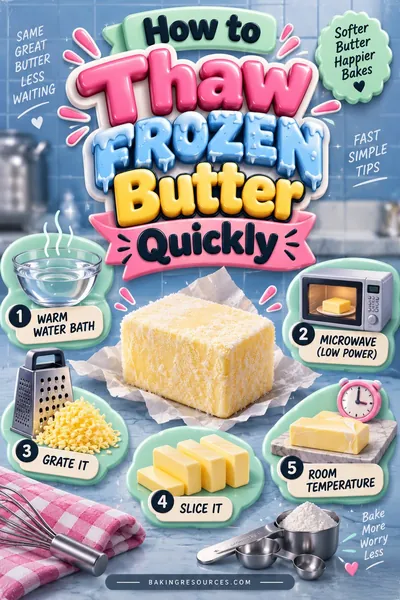
Freezer notes for both: wrap in the original paper, then a freezer bag with the air pressed out. Butter picks up odors from the freezer readily, and once it does there's no fixing it. Thawing is covered in how to thaw frozen butter.
One more storage point that matters more than the salt: butter goes rancid through oxidation, and light and air drive that reaction. A stick left unwrapped on a fridge shelf tastes off long before its date, salted or not.
Temperature matters far more than salt
Here's the thing worth ending on. Bakers spend a lot of energy on salted versus unsalted and comparatively little on butter temperature, and temperature is the bigger variable by a wide margin.
Creaming works because sugar crystals cut air pockets into solid fat. That only happens in a narrow window. Butter at about 65 to 67°F holds its shape and traps air. At 74°F it's greasy and the air escapes as fast as you beat it in, and your cake comes out dense with a coarse crumb.
Swap salted for unsalted without adjusting the salt and you get a cake that tastes slightly saltier. Cream butter at 74°F instead of 67°F and you get a cake with the wrong texture entirely. One of those is a seasoning issue, the other is a structural one.
If your butter keeps ending up too soft, how to soften butter covers the fast methods that don't overshoot, and how to cream butter and sugar covers what you should actually be looking for in the bowl.
Frequently asked questions
Can I use salted butter instead of unsalted?
Yes, in nearly every recipe. Reduce the salt the recipe adds by about 1/4 teaspoon per stick, which is per 113 g or per half cup. Salt levels vary by brand and country, so treat it as a starting point and lean toward removing slightly less than the full amount.
How much salt is in a stick of salted butter?
Roughly 1.5 to 2.3 g, which is about 1/4 teaspoon of fine table salt. US salted butter typically runs 1.5 to 2 percent salt by weight, and a stick is 113 g. No brand is required to print the exact number, so any conversion is an estimate.
Why do bakers use unsalted butter?
Control and consistency. Unsalted butter is a known quantity, so the recipe can specify exactly how much salt goes in and get the same result in any kitchen. Unsalted stock also tends to be fresher, since salt acts as a preservative and lets salted butter sit longer.
Can I use salted butter for buttercream?
You can, and some bakers prefer it because a little salt cuts the sweetness of all that powdered sugar. Just leave out the salt the recipe calls for, since American buttercream typically only uses about 1 g against 227 g of butter. Taste as you go, because buttercream is exactly the kind of recipe where extra salt has nowhere to hide.
Does salted butter change the texture of baked goods?
Barely. The butterfat is the same, so creaming, melting and browning all behave identically. Some salted brands carry marginally more water, which can show up in very lean, high butter doughs like shortbread, but for cakes, cookies and quick breads the texture difference is not something you'd notice.
Is sweet cream butter the same as unsalted?
Not necessarily. "Sweet cream" describes the cream it was churned from, meaning fresh rather than cultured, and it says nothing about salt. Sweet cream butter is sold in both salted and unsalted versions, so read the label rather than the front-of-pack name.
What if I only have salted butter and the recipe has no added salt at all?
Use it and change nothing. Recipes that skip salt entirely are rare, and the small amount the butter contributes will improve most of them rather than hurt them. The one exception is a recipe where the salt was deliberately left out for dietary reasons, in which case the salted butter defeats the purpose.
Related guides: What does butter do in baking | Kosher salt vs table salt | How to soften butter | Butter converter