
Caramel Temperature Guide: From Soft Caramels to Dark Amber

The right caramel temperature depends on what you are making: about 245°F for chewy caramel candies, 300 to 310°F for toffee and brittle, and 340 to 350°F for a medium amber caramel sauce. Plain sugar starts to turn into caramel at about 320°F, and it burns quickly past 360°F. Soft caramels made with cream stop lower, around 240°F.
A couple of degrees decides whether caramels come out soft or chewy, and altitude shifts every number. Pick your caramel and your elevation in the calculator below, and it gives you the exact temperature to stop at, plus the stage and how to test it.
Free calculator
Caramel temperature calculator
Pick the caramel you are making and your altitude to see the temperature to stop at.
More free baking tools


Caramel temperature chart
Every sugar candy is really the same thing: sugar and water boiled until enough water is gone. The temperature tells you how much water is left, and that sets the texture. Caramels sit right across the chart, from soft ball for tender candies all the way past hard crack, where the sugar itself starts to turn brown.
| Stage | Temperature at sea level | What you see | Caramel uses |
|---|---|---|---|
| Soft ball | 235 to 245°F | Soft ball in cold water | Soft caramels, caramel apples |
| Firm ball | 245 to 250°F | Firm ball that squishes | Chewy caramels |
| Hard ball | 250 to 265°F | Hard ball with a little give | Caramel corn, firm caramels |
| Soft crack | 270 to 290°F | Bendy threads | Butterscotch, softer toffee |
| Hard crack | 300 to 310°F | Threads that snap | Toffee, brittle, spun sugar |
| Light caramel | 320 to 338°F | Pale gold to honey | Flan, cages, shards |
| Medium caramel | 340 to 350°F | Deep amber | Caramel sauce |
| Dark caramel | 350 to 360°F | Reddish mahogany, light smoke | Dark sauce, glazes |
Past about 360°F, caramel tastes burnt and bitter, and there is no saving it. The thread stage, from 223 to 234°F, comes first but is mostly for syrups, so it only shows up in the calculator.
Two kinds of caramel, two sets of numbers
This is the part that confuses most people. Why do chewy caramels stop at 245°F when "caramel" only starts at 320°F? Because the word covers two different things.
Sugar caramel
This is just sugar, sometimes with a little water, cooked until the sugar itself breaks down and turns brown. That only happens above about 320°F. It is what you make for caramel sauce, flan and decorations. Here the color is the real guide, and the thermometer helps you see it coming.
Dairy caramel (caramel candies)
Chewy caramels, soft caramels and caramel apple coatings are made with sugar plus cream, butter and often corn syrup. The milk proteins brown at much lower temperatures, which is where the golden color and toasty flavor come from. That is the same kind of browning you get when you brown butter. With these, temperature controls texture, and color is just a bonus. Corn syrup also matters here: it keeps the sugar from forming grains, which is why most candy recipes use it. Our page on what corn syrup is explains how it works.
 Baking guideHow to Brown Butter (And the Water Loss Nobody Warns About)Show me how →
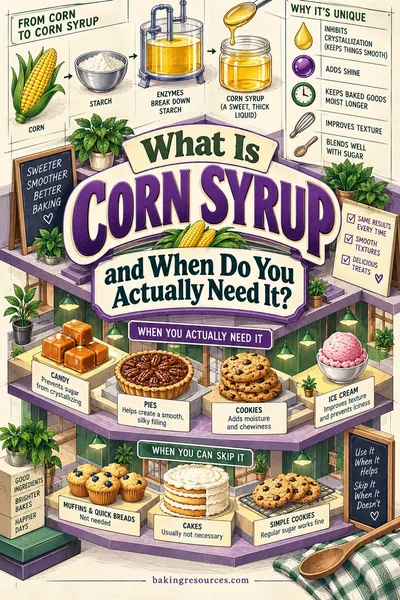 Baking guideWhat Is Corn Syrup and When Do You Actually Need It?Take a look →
Chewy and soft caramels: every degree counts
For cut-and-wrap caramels, the final temperature decides the bite. The difference between a caramel that melts on your tongue and one that sticks to your teeth is only about 10 degrees.
| Stop at (sea level) | Texture once cool | Best for |
|---|---|---|
| 236 to 240°F | Soft, holds a coat | Caramel apples |
| 240 to 244°F | Very soft, tender | Soft caramels, kept cool |
| 245 to 248°F | Chewy, holds its shape | Classic wrapped caramels |
| 250 to 260°F | Firm, almost hard | Caramel corn coating |
Stir slowly and constantly once the cream goes in, because the milk solids scorch on the bottom of the pot. Use a heavy pot with tall sides, since the mixture foams up as it boils. And pull it off the heat a degree early. The hot pot keeps cooking for a moment after you take it off the burner.
If your caramel apples keep losing their coating, temperature is only part of it. The page on how to keep caramel from sliding off apples covers wax, dipping and chilling.
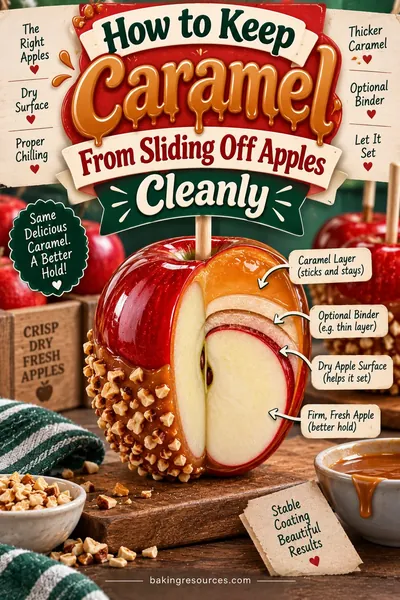 Baking guideHow to Keep Caramel From Sliding Off Apples CleanlyRead the step by step →
Caramel sauce: cook to color, then add cream
Caramel sauce works the other way around from candy. You cook plain sugar until it turns deep amber, at 340 to 350°F, then stop the cooking by whisking in warm cream and butter. The cream cools the sugar instantly and turns it into a pourable sauce.
- Warm the cream first. Cold cream makes the hot sugar seize into hard lumps. If that happens, keep stirring over low heat and the lumps will melt back in.
- Stand back. The sauce bubbles up hard and throws steam when the cream goes in.
- Salt at the end. For salted caramel, stir in flaky or fine salt after the cream. Our guide on salted vs unsalted butter helps you keep the total salt in check.
 Baking guideSalted vs Unsalted Butter: How to Swap in Any RecipeRead the guide →
The darker you take the sugar, the less sweet and the more bitter the sauce. Light caramel at about 330°F tastes like candy. Dark caramel at 350 to 355°F tastes almost like coffee. In a sauce, the cream also matters. If you are out of it, check our list of heavy cream substitutes, but stick to options with plenty of fat, or the sauce will be thin.
 Baking guideHeavy Cream Substitute: What Whips and What Doesn'tWhat can I use? →
Toffee, brittle and spun sugar
These three are cooked to the hard crack stage, 300 to 310°F, where almost no water is left. Once cool, they snap instead of bend.
- Toffee: butter and sugar cooked together to 300 to 305°F. It turns deep golden at about the same time it reaches temperature, which is a nice double check.
- Peanut brittle: cooked to 300 to 310°F, then baking soda goes in. The soda makes tiny bubbles that give brittle its light, crunchy texture.
- Spun sugar: sugar syrup cooked to 305 to 310°F, cooled slightly until it falls from a fork in long threads, then flicked over a rolling pin.
Cracker toffee is a quicker cousin, made on saltines in the oven. For a version without the chocolate layer, see saltine toffee without chocolate.
 Baking guideSaltine Toffee Without Chocolate: Ratios and TimingFind my swap →
Wet caramel vs dry caramel
There are two ways to start sugar caramel. In the wet method, you dissolve the sugar in a little water first. It is slower but more forgiving, and a thermometer works well because the syrup is deep enough to read. In the dry method, you melt sugar on its own in a wide pan. It is faster, but the sugar melts unevenly and needs gentle swirling. With dry caramel there is often too little liquid to read a thermometer, so go by color.
With the wet method, the biggest risk is crystallization: the syrup suddenly turns cloudy and grainy. A splash of lemon juice or a pinch of cream of tartar helps prevent it. Here is what cream of tartar does in sugar syrups. Brushing the sides of the pot with a wet pastry brush also washes stray crystals back down.
 Baking guideWhat Is Cream of Tartar and What Does It Do in Baking?Learn more →
Getting an accurate reading
Caramel leaves no room for a thermometer that reads 5 degrees off. Test yours before a big candy day: put it in a pot of boiling water. At sea level it should read 212°F. If it reads 210°F, add 2 degrees to every target. Clip the thermometer so the tip sits in the syrup but does not touch the bottom of the pot, which runs hotter.
Altitude matters too. Water boils at a lower temperature the higher you live, so syrup reaches each stage at a lower reading. Subtract about 2°F for every 1,000 feet. The calculator does this for you. For the light, medium and dark caramel stages, trust the color as the final word, since by then the water is gone. Our high altitude baking chart covers the baking side of mountain cooking.
 Baking guideHigh Altitude Baking Adjustments: The Chart by ElevationSee the chart →
No thermometer? Drop a little syrup into a glass of very cold water and check the shape it forms. The calculator lists what each stage looks like.
Worked example: chewy Christmas caramels at 5,000 feet
Say you live in Denver and want to make chewy salted caramels to wrap in wax paper for Christmas gifts. The recipe says to cook to 245°F.
- Test the thermometer in boiling water. At 5,000 feet, water boils at about 202°F, roughly 10 degrees below sea level.
- Subtract 10 from the recipe's target: 245 minus 10 is 235°F. That is your new stopping point.
- Cook the sugar, corn syrup, cream and butter in a heavy pot, stirring slowly once it boils.
- Pull the pot at 234°F, a degree early, since it keeps climbing for a moment.
- Pour into a lined 8 inch square pan, sprinkle with flaky salt, and let it set at room temperature for several hours before cutting.
If you skipped the altitude step and cooked to 245°F, you would have caramels about 10 degrees harder than planned, closer to the hard ball stage.
Caramel mistakes and fixes
- Grainy or sandy syrup. Sugar crystals formed. Next time, add a little corn syrup or lemon juice and avoid stirring plain syrup before it boils.
- Caramels too hard. Cooked too high, or no altitude adjustment. Melt them with 2 to 3 tablespoons of cream and cook to a lower number.
- Caramels too soft to hold a shape. Pulled too early. Return them to the pot and cook 2 to 3 degrees higher.
- Burnt taste. Went past 360°F, or the bottom scorched. Use a heavier pot and lower heat near the end.
- Butter separated in toffee. The heat jumped too fast. Lower the heat and stir until it comes back together.
Sugar does a lot more than sweeten, and seeing what sugar does in baking makes these fixes easier to understand.
 Baking guideWhat Does Sugar Do in Baking? Six Jobs, Not Just SweetRead it next →
Holiday caramel gifts and safety
Wrapped caramels, tins of toffee, bags of caramel corn and slabs of peanut brittle are classic Christmas gifts because they keep well. Wrap chewy caramels in wax paper so they do not stick together, and keep brittle and toffee in airtight tins so humid air does not make them sticky.
Hot sugar is one of the most serious burns in a kitchen, since it sticks to skin and is much hotter than boiling water. Keep a bowl of ice water nearby, use long-handled spoons, and keep little helpers well away from the stove until the candy has cooled. They can help with wrapping and tying ribbons instead.
Questions people ask
What temperature should caramel be?
It depends on the caramel. Chewy caramel candies stop at 245 to 248°F, soft caramels at 240 to 244°F, toffee and brittle at 300 to 310°F, and caramel sauce at 340 to 350°F, when the sugar is deep amber. Those are sea-level numbers, so subtract about 2°F for every 1,000 feet of altitude.
At what temperature does sugar turn into caramel?
Plain sugar starts to caramelize at about 320°F, when it turns pale gold. It reaches a medium amber at 340 to 350°F and dark mahogany at 350 to 360°F. Past about 360°F it burns and tastes bitter. Caramels made with cream brown at lower temperatures because the milk solids color first.
Why do chewy caramels cook to a lower temperature than caramel sauce?
They are made differently. Chewy caramels cook sugar together with cream and butter, and the temperature sets how firm they are, so they stop around 245°F. Caramel sauce starts with plain sugar cooked until it browns at 340 to 350°F, then cream is added to stop the cooking and make it pourable.
How do I adjust caramel temperature for high altitude?
Subtract about 2°F from the recipe's target for every 1,000 feet above sea level. At 5,000 feet, a 245°F caramel becomes about 235°F. The easiest check is to boil water with your thermometer in it: however far below 212°F it reads, take that many degrees off your target.
Can I make caramel without a thermometer?
Yes. For candies, drop a little hot syrup into very cold water and check its shape: a soft ball for soft caramels, a firm ball for chewy ones, and brittle threads for toffee. For caramel sauce, go by color and pull it at deep amber, like maple syrup. A thermometer just makes it more reliable.
Why did my caramel turn grainy?
Sugar crystals formed in the syrup, often from stirring plain syrup before it boiled or from crystals on the sides of the pot falling back in. Add a little corn syrup or lemon juice to the sugar, brush the pot sides with a wet pastry brush, and swirl rather than stir until the sugar fully dissolves.