
How Long to Bake a Cake: Times for Every Pan and Oven

Most cakes bake at 350°F for 25 to 35 minutes in 8 or 9 inch round layer pans or a 9x13 pan, 45 to 55 minutes in a Bundt pan, 50 to 60 minutes in a 9x5 loaf pan, and 18 to 22 minutes as cupcakes. The cake is done when a toothpick in the center comes out clean or with a few moist crumbs and the middle reads 200 to 210°F.
That range is wide because the pan does most of the deciding. How deep the batter sits, what the pan is made of, and how hot your oven really runs can each move the clock by 5 to 10 minutes. Pick your pan and its material in the calculator below and it gives you the time, the oven setting, and what to look for when you open the door.
Free calculator
Cake bake time calculator
Pick your pan and what it is made of to see the bake time, oven temperature and the doneness check.
More free baking tools


Cake bake times by pan size at a glance
These are starting windows for a standard butter or oil cake, the kind most recipes and boxed mixes make, baked at 350°F in a light-colored metal pan on the middle rack. Start checking at the low number. Most cakes land somewhere inside the window, and very few need more than 5 minutes past the high end.
| Pan | Typical batter depth | Time at 350°F | Notes |
|---|---|---|---|
| 6 inch round layer | 1 1/2 to 2 inches | 25 to 30 minutes | Often filled deeper, so it may need the full time |
| 8 inch round layer | About 1 1/2 inches | 30 to 35 minutes | Deeper than a 9 inch with the same batter |
| 9 inch round layer | About 1 inch | 25 to 30 minutes | The most common layer pan in US recipes |
| 8x8 square | About 1 1/2 inches | 30 to 35 minutes | Corners set first; test the very middle |
| 9x13 sheet | About 1 1/2 inches | 30 to 35 minutes | One full recipe or one boxed mix |
| Half sheet, 12x18 | About 3/4 inch | 20 to 25 minutes | Thin, so it dries out quickly if overbaked |
| Bundt, 10 to 12 cup | 3 to 4 inches | 45 to 55 minutes | Pound cake batter: 55 to 70 minutes |
| 9x5 loaf | 2 1/2 to 3 inches | 50 to 60 minutes | Pound cake loaf: 60 to 75 minutes |
| Standard cupcakes | Cups two thirds full | 18 to 22 minutes | Mini cupcakes: 10 to 12 minutes |
Two things jump out of that table. First, the 8 inch layer takes longer than the 9 inch, even though it is the smaller pan. Second, a Bundt or loaf takes almost twice as long as a 9x13 that holds about the same batter. Both come down to depth, which is the next section.
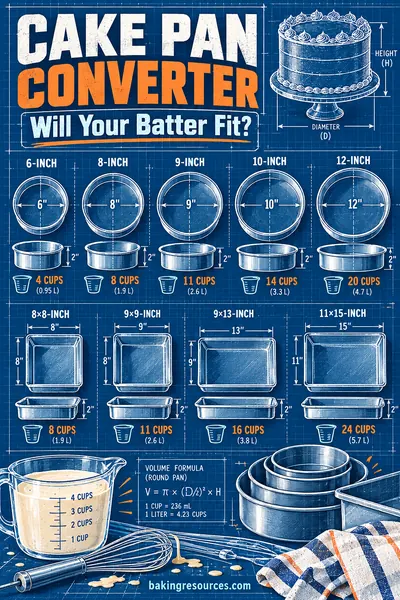
If you are moving a recipe from the pan it was written for into a different one, the baking time calculator works out the new time from the change in depth, and the cake pan converter tells you whether the batter will even fit.
 Free toolBaking Time Calculator: New Pan, New TimeRun my numbers →
 Free toolCake Pan Converter: Will Your Batter Fit?Use the free tool →
Why the pan changes the time so much
Heat moves into a cake from the outside in. The edges and bottom touch hot metal, the top faces hot air, and the very center is the last spot to reach a set temperature. The farther that center sits from a hot surface, the longer it takes. That is why batter depth matters more than the total amount of batter.
A 9 inch round has about 64 square inches of surface. An 8 inch round has about 50. Pour the same batter into each and the 8 inch layer sits roughly 25 percent deeper, so it needs about 5 more minutes. A Bundt pan holds batter 3 to 4 inches deep, and even with its center tube pulling heat into the middle, that depth roughly doubles the time compared with a sheet cake.
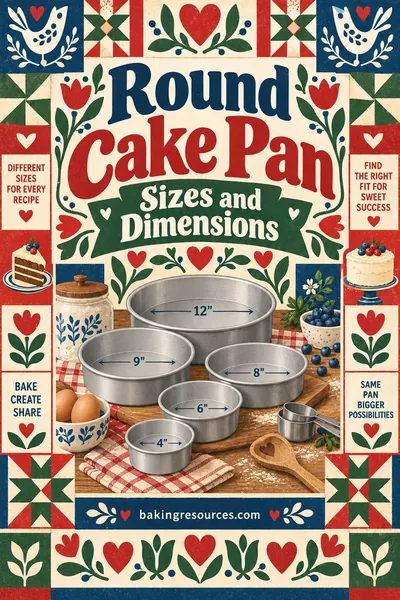
Shape matters too. Square and rectangular pans have corners that heat from two sides, so the corners set and brown first. Round pans heat more evenly around the edge. Tube and Bundt pans add a hot metal column in the middle, which is the only reason a deep pound cake can bake through at all without the outside turning to leather. If you want the full measurements for each pan, see the charts for round cake pan sizes and sheet cake pan sizes.
 Baking guideRound Cake Pan Sizes and Dimensions: Chart and Free ConverterFind my pan size →
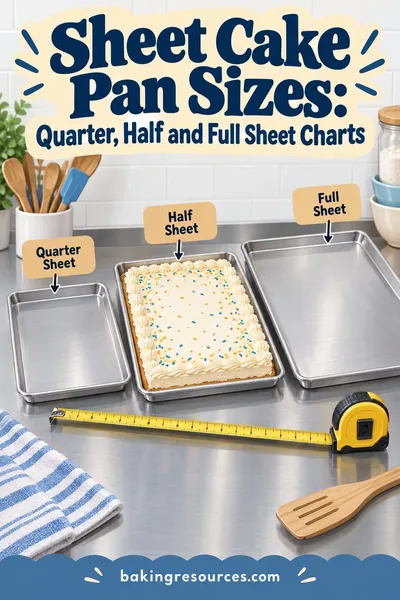 Baking guideSheet Cake Pan Sizes: Quarter, Half and Full Sheet ChartsCheck the pan chart →
Rule of thumb for depth
- Batter about 1 inch deep: 25 to 30 minutes at 350°F.
- Batter about 1 1/2 inches deep: 30 to 35 minutes.
- Batter 2 inches or more: 35 minutes and up, and consider lowering the oven to 325°F so the outside does not overbake while the middle catches up.
- Batter under 3/4 inch: 20 to 25 minutes, sometimes less.
How oven temperature changes the bake time
Most cake recipes are written for 350°F because it is a good middle ground. It is hot enough to set the structure and brown the outside, and gentle enough that the middle cooks through before the edges dry out. Moving 25°F in either direction changes the time in a fairly predictable way.
| Pan | 325°F | 350°F | 375°F |
|---|---|---|---|
| 9 inch round layer | 30 to 35 minutes | 25 to 30 minutes | 20 to 25 minutes |
| 8 inch round layer | 35 to 40 minutes | 30 to 35 minutes | 25 to 30 minutes |
| 9x13 sheet | 35 to 45 minutes | 30 to 35 minutes | 25 to 30 minutes |
| Bundt, 10 to 12 cup | 55 to 65 minutes | 45 to 55 minutes | Not recommended |
| Standard cupcakes | 22 to 25 minutes | 18 to 22 minutes | 15 to 18 minutes |
When a lower oven helps
Dropping to 325°F is the fix for deep cakes, dense pound cakes, cakes in dark or glass pans, and any batter that has been doubled into a bigger pan. The slower heat gives the center time to catch up, so the cake rises more evenly and domes less. The cost is about 5 to 10 extra minutes.
When a hotter oven makes sense
Some cupcake recipes start at 375°F or even 400°F to get a taller dome. A hotter oven sets the outside quickly and pushes the middle up. For layer cakes it usually backfires: the edges set, the center keeps rising, and you get a peak with a crack down the middle. Leave layers at 350°F unless the recipe says otherwise.
Recipes from outside the US often give Celsius or gas marks. The oven temperature conversion chart covers those, including the 25°F drop most fan ovens need. Speaking of which, convection gets its own section further down.
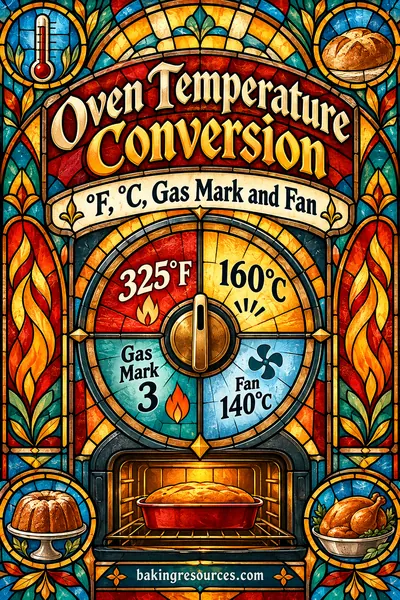 Free toolOven Temperature Conversion: °F, °C, Gas Mark and FanGet my number →
Dark, light and glass pans
The pan's material changes how fast heat reaches the batter, and it is one of the most common reasons a cake comes out different from the recipe's promise.
| Pan | What it does | Oven setting | 9x13 example |
|---|---|---|---|
| Light aluminum | Reflects some heat, bakes evenly, browns gently | 350°F as written | 30 to 35 minutes |
| Dark or nonstick metal | Absorbs more heat, browns edges and bottom faster | 325°F, check 5 minutes early | 25 to 35 minutes |
| Glass or ceramic | Heats slowly, then holds heat and keeps baking after the oven | 325°F | 35 to 40 minutes |
Light metal
Plain, shiny aluminum is what most recipe developers use, so recipe times are written for it. If you only own one set of cake pans, light aluminum is the most predictable choice.
Dark and nonstick metal
A dark surface absorbs more radiant heat, so the outside of the cake browns and sets faster. Left at 350°F, you often get a dark, crusty edge and a thin, dry band around the outside. Lowering the oven 25°F slows that down while the middle bakes through. Even at 325°F, a dark pan often finishes as quickly as a light pan at 350°F, which is why you start checking early.
Glass and ceramic
Glass is a slow conductor. It takes a while to heat, then it holds that heat and passes it to the batter evenly, including after the cake comes out. At 350°F the edges and bottom tend to overbake before the center sets. At 325°F, a glass pan usually needs about 5 minutes more than a light metal pan at 350°F. Pull it at the first clean toothpick, since it keeps cooking on the counter. Silicone pans are a different case again: they bake paler and a little slower, so set them on a sheet pan for support.
Cake type changes the time too
Not every batter behaves like a classic yellow cake. Dense batters take longer, airy foam cakes need a different test, and some cakes are not even baked at 350°F.
| Cake | Usual pan | Oven | Time | Main doneness sign |
|---|---|---|---|---|
| Butter or oil layer cake | Two 9 inch rounds | 350°F | 25 to 30 minutes | Clean toothpick, 200 to 210°F |
| Boxed cake mix | 9x13 | 350°F | Follow the box, often about 30 minutes | Clean toothpick |
| Pound cake | Bundt or 9x5 loaf | 325°F to 350°F | 55 to 75 minutes | Skewer clean, 200 to 210°F |
| Carrot or spice cake | 9x13 | 350°F | 35 to 40 minutes | Clean toothpick; moist batter runs longer |
| Chocolate cake (thin batter) | Two 9 inch rounds | 350°F | 28 to 33 minutes | Springs back; color is no help |
| Angel food | 10 inch tube | 350°F | 35 to 45 minutes | Top springs back, cracks look dry |
| Sponge or jelly roll | Jelly roll pan | 375°F | 10 to 12 minutes | Springs back when touched |
Carrot cake, banana cake and anything with lots of fruit or vegetables holds more water, so it runs toward the long end. Chocolate cakes are tricky because they are already brown, so you cannot use the color of the top to judge them. Angel food cake is the exception to the toothpick rule: it is done when the top springs back and the cracks look dry, not wet.
How to tell when a cake is done
A timer only tells you when to start checking. These are the checks that tell you the cake is actually ready, from most to least reliable.
1. Internal temperature
An instant-read thermometer pushed into the center of the cake should read 200 to 210°F for a butter or oil cake. Below about 195°F, the crumb in the middle has not fully set and may sink as it cools. This is the one test that works for every cake, including dark chocolate and spice cakes where color tells you nothing. Push the probe in from the top, aim for the middle of the thickest part, and keep it off the pan.
2. The toothpick test
Slide a toothpick or thin skewer into the center and pull it out. Wet, shiny batter means it needs more time. A few moist crumbs clinging to it means it is done. A perfectly clean, dry pick usually means it is done or a minute or two past done, which is fine for most cakes but is how dry cakes happen. For Bundt and loaf cakes, use a long skewer so you reach the true middle.
3. The spring-back test
Press the top lightly near the center with a fingertip. A done cake springs back. An underbaked cake leaves a dent that stays.
4. The edges
Most cakes start to pull away from the sides of the pan when they are done or very close. This is a good early warning, but do not rely on it alone, since well-greased pans and dark pans can make the edges pull away early.
Once it passes, let the cake rest in the pan for 10 to 15 minutes before turning it out. The guide on how to cool a cake covers the timing for each pan so it releases cleanly.
 Baking guideHow to Cool a Cake: Timing, Pans and Clean ReleaseLearn the method →
Worked example: one recipe, three pans
Say your favorite yellow cake recipe is written for two 9 inch round pans at 350°F for 25 to 30 minutes. It makes about 6 cups of batter. Here is what happens when you bake it in three other ways.
Two 8 inch rounds
The same batter in smaller pans sits about 25 percent deeper. Bake at 350°F and start checking at 30 minutes. Most will be done at 30 to 35 minutes. If the domes look high and the edges dark, lower the oven to 325°F next time and add about 5 minutes.
One 9x13 pan
A 9x13 has about 117 square inches, a little less than two 9 inch rounds at about 127. The batter sits slightly deeper and in one big slab, so the middle is farther from any edge. Bake at 350°F and check at 30 minutes, expecting 30 to 35. Test right in the center, since the corners will set 5 minutes before the middle.
24 cupcakes
Six cups of batter fills about 24 standard cups two thirds full. Each cupcake is small and surrounded by hot metal, so they bake in 18 to 22 minutes at 350°F. Rotate the pans halfway through if you bake two at once.
And if your 9x13 is glass? Set the oven to 325°F and plan on 35 to 40 minutes, checking at 35. That one change saves the edges.
Doubling, halving and boxed mixes
Changing the amount of batter changes the time only if it changes the depth. Double a recipe and bake it in two of the original pans, and the time stays the same. Double it into one bigger, deeper pan, and the time goes up, often a lot.
- Halving a 9x13 recipe into an 8x8: the depth stays about the same, so bake at 350°F for close to the original time, checking 5 minutes early since a smaller pan heats through a little faster.
- One 9x13 recipe in a half sheet: the batter spreads thin, so it bakes in about 15 to 20 minutes. Use 1 1/2 batches to get the usual half sheet thickness and 20 to 25 minutes.
- A doubled recipe in one deep pan: lower the oven to 325°F and expect 15 to 25 minutes more than the original. Test the center with a thermometer rather than guessing.
Boxed mixes print times for several pans on the side of the box, and those times are a good guide because the mix is made to match them. They are usually written for light metal pans, so the same dark and glass pan rules apply. If you want the batter amounts behind a pan swap, see how to substitute cake pan sizes.
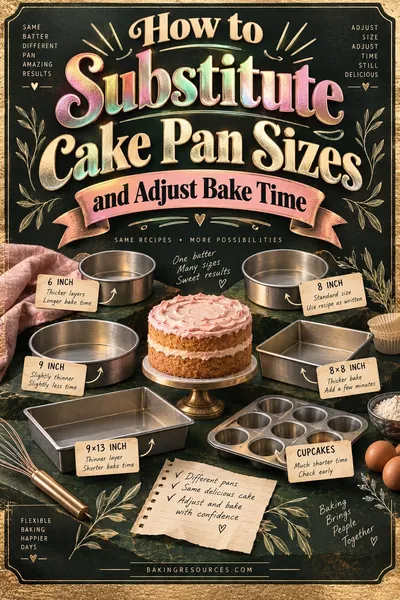 Baking guideHow to Substitute Cake Pan Sizes and Adjust Bake TimePick a substitute →
Convection ovens and cake
A convection or fan setting blows hot air around the oven, which moves heat into the pan faster. The usual adjustment is to lower the temperature by 25°F and keep the time about the same, or keep the temperature and check about 25 percent sooner. Do one or the other, not both.
Convection works well for cupcakes and multiple pans at once, since the moving air evens out hot spots. It can be rough on tall, delicate cakes: the fan sets the top quickly, and the cake can rise unevenly or lean. If your oven lets you choose, use the regular bake setting for layers and Bundts. The full rundown is in convection vs conventional oven.
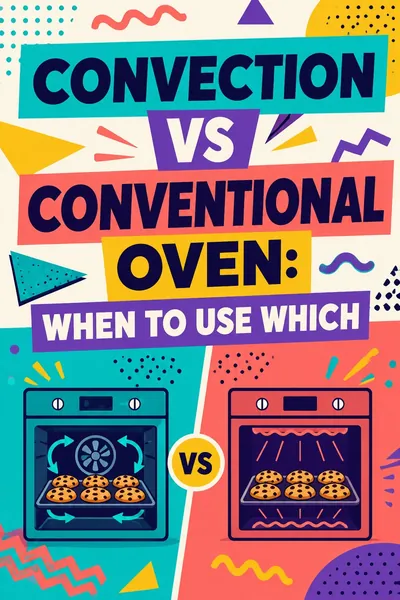 Baking guideConvection vs Conventional Oven: When to Use WhichSee the chart →
Rack position and spacing
Bake cakes on the middle rack so heat reaches the top and bottom evenly. When baking two layer pans, set them side by side with at least an inch between the pans and the oven walls. If they do not fit, stagger them on two racks and swap them about two thirds of the way through, once the cakes have set. The guide to which oven rack to use explains why the top and bottom racks bake so differently.
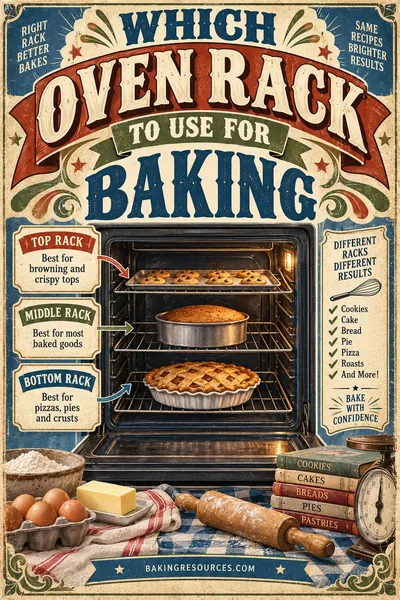 Baking guideWhich Oven Rack to Use for Baking: Top, Middle, LowTake a look →
High altitude cake baking
Above about 3,000 feet, cakes behave differently. Air pressure is lower, so gas bubbles expand faster and the batter can rise and then collapse before it sets. Water also boils at a lower temperature, which changes how the cake bakes.
The standard fix is to raise the oven 15 to 25°F so the structure sets sooner, and to shorten the time. For a cake that takes 30 minutes at sea level, start checking about 5 to 8 minutes early. Most high altitude recipes also cut the baking powder or soda a little, cut the sugar slightly, and add a few tablespoons of liquid.
The internal temperature test changes too. A moist cake cannot get much hotter inside than the local boiling point. At 5,000 feet water boils around 203°F, so the center of a finished cake may read in the high 190s rather than 205°F. At altitude, go by the toothpick and spring-back tests first and treat the thermometer as backup. The high altitude baking chart gives the exact changes by elevation.
 Baking guideHigh Altitude Baking Adjustments: The Chart by ElevationGet the details →
Troubleshooting: raw middle, dry edges, cracks and sinking
Raw or gummy middle, done edges
The center did not get enough heat before the outside finished. Common causes are a pan that is too small for the batter, a dark or glass pan at full temperature, or an oven running cool. If you catch it before the cake cools, put it back in for 5 to 10 minutes with a loose sheet of foil over the top. Next time, use a bigger pan or drop to 325°F and bake a little longer.
Dry, hard edges
Usually a dark pan, an oven running hot, or a cake left in a few minutes past done. Lower the oven 25°F for dark pans, check at the low end of the window, and grease and line the pan well. Fabric bake-even strips soaked in water and wrapped around the pan also keep the edges cooler.
A crack or big dome on top
The outside set while the middle was still rising, so the center pushed up and split. A hot oven, too much leavening, or a deep pan cause most cracks. The fixes are in why did my cake crack on top, and a small dome can simply be leveled with a serrated knife before frosting.
Sunk in the middle
Most sinking comes from underbaking: the center looked set, but the crumb had not firmed up enough to hold itself as it cooled. Opening the oven door in the first half of the bake, too much leavening, and an oven that runs cool are the other usual suspects. Checking for 200 to 210°F in the center fixes the underbaking cause. The rest are covered in why did my cake sink in the middle.
Dense or heavy all the way through
This is rarely a timing problem. It usually traces back to cold ingredients, under-creamed butter, or too much flour. See why is my cake dense for the causes and fixes.
Common timing mistakes
- Trusting the dial. Home ovens commonly run 15 to 25°F off from what the dial says. An inexpensive oven thermometer hanging on the middle rack tells you the real number, and that one fact explains a lot of cakes that "always take longer than the recipe."
- Not preheating fully. Many ovens beep before the walls are truly hot. Give it 15 to 20 minutes after the beep for best results, especially for cakes that rely on a quick early rise.
- Opening the door too early. Each peek lets out a lot of heat. Keep the door shut for at least the first two thirds of the bake time, then check through the window first.
- Testing near the edge. The edges always finish first. Put the toothpick or thermometer in the true center.
- Crowding the oven. Pans touching each other or the oven walls block air flow and bake unevenly. Leave at least an inch of space around every pan.
- Waiting for a bone-dry toothpick. A few moist crumbs is the sign to pull the cake. Waiting for spotless often costs you 3 to 5 minutes and a drier crumb.
- Cold batter. Batter made with cold eggs and milk can take several minutes longer and rise less evenly. Room temperature ingredients mix smoother and bake closer to the recipe time.
Holiday cake baking: plan the oven, not just the cake
Thanksgiving and Christmas are when cake timing gets hard, because the oven is shared with a turkey, a ham, rolls and pies. A few habits make it much easier.
Bake the cake a day or more ahead
Unfrosted layers keep well. Once fully cool, wrap them tightly and keep them at room temperature for a day, or freeze them. Frozen layers are actually easier to frost because they crumb less. The steps are in how to freeze cake layers, and frozen layers keep their best quality for about 2 to 3 months.
Do not bake a cake at the turkey's temperature
Roasts often go at 325°F, and it is tempting to slide a cake in alongside. If you must, treat it like a cake at 325°F: add 5 to 10 minutes and test the center. A roast also fills the oven with steam and moisture, which can soften the top of the cake. It is usually better to bake desserts first, before the bird goes in, or the day before.
A sample Christmas Eve schedule
- Morning: bake the two 9 inch layers at 350°F for 25 to 30 minutes. Cool 10 to 15 minutes in the pans, then on a rack for about 2 hours.
- Midday: wrap the cooled layers and chill them while the oven goes to rolls and sides.
- Evening: frost the chilled layers. A cake with cream cheese frosting or whipped cream must go back in the fridge, and should not sit out more than 2 hours.
Holiday Bundt cakes, from gingerbread to cranberry orange, follow the Bundt timing: 45 to 55 minutes at 350°F for a regular batter, longer for a dense pound cake. Grease every ridge well; the guide on getting a Bundt cake out of the pan will save you from a torn top on the big day.
Storing the finished cake
A cake with plain buttercream can stay at cool room temperature for a day or two under a cover. Anything with cream cheese frosting, whipped cream, custard or fresh fruit filling belongs in the fridge. For the full rules, including how long each kind lasts, see how to store cake.
Questions people ask
How long do you bake a cake at 350°F?
At 350°F, two 9 inch round layers take 25 to 30 minutes, two 8 inch layers 30 to 35 minutes, a 9x13 cake 30 to 35 minutes, a Bundt cake 45 to 55 minutes, a 9x5 loaf 50 to 60 minutes, and standard cupcakes 18 to 22 minutes. These assume light metal pans. Start checking at the low number and pull the cake when a toothpick in the center shows a few moist crumbs.
What internal temperature means a cake is done?
Most butter and oil cakes are done at 200 to 210°F in the center, measured with an instant-read thermometer pushed into the middle of the thickest part. Below about 195°F the center may still be soft and can sink as it cools. At high altitude the reading tops out lower because water boils at a lower temperature, so rely more on the toothpick and spring-back tests there.
How long should a 9x13 cake bake?
A 9x13 cake bakes 30 to 35 minutes at 350°F in a light metal pan. In a glass 9x13, lower the oven to 325°F and plan on 35 to 40 minutes. In a dark or nonstick pan, use 325°F and start checking at 25 minutes. Always test the very center, since the corners set several minutes before the middle.
Can I bake a cake at 325°F instead of 350°F?
Yes. A lower oven is often better for deep pans, pound cakes, and glass or dark pans. Expect about 5 to 10 extra minutes: a 9x13 that takes 30 to 35 minutes at 350°F usually needs 35 to 45 minutes at 325°F. The cake will rise more evenly and brown less, so go by the toothpick and the center temperature rather than the color.
Why is my cake still raw in the middle after the full time?
The usual reasons are an oven that runs cool, batter that is too deep for the pan, or a dark or glass pan that set the edges before the center finished. Check your oven with an oven thermometer, make sure the pan matches the recipe, and lower the oven 25°F for deep or dark pans. If the cake is still warm, it can go back in for 5 to 10 minutes under loose foil.
How long do cupcakes take compared with a cake?
Standard cupcakes bake much faster than a layer: 18 to 22 minutes at 350°F, filled about two thirds full. Mini cupcakes take about 10 to 12 minutes, and jumbo cupcakes about 25 to 30 minutes. One recipe for two 9 inch layers makes roughly 24 standard cupcakes. They are done when the tops spring back and a toothpick in the center comes out with a few moist crumbs.
Does a convection oven bake cake faster?
Yes. The fan moves heat into the pan faster, so either lower the temperature by 25°F and keep the recipe time, or keep the temperature and start checking about 25 percent sooner. Do not do both. Convection is great for cupcakes and several pans at once, but tall layer cakes and Bundts often bake more evenly on the regular setting.