Can You Use Almond Flour Instead of All-Purpose Flour?
Free calculator from Baking Resources
Almond Flour for All-Purpose Flour Swap Finder
Pick what you're baking and how much of the flour you want to swap.
Need more? Open the free Baking Substitutions.
More free baking tools



Want more options? Open the full Baking Substitutions tool.
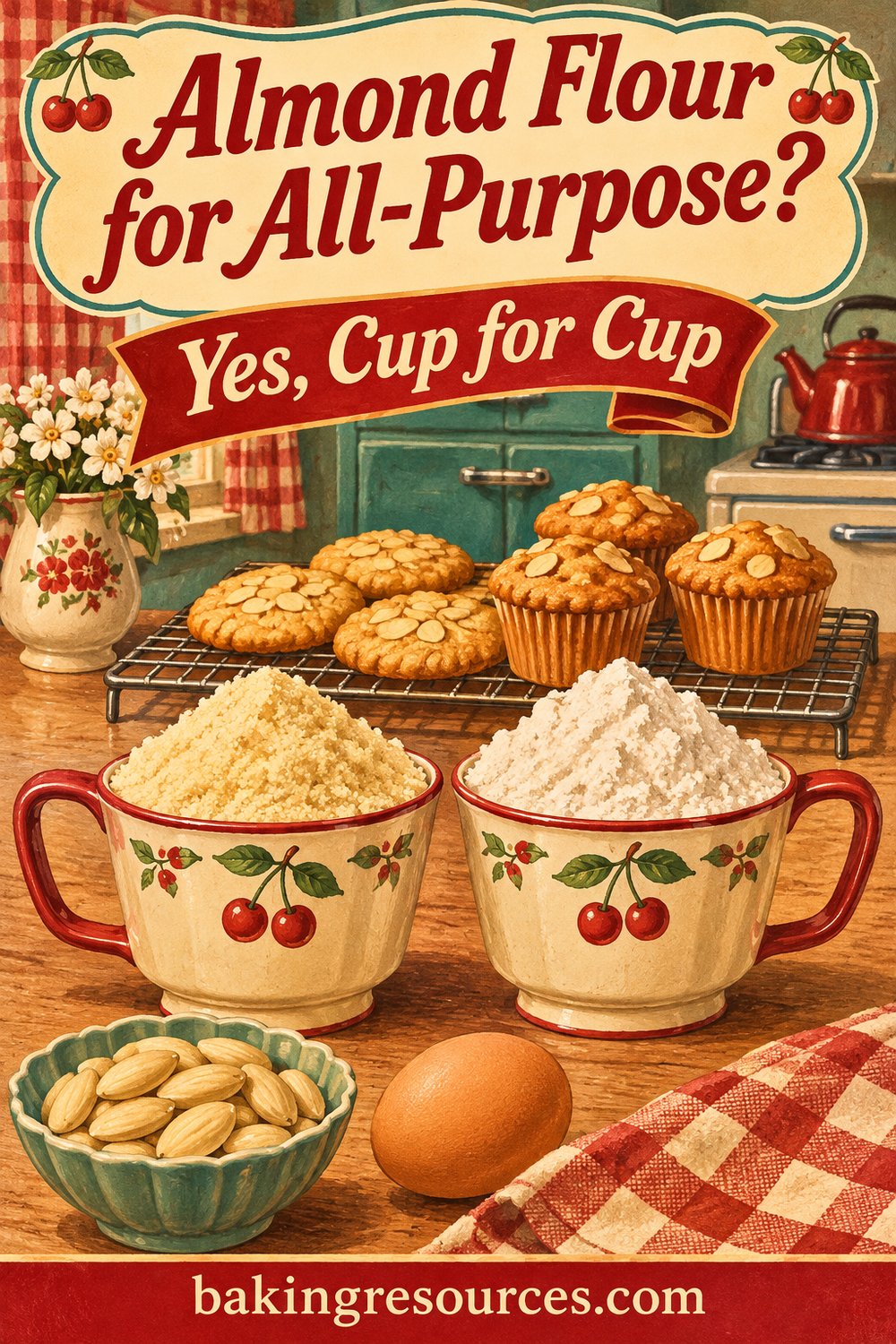
- Swap almond flour for all-purpose flour 1 cup for 1 cup in cookies, brownies, muffins, quick breads and pancakes.
- 1 cup of almond flour weighs about 96 g; 1 cup of all-purpose flour weighs about 125 g (spooned and leveled).
- For a full swap in cakes and muffins, add 1 extra egg for up to 2 cups of almond flour.
- Bake 25°F (about 15°C) lower, because almond flour browns faster.
- In yeast bread, replace no more than a quarter of the flour, by weight.
- Almond flour won’t thicken gravy or pudding. Use cornstarch or flour for that.
Can you use almond flour instead of all-purpose flour?
Yes, you can use almond flour instead of all-purpose flour in most quick bakes, swapping 1 cup for 1 cup, but in yeast bread a quarter of the flour is the limit. It works best where the recipe leans on butter, eggs and sugar, and worst where it leans on gluten.
Almond flour is just blanched almonds (skins removed) ground very fine. It has no gluten, almost no starch, and about half its weight is fat. All-purpose flour is mostly starch, with about 10 to 12 percent protein. That protein turns into gluten, the stretchy web that holds bread up, when you mix it with water.
So every swap brings three changes:
- Less structure. Bakes turn more tender and crumbly. Eggs or a binder have to hold things together.
- More richness. The fat keeps things moist, but it also makes dough spread and brown faster.
- A lighter cup. A cup of almond flour weighs less than a cup of wheat flour.
Want to go the other way and replace almond flour? That’s a different swap, and our almond flour substitute guide covers it.
How to substitute almond flour for all-purpose flour: the ratio
The ratio is 1 to 1 by volume: 1 cup of almond flour for each cup of all-purpose flour, which is about 96 g of almond flour for every 125 g of flour. Spoon it into the cup and level it, the same way you measure flour. Don’t pack it.
By weight, that’s roughly three-quarters as many grams. That’s on purpose. Almond flour doesn’t soak up liquid the way wheat starch does, so matching the grams on a full swap makes a heavy, oily bake.
| All-purpose flour (cups) | Weight (g) | Almond flour (cups) | Weight (g) |
|---|---|---|---|
| 1/4 cup | 31 g | 1/4 cup | 24 g |
| 1/2 cup | 63 g | 1/2 cup | 48 g |
| 3/4 cup | 94 g | 3/4 cup | 72 g |
| 1 cup | 125 g | 1 cup | 96 g |
| 2 cups | 250 g | 2 cups | 192 g |
| 3 cups | 375 g | 3 cups | 288 g |
The one exception is a partial swap in yeast bread, where you weigh everything anyway. There, swap up to a quarter of the flour gram for gram. Brands run from about 90 to 100 g per cup, so a kitchen scale keeps things steady from bag to bag. Need other flours in grams? The gluten-free flour in grams chart lists them.
Almond flour vs all-purpose flour: what’s different?
Almond flour has about 50 percent fat and no gluten, while all-purpose flour has about 1 percent fat and makes plenty of gluten. That one difference explains almost every change you’ll see in the oven.
| Trait | All-purpose flour | Almond flour |
|---|---|---|
| Weight per cup | About 125 g | About 96 g |
| Fat | About 1% | About 50% |
| Gluten | Yes | None |
| Soaks up liquid | A lot (starch) | Very little |
| Browning | Normal | Fast |
| Texture it gives | Light, springy, chewy | Moist, tender, dense |
If you’d like to compare protein across the whole flour shelf, see types of flour.
What can you make with almond flour instead of regular flour?
Brownies, cookies, muffins, quick breads and pancakes all take a full almond flour swap, while cakes do best at half and yeast bread at a quarter. Here’s how each type of bake holds up.
| What you’re baking | Most you can swap | What to change | Result |
|---|---|---|---|
| Brownies and bars | All of it | Nothing, just cool fully before cutting | Fudgy, a little nutty |
| Cookies | All of it | Chill dough; 1/4 tsp xanthan gum or 1 extra yolk per cup | Soft, tender, more fragile |
| Muffins and quick breads | All of it | 1 extra egg per 2 cups; bake 25°F lower | Moist, denser, shorter |
| Pancakes and waffles | All of it | 1 extra egg; medium-low heat | Tender, browns fast |
| Cake | Half, or all with care | Extra egg; 1/2 tsp xanthan gum per cup for a full swap | Moist, tight crumb, can sink |
| Yeast bread | A quarter | Swap by weight; bread flour for the rest | Softer, a bit shorter |
| Flaky pie crust | A quarter | Keep the butter cold | Tender but less flaky |
| Thickening gravy or pudding | None | Use cornstarch or flour | Almond flour won’t thicken |
Crumb toppings, crumbles and press-in bar crusts are great with almond flour too. It’s rolled, flaky pastry and tall, airy loaves where it struggles.
Do you need a binder with almond flour?
You need a binder only for a full swap: add 1 extra egg for up to 2 cups of almond flour, or about 1/4 tsp xanthan gum per cup for cookies and 1/2 tsp per cup for cakes. For a quarter or half swap, the wheat flour still makes enough gluten to hold things together. Pick one of these:
- Eggs. The easiest binder. Use 1 extra egg for up to 2 cups of almond flour, or 2 eggs for 3 cups. Our page on what eggs do in baking explains why it works.
- Xanthan gum. A plant-based thickener sold in small bags. Out of it? Try a xanthan gum substitute.
- Psyllium husk powder. The go-to for almond flour breads and rolls, since it adds a bit of chew. See psyllium husk substitutes if you don’t have any.
- Ground flaxseed. 1 tablespoon mixed with 3 tablespoons of water stands in for an egg in muffins and quick breads.
Worked example: chocolate chip cookies with half almond flour
A cookie recipe with 2 1/4 cups (281 g) of all-purpose flour becomes 1 1/8 cups (141 g) of flour plus 1 1/8 cups (108 g) of almond flour for a half swap.
- Split the flour. Half of 2 1/4 cups is 1 1/8 cups. Use 1 1/8 cups (141 g) all-purpose flour.
- Add the almond flour. Use 1 1/8 cups almond flour. By weight, that’s 1 1/8 x 96 g = 108 g.
- Leave the rest alone. Same butter, sugar, eggs and baking soda.
- Chill the dough 30 minutes. The extra fat makes it soft, and chilling keeps the cookies from spreading flat.
- Check early. Start looking 1 to 2 minutes before the recipe says. The edges brown faster than usual.
You’ll get a softer, chewier cookie with a toasty, nutty taste. For a full swap, use 2 1/4 cups (216 g) almond flour, add 1/2 tsp xanthan gum or an extra yolk, and bake 25°F lower. If they still spread, our guide on why cookies turn out flat has more fixes.
Worked example: muffins with all almond flour
A muffin recipe with 2 cups (250 g) of flour and 2 eggs becomes 2 cups (192 g) of almond flour and 3 eggs, baked 25°F lower.
- Swap the flour. Use 2 cups (192 g) of almond flour in place of the 2 cups of all-purpose flour.
- Add 1 egg. Two cups of almond flour takes 1 extra egg, so 2 eggs become 3.
- Keep the leavening. Leave the baking powder and soda as written. They still give lift, even without gluten.
- Lower the oven. If the recipe says 375°F (190°C), bake at 350°F (175°C).
- Bake a little longer. Plan on 3 to 5 extra minutes. A toothpick should come out with a few moist crumbs, not wet batter.
The muffins come out shorter and more moist than the wheat version, with a tender, almost cake-like crumb. Let them cool in the pan for 10 minutes, because they’re fragile while hot.
Is almond flour healthier than regular flour?
Almond flour has about 6 g of carbs per ounce (28 g) compared with about 21 g in all-purpose flour, but it also has about 165 calories per ounce compared with about 100. It’s different more than it’s better, so it depends on what you’re looking for.
| Per 1 ounce (28 g) | All-purpose flour | Almond flour |
|---|---|---|
| Calories | About 100 | About 165 |
| Carbs (g) | About 21 | About 6 |
| Fiber (g) | Under 1 | About 3 |
| Protein (g) | About 3 | About 6 |
| Fat (g) | Under 1 | About 14 |
These are typical label values, so check your own bag. Almond flour is naturally gluten-free, which is why it shows up in so many gluten-free recipes.
Variations: gluten-free, dairy-free and holiday baking
Almond flour swaps work for gluten-free and dairy-free baking with a few small checks. Here’s what to watch for.
- Gluten-free. A full swap is only gluten-free if everything else is too. Buy almond flour labeled gluten-free to avoid cross-contact, and check the baking powder and chocolate chips. Our gluten-free baking substitutions page covers the rest of the pantry.
- Dairy-free. Almond flour plays well with oil or plant butter, since it brings its own richness. Swap the butter and milk using our dairy-free baking substitutions.
- Egg-free. A full almond flour swap leans on eggs, so egg-free versions are hard. Stick to a half swap and use a flax egg.
- Holiday cookies. Shortbread, thumbprints and snowball-style cookies take a half swap beautifully. The nutty taste fits right in on a cookie tray.
Troubleshooting almond flour bakes
Most almond flour problems come from too much fat, too little structure or too much heat, and each has a simple fix.
| If this happens | Why | Do this next time |
|---|---|---|
| Cookies spread flat | Extra fat, no gluten | Chill dough 30 to 60 minutes; add 1/4 tsp xanthan gum per cup |
| Bakes fall apart | Not enough binder | Add 1 extra egg; cool fully before cutting |
| Dark outside, raw inside | Almond flour browns fast | Bake 25°F lower; tent with foil |
| Oily or heavy | Too much almond flour by weight | Swap cup for cup, not gram for gram |
| Gritty, speckled crumb | Almond meal instead of flour | Use fine, blanched almond flour |
| Short, dense bread | Swapped more than a quarter | Keep yeast bread to 25% almond flour |
How to store almond flour and almond flour bakes
Store almond flour airtight in the fridge for about 6 months or the freezer for up to a year, because its oils go rancid in a warm pantry. Let cold flour come to room temperature before baking, or it can firm up the butter in your dough. Our guide to storing flour has the details.
Almond flour bakes stay moist longer than wheat ones. Keep cookies and bars airtight at room temperature for 3 to 4 days. Muffins and quick breads keep 2 days on the counter or about a week in the fridge. Everything freezes well for about 3 months.
Myths vs facts about almond flour
The biggest myth is that almond flour swaps 1 to 1 in everything; it does in most quick bakes, but not in yeast bread or flaky pastry.
| Myth | Fact |
|---|---|
| Almond flour swaps 1 to 1 in any recipe | Only by volume, and not in yeast bread, flaky pastry or sauces |
| Almond meal and almond flour are the same | Meal is coarser, with skins; flour is fine and blanched |
| You should match the grams | Use about three-quarters of the weight on a full swap |
| Almond flour bakes need longer at the same heat | They need lower heat, about 25°F less |
| Almond flour keeps forever in the pantry | Its oils go rancid; refrigerate or freeze it |
Mistakes to avoid
The most common mistake is swapping all the flour in a yeast bread, which gives a flat, crumbly loaf.
- Matching grams on a full swap. Go cup for cup, or about three-quarters of the weight.
- Using almond meal for cakes. It’s fine in muffins and crumbles but makes cakes gritty.
- Baking at the usual temperature. Drop the oven 25°F or tent with foil.
- Cutting too soon. Almond flour bakes firm up as they cool. Give cakes and bars at least an hour.
- Swapping coconut flour in its place. Coconut flour soaks up far more liquid. See our coconut flour substitute guide before you try it.
Quick reference: almond flour instead of all-purpose flour
For most quick bakes, use 1 cup (96 g) of almond flour per cup (125 g) of all-purpose flour, add an egg for a full swap in cakes and muffins, and bake 25°F lower.
| Recipe | Swap | Per cup of flour (125 g) | Extra step |
|---|---|---|---|
| Brownies | All | 1 cup almond flour (96 g) | Cool before cutting |
| Cookies | All | 1 cup almond flour (96 g) | Chill dough; 1/4 tsp xanthan gum |
| Muffins | All | 1 cup almond flour (96 g) | 1 extra egg per 2 cups; 25°F lower |
| Cake | Half | 1/2 cup flour (63 g) + 1/2 cup almond flour (48 g) | 1 extra egg for 2+ cups flour |
| Pancakes | All | 1 cup almond flour (96 g) | 1 extra egg; medium-low heat |
| Yeast bread | A quarter | 94 g flour + 31 g almond flour | Swap by weight |
For more swaps like this, the Baking Resources baking substitutions tool covers dozens of pantry ingredients.
Frequently asked questions
Can I substitute almond flour for regular flour 1 to 1?
By volume, yes, in cookies, brownies, muffins, quick breads and pancakes. One cup for one cup. Add an extra egg for muffins and cakes, and don’t use a full swap in yeast bread.
How much almond flour replaces 1 cup of all-purpose flour?
One cup of almond flour, which weighs about 96 g. Spoon and level it rather than packing it.
Can I use almond flour instead of all-purpose flour in bread?
Only for up to a quarter of the flour, swapped by weight. More than that and the loaf turns short and dense, because almond flour has no gluten to trap the gas.
Do I need xanthan gum when I use almond flour?
Not for a partial swap. For a full swap in cookies, use about 1/4 tsp per cup, and in cakes about 1/2 tsp per cup, or use an extra egg instead.
Can I substitute almond meal for all-purpose flour?
Yes, in the same amounts, but it gives a coarser, darker crumb. It’s best in muffins, quick breads, crumbles and rustic cookies rather than light cakes.
Why are my almond flour cookies flat?
Almond flour has extra fat and no gluten, so the dough spreads. Chill it for 30 to 60 minutes, add 1/4 tsp xanthan gum or an extra yolk per cup, and bake on a cool pan.
Is almond flour better than regular flour?
Not better, just different. It’s lower in carbs, higher in fat and calories, and gluten-free, so it makes moist, tender bakes but can’t make light, chewy bread.