Can You Use Quick Oats for Oatmeal Cookies?
Free calculator from Baking Resources
Quick Oats for Oatmeal Cookies
Pick the rolled oats in your recipe and the oats you have on hand.
Need more? Open the free Baking Substitutions.
More free baking tools



Want more options? Open the full Baking Substitutions Calculator.
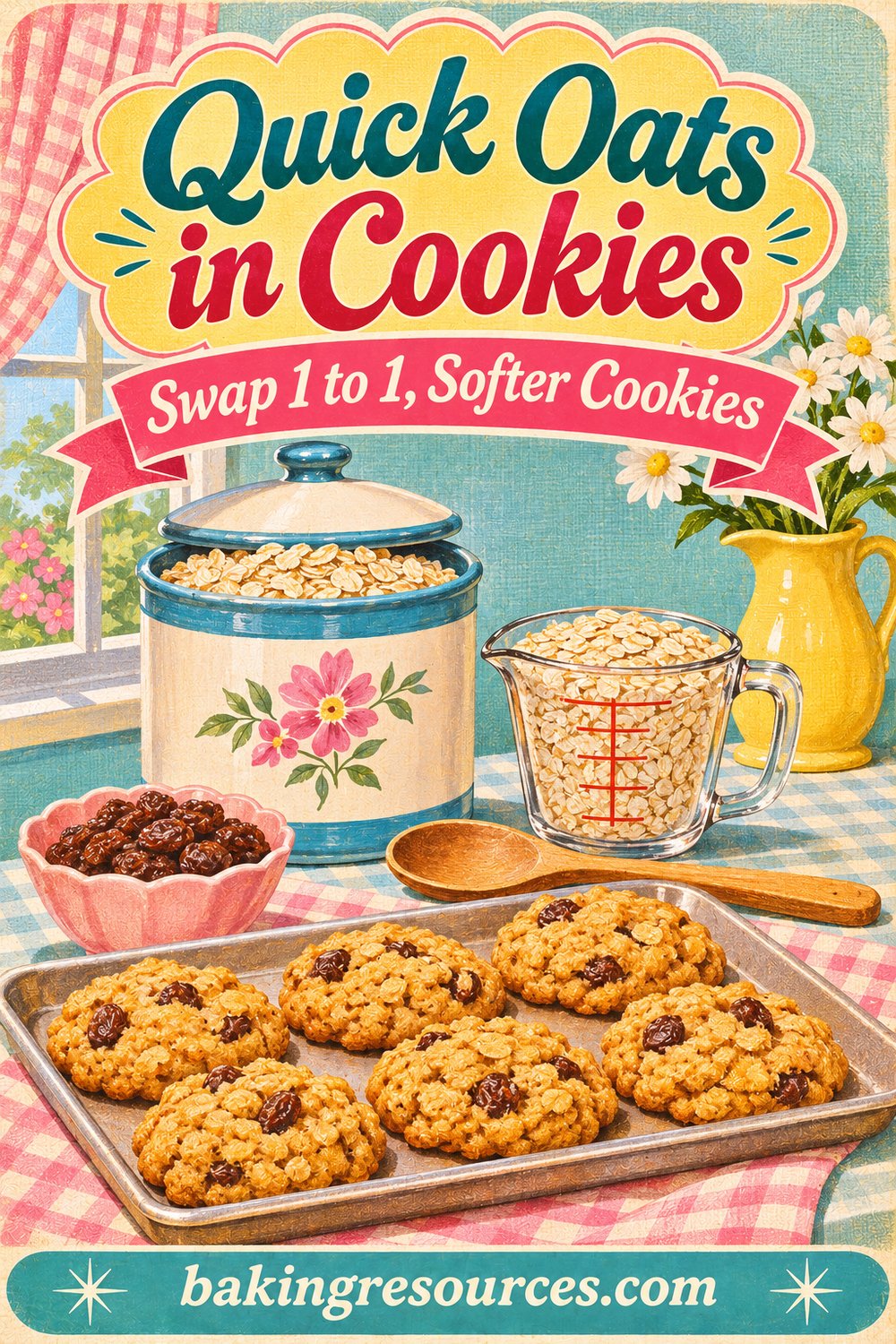
- Quick oats replace old-fashioned oats cup for cup: 1 cup is about 85 g (3 oz) for both.
- Quick oats are rolled thinner and cut smaller, so cookies turn out softer and less chewy.
- Bake time can drop by about 1 minute, so start checking at 9 to 10 minutes for a 350 F (175 C) cookie.
- Plain instant oats also work, but the texture is finer and cakier.
- Flavored instant packets add sugar and salt and should not be used.
- For extra chew, replace 1/4 of the quick oats with old-fashioned oats if you have a few.
Can you use quick oats for oatmeal cookies?
Yes, you can use quick oats for oatmeal cookies, and the swap is easy: use the same amount of quick oats as the recipe asks for in old-fashioned (rolled) oats. A cup of either weighs about 85 g (3 oz), so a measuring cup or a scale gives you the same result.
The only difference is in the finished cookie. Quick oats are rolled thinner and cut into smaller pieces than old-fashioned oats, so they soften more completely and blend into the dough. The cookies are tender and a little cakey, with a milder oat bite, instead of the bumpy, chewy texture of the classic version.
What is the difference between quick oats and old-fashioned oats?
Quick oats are old-fashioned oats that have been steamed longer, rolled thinner and cut into smaller flakes, so they cook in about 1 minute instead of 5. Both are made from the same oat groat. They differ only in how thin and how small the flakes are.
| Type | Flake size | Stovetop time | Weight per cup | Texture in cookies |
|---|---|---|---|---|
| Old-fashioned (rolled) | Large, thick flakes | About 5 minutes | About 85 g | Chewy, bumpy |
| Quick | Smaller, thinner flakes | About 1 minute | About 85 g | Soft, tender |
| Instant (plain) | Very fine, thin pieces | Just add hot water | About 80 g | Fine, cakey |
| Steel cut | Chopped groats | 20 to 30 minutes | About 160 g | Hard unless cooked first |
If you only have steel cut oats in the pantry, they need extra prep first. Our guide to using steel cut oats in oatmeal cookies covers the simmer and soak methods. For weights of other pantry staples, check the ingredient weight chart.
How do quick oats change the texture of oatmeal cookies?
Quick oats make oatmeal cookies softer, more tender and more uniform, because the smaller pieces absorb more moisture and break down in the oven. The cookies look a little smoother on top and hold together well.
- Chew: less chew. You get a soft, almost cake-like bite instead of the hearty, ropey chew of old-fashioned oats.
- Spread: slightly less spread, because the smaller flakes drink up more of the moisture in the dough.
- Appearance: a smoother, more even surface with fewer visible flakes.
- Browning: about the same, though thin edges can brown slightly faster.
- Flavor: the same toasty oat flavor, a little less pronounced.
Many people actually prefer this. Kids and picky eaters often like quick oat cookies better because there are fewer big, chewy flakes. If you want a thicker, chewier cookie, our chewy vs crispy cookies guide explains how butter, sugar and bake time change the texture.
How much quick oats do you use instead of old-fashioned oats?
Use the same amount of quick oats as old-fashioned oats, 1 to 1 by volume or by weight. If a recipe calls for 2 cups (170 g) of old-fashioned oats, use 2 cups (170 g) of quick oats. No other changes are needed for most drop cookies.
| Recipe calls for old-fashioned oats | Use quick oats | Weight (about) |
|---|---|---|
| 1/2 cup | 1/2 cup | 43 g (1 1/2 oz) |
| 1 cup | 1 cup | 85 g (3 oz) |
| 1 1/2 cups | 1 1/2 cups | 128 g (4 1/2 oz) |
| 2 cups | 2 cups | 170 g (6 oz) |
| 3 cups | 3 cups | 255 g (9 oz) |
The brand names and packaging vary, so a cup of quick oats can weigh a few grams more or less than the numbers above. If a dough looks very dry, add 1 tablespoon of milk. If it looks loose, chill it for 30 minutes. A kitchen scale takes the guesswork out, and our scale vs measuring cups guide shows why.
Worked example: swapping quick oats into a classic recipe
Suppose your oatmeal raisin cookie recipe makes about 36 cookies and calls for 3 cups (255 g) of old-fashioned oats, 1 1/2 cups (190 g) of flour, 1 cup of butter, 1 cup of brown sugar, 1/2 cup of white sugar and 2 eggs.
- Measure 3 cups (255 g) of quick oats. Spoon them into the cup and level the top. Don’t press them down.
- Mix the dough as written. Cream the butter and sugars first, then add eggs, flour and spices, and stir in the oats last.
- Chill the dough for 30 minutes. The smaller oats absorb moisture, and a short rest lets them do it before baking.
- Scoop onto a lined sheet with a #40 scoop (about 1 1/2 tablespoons).
- Bake at 350 F (175 C) and start checking at 9 minutes. The cookies are done when the edges are golden and the centers look set but slightly soft.
The cookies will be slightly softer than the original and spread a little less. If you want to double-check doneness, our how to tell when cookies are done guide shows what to look for. For general timing, the how long to bake chocolate chip cookies page is a handy reference for similar-size cookies.
Should you change the bake time when using quick oats?
You usually do not need to change the temperature, but check the cookies about 1 minute early, because the smaller oats can brown slightly faster at the thin edges. A cookie that normally bakes 10 to 12 minutes at 350 F (175 C) is often ready in 9 to 11 minutes with quick oats.
Use the look of the cookie, not just the clock. The edges should be golden and set, and the center should look matte and just barely soft. Cookies keep cooking on the hot pan for 2 to 3 minutes after you pull them out.
Can you mix quick oats and old-fashioned oats in cookies?
Yes, mixing is a great way to get some chew and some tenderness. A 50-50 blend of quick and old-fashioned oats makes a cookie that holds together well and still has visible flakes on top.
- All quick oats: soft, tender, uniform.
- Half quick, half old-fashioned: balanced, soft with some chew.
- Mostly old-fashioned with a little quick: chewy with slightly better binding.
The mix also works the other way. If you only have old-fashioned oats but want a smoother cookie, pulse 1/2 of them 3 or 4 times in a food processor. If you want to turn oats into flour for other baking, see how to make oat flour.
Can you use instant oatmeal for oatmeal cookies?
Plain instant oats can work in oatmeal cookies, but flavored instant oatmeal packets should not be used, because they add sugar, salt and flavoring that throw off the recipe. Plain instant oats are rolled the thinnest of all, so the cookie ends up fine-textured and cakey, with almost no visible oat flakes.
If you must use plain instant oats, use the same amount by volume, but spoon them in lightly instead of pressing them into the cup. Packing them can make the dough too dry. Also reduce the bake time by 1 minute and chill the dough for 30 minutes.
A flavored packet, such as maple or apple cinnamon, is a different story. Each packet usually holds sugar and salt that you can’t measure out, so the cookies can turn out too sweet or salty. Save those for breakfast.
Why are my oatmeal cookies dry or cakey with quick oats?
Oatmeal cookies made with quick oats turn out dry or cakey when there is too much flour, too many oats or too much time in the oven. Smaller flakes absorb more moisture, so the dough has less moisture to spare than one made with old-fashioned oats.
| Problem | Likely cause | Fix |
|---|---|---|
| Dry, crumbly dough | Oats packed into the cup | Spoon and level, or weigh 85 g per cup |
| Cakey cookies | Too much flour or oats, or over-mixing | Weigh the flour, mix just until combined |
| Hard cookies | Overbaked | Pull them when the centers still look soft |
| Cookies too flat | Warm dough or soft butter | Chill the dough 30 minutes |
| Bland flavor | Thin oats lose some toastiness | Toast the oats 5 minutes at 350 F (175 C) |
Toasting is a nice trick. Spread quick oats on a sheet pan and toast them for about 5 minutes at 350 F (175 C), then cool them before mixing. They gain a nutty, deeper flavor that makes up for the lost chew. Our how to toast nuts guide uses the same oven method. If cookies come out too hard, see why are my cookies hard, and if they spread, check why are my cookies flat.
Can you make the cookies healthier or use quick oats in other recipes?
Quick oats work well in many other baked goods, including muffins, cookie bars, crisp toppings and granola bars, because their small flakes soften quickly. In bars and toppings, they give a more even, less rustic look than old-fashioned oats.
- Add-ins: raisins, chocolate chips, dried cranberries or chopped nuts. Keep add-ins to about 1 cup per batch so the dough still holds.
- Less sugar: reduce the sugar by up to 1/4 if you like, but the cookies will be paler and drier. See healthy baking recipes for other lighter ideas.
- Gluten-free: use certified gluten-free oats and a gluten-free flour blend. Our gluten-free substitutions guide has the flour swaps.
- Egg-free: pick a binder that suits cookies, such as a flax egg, and expect a slightly softer cookie.
A crisp topping is another great use for quick oats. Try them in our apple crisp recipe, where they bake into a tender, crunchy layer.
How do you store and freeze quick oat cookies?
Store baked quick oat cookies in an airtight container for 4 to 5 days at room temperature, or freeze them for up to 3 months. Because quick oats hold moisture well, the cookies stay soft for a few days.
- Room temperature: airtight container with parchment between layers, 4 to 5 days.
- Freezer (baked): freeze in a single layer, then bag. Thaw on the counter for 30 minutes.
- Freezer (dough): scoop dough balls, freeze solid, then bag. Bake from frozen and add 1 to 2 minutes. See how to freeze cookie dough.
For more about keeping baked treats fresh, our how to store baked goods page covers the basics.
Quick reference: quick oats in oatmeal cookies
| Question | Answer |
|---|---|
| Can you swap quick oats for old-fashioned? | Yes, 1 to 1 |
| Weight per cup | About 85 g (3 oz) |
| Change in texture | Softer, more tender, less chewy |
| Bake time | Check 1 minute early (9 to 11 minutes at 350 F) |
| Plain instant oats | Same amount, cakier cookie |
| Flavored instant packets | Do not use |
| Best blend for chew | Half quick, half old-fashioned |
| Storage | 4 to 5 days airtight, 3 months frozen |
If you want to scale the recipe or swap other ingredients, use the baking substitutions calculator, and the cookie scoop calculator can tell you how many cookies a batch makes with your scoop.
Frequently asked questions
Can I use quick oats instead of old-fashioned oats in cookies?
Yes. Use the same amount, cup for cup (about 85 g per cup). The cookies will be softer and less chewy, and they may bake about 1 minute faster.
Can I use quick oats for oatmeal raisin cookies?
Yes. Quick oats work well in oatmeal raisin cookies and give a tender, uniform cookie. Chill the dough for 30 minutes and check the cookies at 9 to 10 minutes.
Do quick oats make cookies dry?
They can, because the smaller flakes absorb more moisture. Spoon the oats into the cup instead of packing them, weigh them at about 85 g per cup, and avoid overbaking.
Can you use instant oatmeal for oatmeal cookies?
Plain instant oats work, but they make a finer, cakier cookie. Flavored instant oatmeal packets add sugar, salt and flavoring, so skip them.
What is the difference between quick oats and rolled oats?
Quick oats are rolled thinner and cut smaller than rolled (old-fashioned) oats, so they cook in about 1 minute instead of 5 and give a softer cookie.
Can I mix quick oats and old-fashioned oats in cookies?
Yes. Half and half gives you some chew and some tenderness, and it is a good fix if you run out of one kind.
Should I change the bake time with quick oats?
Keep the same temperature, but check about 1 minute early. Cookies are done when the edges are golden and the centers look set but still a bit soft.
Can I use quick oats to make cookies chewier?
Quick oats make softer cookies, not chewier ones. For more chew, use old-fashioned oats, add an extra egg yolk, or use more brown sugar than white sugar.