
How Long to Bake Chocolate Chip Cookies at 375°F and 350°F

Bake chocolate chip cookies at 375°F for 9 to 11 minutes when each dough ball is about 2 tablespoons. At 350°F the same cookies take 11 to 13 minutes. Small 1 tablespoon balls need 8 to 10 minutes at 375°F, and big 1/4 cup bakery-style cookies need 13 to 16. Pull them when the edges are golden and the centers still look puffy and a little underdone.
Cold dough, frozen dough balls, and dark baking sheets all move the clock by a minute or two, which is a lot for a cookie. Pick your dough ball size, oven temperature and dough in the calculator below and it gives you the minutes for your batch and what the cookies should look like when it is time to take them out.
Free calculator
Chocolate chip cookie bake time calculator
Pick your dough ball size, oven temperature and how cold the dough is to see the bake time and when to pull the pan.
More free baking tools



Chocolate chip cookie bake times at a glance
Classic chocolate chip cookie recipes are usually written for 375°F, and a lot of newer ones use 350°F. Both work. The real question is how big each dough ball is. Here is the full chart for room-temperature dough on a light aluminum baking sheet lined with parchment.
| Dough ball | Weight (about) | Baked size | At 375°F | At 350°F |
|---|---|---|---|---|
| 1 tbsp (small) | 20 g | About 2 1/2 inches | 8 to 10 min | 9 to 11 min |
| 2 tbsp (classic) | 35 to 40 g | About 3 inches | 9 to 11 min | 11 to 13 min |
| 3 tbsp (large) | 50 to 55 g | About 3 1/2 to 4 inches | 11 to 13 min | 13 to 15 min |
| 1/4 cup (bakery style) | 70 to 75 g | About 4 1/2 inches | 13 to 16 min | 15 to 18 min |
Start checking at the low end of every range. Cookies are small and thin, so a single minute changes them from soft to crisp. The first tray of any new batch is your test tray: watch it closely, note the minute that looks right, and use that for the rest.
Weights are rough, since dough with lots of chips or nuts weighs more per spoonful. If your cookie scoop is not marked in tablespoons, fill it with water and pour it into a measuring spoon to find out.
375°F vs 350°F: what the oven temperature changes
Chocolate chip cookie dough is mostly butter, sugar and flour. In the oven, the butter melts and the dough starts to spread, while the eggs and flour set the shape. The oven temperature decides which of those happens first.
At 375°F
The edges set quickly and brown, so the cookie spreads less and keeps a thick, soft middle. You get the classic look: crisp golden rim, chewy center, slightly crackled top. It is fast, and it is the most common temperature for good reason. The catch is that the window between just right and overbaked is short, about a minute.
At 350°F
The dough spreads a little more before it sets, so cookies come out a bit wider, paler and more evenly soft from edge to center. It takes about 2 minutes longer for a standard cookie. Many people like 350°F for big cookies, since the center has more time to cook before the edges get too dark.
Lower or higher
Going down to 325°F with a longer bake slowly dries the cookie out, which is one way to get a thin, crisp, snappy cookie. Going up to 400°F or more is mostly used for very large, thick bakery-style cookies, where the outside needs to set fast so the middle stays gooey. Both are special cases. If you are just making a batch from a standard recipe, stick with 375°F or 350°F.
Convection
A fan oven bakes cookies faster and more evenly across several trays. Drop the temperature 25°F and start checking 1 to 2 minutes early. Our guide on convection vs conventional ovens explains when the fan helps most. Cookies are one of the best uses for it.
 Baking guideConvection vs Conventional Oven: When to Use WhichSee the chart →
Dough ball size: the biggest thing that sets the clock
A larger dough ball needs more time for heat to reach the middle. It also spreads wider, so it needs more room on the pan. The time does not double when the size doubles, though. A 1/4 cup cookie has four times the dough of a 1 tablespoon cookie, but it bakes in only about 5 more minutes, because it flattens as it bakes.
- 1 tablespoon. Bite-size cookies for platters and cookie tins. About 18 to 20 per half sheet pan, spaced 2 inches apart.
- 2 tablespoons. The everyday size most recipes mean. About 12 per half sheet pan.
- 3 tablespoons. Big, soft cookies. About 8 to 9 per half sheet.
- 1/4 cup. Bakery size. Only 6 to 8 per half sheet, with 3 inches between them.
A spring-loaded cookie scoop is the best tool here. Same size dough balls finish at the same moment, so the whole tray comes out right. Hand-rolled balls that vary from small to large give you a tray with burnt small ones and raw big ones.
Shape matters a little too. A tall, round ball spreads less and stays thick in the middle, so it needs the top of the range. A flattened puck spreads faster and bakes a minute sooner.
Chilled, rested and frozen dough
Room-temperature dough is what the chart above is built on. Cold dough takes longer to warm up in the oven, and it also spreads less, so the cookies come out thicker. Here is how much time to add.
| Dough | 2 tbsp at 375°F | 1/4 cup at 375°F | What changes |
|---|---|---|---|
| Room temperature, just mixed | 9 to 11 min | 13 to 16 min | Most spread; thinnest cookies |
| Chilled 30 minutes to 3 days | 10 to 12 min | 14 to 17 min | Less spread, thicker, deeper flavor after a day |
| Frozen dough balls (no thawing) | 11 to 14 min | 15 to 19 min | Least spread; centers stay soft |
Why chilling helps
Resting dough in the fridge does two things. The butter firms up, so the cookies hold their shape longer in the oven. And the flour slowly soaks up liquid, which gives a chewier texture and more toffee-like flavor. Even 30 minutes makes a difference, and 24 to 72 hours makes a bigger one. Our guide on why resting cookie dough works explains what happens during that time. Keep chilled dough covered, and bake it within 2 to 3 days, since it contains raw egg.
 Baking guideResting Cookie Dough: Why Time Makes Better CookiesSee the timing chart →
Baking from frozen
Frozen dough balls go straight from the freezer onto the pan. No thawing. Add about 2 to 3 minutes for standard and larger cookies and 1 to 2 minutes for small ones. Space them a bit farther apart than usual, since they spread later in the bake. Our page on how to freeze cookie dough covers the flash-freeze and storage steps. Frozen dough balls keep their best quality for about 3 months.
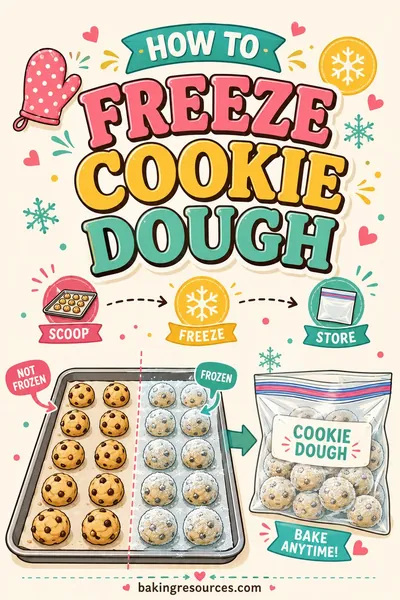 Baking guideHow to Freeze Cookie Dough: Flash Freeze, Then Bag ItGet the proofing tips →
Never taste raw dough
Raw cookie dough carries a real risk from both raw eggs and raw flour. Bake it fully before eating, and keep the dough in the fridge, not on the counter, between batches if it will sit more than 2 hours.
Baking sheet type: light, dark, insulated, parchment or mat
The sheet under the cookies changes how fast heat hits the bottoms. All the times on this page assume a light aluminum half sheet pan lined with parchment.
| Sheet or liner | 2 tbsp at 375°F | What changes | Tip |
|---|---|---|---|
| Light aluminum with parchment | 9 to 11 min | Even browning | The baseline |
| Light aluminum, bare or greased | 9 to 11 min | Slightly more spread on grease | Skip grease unless the recipe asks for it |
| Dark or nonstick sheet | 8 to 10 min | Bottoms brown fast | Check 1 to 2 minutes early, or lower the oven 15 to 25°F |
| Insulated (air-cushion) sheet | 11 to 13 min | Pale bottoms, softer cookies | Expect about 2 extra minutes |
| Silicone baking mat | 10 to 12 min | Paler bottoms, slightly less spread | Add about 1 minute |
Parchment and silicone mats both stop sticking and make cleanup easier, but they bake a little differently. Our comparison of parchment paper vs silicone baking mats goes into which one gives crisper bottoms. If your cookies keep coming out dark underneath, the sheet is usually part of the problem, along with the rack position. Our guide on why cookies burn on the bottom walks through every cause.
 Baking guideParchment Paper vs Silicone Baking Mat: Which WinsGet the details →
 Baking guideWhy Are My Cookies Burnt on the Bottom? 7 Real FixesSee what went wrong →
How to tell chocolate chip cookies are done
The main rule: take them out when they look a little underdone. Cookies keep baking on the hot sheet for 3 to 5 minutes after they leave the oven. If they look fully done in the oven, they will be overdone by the time they cool.
- Edges. Golden brown and set. Press one gently with a spatula; it should hold its shape.
- Centers. Puffy, pale and still a little shiny or soft-looking. They should not look raw and wet in a big patch, but they should not look dry either.
- Tops. Starting to crackle or wrinkle at the edges of the center.
- Bottoms. Lift one with a spatula: light golden underneath, not dark brown.
Let them rest on the pan for about 5 minutes so the centers finish setting, then move them to a rack. For thick bakery cookies, give them up to 10 minutes on the pan; they are too soft to move sooner. Our guide on how to tell when cookies are done shows these signs in more detail for every kind of cookie.
 Baking guideHow to Tell When Cookies Are Done: 5 Reliable SignsSee the doneness test →
Melted chocolate can trick you. A big pool of shiny chocolate on top looks wet even when the dough around it is done, so look at the dough between the chips, not the chips themselves. And remember that the cookies on the edges of the tray often bake a little faster than the ones in the middle, especially near the back of the oven. Judge doneness by the center cookies, and if the outer ones always get darker, turn the tray around halfway through the bake.
A thermometer is not much help for cookies. They are too thin to get a good reading, and the right texture depends more on how they look than on an exact temperature. Your eyes and the clock are the tools here.
Chewy or crisp: using time to control texture
For the same dough, a minute or two in the oven decides much of the texture. Pull early for soft and chewy. Leave in longer for crisp. Here is how that plays out with 2 tablespoon dough balls at 375°F:
- 9 minutes: very soft, almost gooey center; pale edges. Best eaten the same day.
- 10 minutes: golden edges, chewy center. The classic.
- 11 minutes: crisper rim, firmer center that still bends.
- 12 to 13 minutes: crisp all the way through once cool. Good for dunking.
Time is only one lever. The type of sugar, the butter, the flour and the temperature all play a part too. If you want to push your cookies one way or the other on purpose, our guide on how to make cookies chewy or crispy lays out each change. If your cookies keep turning hard by the next day even when you pull them early, see why cookies turn hard.
 Baking guideHow to Make Cookies Chewy or Crispy: The 8 Real LeversLearn more →
 Baking guideWhy Are My Cookies Hard? 7 Causes and How to Fix ThemFix it next time →
Recipe changes that shift the bake time
Not every chocolate chip cookie dough behaves the same. If your cookies never match the time in a recipe, one of these differences is often the reason.
Melted or browned butter
Doughs made with melted butter are softer and looser, so they spread faster and bake a touch quicker, often near the low end of the range. They also brown more. Browned butter adds a nutty flavor but loses some water as it cooks, which makes the dough a little stiffer. Either way, a 30 minute chill helps these doughs hold their shape, and the bake time stays within the chart once the dough is cool.
More brown sugar
Brown sugar holds onto moisture and makes cookies softer and chewier. Doughs heavy on brown sugar also color faster, so they can look done on the edges a minute before the centers are ready. Judge them by the puffy center, not the color.
Chocolate chunks and add-ins
Big chocolate chunks, chopped bars or a lot of nuts make dough balls heavier for the same scoop. That pushes the bake toward the high end of each range. Toasted nuts are already cooked, so they will not change the time, but they can darken faster on the surface.
Whole wheat or gluten-free flour
Whole wheat flour soaks up more liquid and gives a thicker, nuttier cookie that can take an extra minute. Gluten-free blends vary a lot. Many spread more at first, then set quickly, and benefit from a 30 minute rest before baking so the starches can absorb liquid.
Egg-free dough
Without egg, the dough has less to set its shape, so cookies often spread more and stay softer. The time is usually close to normal. If you are swapping out the egg, our guide to egg substitutes for muffins, cookies and brownies lists which swaps hold up best in cookies.
 Baking guideEgg Substitutes for Muffins, Cookies and BrowniesGet the swap chart →
Pan cookies, bars and skillet cookies
The same dough pressed into a pan bakes much longer, since it is thick and does not spread. These are the usual times for one standard batch of dough (about 2 1/4 cups of flour).
- 15x10 inch jelly roll pan: 20 to 25 minutes at 350°F. Golden on top, set at the edges, center no longer wet.
- 9x13 inch pan: 25 to 30 minutes at 350°F. Thicker and softer. The center should look set, not glossy, and a toothpick should come out with moist crumbs.
- Half batch in an 8x8 or 9x9 pan: about 25 to 30 minutes at 350°F, since the dough sits about as deep as a full batch in a 9x13.
Bars keep firming as they cool, so pull them when the middle still looks slightly soft. Let them cool fully in the pan before cutting, or they fall apart.
High altitude chocolate chip cookies
At higher elevation, cookie dough tends to spread more and dry out faster. The bake time does not change much, since cookies are small and quick, but the recipe often needs a few tweaks.
- Add 1 to 2 tablespoons of extra flour per cup to help hold the shape.
- Cut the baking soda slightly, about an eighth to a quarter, at 5,000 feet and above.
- Many bakers raise the oven 15 to 25°F at altitude. For cookies, a smaller bump of about 15°F, or none at all, is often enough. Either way, pull them a minute or two sooner than you would at sea level.
- Chill the dough for at least 30 minutes so the butter starts firm.
Our high altitude baking chart has the full set of changes by elevation, so you can adjust one thing at a time.
 Baking guideHigh Altitude Baking Adjustments: The Chart by ElevationTake a look →
Worked example: three dozen cookies, two sheets, chilled dough
Say you have a classic recipe that makes about 36 cookies with a 2 tablespoon scoop. You mixed the dough last night and it has been in the fridge. You own one light aluminum half sheet and one dark nonstick half sheet.
- Heat the oven. Set it to 375°F and give it a full 15 minutes.
- Portion. Scoop all 36 balls at once while the dough is cold. Put 12 on each sheet and keep the last 12 on a plate in the fridge.
- Set the times. Chilled 2 tablespoon dough on light aluminum needs 10 to 12 minutes. The dark sheet runs hot, so it needs about a minute less: 9 to 11.
- Bake one sheet at a time. The light sheet goes on the center rack. At 10 minutes the edges are just golden and the centers are puffy. At 11 minutes they look right. Out.
- Next sheet. The dark sheet goes in. Check at 9 minutes, and pull at 10 when the edges are set.
- Last batch. Let the light sheet cool for 5 minutes, or run it under cool water and dry it. Load the last 12 cold dough balls and bake 10 to 12 minutes again.
That is three trays at about 11 minutes each, plus a few minutes between them, so roughly 40 minutes of oven time for three dozen cookies. The calculator near the top of this page gives the time for any size, temperature and dough temperature.
Troubleshooting: flat, domed, burnt bottoms, raw centers
| Problem | Likely cause | Fix |
|---|---|---|
| Flat, greasy cookies that spread thin | Butter too warm or melted, warm pan, too little flour | Chill the dough; use a cool sheet; measure flour carefully |
| Puffy domes that do not spread | Too much flour, very cold dough, or oven too hot | Spoon and level flour; let frozen balls sit 5 minutes; flatten balls slightly |
| Burnt or dark bottoms | Dark sheet, bottom rack, oven running hot | Light sheet with parchment; center rack; check oven with a thermometer |
| Raw, doughy centers after cooling | Pulled too early, very large balls, or oven too cool | Add 1 minute; use 350°F for big cookies so the middle catches up |
| Hard, dry cookies | Baked too long, or too much flour | Pull while centers look soft; rest on the pan, not in the oven |
| Uneven tray, some dark, some pale | Uneven scoops or oven hot spots | Use a scoop; turn the pan around halfway through |
Flat cookies are the most common complaint, and they are almost never about bake time. The dough was too warm when it went in. Our guides on why cookies come out flat and how to stop cookies from spreading go through each cause and fix.
If you pull a tray and the cookies are clearly too raw, you can put the whole tray back in for 1 to 2 minutes, as long as you catch it within a minute or so of taking it out. Once cookies have cooled and set, putting them back in the oven mostly dries the edges without fixing the middle. If a tray came out too dark on the bottom, slide the cookies off the hot sheet onto a cool plate or rack right away, since every extra minute on hot metal makes the bottoms darker.
One more check if every batch fails the same way: bake a single test cookie before you scoop the whole batch. It takes 10 minutes and tells you whether the dough spreads too much, needs more chilling, or needs a different time in your oven.
Christmas, cookie swaps and bake-sale batches
Chocolate chip cookies show up in nearly every Christmas tin, school bake sale and winter cookie swap. A big batch is mostly about oven time, not mixing time.
Plan the oven time
Count each tray as bake time plus about 2 to 3 minutes to swap pans. With 2 tablespoon cookies at 375°F, that is roughly 13 minutes per tray of 12. Ten dozen cookies means 10 trays and a little over 2 hours of baking with one oven. Our guide on planning oven time for a Christmas cookie baking marathon shows how to work out a big day with several kinds of cookies.
Scoop and freeze ahead
The easiest holiday plan is to scoop all the dough balls in early December, freeze them on a tray, and bag them. Then bake a tray or two whenever you need fresh cookies, adding 2 to 3 minutes for frozen dough. It also means you can hand out warm cookies at a party without mixing anything that day.
Tins and gifts
For gift tins, smaller 1 tablespoon cookies look neat and stack well. Let them cool completely before packing, or steam softens everything in the tin. Our page on how many cookies to bake for neighbor gift tins helps with the count. Baked chocolate chip cookies keep in an airtight container at room temperature for about 3 to 5 days, and frozen for about 3 months for best quality. For more on how long holiday cookies last, see how long Christmas cookies last.
Common chocolate chip cookie timing mistakes
- Waiting until they look done. If the centers look fully baked in the oven, they will be hard once cool. Pull them while the middles look soft.
- Putting dough on a hot sheet. Dough on a warm pan starts melting before it goes in the oven, so it spreads more and bakes faster. Let sheets cool between batches.
- Two trays on two racks without swapping. The bottom tray burns underneath and the top tray browns on top. If you bake two at once, swap and turn them halfway through and add a minute.
- Uneven dough balls. Different sizes on the same tray finish at different times. Use a scoop.
- Trusting the oven dial. Many ovens run 25°F or more off. A cheap oven thermometer explains a lot of cookies that always burn or always stay pale.
- Using a recipe time for a different size. If a recipe says 10 minutes for 2 tablespoon balls and you make 1/4 cup cookies, they will be raw in the middle at 10 minutes. Use the size chart above.
Questions people ask
How long do you bake chocolate chip cookies at 350°F?
At 350°F, 2 tablespoon dough balls take 11 to 13 minutes on a light baking sheet. Small 1 tablespoon cookies take 9 to 11 minutes, 3 tablespoon cookies take 13 to 15, and 1/4 cup bakery-style cookies take 15 to 18. Pull them when the edges are golden and the centers still look soft and puffy.
How long do you bake chocolate chip cookies at 375°F?
At 375°F, classic 2 tablespoon dough balls bake in 9 to 11 minutes. Small 1 tablespoon cookies need 8 to 10 minutes, 3 tablespoon cookies need 11 to 13, and 1/4 cup cookies need 13 to 16. The hotter oven gives crisper golden edges and a chewier center, so watch the first tray closely.
How long do you bake frozen chocolate chip cookie dough?
Bake frozen dough balls straight from the freezer without thawing. Add about 2 to 3 minutes to the normal time for standard and larger cookies, and 1 to 2 minutes for small ones. For 2 tablespoon frozen dough balls at 375°F, that is about 11 to 14 minutes. Space them a little farther apart than usual.
Should chocolate chip cookies look underbaked when you take them out?
Yes, a little. The edges should be golden and set, but the centers should still look puffy, pale and slightly soft. Cookies keep baking on the hot sheet for 3 to 5 minutes after they leave the oven. If they look fully done in the oven, they usually turn out dry or hard once they cool.
Why are my chocolate chip cookies raw in the middle?
They were pulled a little too early, the dough balls were large, or the oven runs cool. A cookie should look soft in the center but not wet and glossy in a wide patch. Add a minute to the bake, check your oven with a thermometer, and try 350°F for big cookies so the center has more time to cook.
Do I need to chill chocolate chip cookie dough before baking?
It is not required, but it helps. Chilling for 30 minutes or more firms the butter so the cookies spread less and come out thicker, and a 24 hour rest deepens the flavor. Chilled dough needs about 1 extra minute in the oven. Keep the dough covered in the fridge and bake it within 2 to 3 days.
Can I bake two trays of cookies at the same time?
Yes. Put the racks in the upper and lower thirds of the oven, swap the trays top to bottom and turn them around halfway through, and add about a minute to the bake time. The bottom tray tends to brown faster underneath. For the most even cookies, bake one tray at a time on the center rack.
How long do big bakery-style chocolate chip cookies take?
Cookies made from 1/4 cup of dough, about 70 to 75 grams, take 13 to 16 minutes at 375°F or 15 to 18 minutes at 350°F. Bake only 6 to 8 on a half sheet so they have room to spread. Pull them when the edges are golden and the centers look puffy and soft, then let them rest on the pan for up to 10 minutes before moving them.