Dairy Free Buttermilk Substitutes That Work in Baking

Put 1 tablespoon of lemon juice or white vinegar in a measuring cup, top it up to the 1 cup line with unsweetened soy milk, stir once and leave it 10 minutes. It will thicken slightly and look curdled, which is exactly right. That is the best of the dairy free buttermilk substitutes because soy is the only common plant milk with enough protein to actually curdle.
Every other option works to some degree, and the ranking below tells you which ones hold up in a cake and which ones fall apart in a biscuit. Oat milk comes second, coconut milk gives you the richest result, and almond milk is the weakest of the group.
Working with an odd amount? Our free baking substitutions finder scales any swap to the exact quantity your recipe needs.
Updated September 2026
The swaps, at a glance
Each row makes the equivalent of 1 cup of buttermilk, which weighs about 245 g.
| Swap | The ratio | Best for | Trade-off |
|---|---|---|---|
| Soy milk plus lemon juice | 1 cup unsweetened soy + 1 tbsp lemon juice | Everything. The default | Faint beany note under the sour |
| Soy milk plus white vinegar | 1 cup unsweetened soy + 1 tbsp vinegar | Savory bakes, soda bread | Sharper, less fruity |
| Oat milk plus acid | 1 cup oat milk + 1 tbsp acid | Muffins, cakes, quick breads | Thickens but barely curdles |
| Canned coconut milk, thinned | 3/4 cup coconut milk + 1/4 cup water + 1 tbsp acid | Rich cakes, scones | Reads as coconut in a plain bake |
| Unsweetened soy yogurt, thinned | 3/4 cup soy yogurt + 1/4 cup plant milk | Pancakes and biscuits, best body | Needs whisking to pour |
| Cashew milk plus acid | 1 cup cashew milk + 1 tbsp acid | Cakes, anything pale | Thin, but neutral and creamy |
| Almond milk plus acid | 1 cup almond milk + 1 tbsp acid | Light cakes, waffles | Almost no curdle, watery batter |
| Water plus vinegar plus oil | 1 cup water + 1 tbsp vinegar + 1 tbsp neutral oil | Emergency, no plant milk at all | No body, no richness, but the soda still works |
Every one of those does the chemical job. The differences are all about body and flavor, which is where most swap charts go quiet and where the results actually diverge.
Dairy free buttermilk substitutes ranked by what they do in the bowl
Buttermilk is doing three separate jobs in a batter, and each swap keeps some of them.
Job one: it is an acid. Cultured buttermilk sits around pH 4.5. That acid reacts with baking soda to release carbon dioxide, which is the lift in pancakes, biscuits and soda bread. Baking soda alone is a base and cannot make gas without a partner. Our guide to baking soda vs baking powder covers the pairing in detail.
Job two: it tenderizes. The acidity weakens gluten as it forms and helps flour proteins set softer. That is the plush crumb in a buttermilk cake.
Job three: it has body. Real cultured buttermilk is thick. A batter built on it pours slowly and holds air. This is the job that plant milk plus acid does worst, and it is why some swaps disappoint even though the chemistry was perfect.
Here is how the options score on all three:
| Swap | Acid job | Tenderizing | Body |
|---|---|---|---|
| Soy plus acid | Full | Full | Partial, the protein sets a little |
| Oat plus acid | Full | Full | Slight, from the oat starch |
| Coconut, thinned | Full | Full | Good, from fat rather than protein |
| Soy yogurt, thinned | Full | Full | Best of the group |
| Cashew plus acid | Full | Full | Low |
| Almond plus acid | Full | Full | None worth counting |
| Water, vinegar, oil | Full | Full | None, but the oil restores richness |
If a recipe leans on buttermilk mostly for lift, like a soda bread or a chocolate cake, every row works and you can pick on flavor alone. If the recipe leans on buttermilk for texture, like biscuits, scones or thick pancakes, choose soy yogurt or coconut.
Why soy curdles and almond does not
Curdling is protein coagulation. When acid drops the pH, protein molecules lose the charge that keeps them apart, clump together, and the liquid thickens and separates into visible flecks.
Soy milk carries by far the most protein of the common plant milks, which is why a spoonful of lemon juice turns it visibly grainy within a couple of minutes. Oat milk has some protein and a lot of dissolved starch, so it thickens without really breaking. Almond, rice and most nut milks have very little protein, so nothing happens except that the liquid turns sour.
That distinction matters less than it looks. The curdle is a sign, not a mechanism. The acid is doing its work with the baking soda regardless of whether you can see flecks. What you lose with almond milk is body, not lift.
Two practical notes on buying:
- Buy unsweetened and unflavored. Vanilla soy milk in a savory bake is a distinctive mistake, and sweetened versions throw off the sugar balance. If sweetened is all you have, cut a tablespoon or two of sugar from the recipe.
- Check for added gums. Milks with gellan or locust bean gum already have body, which helps here. They also thicken more aggressively when acid hits them, so stir well before pouring.
Which acid, and how much
One tablespoon of acid per cup of plant milk is the standard, and it holds across every option in the chart. Here are the acids that work and how they differ.
| Acid | Amount per 1 cup | Notes |
|---|---|---|
| Fresh lemon juice | 1 tbsp | Cleanest flavor, slight fruitiness. The default |
| White vinegar | 1 tbsp | Sharpest, most neutral once baked |
| Apple cider vinegar | 1 tbsp | Mild fruit note, good in spiced bakes |
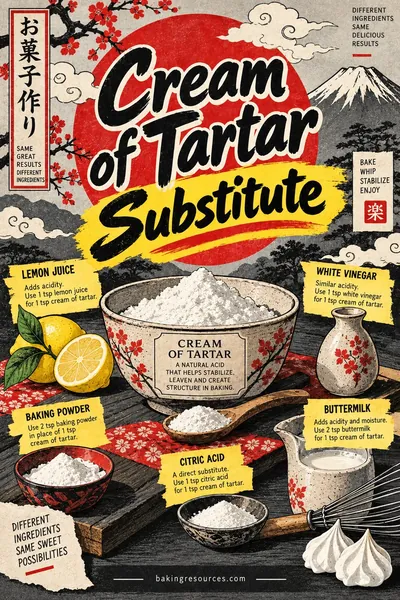
| Cream of tartar | 1 3/4 tsp, whisked in | No flavor at all, but it clumps unless you whisk hard |
| Bottled lemon juice | 1 tbsp | Works fine. Slightly flat compared with fresh |
What does not work: rice vinegar and balsamic are either too weak or too strongly flavored, and citric acid powder is hard to dose at home without a fine scale.
Rest the mixture for a full 10 minutes. Five is enough for the reaction, but the extra time lets soy and oat thicken properly, and it gives coconut fat time to disperse.
Partial amounts, since recipes rarely want a round cup
Scaling the acid down is where people guess and get it wrong. A tablespoon is 3 teaspoons, so the math is simple once you see it laid out.
| Buttermilk needed | Plant milk | Acid |
|---|---|---|
| 1/4 cup | 1/4 cup | 3/4 tsp |
| 1/3 cup | 1/3 cup | 1 tsp |
| 1/2 cup | 1/2 cup | 1 1/2 tsp |
| 2/3 cup | 2/3 cup | 2 tsp |
| 3/4 cup | 3/4 cup | 2 1/4 tsp |
| 1 cup | 1 cup | 1 tbsp |
| 1 1/4 cups | 1 1/4 cups | 1 tbsp + 3/4 tsp |
| 1 1/2 cups | 1 1/2 cups | 1 1/2 tbsp |
| 2 cups | 2 cups | 2 tbsp |
Remember the fill order. Acid into the measuring cup first, then top up to the line with plant milk. If you pour a full cup of milk and then add the acid you have made a cup and a tablespoon of liquid, which is enough to loosen a stiff batter.
Worked example: a pancake batter that came out flat
Say a stack of pancakes calls for 1 1/2 cups of buttermilk and 1 teaspoon of baking soda, and your almond milk version poured like water and baked thin.
Step 1. Check the acid, not the soda. 1 1/2 cups needs 1 1/2 tablespoons of acid. If you used one tablespoon for the whole batch, the soda had a partner for only two thirds of itself and the rest sat there tasting soapy.
Step 2. Diagnose the pour. Almond milk plus acid is thinner than water once it warms up. A thin batter spreads before the bubbles can set, which gives you a crepe rather than a pancake.
Step 3. Rebuild it with body. Use 1 1/8 cups of unsweetened soy yogurt whisked with 3/8 cup of soy milk, which is 1 1/2 cups total at the same 3 to 1 ratio as the chart. No added acid is needed, because yogurt is already sour enough to move the soda.
Step 4. If you only have almond milk, keep it and add 1 tablespoon of neutral oil plus 2 teaspoons of cornstarch per cup, whisked in before the acid. The starch gelatinizes on the griddle and gives you a batter that stays where you pour it.
Step 5. Rest the batter 10 minutes before cooking so the flour hydrates and the starch swells. That single step does more for thickness than anything else on this list.
Coconut milk, which behaves differently
Canned coconut milk is the only swap here that gets its body from fat rather than protein, so it earns its own paragraph.
Use 3/4 cup of full fat canned coconut milk thinned with 1/4 cup of water, then add the tablespoon of acid. Straight from the can it is too thick and too rich, and it will weigh down a light crumb.
Carton coconut milk is a different product, closer to almond milk in thickness, and it needs no thinning at all. Use it cup for cup with the standard tablespoon of acid.
Coconut flavor survives baking more than people expect. It disappears in chocolate, spice and banana bakes, and it is clearly noticeable in a plain vanilla cake or a biscuit. Our vegan heavy cream substitutes guide covers the same can for whipping and ganache.
Matching the swap to the bake
| What you are making | Best choice | Why |
|---|---|---|
| Pancakes and waffles | Soy yogurt thinned, or soy plus acid | Body keeps the batter from spreading |
| Biscuits and scones | Soy yogurt thinned, or coconut | Fat and thickness give flaky layers |
| Chocolate cake | Any of them, including almond | Cocoa covers every flavor difference |
| Vanilla or white cake | Soy or cashew plus acid | Neutral color and clean flavor |
| Spice or banana bread | Coconut, or oat plus cider vinegar | The warm flavors match |
| Soda bread | Soy plus white vinegar | Maximum acid, clean flavor |
| Cornbread | Soy or oat plus acid | Needs the acid more than the body |
| Frosting or glaze | Do not swap here | Use a plant milk straight, acid will thin it |
For everything else on the dairy side of the pantry, our dairy free baking substitutions guide covers butter, cream, milk and sour cream in one place, and the general buttermilk substitute guide has the dairy versions if only part of your kitchen is going dairy free.
Mistakes that quietly ruin the swap
- Using it straight away. The acid needs those 10 minutes. Pour it in immediately and the soda reaction happens in the bowl rather than in the oven.
- Adding acid on top of a full cup. Extra liquid, looser batter, longer bake.
- Reaching for sweetened vanilla milk. It is not a disaster in a cake and it is very obvious in cornbread.
- Using a heavy Greek style plant yogurt undiluted. Too thick to pour, and the batter will not spread. Thin it to the 3 to 1 ratio.
- Assuming no curdle means it failed. Almond milk will never curdle and it still works chemically. Judge the batter, not the cup.
- Doubling the acid to force a curdle. You get a sour bake and a soda reaction that finishes before it reaches the heat.
Making it ahead and storing it
Mix it fresh. The soured milk keeps in the fridge for two or three days, but the acid keeps working on the proteins, so the texture changes and it separates further. Stir it back together and it is fine for a cake.
What you cannot do is mix it, add it to a batter, and then leave the batter sitting. Baking soda starts releasing gas the moment it meets acid, so a batter that rests an hour has already spent most of its lift. Baking powder batters are more forgiving because they are double acting. If you need to mix ahead, use a recipe built on baking powder, or keep the soured milk separate and combine at the last minute.
FAQ
What is the best dairy free buttermilk substitute?
Unsweetened soy milk with 1 tablespoon of lemon juice or vinegar per cup. Soy is the only widely sold plant milk with enough protein to curdle and thicken, so it copies both the acid and part of the body of real buttermilk.
Can I use almond milk to make buttermilk?
Yes, and it works chemically, but it will not curdle or thicken. Use 1 cup of unsweetened almond milk with 1 tablespoon of acid, and if the recipe needs a thick batter add 1 tablespoon of oil and 2 teaspoons of cornstarch to make up for the missing body.
Does oat milk curdle for buttermilk?
Not really. It thickens because of the dissolved starch but rarely breaks into visible flecks. That thickening is useful, so oat milk is a solid second choice for muffins, cakes and quick breads even though it does not look curdled.
How much vinegar do I need per cup of plant milk?
One tablespoon per cup, the same as with dairy milk. Scale it down proportionally for smaller amounts: 1 1/2 teaspoons for half a cup, and 3/4 teaspoon for a quarter cup.
Can I use lemon juice instead of vinegar?
Yes, at the same 1 tablespoon per cup. Lemon is slightly fruity and better in sweet bakes, white vinegar is sharper and cleaner in savory ones. Both drop the pH far enough to activate baking soda fully.
Will the bake taste like soy or coconut?
Soy leaves a faint background note that disappears in anything chocolate, spiced or citrus, and is mildly noticeable in a plain vanilla cake. Coconut is much more assertive and stays detectable in pale, simple bakes, so save it for rich or spiced ones.
Do I still need baking soda if I use a dairy free buttermilk substitute?
Yes, and keep the recipe amount. The acid is only half of the reaction. Removing the soda leaves you with a sour batter and no lift, which is the most common way this swap goes wrong.
Can I use plain water and vinegar if I have no plant milk?
You can, and the soda will still work. Add 1 tablespoon of neutral oil per cup to replace some of the fat and richness, and expect a slightly drier, less tender crumb than any of the milk based options.