Molasses Substitutes for Baking

For 1 cup of molasses, warm 3/4 cup of packed dark brown sugar with 1/4 cup of water until it dissolves. That is the closest of the molasses substitutes for baking, because brown sugar is white sugar with molasses added back, so you are rebuilding the real thing rather than approximating it.
If you would rather pour something straight from a bottle, dark corn syrup, maple syrup, honey and golden syrup all swap 1 for 1 by volume. They differ in flavor and, more importantly, in acidity, which is the part that trips people up in gingerbread.
Need this scaled to half a cup or a third? Our free baking substitutions finder does the arithmetic for any amount.
Updated September 2026
The 6 molasses substitutes for baking, ranked
All ratios replace 1 cup of molasses, which weighs about 337 g.
| Swap | Amount | Flavor match | Watch out for |
|---|---|---|---|
| Dark brown sugar plus water | 3/4 cup packed sugar + 1/4 cup water | Closest available | Never as dark or as bitter |
| Dark corn syrup | 1 cup | Same body, milder taste | Not acidic, adjust the soda |
| Black treacle or golden syrup | 1 cup | Treacle is nearly identical | Golden syrup is much lighter |
| Maple syrup | 1 cup | Clearly maple, not molasses | Thinner, and not acidic |
| Honey | 1 cup | Floral rather than mineral | Browns fast, drop the oven 25F |
| Date or sorghum syrup | 1 cup | Dark and fruity, surprisingly close | Sweeter, and harder to find |
The ranking is about flavor, not function. Every one of them works structurally: they are all liquid sugars with similar moisture, so the batter behaves. What changes is the taste and the chemistry with baking soda.
What molasses is actually doing in the recipe
Understanding the four jobs tells you instantly which swap is safe for your bake.
It is a liquid sugar. Roughly a quarter of molasses by weight is water, so it sweetens and hydrates at the same time. Swapping in a dry sugar without adding liquid gives you a stiff batter.
It is acidic. This is the job everyone forgets. Molasses sits low enough on the pH scale to react with baking soda, and gingerbread, dark cookies and spice cakes rely on that reaction for their lift.
It holds moisture. Molasses is hygroscopic, meaning it pulls water out of the air, which is why molasses cookies stay chewy for days while a plain sugar cookie goes crisp. Our guide to what does sugar do in baking covers this in more depth.
It browns hard. Molasses is loaded with the compounds that drive both caramelization and the Maillard reaction, so anything containing it darkens fast and can scorch at the edges.
A swap that keeps all four is a true substitute. A swap that keeps three is fine as long as you patch the missing one, and the missing one is almost always the acid.
The acid problem, and the two ways to fix it
Corn syrup, maple syrup and golden syrup are all far less acidic than molasses. Put one of them into a batter leavened with baking soda and the soda has nothing much to react with. You get a flatter, denser bake and sometimes a faint soapy or metallic taste from unreacted soda.
Two fixes, and you only need one.
Fix one: add the acid back. Stir 1 teaspoon of lemon juice per cup of the substitute syrup into the wet ingredients. It disappears in flavor completely under spices. Cream of tartar works too, at about 1/2 teaspoon per cup, whisked into the dry ingredients instead.
Fix two: change the leavener. Swap the baking soda for baking powder at a ratio of 1 teaspoon of soda to 3 teaspoons of powder. Baking powder brings its own acid, so it does not need one from the batter. The catch is that you cannot always fit three times the volume into a small recipe without a chemical aftertaste, so this works best when the recipe called for half a teaspoon of soda or less. Our baking soda vs baking powder guide has the full comparison.
Brown sugar is the exception that needs neither fix. It carries residual molasses and stays acidic enough for the soda to work.
Swap 1: dark brown sugar and water, the closest match
This is the substitute worth learning by heart.
Per 1 cup of molasses: 3/4 cup of packed dark brown sugar plus 1/4 cup of water. Warm them together, stirring, until the sugar dissolves and the mixture pours like syrup. Let it cool before adding it to a batter with eggs in it.
Why it works: commercial dark brown sugar is white sugar with about 6.5% molasses sprayed back on, so it carries real molasses flavor and real molasses acidity. You are diluting a concentrated form back into a syrup.
Why it is not perfect: 6.5% of three quarters of a cup is not a lot of actual molasses, so the result is milder and much less bitter. In a light spice muffin, nobody will notice. In a dark, treacly gingerbread built around the flavor, it will taste thin.
You can push it darker by using muscovado instead of ordinary dark brown sugar. Muscovado keeps far more of its molasses and tastes almost smoky. See muscovado sugar substitute for what it does and does not replace.
If you have molasses but no brown sugar, the swap also runs backwards. Our brown sugar substitute guide covers that direction: 1 cup of white sugar plus 1 tablespoon of molasses gives light brown, and 2 tablespoons gives dark.
Swap 2: dark corn syrup, the texture twin
Dark corn syrup pours the same, weighs almost the same at about 328 g per cup, and gives you exactly the same chew and stickiness. It is the best choice when you care more about texture than taste, which covers most cookies, bars and sticky toppings.
It carries some caramel flavor and a little of the molasses note, because dark corn syrup is corn syrup with refiner's syrup blended in. What it lacks is the bitter mineral edge and the acidity.
Use it 1 for 1, then add the 1 teaspoon of lemon juice per cup if the recipe leans on baking soda. What is corn syrup explains why it behaves the way it does, including its real job of stopping sugar from recrystallizing.
Light corn syrup also works, but it is entirely neutral and pale, so you lose all the color as well as the flavor.
Swap 3: treacle and golden syrup
These two names get used loosely and they are not the same thing.
Black treacle is the British equivalent of molasses. It is dark, bitter and acidic, and it swaps 1 for 1 with no adjustments at all. If you can find it, it is the best substitute on this page, better than the brown sugar version.
Golden syrup is a different product: pale, buttery, sweet and barely acidic. It swaps 1 for 1 by volume and it will change the character of the bake completely. Use it when you want stickiness and moisture without darkness, and add the lemon juice.
Swap 4: maple syrup
Straight 1 for 1 swap, similar moisture, lighter body. What you get is a maple bake, not a molasses one, and there is no way around that.
Maple is much less acidic, so add the 1 teaspoon of lemon juice per cup or your gingerbread will rise less and taste flatter. Real maple also burns a little faster than molasses, so check 5 minutes early. If the bake is a house rather than cookies, the gingerbread house size guide has the panel dimensions to cut to.
Pancake syrup is not maple syrup. It is corn syrup with flavoring, and once heated it tastes of very little. If that is what is in the cupboard, treat it as light corn syrup instead.
Swap 5: honey
Honey swaps 1 for 1 by volume and weighs about 340 g per cup, so it is a near match by weight as well.
Two adjustments make it work properly:
- Drop the oven temperature by 25F. Honey browns faster than any other sugar on this list because its fructose caramelizes at a lower temperature. Without the drop you get dark edges and a pale center.
- Keep the acid in mind. Honey is mildly acidic, more so than corn syrup and less so than molasses, so half a teaspoon of lemon juice per cup is usually enough.
Honey tastes distinctly of honey, and it competes with ginger and clove rather than supporting them. It is a better fit for a soft cookie or a quick bread than for a dark gingerbread.
Swap 6: date syrup or sorghum syrup
Both are underrated here. Date syrup is dark, thick and fruity, and it comes closer to molasses in color and body than maple or honey does. Sorghum syrup is a traditional US cane style syrup with a mineral tang that sits very close to a mild molasses.
Both swap 1 for 1. Both are sweeter than molasses, so if the recipe is already very sweet you can cut a tablespoon or two of the other sugar. Sorghum is acidic enough to leave the soda alone. Date syrup is milder, so add the lemon juice.
About blackstrap, which is not a 1 for 1 swap
Blackstrap is the third boiling of the cane syrup. Most of the sugar has been crystallized out of it, which leaves it dark, thin, mineral heavy and genuinely bitter.
If a recipe says molasses and you own only blackstrap, do not pour it in cup for cup. Use half blackstrap and half dark corn syrup or maple syrup to bring the bitterness back into range. Going the other way, if a recipe specifically asks for blackstrap and you have regular molasses, use it straight and accept a sweeter, gentler result.
| Molasses type | Boil | Taste | Use it for |
|---|---|---|---|
| Light or mild | First | Sweet, gentle caramel | Cookies, quick breads, general baking |
| Dark or robust | Second | Deeper, faintly bitter | Gingerbread, spice cake, dark rye |
| Blackstrap | Third | Bitter and mineral, barely sweet | Recipes that name it. Cut it for anything else |
| Unsulfured | Any | Cleaner, no sulfur note | The default on US shelves now |
| Pomegranate molasses | Not cane at all | Sour, fruity, savory | Not a baking swap. Do not use it here |
That last row catches people every year. Pomegranate molasses is a reduced fruit syrup with nothing in common with cane molasses except the word.
Worked example: gingerbread with no molasses in the house
Your recipe calls for 1/2 cup of molasses, 1 teaspoon of baking soda and 2 1/4 cups of flour. The jar is empty and you have dark brown sugar, maple syrup and honey.
Step 1. Scale the closest swap. The ratio is 3/4 cup sugar plus 1/4 cup water per full cup. Halve it: 6 tablespoons of packed dark brown sugar plus 2 tablespoons of water.
Step 2. Check the weight. 1/2 cup of molasses is about 168 g. Six tablespoons of packed dark brown sugar is around 80 g, plus 30 g of water, so 110 g. You are short on total mass, which means slightly less moisture and a slightly firmer dough. Add a tablespoon of extra water if the dough looks dry.
Step 3. Leave the soda alone. Brown sugar keeps enough acidity, so the full teaspoon stays.
Step 4. Expect a lighter color. The bake will be a warm tan rather than near black. If you want the color back, a teaspoon of cocoa powder in the dry ingredients darkens it without adding a chocolate flavor at that dose.
Step 5. If you use the maple syrup instead, pour 1/2 cup straight in, add 1/2 teaspoon of lemon juice to keep the soda working, and check the bake 5 minutes early because maple browns quicker.
That is the whole decision, and it takes about a minute once you have the ratios.
What not to substitute molasses with
- Brown sugar dry, with no water. You lose about a quarter cup of liquid per cup and the batter tightens noticeably.
- Agave or simple syrup. Neutral, thin and not acidic. You keep the sweetness and lose everything else.
- Coffee or espresso. It darkens and adds bitterness, but it brings no sugar and no body, so it changes the recipe rather than substituting into it.
- Pomegranate molasses. Different plant, different flavor, sour rather than bitter.
- Brown sugar syrup in candy work. Anything relying on molasses for its anti-crystallizing behavior needs an invert sugar such as corn syrup or honey instead.
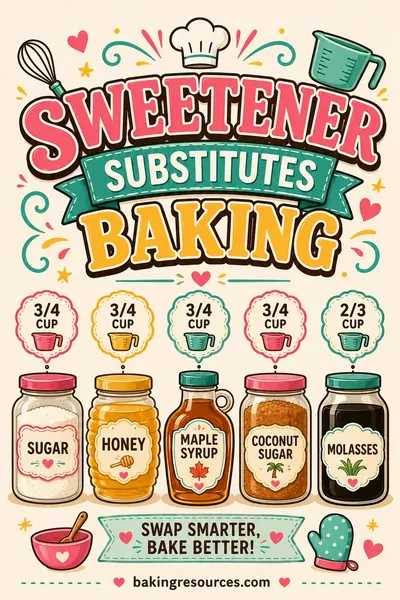
For the wider question of trading one sweetener for another across a whole recipe, our sweetener substitutes for baking guide covers the liquid to dry conversions and the oven adjustments each one needs.
FAQ
What is the best substitute for molasses in baking?
Dark brown sugar dissolved in water, at 3/4 cup packed sugar plus 1/4 cup water per cup of molasses. Brown sugar already contains molasses, so it brings back both the flavor and the acidity that baking soda needs, unlike the neutral syrups.
Can I use honey instead of molasses?
Yes, 1 for 1 by volume, but drop the oven temperature by 25F because honey browns much faster. The flavor is clearly honey rather than molasses, so it suits soft cookies and quick breads better than a dark gingerbread.
Is dark corn syrup a good molasses substitute?
It is the best match for texture. Same pour, same chew, same stickiness, with a milder flavor and no bitterness. Add 1 teaspoon of lemon juice per cup if the recipe uses baking soda, since corn syrup is not acidic.
What can I use instead of blackstrap molasses?
Regular dark molasses used straight is the simplest answer, though the result is sweeter and less mineral. Going the other way, if blackstrap is all you have, cut it half and half with dark corn syrup or maple syrup so it is not overwhelming.
Does substituting molasses change how much baking soda I need?
It can. Molasses is acidic and most swaps are not, so the soda loses its reaction partner. Either add 1 teaspoon of lemon juice per cup of substitute syrup, or replace the soda with three times as much baking powder.
Is treacle the same as molasses?
Black treacle is essentially the same product under a British name, and it swaps 1 for 1 with no adjustments. Golden syrup is a completely different thing: pale, buttery and mild, so it changes the flavor of the bake even though it pours the same.
How much does a cup of molasses weigh?
About 337 g, which is close to honey at 340 g and slightly more than maple syrup at 322 g. Weighing sticky syrups is faster and cleaner than measuring them, and our ingredient weights chart covers the rest of the pantry.
Will my cookies still be chewy without molasses?
Mostly, if you swap in another liquid sugar such as corn syrup, honey or date syrup, since all of them hold moisture. A dry sugar swap with no added liquid gives a crisper, shorter cookie, which is fine if that is what you want but is a real change in texture.