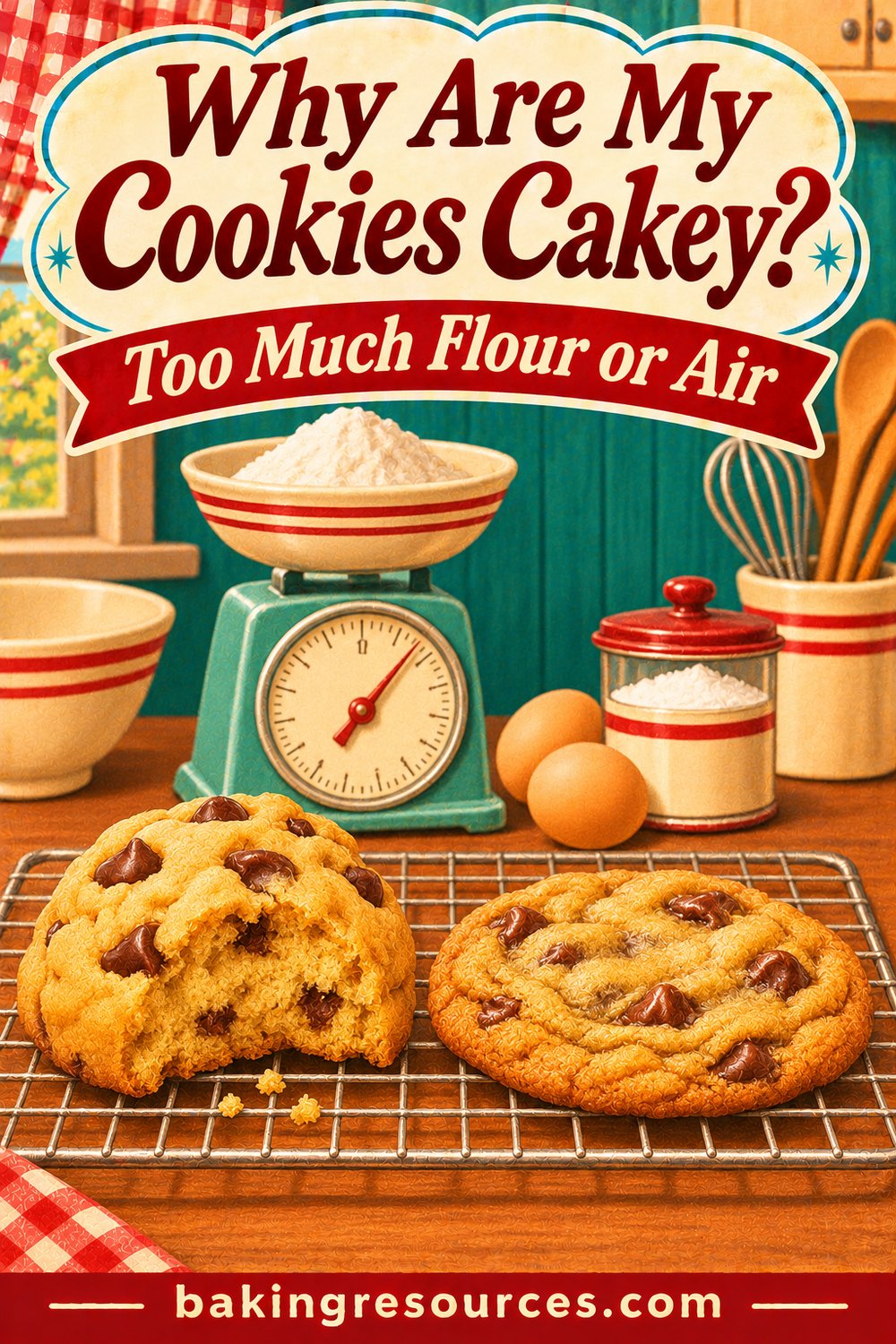
Why Are My Cookies Cakey? 6 Causes and How to Fix Them
Free calculator from Baking Resources
Cakey Cookie Fixer
Pick what your cookies look like and how you measure flour.
Need more? Open the free Cookie Scoop Calculator.
More free baking tools



Want more options? Open the full Cookie Scoop Calculator.
- Too much flour is the top cause: a scooped cup can weigh 145 g instead of 125 g, about 16 percent extra.
- A large egg is about 50 g out of the shell; jumbo eggs are about 63 g and add extra water and protein.
- A level teaspoon of baking powder is about 4 g; a heaped one is about half again as much.
- Drop cookie dough needs only 2 to 3 minutes of creaming, not the 3 to 5 minutes a cake batter gets.
- Mix the flour in on low just until no dry streaks show.
Why are my cookies cakey?
Your cookies are cakey because the dough has more structure, more air or more lift than the recipe planned, most often from too much flour (145 g instead of 125 g per cup). A cakey cookie has a light, open, fluffy crumb, like the top of a muffin. That texture comes from the same things that make a cake: plenty of structure from flour and egg, lots of trapped air, and lift from baking powder. A chewy cookie has less of each. So when a recipe that should be chewy comes out cakey, one of these crept in.
| Cause | What it does | How much is too much | Fix |
|---|---|---|---|
| Too much flour | Stiffens the dough so it puffs instead of spreading | Scooped cups: about 145 g each instead of 125 g | Spoon and level, or weigh |
| Extra egg or liquid | Adds water and protein that steam and set like cake | An extra egg, larger eggs, or a splash of milk | Large eggs, exact count, no added milk |
| Too much baking powder | Lifts the cookie up as it sets | A heaped teaspoon is about half again as much | Level spoons; use soda if the recipe says soda |
| Creaming too long | Whips in air, so the cookie rises like a cake | 5 minutes or more for a drop cookie | Cream about 2 to 3 minutes |
| Overmixing the flour | Builds gluten for a bready, springy crumb | Beating on high after the flour goes in | Mix on low just until no flour shows |
| Cake flour or less sugar and fat | A lean, soft dough puffs instead of flowing | Swapping flours or cutting sugar by a quarter or more | Use all-purpose flour and the full sugar and butter |
Can too much flour make cookies cakey?
Yes, too much flour is the most common reason cookies turn cakey: a scooped cup can hold about 145 g instead of 125 g. Dipping the measuring cup into the bag packs the flour down, so a “cup” can weigh about 145 g instead of the 125 g most recipes expect. That is about 16 percent extra. In a recipe that calls for 2 1/4 cups, scooping adds about 45 g, or roughly a third of a cup of flour nobody asked for.
Extra flour soaks up the butter and sugar that would normally melt and let the dough spread. The cookie stays tall and sets with a dry, cake-like crumb. Our page on how to measure flour shows the spoon-and-level method, and the ingredient weight chart has grams per cup for other flours.
Do eggs make cookies cakey?
Yes, eggs make cookies cakey when there is more egg than the recipe planned, such as an extra egg or two jumbo eggs (about 126 g) in place of two large ones (about 100 g). Egg whites are mostly water and protein. In the oven, the water turns to steam and puffs the dough, and the protein sets around those bubbles, much like a cake. A large egg weighs about 50 g out of the shell, an extra-large about 56 g and a jumbo about 63 g. Using two jumbo eggs in place of two large ones adds about 26 g of egg, which is enough to notice.
Yolks work the other way. They add fat that keeps cookies tender and chewy. That is why “one whole egg plus one yolk” shows up in so many chewy recipes. For more on what each part does, see what eggs do in baking.
Does baking powder make cookies cakey?
Yes, baking powder makes cookies cakier than baking soda does, and even a heaped teaspoon instead of a level 4 g one is enough to notice. Most baking powder releases much of its gas once the dough heats up, just as the cookie starts to set, so the lift goes straight up. Baking soda raises the dough’s pH, which helps it spread and brown. A recipe built on soda that gets powder instead, or a heaped spoon of powder, bakes up domed and fluffy. A level teaspoon of baking powder weighs about 4 g. Our guide to baking soda vs baking powder explains the difference in full.
Can creaming butter and sugar too long make cookies cakey?
Yes, creaming butter and sugar for 5 minutes or more makes drop cookies cakey; about 2 to 3 minutes is enough. Creaming beats tiny air pockets into the butter. Cakes need a lot of that air, which is why our guide on how to cream butter and sugar gives 3 to 5 minutes for a fluffy cake batter. Most drop cookies need much less. About 2 to 3 minutes on medium, until the mixture is smooth and slightly lighter in color, is plenty. Beat a cookie dough like a cake and it bakes like one.
The same goes for the flour. Once it is in, mix on low and stop as soon as you cannot see dry streaks. Long mixing develops gluten, which gives a springy, bready bite. See what overmixing does for the full picture.
How do you make cookies chewy, not cakey?
To make cookies chewy, not cakey, weigh the flour at 125 g per cup, use large eggs, level the leavening and cream for only 2 to 3 minutes. Here is the full routine:
- Weigh the flour at 125 g per cup of all-purpose flour, or spoon it into the cup and level it.
- Use large eggs and the exact count. If the recipe has two eggs, try one whole egg plus one yolk for more chew.
- Level every spoon of baking soda and baking powder, and never swap one for the other.
- Cream for 2 to 3 minutes, or use melted and cooled butter, which adds almost no air.
- Swap some white sugar for brown. Brown sugar holds moisture and gives a chewier, denser cookie.
- Mix the flour on low just until combined, then fold in chips by hand.
- Pull them early. Take the tray out when the centers still look puffy. Our page on how to tell when cookies are done shows the signs.
Change one or two things per batch, so you know which one worked. For the full list of texture levers, see chewy vs crispy cookies.
Worked example: a chocolate chip batch that came out cakey
In this example, 45 g of extra flour, 26 g of extra egg and 6 minutes of creaming turned a chewy recipe cakey. A classic recipe calls for 2 1/4 cups flour, 1 cup butter, 3/4 cup each brown and white sugar, 2 large eggs and 1 teaspoon baking soda. Here is what one baker actually used:
- Flour scooped from the bag: about 326 g instead of 281 g, so 45 g extra (16 percent).
- Two jumbo eggs: about 126 g instead of 100 g, so 26 g extra (26 percent).
- Butter and sugar creamed for 6 minutes because “fluffy is good.”
Each change pushes toward cake. Together, the dough had more structure, more water and more air than the recipe planned, and the cookies came out tall, soft and bready. Weighing 281 g of flour, using large eggs and creaming for 2 1/2 minutes brings the same recipe back to a chewy, flatter cookie. Our chocolate chip cookies recipe lists the weights so you can check yours.
Can you fix cakey cookie dough before baking?
You can partly fix cakey cookie dough by pressing each ball to about 3/4 inch and working in 1 tablespoon of softened butter per batch. You cannot take out extra flour or egg, but you can help the dough spread:
- Press each dough ball down to about 3/4 inch thick before baking so it starts flatter.
- Work 1 tablespoon of softened butter into a full batch to loosen it.
- Bake at 350°F rather than a hotter oven, so the dough has a little more time to spread before it sets.
- Do not chill the dough for long. Cold, stiff dough spreads even less.
If your cookies are puffy in shape more than cakey inside, our page on why cookies do not spread covers that problem in depth. Brownies have their own version of this issue, explained in why brownies turn out cakey.
Weights that keep cookies chewy, not cakey
Weighing five ingredients prevents most cakey cookies: flour at 125 g per cup, large eggs at about 50 g, butter at 226 g per cup, and level teaspoons of baking soda (about 4.6 g) and baking powder (about 4 g).
| Ingredient | Right amount | Common mistake | What the mistake adds |
|---|---|---|---|
| All-purpose flour, 1 cup | 125 g, spooned and leveled | Scooped from the bag, about 145 g | 20 g per cup (16 percent) |
| Eggs | Large, about 50 g each | Jumbo, about 63 g each | 13 g per egg |
| Butter, 1 cup (2 sticks) | 226 g, softened | Too little, or a lower-fat spread | Less tenderness and spread |
| Baking soda, 1 tsp | About 4.6 g, level | Swapped for baking powder | Upward lift instead of spread |
| Baking powder, 1 tsp | About 4 g, level | Heaped spoon, about 6 g | About 50 percent more lift |
A kitchen scale makes this easy. Our page on kitchen scale vs measuring cups shows why one cup of flour can vary so much.
Why are my cookies cakey? Causes by cookie type
The likely cause depends on the cookie: chocolate chip cookies usually turn cakey from extra flour, while sugar and peanut butter cookies more often go cakey from extra leavening or long creaming.
| Cookie | Most common cause | Quick fix |
|---|---|---|
| Chocolate chip | Scooped flour | Weigh 281 g for 2 1/4 cups |
| Oatmeal | Extra flour plus thirsty oats | Weigh the flour; let the dough rest 30 minutes |
| Drop sugar cookies | Long creaming | Cream about 2 to 3 minutes |
| Peanut butter | Heaped leavening or extra egg | Level spoons; large eggs |
| Snickerdoodles | Usually fine: they are meant to puff | Pull while the centers still look soft |
Snickerdoodles use cream of tartar with baking soda, which makes them puff and crack on purpose. A soft, slightly puffy snickerdoodle is correct; a dry, bready one is overbaked or over-floured.
Which cookies are supposed to be cakey?
Pumpkin cookies, soft frosted sugar cookies and whoopie pie shells are meant to be cakey, because their doughs carry extra liquid and often baking powder. If you are baking one of these, a fluffy crumb is the goal, not a mistake.
The trouble only starts when a recipe meant to be chewy comes out that way. If a chewy chocolate chip or oatmeal recipe bakes up like a muffin top, something in the dough drifted.
Cakey cookies with egg substitutes, gluten-free flour or at high altitude
Swaps change texture too, and each one can tip a cookie toward cake or away from it.
- Egg substitutes. Swaps like applesauce or yogurt add moisture and often a cakey crumb. Our guide to egg substitutes for muffins, cookies and brownies lists which ones stay chewy.
- Gluten-free blends. Many blends are thirsty and puff more. Weigh the blend instead of using cups, and let the dough rest 30 minutes before baking.
- High altitude. Leavening works harder up high, so cookies can puff and then dry out. Cut the baking soda by about an eighth to a quarter at 5,000 feet and above; the high altitude baking chart has the rest.
- Butter temperature. Butter at about 65°F creams properly. Butter that is too cold never blends, and the cookies stay tall. Our page on how to soften butter gets it right quickly.
Myths and facts about cakey cookies
The biggest myth is that more creaming always makes better cookies; for drop cookies, 2 to 3 minutes is enough and longer pushes them toward cake.
- Myth: cakey cookies are underbaked. Fact: underbaked cookies are gooey. Cakey cookies have a set, fluffy crumb, which points to the dough, not the time.
- Myth: more eggs make richer cookies. Fact: extra whites make them cakier. Extra yolks make them richer and chewier.
- Myth: baking powder and baking soda are interchangeable. Fact: powder lifts up, soda helps spread. Swapping them changes the shape.
- Myth: a cup is a cup. Fact: a cup of flour can weigh 125 g or 145 g depending on how you fill it.
Quick reference: cakey cookie causes and fixes
This table sums up why cookies turn cakey and the number to aim for next time.
| Cause | Aim for | Next batch |
|---|---|---|
| Too much flour | 125 g per cup | Spoon and level, or weigh |
| Extra egg | Large eggs, about 50 g each | Exact count; try a yolk for chew |
| Too much baking powder | Level 1 tsp, about 4 g | Level spoons; soda if the recipe says soda |
| Creaming too long | 2 to 3 minutes | Stop when smooth and slightly lighter |
| Overmixing the flour | Low speed, just combined | Fold in chips by hand |
| Lean dough | Full sugar and butter | Do not cut sugar by a quarter or more |
Frequently asked questions
Why are my chocolate chip cookies cakey?
Usually too much flour from scooping the cup, larger eggs than the recipe expects, or creaming the butter and sugar too long. Weigh the flour at 125 g per cup, use large eggs, and cream for about 2 to 3 minutes.
What makes cookies cakey instead of chewy?
More structure and more air. Extra flour, extra egg white, baking powder and long creaming all push toward cake. Brown sugar, melted butter, an extra yolk and a short bake push toward chewy.
Does adding an extra egg make cookies cakey?
Yes. An extra whole egg adds water and protein that puff and set like cake. If you want a richer cookie, add an extra yolk instead, which adds fat and makes cookies chewier.
Can too much baking powder make cookies cakey?
Yes. Baking powder lifts the dough upward as it sets, giving a tall, fluffy cookie. Level the spoon, and use baking soda when the recipe calls for soda.
Why are my cookies soft and puffy like cake?
Soft and puffy points to too much flour or too much leavening. If the cookies also sank in the middle, the butter and sugar were probably creamed too long and trapped extra air.
Does melted butter make cookies less cakey?
Yes. Melted and cooled butter adds almost no air, so cookies come out denser and chewier than with creamed butter. Cool it to about 90°F before mixing so it does not cook the eggs.
Can you fix cookies that already came out cakey?
You cannot make baked cookies chewy, but cakey cookies are still good to eat. Use them for ice cream sandwiches or crumble them over ice cream, and fix the dough on the next batch.
Does cold butter make cookies cakey?
It can make them tall and dense rather than spread. Butter at about 65°F creams properly; very cold butter does not blend, so the cookies stay puffy.