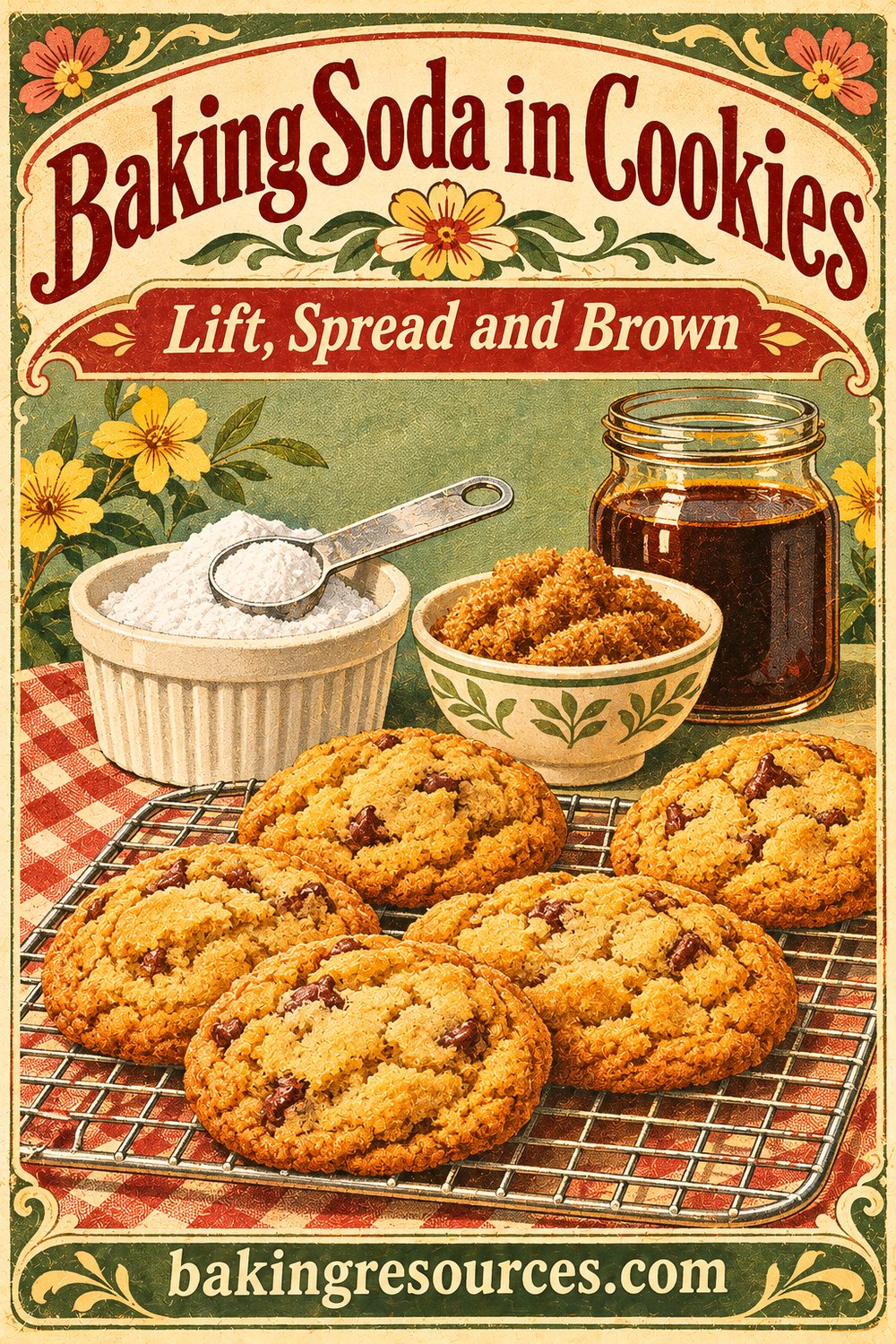
What Does Baking Soda Do in Cookies?
Free calculator from Baking Resources
Baking Soda for Cookies
Pick your flour amount and the acid in the dough.
Need more? Open the free Ingredient Weight Chart.
More free baking tools



Want more options? Open the full ingredient weight chart.
- Baking soda is sodium bicarbonate. It needs an acid to work.
- Use 1/4 to 1/2 tsp per cup of flour (125 g); 1 tsp is about 4.6 g.
- A typical cookie recipe with 2 1/4 cups of flour uses 1 tsp.
- It makes cookies brown faster and spread wider than baking powder alone.
- No acid in the dough? Use 3 tsp baking powder for every 1 tsp of baking soda.
- Test freshness: 1/2 tsp in 1 tbsp of vinegar should fizz at once.
You are standing at the counter, the recipe says 1 teaspoon of baking soda, and you wonder what it does in cookies anyway. What does baking soda do in cookies, and what happens if you use more, less or none? Here is the plain answer, with numbers you can use tonight.
What does baking soda do in cookies?
Baking soda does four jobs in cookies: it gives a little lift, helps the cookies spread, speeds up browning and keeps the texture tender. It makes these things happen by reacting with an acid in the dough, which releases small bubbles of carbon dioxide.
- Lift. The gas bubbles puff the dough up a little before it sets. Cookies need less lift than cakes, so the amount is small.
- Spread. Baking soda lowers the acidity of the dough. The dough stays loose longer in the oven, so the cookie spreads before it sets.
- Browning. A less acidic dough browns faster and deeper. That is why soda cookies get golden edges and a toasty, caramel taste.
- Tenderness. The reaction weakens the gluten a little, so the cookies are softer to bite.
Baking soda is also called sodium bicarbonate or bicarbonate of soda. In American recipes, “soda” always means this white powder, not soda water.
Why do cookies need an acid for baking soda to work?
Baking soda is a base, so it only makes gas when it meets an acid. In cookies the acid is usually hiding in a familiar ingredient, so you do not have to add anything extra.
| Ingredient | Acid level | What it does with soda |
|---|---|---|
| Brown sugar (light or dark) | Mildly acidic | Reacts, helps brown and soften |
| Molasses | Acidic | Reacts strongly; gives dark, soft cookies |
| Buttermilk, yogurt, sour cream | Acidic | Reacts well; 1/2 tsp soda per 1 cup |
| Natural cocoa powder | Acidic | Reacts; Dutch-process cocoa does not |
| Honey | Mildly acidic | Reacts a little; browns fast |
| Lemon juice or vinegar | Strongly acidic | Reacts at once; mix fast and bake right away |
| White sugar, butter, flour | Not acidic | No reaction on their own |
A handy rule of thumb: 1/2 teaspoon of baking soda neutralizes about 1 cup of buttermilk or yogurt. In a cookie recipe the acid amounts are small, which is why the soda amount is small too. If you want the full science, read baking soda vs baking powder and our short page on what leavening means.
How much baking soda do you put in cookies?
Use 1/4 to 1/2 teaspoon of baking soda per cup of flour (125 g), which is about 1 to 2 grams per 125 g of flour. That is what most classic cookie recipes use. Here is the range for common batch sizes.
| Flour (cups) | Flour (grams, 125 g per cup) | Baking soda (tsp) | Baking soda (grams, about 4.6 g per tsp) |
|---|---|---|---|
| 1 1/2 cups | 188 g | 3/8 tsp to 3/4 tsp | 1.7 to 3.4 g |
| 2 cups | 250 g | 1/2 tsp to 1 tsp | 2.3 to 4.6 g |
| 2 1/4 cups | 281 g | 1/2 tsp to 1 1/8 tsp | 2.3 to 5.2 g |
| 2 3/4 cups | 344 g | 3/4 tsp to 1 3/8 tsp | 3.4 to 6.3 g |
| 3 cups | 375 g | 3/4 tsp to 1 1/2 tsp | 3.4 to 6.9 g |
Level the spoon with a knife. A heaping teaspoon can hold up to double the amount, and that is the usual cause of soapy cookies.
A worked example: a recipe with 2 1/4 cups of flour (281 g) and brown sugar calls for 1 teaspoon of baking soda. That is 0.44 teaspoon per cup, in the middle of the range. If you double or halve the batch, scale the soda with the flour, and the recipe converter will do the math for you.
What happens if you use too much baking soda in cookies?
Too much baking soda makes cookies taste soapy or metallic, turns them dark yellow-brown and makes them spread too thin. The soda that is left over has no acid to react with, so it stays in the cookie and tastes bitter.
| Amount of baking soda | What you get |
|---|---|
| Too little | Pale, dense, puffy cookies that barely spread |
| About right (1/4 to 1/2 tsp per cup of flour) | Golden edges, soft middle, gentle spread |
| Too much | Soapy or metallic taste, dark yellow-brown color, flat cookies with coarse holes |
If you are worried you already added too much, here is what helps:
- Double the rest of the dough if you still can. That brings the soda back to a normal ratio.
- Bake one test cookie and taste it before you bake the whole tray.
- If it tastes soapy, add a little more brown sugar and flour to the dough, and chill it before baking.
What happens if you leave baking soda out of cookies?
Cookies without baking soda are paler, puffier and denser, and they spread much less. They also taste less toasty because the dough browns less.
If the recipe also has baking powder, the cookies will still rise. If the recipe has only baking soda and you leave it out, you get a heavy, flat-topped biscuit-like cookie. You can fix it: add 3 teaspoons of baking powder for each teaspoon of baking soda that was called for. The baking powder substitute page and baking soda substitute page cover other swaps, including a low-sodium option.
Does baking soda make cookies chewy or crispy?
Baking soda makes the edges crisp and the cookie wide, and the center stays chewy when the dough has a lot of brown sugar. The texture also depends on butter, sugar and bake time.
Think of it as a dial. More soda gives a thinner, crisper, browner cookie. Less soda gives a thicker, softer, paler one. If you want puffy, cakey cookies, use baking powder in place of some or all of the soda. Our guide to chewy vs crispy cookies shows how to tune the dial, and why are my cookies not spreading helps when the cookies stay too tall.
How do you use baking soda so cookies turn out right?
To use baking soda well, measure it with a level spoon, whisk it into the dry ingredients and bake soon after mixing. Follow these steps:
- Level the spoon. Scrape the top with a knife. Never use a heaping spoon.
- Whisk it into the flour. This spreads the soda evenly so there are no bitter pockets. If it looks lumpy, press it through a fine sieve.
- Mix the wet and dry quickly. The reaction begins when the soda meets the liquid.
- Do not leave the dough on the counter for hours. Bake it within about 30 minutes at room temperature, or chill it. Chilled dough reacts slowly, and most of the lift happens in the oven.
- Preheat the oven fully. The gas works best when the heat sets the cookie quickly.
Our how to measure ingredients page has more on spoons and scales, and how to stop cookies spreading helps if your soda cookies go too thin.
Does baking soda go bad?
Yes. Baking soda loses its strength slowly, and old soda makes weaker cookies. Unopened boxes last about 2 years, and an opened box is best within 6 months to a year.
Test it in 10 seconds: stir 1/2 teaspoon of baking soda into 1 tablespoon of vinegar. If it fizzes right away, it is good. If it barely bubbles, replace it. Keep it in a tightly closed jar, away from strong smells like onions, because it absorbs odors. For baking powder, which fades faster, see how long baking powder lasts.
Troubleshooting: what to do if your cookies go wrong
- Cookies spread too thin: too much soda or warm dough. Cut the soda by 1/4 teaspoon and chill the dough 30 minutes.
- Cookies are pale and puffy: too little soda, or old soda. Test it with vinegar.
- Soapy taste: too much soda. Measure with a level spoon.
- Cookies look dark yellow: too much soda or an overbaked batch. Lower the soda and watch the time.
- Cookies are hard: usually overbaking rather than soda. See why are my cookies hard.
- Holes and coarse crumb: too much gas made big bubbles that burst. Use less soda.
What does baking soda do in other cookie recipes?
In molasses, gingerbread, oatmeal and chocolate chip cookies, baking soda does the same four jobs, but the amount changes with the acid. Molasses cookies have more acid and need a little more soda to balance it, while a shortbread has no acid and uses none.
You can see baking soda at work in our molasses cookies recipe, a classic home for soda because molasses is acidic, and in our chocolate chip cookies recipe, where the brown sugar and soda give golden edges. Compare those with shortbread cookies, which have no acidic ingredient and are meant to stay dense and crumbly.
Quick reference: baking soda in cookies
| Question | Answer |
|---|---|
| What it does | Lifts, spreads, browns and tenderizes cookies |
| How much | 1/4 to 1/2 tsp per cup of flour (125 g) |
| Typical 2 1/4 cup cookie recipe | 1/2 to 1 tsp |
| Needs an acid? | Yes: brown sugar, molasses, buttermilk, natural cocoa |
| No acid in the recipe? | Use baking powder, 3 tsp per 1 tsp of soda |
| Too much? | Soapy taste, yellow color, flat cookies |
| Freshness test | 1/2 tsp in 1 tbsp vinegar should fizz at once |
| Best habit | Mix evenly and bake soon after mixing |
Need to convert an amount? Try the baking substitutions tool or the kitchen conversion calculator.
Frequently asked questions
What does baking soda do in cookies?
Baking soda makes cookies rise a little, spread wider, brown faster and turn out tender. It does this by reacting with an acid such as brown sugar, which releases carbon dioxide gas and raises the pH of the dough.
What does baking soda do to cookies if you leave it out?
The cookies come out pale, dense and puffy, and they spread less. They also taste a bit flat because they brown less. If the recipe has baking powder instead, that is usually fine.
Does baking soda make cookies chewy or crispy?
It does both, depending on the rest of the recipe. It helps edges brown and crisp, while a higher brown sugar share keeps the center soft and chewy. See chewy vs crispy cookies for the full picture.
How much baking soda do I put in cookies?
Use 1/4 to 1/2 teaspoon per cup of flour (125 g). A typical recipe with 2 1/4 cups of flour uses 1 teaspoon. Do not add more than the recipe asks for.
Can I use baking powder instead of baking soda in cookies?
Yes. Use 3 teaspoons of baking powder for every 1 teaspoon of baking soda. The cookies will be a little puffier and paler. Our baking soda substitute guide has the details.
Why do my cookies taste soapy or metallic?
You used too much baking soda, or it was not mixed in evenly. The extra soda has no acid to react with, and it leaves a bitter, soapy taste. Reduce the amount and whisk it into the flour.
Does baking soda go bad?
Yes. It loses strength slowly. Test it by stirring 1/2 teaspoon into 1 tablespoon of vinegar; it should fizz right away. Keep it in a sealed container, away from strong smells.
Why do cookies spread more with baking soda?
Baking soda makes dough less acidic. A higher pH keeps the dough runny longer in the oven, so the cookies spread before they set. That is why a cookie with soda is flatter than one with baking powder only. See why are my cookies flat if yours spread too much.