How Much Frosting for a Bundt Cake? (Glaze vs Frosting)
Free calculator from Baking Resources
How Much Frosting for a Bundt Cake?
Pick your bundt pan size and how you want to finish the cake.
Need more? Open the free Frosting Calculator.
More free baking tools


Want more options? Open the full Frosting Calculator.
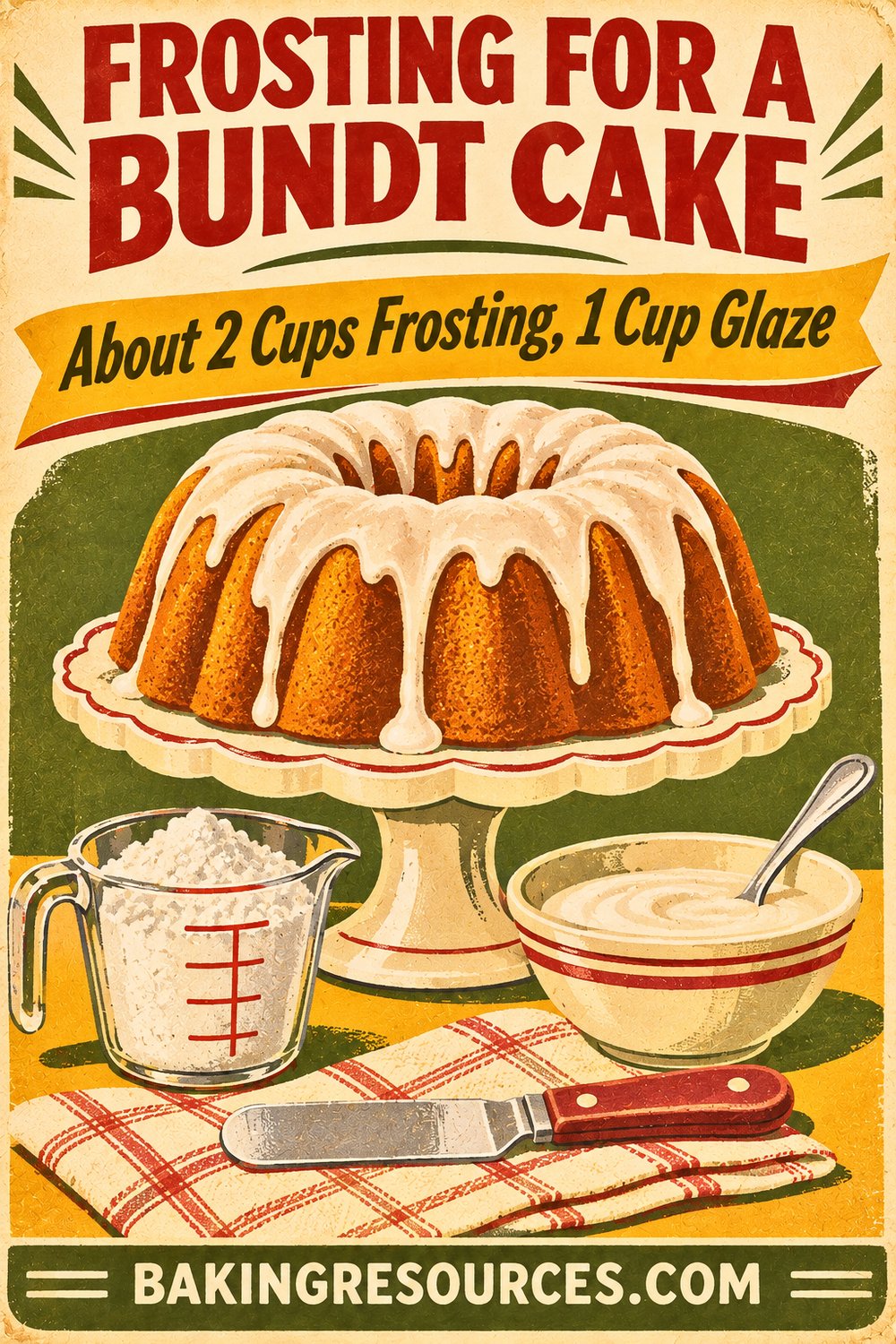
- A standard 12-cup bundt cake takes about 2 cups (480 ml) of frosting on the top and sides, or about 1 cup (240 ml) of glaze for a full pour.
- A light glaze drizzle for a 12-cup bundt needs only about 1/2 cup (120 ml), made from 1 cup (120 g) of powdered sugar and about 2 1/2 tablespoons of milk.
- One batch of American buttercream (1 cup butter and 4 cups powdered sugar) makes about 3 cups, which covers a 12-cup bundt with some left over.
- Bundt pans are sold by capacity: 6, 10, 12 and 15 cups are the common sizes, and surface area grows slower than volume.
- Glaze is pourable and thin, about 1/16 inch thick. Frosting is spreadable and thick, about 1/6 to 1/5 inch.
- Let the cake cool completely, at least 1 1/2 to 2 hours out of the pan, before frosting. Glaze can go on while the cake is still slightly warm.
A bundt cake looks like it should need a lot of frosting, but it does not. The surface is mostly ridges and curves, and a bundt is meant to wear a light coat so the shape shows. Most people end up making twice as much topping as they need. The calculator above gives a number for your pan. The rest of this page explains where that number comes from, so you can adjust it for your own cake.
How much frosting do you need for a bundt cake?
A 12-cup bundt cake needs about 2 cups (480 ml) of frosting to cover the top and sides, and about 3 1/2 cups (830 ml) if you want a thick coat over every surface, including the center ring. A glaze needs far less: about 1 cup (240 ml) for a full coat and 1/2 cup (120 ml) for a drizzle.
These numbers come from surface area. A 12-cup bundt is about 10 inches (25 cm) across and 3 3/4 inches (9.5 cm) deep, and the pan’s flutes add roughly 20 percent more surface than a smooth cake that size. That adds up to about 250 square inches of cake skin. Spread at about 1/6 inch thick, the outer surfaces take a little under 2 cups. The Baking Resources frosting calculator uses the same thickness idea for layer cakes: surface area times coat thickness.
| Bundt pan size | Light drizzle of glaze | Full glaze coat | Frosting, top and sides | Thick frosting everywhere |
|---|---|---|---|---|
| Mini bundt (1 cup) | 1 1/2 tbsp | 3 tbsp | 1/3 cup | 2/3 cup |
| 6-cup bundt | 1/3 cup | 2/3 cup | 1 1/4 cups | 2 1/4 cups |
| 10-cup bundt | 1/2 cup | 3/4 to 1 cup | 1 3/4 cups | 3 cups |
| 12-cup bundt (standard) | 1/2 cup | 1 cup | 2 cups | 3 1/2 cups |
| 15-cup bundt | 2/3 cup | 1 1/4 cups | 2 1/4 cups | 4 cups |
Not sure which pan you own? Fill it with water, one cup at a time, until it reaches the rim. The number you reach is your pan size. Our bundt pan sizes and capacities chart lists the diameter and depth of each size.
Should you use glaze or frosting on a bundt cake?
For most bundt cakes, glaze is the better fit: it sets in a thin shell, follows every ridge and uses about half as much topping as frosting. Frosting makes sense when you want a thick, soft coat, such as cream cheese frosting on a carrot or spice bundt, or when the cake will be served as a celebration cake.
| Topping | Texture | Typical thickness | Amount for a 12-cup bundt | Best on |
|---|---|---|---|---|
| Powdered sugar glaze | Pourable, sets firm | About 1/16 in (1.5 mm) | 1/2 to 1 cup | Lemon, vanilla, orange, almond, poppy seed |
| Chocolate ganache glaze (1:1) | Pourable, sets soft and glossy | About 1/8 in (3 mm) | 3/4 to 1 cup | Chocolate, coffee, red velvet |
| Cream cheese frosting | Thick, spreadable, stays soft | About 1/6 in (4 mm) | 2 cups | Carrot, pumpkin, spice, banana |
| American buttercream | Thick, forms a light crust | About 1/6 in (4 mm) | 2 cups | Vanilla, chocolate, funfetti |
A good rule: if the cake is already rich, glaze it. If the cake is plain and light, a thicker frosting gives it a second job. For a deeper look at how thick frosting needs to be on flat cakes, see how to frost a cake smoothly.
How much glaze do you need for a bundt cake?
For a standard 12-cup bundt, make about 1 cup of glaze for full coverage: 2 cups (240 g) of powdered sugar and about 5 tablespoons (75 ml) of milk. For a lighter drizzle, halve that. One cup of powdered sugar and 2 1/2 tablespoons of milk makes about 1/2 cup of glaze.
Glaze is a ratio, not a recipe. The only thing that changes is how thick it is, and thickness decides how it behaves:
- Thick glaze (1 cup sugar to about 2 tablespoons liquid): falls off a spoon in a slow ribbon. It makes distinct drips and stays where you put it.
- Medium glaze (1 cup sugar to about 2 1/2 tablespoons liquid): coats the back of a spoon. This is the one for a full pour.
- Thin glaze (1 cup sugar to 3 tablespoons liquid or more): runs like heavy cream and soaks into the cake. It sets as a see-through shine.
Add liquid a teaspoon at a time. Powdered sugar thins fast, and a few extra drops can ruin the texture. If you go too far, stir in another spoonful of sugar. For more on getting glaze and icing to the right consistency, see our guide to icing consistency and what to do when frosting turns runny.
How much chocolate ganache for a bundt cake?
A 12-cup bundt takes about 3/4 cup of 1:1 ganache for a glossy pour over the top: 4 ounces (113 g) of chopped chocolate melted into 4 ounces (113 g, about 1/2 cup) of warm cream makes just under 3/4 cup. Make 1 1/2 times that if you want drips running down the whole side.
The 1:1 ratio, by weight, gives a pourable ganache that sets soft. Let it cool to about 90°F (32°C), thick like warm honey, before pouring. Pour onto a cake that is fully cool, or it will slide off. Our ganache ratio guide covers 1:1, 2:1 and 3:1 and what each one is for, and the drip effect guide shows how to get neat drips.
How to frost a bundt cake
To frost a bundt cake, cool it completely, set it on a plate or rack, then spread frosting over the top and down the sides with an offset spatula, working in a thin first layer and a second layer where you want more. You do not need a crumb coat for a bundt, because the cake is baked in one piece and has few loose crumbs.
- Cool the cake. Let it rest in the pan for 10 to 15 minutes, turn it out onto a rack, and cool for at least 1 1/2 hours until no warmth is left in the center. If you need help with release, our guide to getting a bundt cake out of the pan covers it.
- Trim and level the base if needed. The wide, flat side of a bundt cake is its base. If the cake domed in the pan and the base is uneven, slice off the dome with a serrated knife so it sits flat on the plate.
- Tuck parchment strips under the edges. Slide four strips of parchment paper under the cake so drips land on the paper, not the plate. Pull them out when you are done.
- Start with a thin coat. Spread a thin layer of frosting over the top and sides. Let it fill the grooves. This is your base coat, and it does not need to look perfect.
- Add the final layer. Add the rest of the frosting in generous scoops on the wide top ring, then smooth outward and downward. Use the back of a spoon to press frosting into the deep flutes.
- Finish. Wipe the plate edge with a damp paper towel, pull out the parchment, and chill the cake for 15 minutes if it will be moved.
If you want a smoother surface, a bench scraper does not work well on a fluted bundt. Use a small offset spatula dipped in warm water and wiped dry. For general frosting technique, our buttercream guide also explains how temperature affects spreading.
How to ice a bundt cake so it does not slide off
To ice a bundt cake without the icing sliding off, make sure the cake is fully cooled and the glaze is thick enough to coat a spoon. Warm cake melts glaze into a thin puddle, and glaze that is too thin runs straight to the plate.
Use this quick test before you pour: lift your spoon out of the bowl and let the glaze fall back. If it makes a ribbon that stays on top for 2 to 3 seconds before melting in, it is the right thickness. If it disappears at once, add powdered sugar, a spoonful at a time.
A few more tricks help:
- Chill first. A cake that sat in the fridge for 30 minutes holds glaze better, because the cold surface sets the glaze fast.
- Pour on the high point. Pour onto the top ridge and let gravity pull it down in streaks. Do not pour into the center hole.
- Use a spoon for control. For neat drips, drag the spoon along the edge so the glaze overflows one spot at a time.
For a warm, soaked-in glaze, such as a lemon or orange glaze, the opposite rule applies: pour it while the cake is still slightly warm, and it sinks in for a moist finish. That works for thin glazes only. Anything thick, and all frostings, need a cool cake. If the frosting itself is the problem, see how to keep buttercream from melting.
Worked examples: how much to make
Example 1: A lemon bundt for a brunch. You have a 12-cup bundt and want a full glaze. The calculator says about 1 cup. Make 2 cups (240 g) of powdered sugar, mixed with about 5 tablespoons (75 ml) of lemon juice and milk. That gives you about 1 cup of glaze, with a little left over in the bowl.
Example 2: A spice bundt with cream cheese frosting. A 10-cup bundt takes about 1 3/4 cups for the top and sides. One batch of cream cheese frosting made with 4 cups of powdered sugar makes about 3 cups, so you will have more than you need. Make a 3/4 batch, which needs about 3 cups (360 g) of powdered sugar and 3/4 of the butter and cream cheese, and you should end up with about 2 1/4 cups. That covers the cake with a small amount to spare.
The general rule: powdered sugar frosting needs about 1 1/3 cups of powdered sugar for every cup of frosting you want, and 1 stick (1/2 cup) of butter per 2 cups of sugar. If you want help scaling ingredients, our butter converter turns sticks into cups, tablespoons and grams (113 g per stick).
Can you frost a bundt cake ahead of time?
Yes, you can frost a bundt cake up to 1 day ahead with buttercream or glaze, and up to 2 days ahead if you keep cream cheese frosting refrigerated. Store it in a covered cake carrier or under a large inverted bowl so the topping does not smudge.
- Glazed bundt: Keep it covered at room temperature for up to 2 days. The glaze may turn slightly sticky or cracked after the first day, but it still tastes the same.
- Buttercream-frosted bundt: Room temperature for 1 day in a cool kitchen. Refrigerate if it is warm or if the room is above about 75°F (24°C). Let the cake sit out for 30 minutes before serving.
- Cream cheese frosting: Refrigerate. Cream cheese frosting should not sit out for more than 2 hours, according to general food safety guidance.
- Freezing: Freeze the plain cake, wrapped tightly, and glaze it after thawing. Our guides to freezing cake and storing cake give the times.
Leftover frosting keeps well. See how to store frosting for fridge and freezer times.
Common mistakes with bundt cake frosting
- Making a full batch every time. A standard buttercream batch is about 3 cups, which is 50 percent more than a 12-cup bundt needs. Scale down.
- Frosting a warm cake. The frosting melts and slides off. Wait until the cake feels cool to the touch all the way through.
- Using a glaze that is too thin. It disappears into the cake and leaves a wet patch. Thicken it with powdered sugar.
Quick reference: bundt frosting and glaze amounts
| Pan size | Glaze, full coat (cups / ml) | Powdered sugar for glaze (cups / g) | Frosting, top and sides (cups / ml) | Powdered sugar for frosting (cups / g) |
|---|---|---|---|---|
| Mini (1 cup) | 3 tbsp / 45 ml | 6 tbsp / 45 g | 1/3 cup / 80 ml | 1/2 cup / 55 g |
| 6-cup | 2/3 cup / 160 ml | 1 1/3 cups / 160 g | 1 1/4 cups / 300 ml | 1 2/3 cups / 200 g |
| 10-cup | 3/4 to 1 cup / 180 to 240 ml | 1 1/2 to 2 cups / 180 to 240 g | 1 3/4 cups / 420 ml | 2 1/3 cups / 280 g |
| 12-cup | 1 cup / 240 ml | 2 cups / 240 g | 2 cups / 480 ml | 2 2/3 cups / 320 g |
| 15-cup | 1 1/4 cups / 300 ml | 2 1/2 cups / 300 g | 2 1/4 cups / 530 ml | 3 cups / 360 g |
Powdered sugar is measured as 120 g per cup, spooned and leveled. For help with other pans, see the cake pan converter, and for layer cakes use the frosting calculator. If you are working from a cream cheese frosting recipe or a chocolate frosting recipe, check its yield in cups and compare it to the table.
Frequently asked questions
How much frosting do I need for a 12-cup bundt cake?
About 2 cups (480 ml) covers the top and sides. A thick coat over every surface takes about 3 1/2 cups. A glaze needs only about 1 cup for a full pour.
Is one can of frosting enough for a bundt cake?
A standard 16-ounce can holds about 1 3/4 cups. That is enough for a 10-cup bundt, but a little short for a 12-cup bundt, which needs about 2 cups. Buy two cans for a 12-cup or larger pan, or choose a glaze instead.
How do you frost a bundt cake without it falling apart?
Cool it completely first. A warm cake is soft, and spreading frosting over it pulls crumbs away. A cold cake from the fridge is even easier to frost, since it is firm.
How do you ice a bundt cake neatly?
Use a glaze that coats a spoon, pour it onto the top ridge, and let it run down the sides on its own. Do not spread it with a knife. A rack over a sheet pan catches the extra.
Can you use buttercream on a bundt cake?
Yes. Use a small offset spatula and press the buttercream into the flutes in two thin passes, rather than one thick one. Buttercream suits sturdy cakes best, such as chocolate, spice or vanilla.
How much powdered sugar do I need for bundt cake glaze?
Plan on 2 cups (240 g) of powdered sugar for a full 1-cup glaze on a 12-cup bundt, or 1 cup (120 g) for a light drizzle. Mix with 2 1/2 tablespoons of milk or juice per cup of sugar, then adjust a teaspoon at a time.
How long does a glazed bundt cake stay fresh?
A glazed bundt keeps for 2 to 3 days at room temperature, covered. Cream cheese frosted bundt cakes should go in the fridge and are best within 3 to 4 days.