
How Long to Bake Cheesecake, With or Without a Water Bath

A 9 inch cheesecake bakes at 325°F for 60 to 75 minutes in a water bath, or about 50 to 65 minutes without one. It is done when the center reads about 150°F and the middle 2 to 3 inches still wobble like gelatin while the outer ring looks set. Then it needs an hour in the turned-off oven and a night in the fridge.
Cheesecake is a custard, not a cake, so the usual cake rules do not apply. It bakes low and slow, a toothpick tells you nothing useful, and it is supposed to look underdone when you take it out. The pan size and baking method change the clock the most. Pick both in the calculator below to see your time and exactly what done looks like.
Free calculator
Cheesecake bake time calculator
Pick your pan and how you are baking it to see the time, the oven temperature and the doneness check.
More free baking tools


Cheesecake bake times at a glance
These times are for a classic baked cream cheese filling, about 2 1/2 to 3 inches deep in a springform pan, on a graham cracker crust. Start checking at the low number.
| Pan | Water bath, 325°F | No water bath, 325°F | Low and slow, 300°F, no bath | Wobble when done |
|---|---|---|---|---|
| 6 inch springform | 40 to 50 minutes | 35 to 45 minutes | 45 to 55 minutes | 1 1/2 to 2 inches |
| 8 inch springform | 50 to 65 minutes | 45 to 55 minutes | 55 to 70 minutes | About 2 inches |
| 9 inch springform | 60 to 75 minutes | 50 to 65 minutes | 65 to 80 minutes | 2 to 3 inches |
| 10 inch springform | 70 to 90 minutes | 60 to 75 minutes | 80 to 100 minutes | About 3 inches |
| 9x13 cheesecake bars | 40 to 50 minutes | 35 to 45 minutes | 40 to 50 minutes | About 1 inch |
| Mini, in a muffin tin | 20 to 25 minutes | 18 to 22 minutes | 22 to 27 minutes | Slight jiggle |
Every one of these finishes the same way: the center reaches about 150°F. The time is only how long it takes your oven and pan to get it there. If the recipe was written for one pan and you are using another, the springform pan sizes chart shows how much filling each one holds, and the baking time calculator adjusts the time for the change in depth.
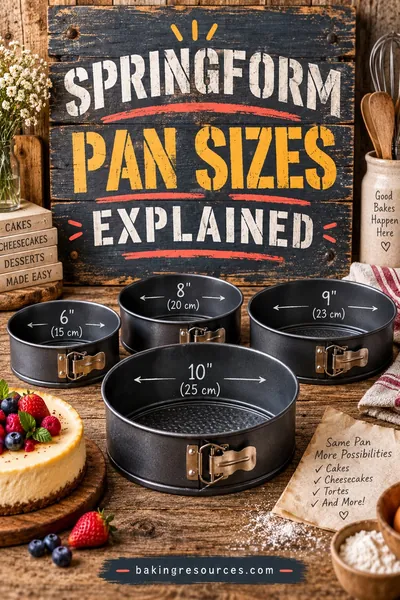 Baking guideSpringform Pan Sizes Explained: Capacity ChartCheck the pan chart →
 Free toolBaking Time Calculator: New Pan, New TimeTry the calculator →
After the bake, plan on another hour cooling in the turned-off oven, an hour or two on the counter, and at least 6 hours in the fridge, ideally overnight. From mixing bowl to slicing, a cheesecake is a day-long project, and most of that time is hands-off.
Why cheesecake bakes low and slow
A baked cheesecake is cream cheese, sugar and eggs, often with sour cream or heavy cream. There is little or no flour. What holds it together is egg protein, the same thing that sets a custard or a pumpkin pie.
Egg proteins set gently in a narrow window. Around 150°F in the center, the filling holds its shape once cold but is still smooth and creamy. Push the center much past about 165°F and the proteins tighten, squeeze out moisture, and give you a dry, grainy texture, a sunken middle and cracks.
The challenge is that the outside of the cheesecake heats long before the middle. In a hot oven the edges overshoot while the center is still liquid. A low oven, around 300 to 325°F, gives the heat time to reach the center while the edges stay below the danger point. That is also why cheesecake takes so much longer than a cake of the same size.
Water bath, no water bath, or a low oven?
There are three common ways to bake a cheesecake. All three work. They trade convenience for evenness.
| Method | How it works | 9 inch time | Best for | Downside |
|---|---|---|---|---|
| Water bath at 325°F | The pan sits in hot water, which keeps the sides from going much above the temperature of simmering water | 60 to 75 minutes | Tall New York style, smooth tops, fewer cracks | Wrapping the pan, risk of leaks |
| No water bath at 325°F | The pan sits straight on the rack | 50 to 65 minutes | Shorter cheesecakes, bars, quick weeknight bakes | Edges set faster, more cracking and browning |
| Low and slow at 300°F, no bath | A cooler oven narrows the gap between edge and center | 65 to 80 minutes | Even texture without the hassle of a bath | Longer bake |
Why a water bath is faster than you would expect
You might think water would slow things down. It does protect the edges, but water also moves heat into the pan very efficiently, and the steam keeps the top from drying out. The bath version lands about 10 minutes longer than the dry version at the same oven setting, and in exchange it bakes much more evenly.
Setting up a water bath
- Wrap the outside of the springform in two layers of heavy-duty foil, or set it inside a slightly larger cake pan or an oven bag, so no water seeps in.
- Set the wrapped pan in a roasting pan and put both on the middle rack.
- Pour hot tap water into the roasting pan until it comes about 1 inch up the sides.
- Bake, then lift the cheesecake out of the water before the cool-down so the crust does not sit in damp foil.
A simpler middle ground: skip the bath and set a pan of hot water on the rack below. You get the steam, which helps prevent a dry, cracked top, without the leak risk. Time it like the no-bath version and add 5 minutes. For more crack-proofing tricks, see how to prevent cheesecake from cracking.
 Baking guideHow to Prevent Cheesecake From Cracking Every TimeSee how it's done →
How pan size and depth change the time
Cheesecake is thick, and the center is a long way from any hot surface. Each step up in pan size adds both width and, often, depth, so the time climbs quickly.
- 6 inch: about half of a 9 inch recipe. With a shorter path to the middle, it bakes in 40 to 50 minutes in a bath.
- 8 inch: if you use a recipe written for an 8 inch, 50 to 65 minutes. If you pour a full 9 inch recipe into it, the filling stands about 25 percent taller, so add 10 to 15 minutes and make sure the pan sides are at least 3 inches high.
- 9 inch: the standard. A typical recipe with 32 ounces of cream cheese fills it about 2 1/2 to 3 inches deep.
- 10 inch: larger recipes, often 40 ounces of cream cheese, and the longest bake at 70 to 90 minutes in a bath.
- 9x13 bars: the filling is only 1 to 1 1/2 inches deep, so it bakes in 35 to 45 minutes and rarely needs a bath.
- Minis: standard muffin cups lined with paper or foil liners, each with a cookie or crumb base, bake in about 18 to 22 minutes.
No springform? A deep cake pan lined with a parchment sling, or a 9 inch pie plate for a shallower cheesecake, can work. A cheesecake in a pie plate is about the depth of bars, so it bakes in about 35 to 45 minutes at 325°F. More options are in what to use instead of a springform pan.
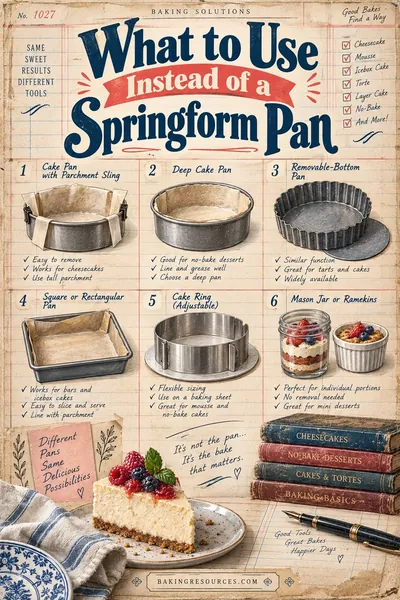 Baking guideWhat to Use Instead of a Springform Pan: 5 Real SwapsFind my swap →
Dark, light and glass pans
Most springform pans are either light aluminum or dark nonstick. The difference matters less with a water bath, because the water controls the side temperature. Without a bath, it matters a lot.
Light metal springform
Bakes evenly with the least browning at the edges. Recipe times are generally written for it.
Dark nonstick springform
Absorbs more heat, so the sides and crust brown faster. Without a water bath, lower the oven to 300°F, which is the same as the low and slow method, or start checking 5 to 10 minutes early at 325°F. In a water bath, bake as written but check about 5 minutes early.
Glass pie plate or ceramic dish
Glass heats slowly and then holds heat, so cheesecakes in glass keep cooking after they come out. Bake at 300 to 325°F, pull the cheesecake as soon as it reaches 150°F with a wobble in the center, and let it cool on the counter rather than in the oven.
Oven temperature and convection
Most recipes call for 325°F, some for 300°F, and a few start hot and then drop. Here is how each changes the bake.
- 300°F: about 15 minutes longer than 325°F without a bath for a 9 inch, with a more even, creamy texture from edge to center.
- 325°F: the most common setting, with or without a bath.
- 350°F: faster, but the edges puff and brown and the risk of cracks goes up. If a recipe uses 350°F, a water bath is worth the trouble.
- Hot start: some New York recipes bake 10 minutes at 500°F to brown the top, then drop to 200°F for about an hour. Follow those recipes exactly, since the times are built around the drop.
Convection and cheesecake do not mix well. The fan dries the surface and sets the top quickly, which leads to cracks and a browned skin. If you can switch the fan off, do. If you cannot, lower the temperature by 25°F, use a water bath, and start checking 10 minutes early. The convection vs conventional oven guide explains why, and the oven temperature conversion chart covers recipes in Celsius or gas marks.
 Baking guideConvection vs Conventional Oven: When to Use WhichRead it next →
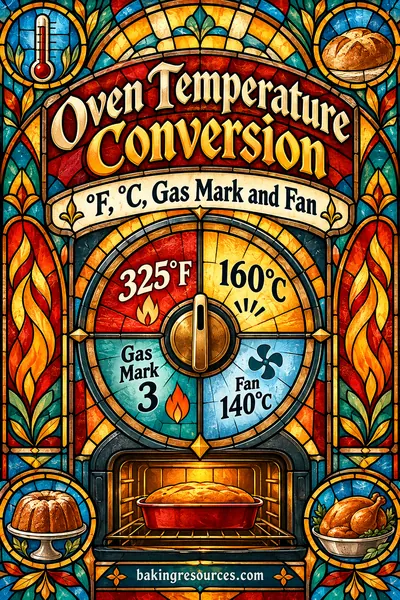 Free toolOven Temperature Conversion: °F, °C, Gas Mark and FanConvert it now →
How to tell when cheesecake is done
A done cheesecake looks underdone. That is the hardest part for most bakers, and the reason so many come out dry and cracked. Use these checks together.
Internal temperature: about 150°F
An instant-read thermometer in the center, pushed about halfway down, is the clearest test. Aim for about 150°F, and anywhere from about 147 to 155°F is a good place to stop. Go in from the side of the wobbly center so the tiny hole is easy to hide, or just accept it; it disappears under a topping.
The jiggle test
Wearing oven mitts, give the pan a gentle nudge. The outer ring should look set and barely move. The middle 2 to 3 inches of a 9 inch cheesecake should wobble together, like set gelatin. If the whole top ripples in waves, it needs more time. If nothing moves at all, it is overbaked.
The edges and surface
The edges look set, matte and slightly puffed, and may be just barely golden. The surface has lost its wet shine everywhere except the center circle.
What not to use
A toothpick or knife comes out creamy from a perfectly done cheesecake, so it is no help. Waiting for the center to look firm means you have gone well past 150°F. For every sign in more detail, see how to tell when cheesecake is done.
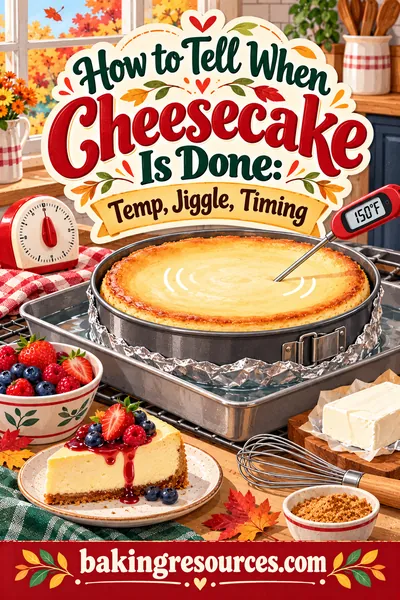 Baking guideHow to Tell When Cheesecake Is Done: Temp, Jiggle, TimingSee the doneness test →
The cool-down is part of the bake
The center keeps rising a few degrees and setting as it cools. A slow cool-down prevents the sudden shrinking that causes cracks and keeps the texture smooth.
- In the oven, 1 hour: turn the oven off, crack the door open a few inches, and leave the cheesecake inside for about an hour. Lift it out of the water bath first if you used one.
- Run a knife around the edge: once you take it out, slide a thin knife around the inside of the pan so the cheesecake can shrink without tearing.
- On the counter, 1 to 2 hours: let it cool on a rack until it is close to room temperature. Do not leave it out longer than 2 hours total once it is out of the oven; it is a dairy and egg dish.
- In the fridge, 6 hours to overnight: chill it uncovered for the first couple of hours, then cover it. It slices cleanly only once it is fully cold.
Baked cheesecake keeps in the fridge for up to 5 days. Wrapped well, it freezes for up to 2 months for best quality; thaw it overnight in the fridge, never on the counter.
Worked example: a 9 inch New York cheesecake
Say you are making a classic New York cheesecake with 32 ounces of cream cheese in a 9 inch springform, baked in a water bath at 325°F. The chart says 60 to 75 minutes.
- Prep the crust: press the graham crust into the pan and bake it at 350°F for about 10 minutes. Let it cool while you lower the oven to 325°F and make the filling.
- Bake: pour the filling over the crust, set up the water bath, and bake. Do not open the door before 55 minutes.
- First check at 55 minutes: the edges look set, but the whole top ripples when you nudge the pan. The thermometer reads about 135°F. Close the door.
- Second check at 65 minutes: the outer ring holds still and the center 4 inches still wobble loosely. About 143°F. Give it 5 more minutes.
- Third check at 70 minutes: the wobbly circle has shrunk to about 2 1/2 inches and moves as one piece. The thermometer reads 150°F. Turn off the oven.
- Cool: 1 hour in the oven with the door cracked, about 1 1/2 hours on the counter, then overnight in the fridge.
Start to finish, that is about 2 hours of oven time and cooling plus an overnight chill. If you are serving it at an evening dinner, bake it the day before. The filling goes smoother when the cream cheese is truly soft, so if yours is cold from the fridge, soften the cream cheese before you start; cold cream cheese makes lumps and traps air that causes cracks.
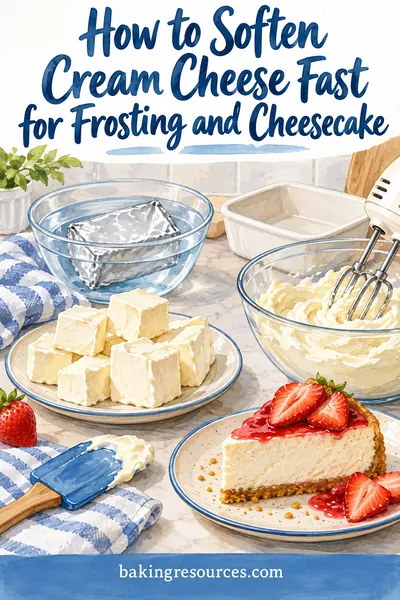 Baking guideHow to Soften Cream Cheese Fast for Frosting and CheesecakeSee how long it keeps →
Flavors and styles that change the time
| Style | 9 inch time and oven | Done when | Why it differs |
|---|---|---|---|
| Classic or New York | 60 to 75 minutes at 325°F, water bath | 150°F, 2 to 3 inch wobble | The baseline |
| Pumpkin cheesecake | 65 to 85 minutes at 325°F, water bath | 150°F, 2 to 3 inch wobble | Pumpkin adds moisture, so it runs 5 to 10 minutes longer |
| Chocolate cheesecake | 60 to 75 minutes at 325°F, water bath | 150°F, slightly smaller wobble | Melted chocolate firms up a lot when cold |
| Lighter, shorter cheesecake (24 oz cream cheese) | 45 to 55 minutes at 325°F, no bath | 150°F, about 2 inch wobble | Less depth to heat through |
| Basque-style burnt cheesecake | 50 to 60 minutes at 400°F, no bath | Very dark top, center very jiggly | Baked hot on purpose for a deeply browned outside and soft, creamy middle |
Swirls and toppings baked onto the cheesecake, like a fruit swirl or a sour cream layer, add a few minutes at most. Toppings added after the chill, like whipped cream or fruit, do not change the bake at all. If you want a quick whipped topping for serving, how to make whipped cream takes about five minutes.
 Baking guideHow to Make Whipped Cream: Cold Cream, Perfect PeaksShow me how →
High altitude cheesecake
Cheesecake handles altitude better than most bakes. There is no baking powder or soda to adjust, and the 150°F target is well below the boiling point of water even at 8,000 feet, so the finish line stays the same.
A few things do change above about 3,000 feet:
- Air bubbles beaten into the filling expand more, so the cheesecake puffs more and then falls and cracks. Mix on low speed and add the eggs last, just until blended.
- Moisture evaporates faster, so the top dries and cracks more easily. A water bath or a pan of water on the lower rack helps more at altitude than at sea level.
- Do not raise the oven temperature the way you would for a cake. Keep it at 300 to 325°F, and go by the thermometer and the wobble. The bake may run a few minutes longer or shorter than the recipe, which is why the check matters more than the clock.
For crusts and other bakes on your holiday table, the high altitude baking chart has the full set of changes by elevation.
 Baking guideHigh Altitude Baking Adjustments: The Chart by ElevationSee the chart →
Common cheesecake timing mistakes
- Baking until the center looks firm. By the time the middle stops wobbling, it is well past 150°F. Pull it while the center still moves.
- Opening the oven too often. Every peek lets out heat and dry air, which lengthens the bake and encourages cracks. Wait until the start of the time window, then check every 5 minutes.
- Using cold ingredients. Cold cream cheese, eggs and sour cream make a lumpy filling that needs more beating, which whips in air, and a cold filling takes longer to bake through. Let them sit out for about an hour first. The reasons are in why room temperature ingredients matter.
- Beating on high speed. Extra air makes the cheesecake puff in the oven and then sink and crack. Mix on low to medium, and stir in the eggs just until blended.
- Skipping the crust prebake. An unbaked crumb crust soaks up moisture from the filling. Bake it at 350°F for 8 to 10 minutes first. If you are making a cookie crust, how many Oreos make a cup of crumbs has the counts.
- The wrong rack. A cheesecake on the top rack browns on top, and one on the bottom rack overcooks the crust. The middle rack is right; see which oven rack to use for why.
- Trusting the oven dial. Many ovens run 15 to 25°F off. At cheesecake temperatures that can add or cut 10 minutes or more. An oven thermometer settles it.
- Cutting it warm. A cheesecake sliced before it is fully chilled looks raw even when it reached 150°F. Give it the full 6 hours or more.
Troubleshooting: raw middle, dry edges, cracks and sinking
Runny or raw in the middle after chilling
The center never reached about 150°F. It happens most with deep pans, a full 9 inch recipe in an 8 inch pan, an oven running cool, or pulling the cheesecake on time instead of by temperature. If you find it right after the bake, put it back at the same temperature and check every 5 minutes. Once it has chilled, it cannot really be rebaked well, but a firm topping or a turn into a frozen dessert can rescue it.
Dry, brown or puffed edges
The edges got too hot. Use a water bath, lower the oven to 300°F, or switch from a dark pan to a light one. Puffed, souffle-like edges that later sink are a sign the oven was too hot or there was too much air in the filling.
Cracks across the top
Overbaking is the number one cause: a center past about 165°F shrinks and splits. The others are too much air whipped into the filling, a dry oven, a sudden temperature change, or a cheesecake stuck to the pan sides as it shrinks. Pull at 150°F, cool slowly in the oven, and loosen the edges with a knife.
Sunk in the middle
A slight dip is normal. A deep one means the cheesecake puffed up from overbaking or too much air and then collapsed as it cooled, or the center was underbaked. A thermometer solves both.
Soggy crust
Water leaked through the foil of a water bath, or the crust was not prebaked. Use two layers of heavy-duty foil or set the springform inside a larger solid pan, and bake the crust 8 to 10 minutes first.
Grainy or curdled texture
The eggs overcooked. Lower the oven, use a water bath, and pull the cheesecake earlier. Lumps of unmixed cream cheese are a different problem: they come from cold cream cheese, so bring it to room temperature first.
Holiday cheesecake planning
Cheesecake is one of the best make-ahead holiday desserts, because it actually needs a day in the fridge. That takes it out of the oven traffic jam on the big day.
Thanksgiving timeline
- Tuesday: bake the cheesecake, check for 150°F and the wobble, cool it in the oven for an hour, then on the counter.
- Tuesday night: chill it uncovered for a few hours, then cover it.
- Thursday: unmold and add toppings a few hours before dessert. Keep it in the fridge until serving, and put leftovers back within 2 hours.
Pumpkin cheesecake works on the same plan. Allow the extra 5 to 10 minutes of bake time and check the center temperature, since pumpkin makes the wobble harder to read.
Christmas and freezing ahead
For Christmas, you can bake two or three weeks ahead and freeze. Chill the cheesecake overnight first, freeze it unwrapped until firm, then wrap it in plastic and foil. Move it to the fridge the night before serving, still wrapped, and add toppings once it is thawed. Plain cheesecake freezes better than one with fruit or whipped cream already on it. If you plan to slice it for a buffet, cut it while it is still partly frozen, wiping a warm knife between cuts, then let the slices thaw in the fridge on a covered tray. Clean slices travel better and you can pull out only as many as the table needs.
Feeding a crowd
A 9 inch cheesecake cuts into 12 to 16 slices, because it is rich. A 9x13 pan of cheesecake bars gives 24 to 32 small squares and bakes in under an hour without a bath, which makes it easier when the oven is busy. If you are planning dessert for a big dinner, the guide to how many pies you need for Christmas dinner helps you count slices across every dessert on the table.
Questions people ask
How long do you bake a cheesecake at 325°F?
A 9 inch cheesecake takes 60 to 75 minutes at 325°F in a water bath, or 50 to 65 minutes without one. A 6 inch takes 40 to 50 minutes in a bath, a 10 inch 70 to 90 minutes, cheesecake bars in a 9x13 about 35 to 45 minutes, and minis in a muffin tin 18 to 22 minutes. Pull it when the center reads about 150°F.
What temperature should the center of a cheesecake be?
About 150°F, measured halfway down in the center with an instant-read thermometer. Anywhere from about 147 to 155°F is a good stopping point. Below 140°F it is still runny and will not set properly in the fridge. Above about 165°F the eggs overcook, which leads to a dry, grainy texture, a sunken middle and cracks.
How much should a cheesecake jiggle when it is done?
For a 9 inch cheesecake, the middle 2 to 3 inches should wobble together like set gelatin when you nudge the pan, while the outer ring stays still. A 6 inch should have a 1 1/2 to 2 inch wobble and a 10 inch about 3 inches. If waves ripple across the whole top, it needs more time. If nothing moves, it is overbaked.
Do I have to use a water bath?
No, but it helps, especially for tall New York style cheesecakes. A water bath keeps the sides from overheating, so the cheesecake bakes evenly, cracks less and stays smooth. Without one, bake at 325°F and check 10 minutes earlier, or use 300°F for a gentler bake. A pan of hot water on the rack below adds steam without the risk of leaks.
Why leave the cheesecake in the oven after turning it off?
A slow cool-down keeps the cheesecake from shrinking suddenly, which is one of the main causes of cracks. The center also keeps setting gently as it cools. Turn off the oven, crack the door a few inches, and leave it inside for about an hour. Then cool it on the counter for 1 to 2 hours and chill it at least 6 hours.
How long does cheesecake need to chill before slicing?
At least 6 hours, and overnight is better. The filling finishes setting as it gets cold, and a cheesecake that has not chilled long enough will look soft and slice messily even when it was baked correctly. Chill it uncovered for the first couple of hours so condensation does not drip on the top, then cover it.
How long does baked cheesecake last in the fridge?
Keep baked cheesecake in the fridge, covered, for up to 5 days. It should not sit at room temperature for more than 2 hours, including serving time, because it is made with eggs and dairy. For longer storage, freeze it well wrapped for up to 2 months for best quality, and thaw it overnight in the fridge rather than on the counter.