How Many Tablespoons in a Stick of Butter?
Free calculator from Baking Resources
Stick of Butter to Tablespoons Calculator
Pick how much butter you have and the unit you want.
Need more? Open the free Butter Converter.
More free baking tools



Want more options? Open the full Butter Converter.
- 1 US stick of butter = 8 tablespoons = 1/2 cup = 4 oz = 113 g.
- 1 tablespoon of butter = 3 teaspoons = 1/2 oz = about 14 g.
- Half a stick = 4 tablespoons = 1/4 cup = 2 oz = 57 g.
- 2 sticks = 16 tablespoons = 1 cup = 8 oz = 227 g.
- 1 lb box = 4 sticks = 32 tablespoons = 2 cups = 454 g.
- A 250 g block of butter is not 2 sticks; it is 23 g (about 1 1/2 tablespoons) more.
How many tablespoons are in a stick of butter?
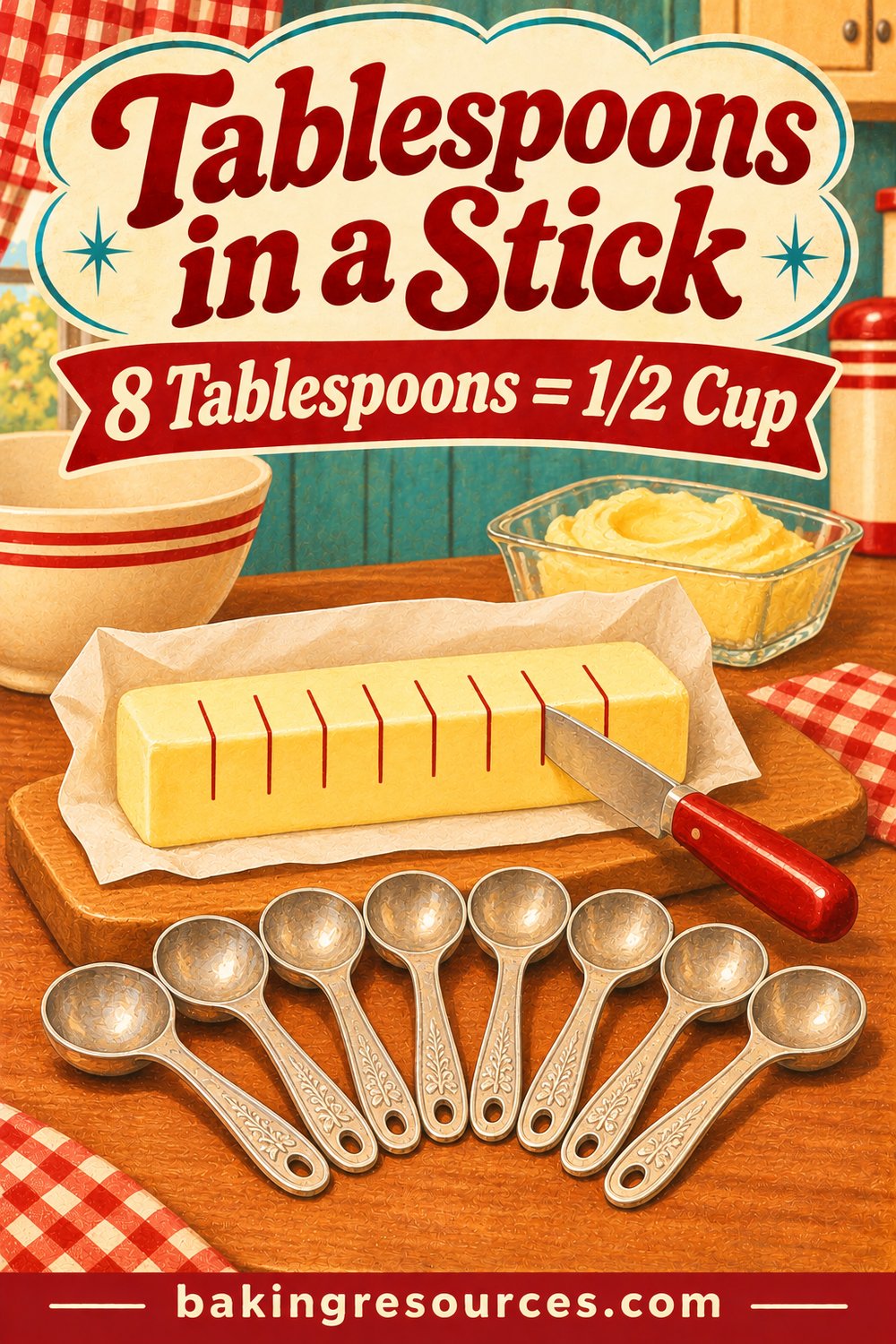
A stick of butter has 8 tablespoons. Every standard US stick holds that same amount, and the paper wrapper is printed with a line for each tablespoon. If a recipe asks for 3 tablespoons, you cut on the line marked 3 and you’re done. No measuring spoon needed.
The number never changes because a stick is sold by weight. It is a quarter of a pound, which is 4 ounces or 113 g. One tablespoon of butter weighs about 14 g, or half an ounce, and eight of those make the stick.
The Baking Resources butter converter uses these same numbers, and so do our ingredient weight chart and the tablespoons to cups chart, where 16 tablespoons make a cup. A stick is exactly half of that cup.
How many ounces are in a stick of butter?
A stick of butter is 4 ounces by weight (113 g). Four sticks make the familiar 1 lb box, and a pound is 16 ounces, so each stick is 4 oz.
Here is a handy coincidence. Half a cup is 4 fluid ounces by volume, and a stick of butter is also half a cup. So whether a recipe means ounces of weight or fluid ounces of volume, 4 oz of butter is one stick.
That is not true for most ingredients. A cup of flour and a cup of sugar weigh very different amounts, which is why our oz to cups guide sorts them out one by one.
How much is a stick of butter in every unit?
One stick of butter equals 8 tablespoons, 24 teaspoons, 1/2 cup, 4 ounces and 113 g. Here is the full chart, from a single tablespoon up to the whole box. Grams are rounded to the nearest gram, which is as fine as a kitchen scale reads.
| Butter | Tablespoons | Teaspoons | Cups | Ounces (weight) | Grams |
|---|---|---|---|---|---|
| 1/8 stick | 1 | 3 | 1/16 | 1/2 | 14 g |
| 1/4 stick | 2 | 6 | 1/8 | 1 | 28 g |
| 1/2 stick | 4 | 12 | 1/4 | 2 | 57 g |
| 3/4 stick | 6 | 18 | 3/8 | 3 | 85 g |
| 1 stick | 8 | 24 | 1/2 | 4 | 113 g |
| 1 1/2 sticks | 12 | 36 | 3/4 | 6 | 170 g |
| 2 sticks | 16 | 48 | 1 | 8 | 227 g |
| 4 sticks (1 lb box) | 32 | 96 | 2 | 16 | 454 g |
The exact weight of a stick is 113.4 g, since 4 oz times 28.35 g is 113.4. Wrappers and recipes round it to 113 g, and two sticks round to 227 g. Your cookies will never notice the missing fraction of a gram.
How many spoons is a stick of butter?
A stick of butter is 8 tablespoons, or 24 teaspoons. When people say “spoons” for butter, they nearly always mean tablespoons, and each tablespoon holds 3 teaspoons.
One thing to watch: a “spoon” in a recipe means a measuring spoon, not the spoon in your silverware drawer. Table spoons and soup spoons vary a lot, and most hold less than a true tablespoon.
If you don’t have measuring spoons, the wrapper lines are your best tool. They are cutting marks on a bar of even thickness, so they are often more accurate than packing soft butter into a spoon.
How many tablespoons is half a stick of butter?
Half a stick of butter is 4 tablespoons, which is also 1/4 cup, 2 ounces or 57 g. On the wrapper, it is the middle line, usually labeled 4 or 1/4 cup.
Other common fractions come up all the time in recipes:
- A quarter stick is 2 tablespoons (1 oz, 28 g).
- A third of a stick is 2 tablespoons plus 2 teaspoons (about 38 g).
- Two thirds of a stick is 5 tablespoons plus 1 teaspoon (76 g), which is 1/3 cup.
- Three quarters of a stick is 6 tablespoons (3 oz, 85 g).
If you need a cup measurement instead, our cups to tablespoons converter handles halves and thirds of any amount.
How to read the tablespoon marks on a butter wrapper
A standard US butter wrapper shows 8 lines, one per tablespoon, often with 1/4 cup and 1/3 cup labels along the side. Here is how to cut an exact amount.
- Check that the wrapper sits straight. The paper sometimes slides during packing. Make sure the first line lines up with the end of the stick before you trust the marks.
- Cut while the butter is cold. A cold stick cuts cleanly. Soft butter squishes, and the line drifts.
- Cut straight down through the paper. Use a sharp knife and press down on the line in one motion, wrapper and all.
- Count from the end you opened. If you already used part of the stick, count the lines that are left, not the number printed on them.
- Use the cup marks too. The 1/4 cup mark sits at 4 tablespoons, half the stick. The 1/3 cup mark sits a little past 5 tablespoons, because 1/3 cup is 5 tablespoons plus 1 teaspoon.
Short, fat sticks and long, thin sticks both weigh 4 oz. Butter packed in the western US is often shorter and wider than butter packed in the east, but the tablespoon count is the same 8 either way.
Worked examples: cutting the butter your recipe needs
Most recipes need a whole stick, half a stick, or a number of tablespoons you can cut on a line. Here are three real kitchen situations.
Example 1: 6 tablespoons for brownies. Six tablespoons is 3/4 of a stick, because 6 of the 8 lines is 3/4. Cut on the line marked 6. You’re left with 2 tablespoons (28 g), a quarter stick, to rewrap and save. With no marks, weigh 6 x 14 g = 85 g.
Example 2: doubling those brownies. Twelve tablespoons is 1 1/2 sticks, 3/4 cup or 170 g. Use one whole stick plus half of a second one, cut on the 4 line.
Example 3: 5 tablespoons for a crumb topping, from a stick you already started. Say 3 tablespoons are already gone. Count the lines left on the wrapper: 5. That is exactly what you need, so use the whole piece. Remember to count the remaining lines, not the printed numbers.
How to measure butter without tablespoon marks
To measure butter with no wrapper marks, weigh 14 g per tablespoon (113 g per stick), or cut a block by length. Butter sold as a plain block, like the 250 g blocks common outside the US, has no lines to follow.
- Weigh it. A digital scale ends the guesswork for good. Our kitchen scale vs measuring cups guide explains why weighing is more reliable.
- Cut by length. A block is an even bar, so a share of its length is the same share of its weight. One US stick is about 45 percent of a 250 g block, a little less than half.
- Use water. With no scale and no ruler, fill a liquid measuring cup to 1 cup with cold water. Add butter until the water reads 1 1/2 cups. That is 1/2 cup of butter, one stick’s worth. Pour off the water before using it.
Don’t simply halve a 250 g block and call it a stick. Half of that block is 125 g, about 12 g more than a stick. That extra fat can make shortbread greasy and cookies spread.
Butter sticks vs blocks and tubs around the world
A US stick is 113 g, but butter in other places comes in blocks of 200 g, 250 g or 500 g, with no tablespoon marks. This table shows how each one compares to sticks and tablespoons.
| Package | Weight | Equals in US sticks | Tablespoons (14 g each) |
|---|---|---|---|
| US stick | 113 g (4 oz) | 1 stick | 8 |
| 8 oz block | 227 g | 2 sticks | 16 |
| 200 g block | 200 g | About 1 3/4 sticks | About 14 |
| 250 g block | 250 g | About 2 1/4 sticks | About 18 |
| 1 lb box or block | 454 g | 4 sticks | 32 |
| 500 g block | 500 g | About 4 1/2 sticks | About 35 |
Tub spreads are a different story. They are whipped or blended with extra water and air, so a tablespoon of tub spread is not a tablespoon of butter. For baking, stick to stick butter, or see our butter substitute guide for swaps that behave.
Storing a partly used stick of butter
A cut stick of butter keeps in the fridge for weeks if you rewrap it tightly, and in the freezer for about 6 months (unsalted) to 6 to 9 months (salted). Butter picks up fridge smells and goes stale fastest at the cut end, so cover it well.
- Fold the original wrapper back over the cut end. The marks stay with the butter, so next time you can keep cutting on the lines.
- Add a second layer. A zip-top bag or airtight box keeps out onion and garlic smells.
- Pre-cut for later. If you often bake with 2 or 4 tablespoons, cut a stick into those pieces, wrap each, and freeze. Our guide on how to thaw frozen butter has quick ways to use them.
- Use salted butter within its window. Salted keeps about 1 to 3 months past the sell-by date in the fridge; unsalted about 1 month.
Troubleshooting butter measurements
Most butter problems in baking come from the wrong amount or the wrong temperature, not the recipe. Here is what to check.
- If your cookies spread into thin puddles, check that you didn’t use 2 sticks where the recipe meant 1/2 cup. Then check the butter wasn’t too warm.
- If cookie dough looks dry and crumbly, you may have used 1 stick where the recipe meant 1 cup. One cup is 2 sticks.
- If your wrapper marks look off, the paper may have slipped. Weigh 14 g per tablespoon instead.
- If cut pieces stick to the knife, the butter is too warm. Chill it 10 minutes, or dip the knife in hot water and wipe it dry.
- If pie crust turns out tough and not flaky, the amount may be right but the butter too soft. See how to cut butter into flour for keeping it cold.
Myths vs facts about a stick of butter
| Myth | Fact |
|---|---|
| A stick of butter is 1 cup. | A stick is 1/2 cup. Two sticks make 1 cup. |
| Melted butter measures more than solid. | The weight stays 113 g per stick; recipes treat a melted stick as 1/2 cup. |
| Half a 250 g block is a stick. | Half a block is 125 g, about 12 g more than a 113 g stick. |
| Short, wide sticks hold less. | Every US stick weighs 4 oz, whatever its shape. |
| Salted butter weighs more. | Both are sold at 4 oz per stick; salted just carries about 1/4 tsp of salt. |
Mistakes to avoid
- Mixing up a stick and a cup. One stick is 1/2 cup, not 1 cup. Using a stick where a recipe means a full cup leaves you with half the butter.
- Packing soft butter into a spoon. Air pockets hide in the spoon, so you end up short. Cut from the stick instead.
- Swapping melted for softened. A melted stick still weighs 113 g, but melted butter makes chewier, flatter cookies than creamed butter. Follow what the recipe says. Our guide on how to soften butter helps when you’re in a hurry.
- Forgetting about salt. If the recipe wants unsalted and you have salted, cut about 1/4 teaspoon of salt per stick. Our salted vs unsalted butter guide has the full chart.
- Measuring browned butter after browning. Browning cooks off water, so measure before you brown. Our brown butter guide shows how much it loses.
Once you have the right amount, how you mix it matters too. See how to cream butter and sugar for the light, fluffy stage most cookie and cake recipes want.
Quick reference: tablespoons in a stick of butter
Here are the amounts you’ll use most, in one place.
| Recipe says | Tablespoons | Sticks | Grams |
|---|---|---|---|
| 2 tbsp | 2 | 1/4 stick | 28 g |
| 1/4 cup | 4 | 1/2 stick | 57 g |
| 1/3 cup | 5 + 1 tsp | 2/3 stick | 76 g |
| 1/2 cup | 8 | 1 stick | 113 g |
| 3/4 cup | 12 | 1 1/2 sticks | 170 g |
| 1 cup | 16 | 2 sticks | 227 g |
| 1 lb | 32 | 4 sticks | 454 g |
Scaling a whole recipe up or down? The recipe converter changes every ingredient at once.
Frequently asked questions
Is 1 stick of butter 1/2 cup?
Yes. One stick is 1/2 cup, which is 8 tablespoons or 113 g. Two sticks make 1 cup.
How many tablespoons are in 2 sticks of butter?
Sixteen. Two sticks are 1 cup of butter, 8 ounces or 227 g.
How many teaspoons are in a stick of butter?
Twenty-four. Each tablespoon is 3 teaspoons, and a stick has 8 tablespoons.
How many grams is a tablespoon of butter?
About 14 g, or half an ounce. A full stick of 8 tablespoons is 113 g.
How many ounces is half a stick of butter?
Two ounces. Half a stick is also 4 tablespoons, 1/4 cup or 57 g.
Does a melted stick of butter still equal 8 tablespoons?
Yes, close enough for any recipe. It weighs the same 113 g whether solid or melted, and recipes treat a melted stick as 1/2 cup.
How much does a stick of butter weigh?
A stick weighs 4 ounces, or 113 g. That is a quarter of a pound.
How many tablespoons are in a pound of butter?
Thirty-two. A 1 lb box holds 4 sticks of 8 tablespoons each, which is 2 cups or 454 g.