Convert Cake Mix to Cookies, Muffins and Brownies: Ratios

To convert cake mix to cookies, stir one standard 15.25 oz box of mix with 1/3 cup (73 g) of vegetable oil or 1/2 cup (113 g) of melted butter and 2 large eggs, and leave out the water completely. Scoop 1 1/2 tablespoon balls onto parchment and bake at 350°F for 8 to 10 minutes. One box makes about 30 cookies.
That one change, taking the water out and cutting back the fat and eggs, is the whole trick. The same box turns into crinkle cookies, bars or muffins by moving those three ingredients, and the reverse swaps run on the same logic: brownie mix becomes cake with more egg and less fat, and muffin mix becomes cake or cookies with more sugar and fat.
A food safety note before anything else: dry cake mix contains raw flour, and dough made from it is not safe to eat unbaked. The full note is further down.
Out of oil, butter or milk? Our free baking substitutions finder gives exact swap ratios for the fats and liquids on this page.
Updated September 2026
How to convert cake mix to cookies, bars and muffins: the chart
Every row starts with one standard 15.25 oz (432 g) box of cake mix. The usual box directions for cake are shown first for comparison.
| Result | Fat | Eggs | Water | Other | Oven | Time | Yield |
|---|---|---|---|---|---|---|---|
| Cake, box directions | 1/2 cup oil | 3 | 1 cup | None | 350°F | Per box | Per box |
| Drop cookies | 1/3 cup oil or 1/2 cup melted butter | 2 | None | Up to 1 cup chips | 350°F | 8 to 10 min | About 30 |
| Crinkle cookies | 1/3 cup oil | 2 | None | 1/2 cup powdered sugar for rolling | 350°F | 9 to 11 min | About 40 |
| Soft cream cheese cookies | 1/2 cup softened butter plus 4 oz cream cheese | 1 | None | Chill 1 hour | 350°F | 10 to 12 min | About 34 |
| Bars in a 9x13 | 1/2 cup melted butter | 2 | None | Up to 1 cup chips or nuts | 350°F | 20 to 25 min | 24 bars |
| Muffins | 1/3 cup oil | 3 | None, 3/4 cup milk instead | 1/2 cup flour, 1 cup fruit | 375°F | 18 to 22 min | 18 to 20 |
The weights behind those measures: 1/3 cup of oil is 73 g, 1/2 cup of butter is 113 g, a large egg is about 50 g out of the shell, 4 oz of cream cheese is 113 g, 3/4 cup of milk is 180 g, 1/2 cup of all-purpose flour is 63 g and 1 cup of chocolate chips is 170 g. Those are the same figures our ingredient weights chart uses, so a recipe measured from this page agrees with every other page on the site.
Why the water comes out
A box of cake mix is mostly sugar and flour, with leavening, emulsifiers and flavoring already blended in. What turns it into a cake or a cookie is how much liquid and fat you add.
Weigh both versions and the difference is obvious:
| Cake batter | Cookie dough | |
|---|---|---|
| Mix | 432 g | 432 g |
| Eggs | 150 g (3) | 100 g (2) |
| Water | 236 g | None |
| Oil | 109 g | 73 g |
| Total | 927 g | 605 g |
| Mix as a share of the total | 47 percent | 71 percent |
In the cake batter, less than half the weight is mix, and the rest is liquid and fat that let it pour and rise into a sponge. In the cookie dough, nearly three quarters is mix. There is just enough egg to hydrate the flour and hold it together, and just enough fat to make the dough scoopable and let it spread a little.
That is why small changes matter. An extra egg pushes the cookie toward cake, soft and puffy. An extra spoonful of oil pushes it toward flat and greasy. A splash of water turns the dough back into batter.
Oil or butter? Both work at the amounts in the chart, and they give different cookies.
- Oil, 1/3 cup (73 g), gives a softer, puffier, more tender cookie that stays soft for days. It is the more forgiving choice, because the dough comes out the same every time.
- Melted butter, 1/2 cup (113 g), gives a richer flavor, crisper edges and a little more spread. Butter is about 80 percent fat, so 113 g of butter brings roughly 90 g of fat plus a little water. Let it cool for a few minutes after melting, and chill the dough if the first tray spreads too far.
- Softened butter, beaten with the mix rather than melted, gives a thicker, sturdier cookie and is the base for the cream cheese version.
Drop cookies, step by step
- Whisk the eggs and fat together in a large bowl.
- Add the dry mix and stir with a sturdy spatula until no dry streaks remain. The dough will be thick and slightly sticky. Do not add water to loosen it.
- Fold in mix-ins. Up to 1 cup (170 g) of chocolate chips, chopped nuts or candy pieces per box.
- Chill for 15 to 30 minutes if the dough feels soft or your kitchen is warm. Cake mix dough is stickier than most scratch cookie doughs and spreads more when warm.
- Scoop 1 1/2 tablespoon balls onto a parchment-lined sheet, about 2 inches apart.
- Bake at 350°F for 8 to 10 minutes. Pull them when the edges are set and the centers look puffed and slightly underdone.
- Cool on the sheet for 5 minutes, then move them to a rack.
Cake mix cookies stay paler than scratch cookies, especially from white or yellow mixes, so color is a poor doneness cue. Look for set edges and a center that has just lost its wet shine, the same cues our guide to how to tell when cookies are done walks through.
If they spread into thin discs, the usual causes are warm dough, butter that was still hot, or a greased pan instead of parchment. Our guide on why cookies turn out flat covers the full list. For cake mix cookies specifically, the fastest fix is 2 tablespoons (16 g) of all-purpose flour stirred into the dough, followed by a 30 minute chill.
Soft cream cheese cookies use a different base: beat 1/2 cup (113 g) of softened butter with 4 oz (113 g) of softened cream cheese until smooth, beat in 1 egg, then stir in the mix. The dough is very soft, so chill it for a full hour before scooping, and bake at 350°F for 10 to 12 minutes. They come out thick, tender and pale. Because they contain cream cheese, store the baked cookies in the refrigerator.
Crinkle cookies
Crinkle cookies use the oil version of the dough and a powdered sugar coating that cracks as the cookie spreads. Chocolate, red velvet, lemon and strawberry mixes work especially well, because the dark or bright color shows through the white cracks.
- Make the dough with 1/3 cup (73 g) oil and 2 eggs, no water.
- Chill for at least 30 minutes. The dough is too sticky to roll while warm.
- Put 1/2 cup (60 g) of powdered sugar in a shallow bowl.
- Roll the dough into 1 tablespoon balls, then roll each ball in the powdered sugar until thickly coated. For bolder cracks, roll them in granulated sugar first, then in powdered sugar. The smaller ball is why a box gives about 40 crinkles against about 30 drop cookies from the same weight of dough.
- Bake at 350°F for 9 to 11 minutes, until the edges are set and the cracks look dry inside.
The granulated sugar layer helps keep the powdered sugar from dissolving into the damp dough, which is why the double roll gives whiter, sharper cracks. If your crinkles come out with no cracks at all, the dough was usually too warm or the coating too thin.
Bars
Bars use the same idea as cookies with a little more fat, pressed into a pan instead of scooped.
The base: one box, 1/2 cup (113 g) melted butter and 2 eggs, no water. Stir in up to 1 cup of chips, nuts or candy.
The pan: press the dough into a parchment-lined 9x13 pan with damp fingers. It makes a thin layer, which is what keeps the bars chewy.
The bake: 350°F for 20 to 25 minutes, until the edges are golden and pulling away from the sides and the center no longer looks wet. The center will still feel soft. It firms as it cools, so cool the bars completely in the pan, at least an hour, before cutting.
For thicker bars, use an 8x8 or 9x9 pan and bake at 325°F for 30 to 35 minutes. The thicker layer needs the lower temperature so the center can set before the edges overbake. Test with a toothpick 1 inch from the edge: moist crumbs mean done, wet dough means more time.
For a crust under a filling, use one box, 1/2 cup melted butter and just 1 egg. Press it into the pan and bake it alone for 10 to 12 minutes so the base sets before the filling goes on.
How much cake batter a box makes for a given pan is covered in our guide to how many boxes of cake mix per pan size. Bar dough is far denser than batter, so those batter volumes do not apply to it.
Muffins
A cake mix baked in a muffin tin by the box directions is a cupcake. To get something closer to a muffin, with a sturdier crumb that holds fruit and a domed top, change the liquid, the fat and the flour.
The ratio, per box:
- 3 large eggs
- 1/3 cup (73 g) oil, down from 1/2 cup
- 3/4 cup (180 g) milk in place of the 1 cup of water, or 3/4 cup of plain yogurt for a thicker batter
- 1/2 cup (63 g) all-purpose flour, whisked into the dry mix
- 1 to 1 1/2 cups of blueberries, chopped apple, banana chunks or chocolate chips
Why each change works. Less oil and less liquid give a less tender, more bread-like crumb. The extra flour thickens the batter so fruit stays suspended rather than sinking, and gives the muffin enough structure to dome. Toss berries in a spoonful of the dry mix before folding them in.
Mix gently. Stir only until no dry mix is visible. Beating the batter for 2 minutes, as a box says for cake, gives a fine cupcake crumb, which is exactly what you are trying to avoid here.
Bake. Fill paper-lined cups three quarters full and bake at 375°F for 18 to 22 minutes, until the tops spring back and a toothpick comes out with a few moist crumbs. The hotter oven than the box's 350°F helps the tops rise into a dome. One box makes 18 to 20 standard muffins.
Cake mix muffins are still sweeter and softer than bakery muffins, and an oat or crumb topping balances them nicely. If they come out dry, overbaking is the usual cause, and our guide to why muffins turn out dry covers the rest.
Reverse swap: brownie mix into cake
Brownie mix is built for a dense, fudgy result: more fat, less leavening and fewer eggs than a cake mix. To push it toward cake, you add structure and air.
A typical family-size brownie mix, around 18 to 20 oz, asks for about 2 eggs, 1/4 to 1/3 cup of water and 1/2 to 2/3 cup of oil. Directions vary, so read your box, then make these changes:
| Change | Why |
|---|---|
| Use 3 eggs instead of 2 | Egg protein builds a cake structure instead of a fudgy one |
| Cut the oil to 1/3 cup (73 g) | Less fat means a lighter, less dense crumb |
| Use 1/2 cup (120 g) milk in place of the box's water | Extra liquid thins the batter so it can rise |
| Add 1 teaspoon baking powder | Brownie mixes carry little leavening |
| Beat for 2 minutes on medium speed | Beaten air lifts the batter, where brownies are only stirred |
Bake in a greased and floured 8 or 9 inch round pan at 350°F for 30 to 35 minutes, until a toothpick in the center comes out clean or with a few dry crumbs. Cool for 15 minutes before turning it out. The result is a moist, tender chocolate cake with a tighter crumb than a cake mix gives, and it takes a simple chocolate frosting well.
The same levers explain why homemade brownies sometimes turn out cakey when you did not want them to. More egg, less fat, added leavening and more beating all push toward cake, and our guide to why brownies turn out cakey goes through each one.
Reverse swap: muffin mix into cake or cookies
Muffin mixes are less sweet and lower in fat than cake mixes, and they are designed to be stirred briefly rather than beaten. Turning them into cake or cookies means adding back what a cake or cookie expects.
Muffin mixes come in two common sizes: small pouches of about 7 oz that make 6 muffins, and larger boxes of around 16 to 18 oz. The ratios below are per 7 oz pouch. For a larger box, multiply by its weight divided by 7.
Muffin mix into cake, per 7 oz pouch:
- The egg and milk the pouch asks for
- 2 tablespoons (25 g) sugar
- 2 tablespoons (27 g) oil or melted butter, in addition to any fat the pouch asks for
- Beat for 1 minute, rather than the brief stir muffins get
Bake in a greased 6 inch round or 8x4 loaf pan at 350°F for 22 to 28 minutes, until a toothpick comes out clean. The cake is modest in size and works well as a snack cake or coffee cake. A crumb topping of flour, sugar and butter pressed over the batter before baking makes it feel like it was always meant to be a cake.
Muffin mix into cookies, per 7 oz pouch:
- 1 large egg
- 3 tablespoons (43 g) softened butter
- No milk or water
- Up to 1/4 cup of chips or nuts
Stir into a soft dough, chill for 20 minutes and scoop 1 tablespoon balls. Bake at 350°F for 10 to 12 minutes. A 7 oz pouch makes about 16 small cookies. Muffin mix cookies are soft and cakey rather than chewy, and blueberry or cinnamon style mixes make a good breakfast cookie. If the dough is too sticky to scoop, stir in 1 to 2 tablespoons of flour.
Adjusting for a smaller box
The ratios on this page are written for a 15.25 oz box. Some cake mixes are sold in 13.25 oz boxes, about 13 percent less mix, so check the net weight on the front before you start.
| For a 13.25 oz box | Fat | Eggs | Other changes |
|---|---|---|---|
| Drop or crinkle cookies | 1/4 cup plus 2 tsp (64 g) oil, or 7 tbsp (99 g) melted butter | 2 | None |
| Bars | 7 tbsp (99 g) melted butter | 2 | None |
| Muffins | 1/4 cup plus 2 tsp (64 g) oil | 3 | 2/3 cup milk, 7 tbsp (55 g) flour |
Keep the eggs as they are, since there is no practical way to measure 13 percent of an egg. The cookies will be slightly softer and puffier, and a 20 minute chill evens that out.
Food safety: cake mix dough is not safe to eat raw
This is the part of cake mix baking that is easy to overlook, because the dough smells and tastes like frosting.
Dry cake mix contains raw flour. Flour is a raw agricultural product. It is not treated to kill bacteria during milling, and raw flour has been linked to outbreaks of illness from harmful strains of E. coli and Salmonella. Blending it into a boxed mix does not change that, and brownie mix and muffin mix are no different.
The dough also contains raw egg. Every ratio on this page adds raw eggs, which carry their own risk of Salmonella.
So:
- Do not eat cake mix cookie dough, bar dough or batter unbaked, and do not let children lick the spoon or the bowl.
- Do not stir dry mix into no-bake treats, frostings, dips, milkshakes or ice cream. Cake batter flavored treats made with raw mix carry the same risk.
- Bake fully. Cookies should be set at the edges and no longer wet in the center. Bars and muffins should pass the toothpick test.
- Wash your hands, bowls, utensils and counters after handling the dough, the same as after handling raw eggs.
If you want edible cookie dough, use a recipe written for it, made with heat-treated flour and no eggs. We do not recommend trying to heat-treat boxed cake mix at home, because it is hard to heat a dry powder evenly enough to be confident every part of it is safe.
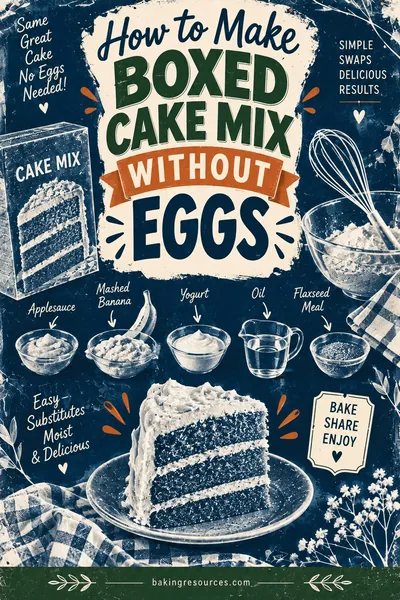
Allergies. Many cake mixes are made in facilities that also handle eggs, milk, wheat, soy and nuts, and the label says so. If you are baking for someone who avoids eggs, our guide to making boxed cake mix without eggs covers the egg swaps. The cookie and bar ratios here rely on eggs to bind the dough, so bake a small test batch before making an egg-free version for a crowd.
Troubleshooting
| What happened | Likely cause | Fix |
|---|---|---|
| Cookies puffed up like little cakes | Too much egg, or water added | 2 eggs and no water per box |
| Cookies spread thin and greasy | Warm dough or hot melted butter | Cool the butter, chill the dough 30 minutes |
| Dough too sticky to scoop | Soft mix or a warm kitchen | Chill it, or stir in 2 tbsp flour |
| Cookies pale but hard | Baked until they browned | Pull at set edges and a matte center |
| Crinkle cookies with no cracks | Coating too thin, or dough too warm | Roll in granulated then powdered sugar, chill first |
| Bars raw in the middle | Thick layer in a small pan | Drop to 325°F and bake longer |
| Bars crumbled when cut | Cut while warm | Cool completely in the pan |
| Fruit sank in the muffins | Batter too thin | Add the 1/2 cup flour, toss fruit in dry mix |
| Brownie cake still dense | Too little egg or beating | 3 eggs, baking powder, 2 minutes on medium |
Frequently asked questions
How do you convert cake mix to cookies?
Mix one 15.25 oz box with 1/3 cup of oil or 1/2 cup of melted butter and 2 large eggs, with no water. Scoop 1 1/2 tablespoon balls and bake at 350°F for 8 to 10 minutes. The water is what makes cake batter, so leaving it out is the key change.
Should I use oil or butter for cake mix cookies?
Either works. Oil at 1/3 cup gives a softer, puffier cookie that stays soft for days. Melted butter at 1/2 cup gives a richer flavor, crisper edges and a little more spread. Chill butter-based dough for 30 minutes if your first tray spreads too much.
Why are my cake mix cookies cakey?
Too much egg, or liquid added to the dough. The cookie ratio uses 2 eggs rather than the 3 on the box, and no water at all. A mix with pudding in it can also bake softer. For a chewier cookie, use melted butter and pull them while the centers still look underdone.
Can I eat cake mix cookie dough raw?
No. Dry cake mix contains raw flour, which can carry harmful bacteria, and the dough also contains raw egg. Bake it fully, keep children from licking the bowl, and wash your hands and utensils afterward. For edible cookie dough, use a recipe made with heat-treated flour and no eggs.
How long do cake mix cookies take to bake?
About 8 to 10 minutes at 350°F for 1 1/2 tablespoon balls, and 9 to 11 minutes for crinkle cookies. They stay pale, so do not wait for them to brown. Pull them when the edges are set and the centers look puffed and have just lost their wet shine.
Can I make muffins from cake mix?
Yes. Use 3 eggs, cut the oil to 1/3 cup, replace the water with 3/4 cup of milk, and whisk 1/2 cup of flour into the mix. Fold in 1 to 1 1/2 cups of fruit or chips, fill the cups three quarters full, and bake at 375°F for 18 to 22 minutes.
How do I turn brownie mix into cake?
Use 3 eggs instead of 2, cut the oil to 1/3 cup, use 1/2 cup of milk in place of the box's water, add 1 teaspoon of baking powder and beat for 2 minutes. Bake in an 8 or 9 inch round pan at 350°F for 30 to 35 minutes, until a toothpick comes out clean.
Can I use a smaller box of cake mix for cookies?
Yes. A 13.25 oz box is about 13 percent smaller, so cut the oil to 1/4 cup plus 2 teaspoons, or the melted butter to 7 tablespoons. Keep 2 eggs and expect a slightly softer, puffier cookie. Chill the dough for 20 minutes if it feels loose.
Related guides
- Eggless Cake Mix for egg-free swaps in a boxed mix
- How Many Cake Mixes per Pan Size for batter volumes by pan
- Why Are My Cookies Flat for the causes of spreading
- How to Tell When Cookies Are Done for doneness cues on pale cookies
- Why Are My Brownies Cakey for the fudgy versus cakey levers
- Substitutions Finder for swapping oil, butter and milk