Can You Substitute Brown Sugar for White Sugar?
Free calculator from Baking Resources
Brown Sugar for White Sugar
Pick what you are baking and how much white sugar the recipe calls for.
Need more? Open the free Baking Substitutions.
More free baking tools



Want more options? Open the full baking substitutions tool.
- Swap brown sugar for white sugar 1 to 1: 1 cup packed brown (213 g) for 1 cup white (200 g).
- Match by weight (200 g for 200 g) if you use a kitchen scale.
- Light brown sugar has about 3.5% molasses; dark brown about 6.5%.
- Bakes turn softer, moister, chewier and darker with brown sugar.
- Do not use brown sugar in meringue, pavlova or macarons.
- Brown sugar is not healthier: about 380 versus 387 calories per 100 g.
Can you substitute brown sugar for white sugar?
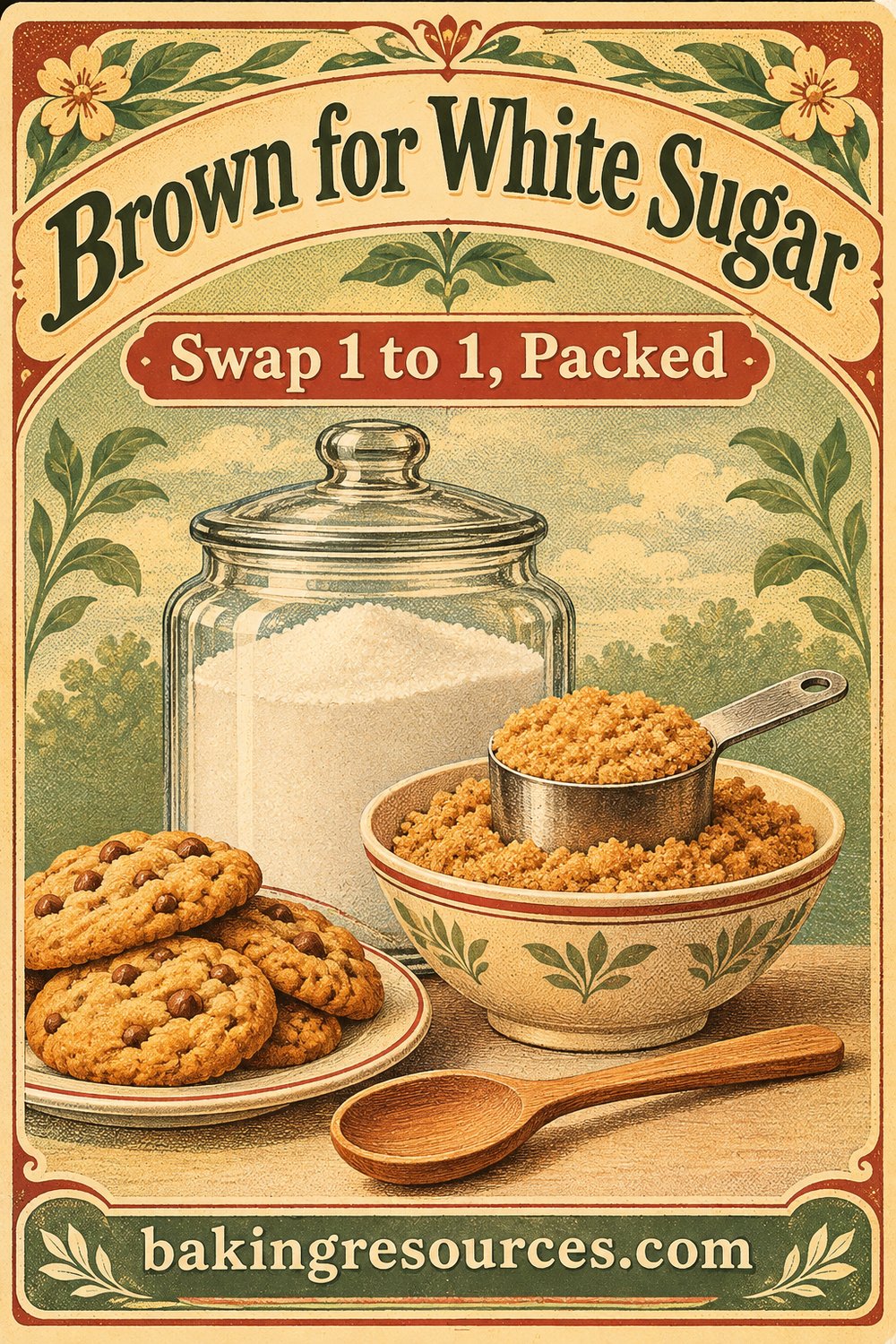
Yes, you can substitute brown sugar for white sugar 1 to 1 in most baking: 1 cup of firmly packed brown sugar (about 213 g) replaces 1 cup of granulated white sugar (200 g). The treat will be softer, moister and a little darker, with a caramel flavor, but it will still turn out.
That is the opposite of the question many bakers ask, which is how to replace brown sugar when you run out. If you are in that spot, see our guide to the brown sugar substitute. This page is for the other direction, when your white sugar jar is empty and the brown sugar is full.
The swap works because brown sugar is just white sugar with molasses added. Same sweetness, different moisture and flavor. That small difference is what the rest of this page is about.
How much brown sugar do you use instead of white sugar?
Use an equal amount of brown sugar by volume or weight: 1 cup packed brown sugar (213 g) for 1 cup white sugar (200 g). Pack it firmly into the cup, pressing down until it holds its shape when you tip it out. The table shows the conversions.
| White sugar | Brown sugar (packed cups) | Brown sugar by volume (g) | Brown sugar to match by weight (g) |
|---|---|---|---|
| 1/4 cup (50 g) | 1/4 cup | 53 g | 50 g |
| 1/2 cup (100 g) | 1/2 cup | 107 g | 100 g |
| 3/4 cup (150 g) | 3/4 cup | 160 g | 150 g |
| 1 cup (200 g) | 1 cup | 213 g | 200 g |
| 1 1/2 cups (300 g) | 1 1/2 cups | 320 g | 300 g |
| 2 cups (400 g) | 2 cups | 426 g | 400 g |
Why two columns? A packed cup of brown sugar weighs about 213 g, while a cup of white sugar weighs about 200 g. That is about 6% more sugar by weight if you go cup for cup. It is a small difference and rarely matters, but if you use a scale, match the grams. Our ingredient weight chart lists both numbers, and kitchen scale versus measuring cups explains why weighing is more accurate.
What changes when you use brown sugar instead of white?
Brown sugar makes baked goods softer, moister, chewier and darker, with a caramel flavor, because it contains molasses, which holds on to water. White sugar gives you a crisper, paler, plainer result. Here is the comparison:
| White sugar | Light brown sugar | Dark brown sugar | |
|---|---|---|---|
| Molasses (about) | None | 3.5% | 6.5% |
| Moisture | Dry | Moist | Moister |
| Flavor | Plain sweet | Mild caramel | Strong molasses |
| Color of bake | Pale | Golden | Deep brown |
| Cookie texture | Crisp edges, thin | Soft, chewy | Very soft, very chewy |
| Acidity | Neutral | Slightly acidic | More acidic |
| Weight per cup | 200 g | 213 g (packed) | 213 g (packed) |
The molasses percentages are the commonly quoted figures, and brands vary a little. For more, read what molasses is and types of sugar. For the big picture, what sugar does in baking explains how sugar affects spread, browning and tenderness.
Can you use brown sugar instead of white sugar in cookies?
Yes, brown sugar in place of white sugar makes cookies softer, thicker and chewier, and they usually spread less in the oven. It is one of the easiest swaps, and many people actually prefer it. Chocolate chip, oatmeal and peanut butter cookies all love it.
If your cookies are meant to be crisp and thin, like classic sugar cookies or snickerdoodles, the swap changes their personality. They come out soft and cakey in the center. To keep some snap, replace only half the white sugar. Our chewy versus crispy cookies guide shows how sugar choices steer the texture, and how to stop cookies spreading helps if the shape changes.
A few tips for cookies:
- Pack the brown sugar firmly, and break up lumps first.
- Cream it with butter for the full 2 to 3 minutes, as in the chocolate chip cookies recipe.
- Bake until the edges are set and the centers look slightly underdone, then cool on the pan 5 minutes.
- Do not overbake. Brown sugar cookies look darker, so judge by firmness, not color.
Can you use brown sugar instead of white sugar in cakes and muffins?
Yes, brown sugar works in cakes, cupcakes, muffins and quick breads, and gives a moister, slightly denser crumb with a golden color. It is especially nice in spice cake, banana bread, carrot cake and anything with apples.
In a white or yellow vanilla cake, expect a tan crumb and a caramel flavor. If you want a pale cake, keep the white sugar. If you want a more rustic cake, go ahead. Light brown sugar keeps the flavor gentle, and dark brown sugar gives a bolder, molasses taste. The banana bread recipe is a good place to try it, since the bananas and brown sugar get along.
Can you use brown sugar instead of white sugar in brownies?
Yes, brown sugar in brownies makes them chewier and fudgier, with a toffee note that goes well with chocolate. A mix of half white and half brown is a popular choice, giving you a crackly top and a chewy middle.
Moist batters brown a little early, so start checking at the early end of the baking time. Use our guide on how to tell when brownies are done to avoid pulling them too soon or too late.
Can you use brown sugar instead of white sugar in meringue or macarons?
No, do not use brown sugar in place of white sugar in meringue, pavlova or macarons, because the molasses and moisture stop the egg whites from setting crisp. You get soft, sticky, beige meringue that weeps, and macarons that do not form their feet. These recipes need dry, fine granulated sugar.
The same goes for any recipe that depends on sugar dissolving cleanly or whipping into egg whites. Our how to whip egg whites and meringue cookies recipe pages explain why. For powdered sugar in frosting, brown sugar is not a swap either, because it is coarse and damp, and cannot be whisked smooth.
Should you use light or dark brown sugar?
Use light brown sugar for a mild swap and dark brown sugar when you want a strong molasses taste. Light brown has about 3.5% molasses, and dark about 6.5%. For most recipes that call for white sugar, light brown is the safer pick.
If you only have dark brown, you can still swap it 1 to 1. Just expect darker color and a spicier flavor, which suits gingerbread and chocolate recipes. If a recipe asks for muscovado, our muscovado sugar substitute page covers it.
Should you change anything else in the recipe?
In most recipes, you do not need to change anything else: keep the same amount of flour, liquid and leavening. Brown sugar is slightly acidic, so it reacts a little more with baking soda, which is fine in standard recipes. The extra moisture is small.
If your dough or batter looks looser than usual, there are two easy fixes. For cookie dough, chill it for 30 to 60 minutes. For batters, bake a few minutes longer and check the center. Use these as guides, not strict rules, since every recipe is different.
The safest way to learn how a swap behaves is to replace half the white sugar first, and bake. If you like it, go all the way next time.
What is a worked example?
Say a sugar cookie recipe asks for 1 1/2 cups (300 g) of white sugar and you want to swap in brown sugar. You can use 1 1/2 cups of firmly packed brown sugar (about 320 g), or weigh out 300 g to match. Here is the math and the plan:
- 1 1/2 cups of white sugar at 200 g per cup is 300 g.
- 1 1/2 cups of packed brown sugar at 213 g per cup is about 320 g.
- Choose a full swap for soft cookies, or 3/4 cup (150 g) white plus 3/4 cup (160 g) brown for a middle path.
- Chill the dough 1 hour, then bake and cool on the pan for 5 minutes.
- Expect softer, tan-colored cookies. Check the sugar cookie recipe for the full method.
For other weights, the grams to cups converter and the baking conversion chart save you math.
Is brown sugar healthier than white sugar?
No, brown sugar is not meaningfully healthier than white sugar: it has about 380 calories per 100 g, compared with about 387 for white sugar. The molasses adds tiny traces of minerals like calcium and iron, but the amounts are too small to matter. Both are added sugar.
Choose between them for flavor and texture, not nutrition. If you are trying to cut sugar, our guides to sweetener substitutes in baking and sugar-free brown sugar substitutes offer other routes.
What if your brown sugar is hard or lumpy?
Hard brown sugar is still fine to use: soften it first, or the lumps will not cream properly. Place a slice of bread or a damp paper towel in the bag for a day, or warm it briefly. Our guide on how to soften brown sugar shows the fast ways. Always measure by packing the soft sugar, not the clumps.
What mistakes should you avoid?
The main mistake is using brown sugar where you need crisp or airy structure. Watch for these:
- Swapping in meringue or macarons. The moisture ruins the structure.
- Not packing the cup. A loose cup holds about 145 g, far less than 213 g packed, so the batter ends up under-sweetened.
- Overbaking by color. Brown sugar bakes look darker, so go by firmness and toothpick.
- Using dark brown for a delicate cake. It can overpower vanilla flavors.
- Expecting a crisp cookie. You will get a soft one, which is great, just not the same.
Quick reference: brown sugar for white sugar
The rule is cup for cup, packed, with softer, darker results. This table sums it up.
| Bake | Swap? | What to expect |
|---|---|---|
| Chocolate chip or oatmeal cookies | Yes, 1 to 1 | Chewier, thicker |
| Sugar cookies, snickerdoodles | Yes, or half and half | Softer, less crisp |
| Cakes and cupcakes | Yes, 1 to 1 | Moister, golden, denser |
| Muffins and quick breads | Yes, 1 to 1 | Moist, rich flavor |
| Brownies and bars | Yes, 1 to 1 | Fudgy, chewy |
| Meringue, pavlova, macarons | No | Soft and sticky |
| Powdered sugar frosting | No | Cannot be whisked smooth |
For more swaps like this, see the baking substitutions tool and the cups to tablespoons chart for smaller amounts.
Frequently asked questions
Can I substitute brown sugar for white sugar?
Yes. Use an equal amount, 1 cup of packed brown sugar (213 g) for 1 cup of white sugar (200 g). Your bake will be softer, moister and darker.
Can I use brown sugar instead of white sugar in cookies?
Yes. The cookies come out softer, thicker and chewier, and they usually spread less.
Is brown sugar the same as white sugar in baking?
Not quite. Brown sugar is white sugar plus molasses, so it adds moisture, color and a caramel flavor.
Can you use brown sugar instead of white sugar in cake?
Yes. The cake will be moister and slightly denser, with a golden crumb and a caramel taste.
Do I pack brown sugar when swapping for white?
Yes. Press it firmly into the cup. A loose cup weighs far less than a packed cup.
Can I use brown sugar for white sugar in meringue?
No. The molasses and moisture keep meringue and macarons from setting properly.
Can I use half brown and half white sugar?
Yes. A half-and-half mix gives a middle texture: softer than white sugar, crisper than all brown.
Is brown sugar healthier than white sugar?
Not really. Brown sugar has about 380 calories per 100 g and white about 387. The mineral difference is tiny.