Can You Bake Cookies on Parchment Paper?
Free calculator from Baking Resources
Parchment Paper for Cookies: Yes or No?
Pick your cookie and your pan to see how to line it.
Need more? Open the free Cookie Scoop Calculator.
More free baking tools



Want more options? Open the full Cookie Scoop Calculator.
- Parchment paper is safe in the oven at normal cookie temperatures of 325 to 375°F (165 to 190°C).
- Most parchment is rated to 400 to 450°F (205 to 230°C), so check the box and never go above its limit.
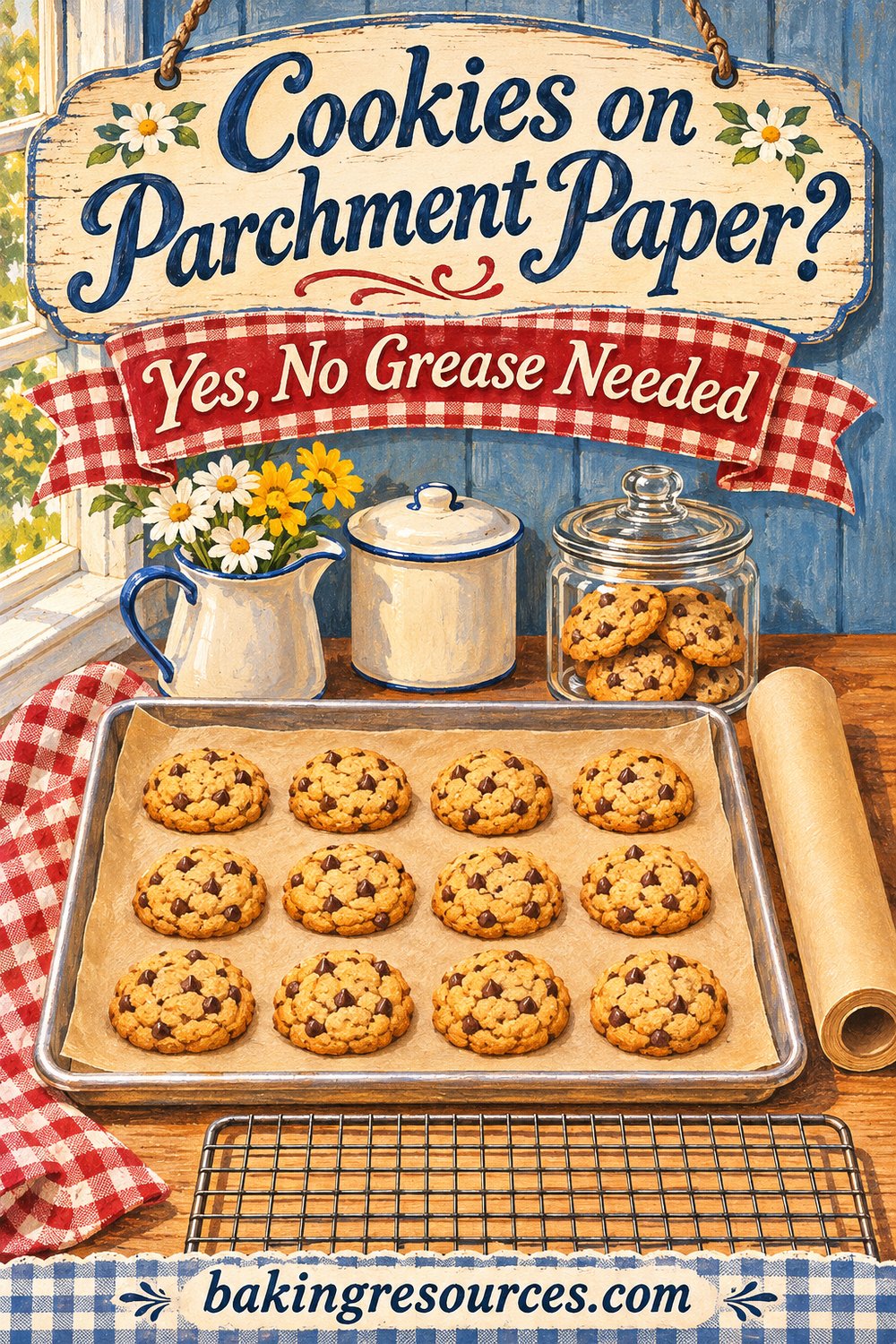
- Do not grease parchment. The silicone coating already releases the cookies.
- A standard 18 x 13 inch (46 x 33 cm) half sheet pan holds about 12 cookies made with 2 tablespoons of dough.
- Parchment can be reused 2 or 3 times for cookies if it is still flat and not brown or brittle.
- Wax paper is not a substitute. It melts and smokes in the oven.
Can you bake cookies on parchment paper?
Yes, you can bake cookies on parchment paper, and most bakers do. Parchment is paper with a thin silicone coating, and that coating is what keeps cookies from sticking and keeps bottoms from scorching. If you have ever asked “do you bake cookies on parchment paper?” the plain answer is yes: lay a sheet on the pan, space out the dough, and bake as the recipe says.
Here is what parchment does for you:
- Nothing sticks. Even soft, buttery or sugary cookies slide off cleanly.
- Cleanup is almost zero. The pan stays clean, so you can wash it once at the end of the day.
- Bottoms brown gently. Parchment is a thin barrier between the hot metal and the dough, so the bottoms turn golden instead of dark.
- Cookies lift off in one move. You can slide the whole sheet to a cooling rack, and fragile cookies never get bent by a spatula.
The one cookie that does not need it is a very buttery shortbread or a rich dough that already releases from a bare pan. Even then, parchment does no harm.
Is parchment paper oven safe at cookie temperatures?
Parchment paper is oven safe up to the temperature printed on its box, which is usually 400 to 450°F (205 to 230°C). Cookies bake at 325 to 375°F (165 to 190°C), so you are well inside the safe range. Different papers vary a little, so read the box once and write the number on the roll if you like.
Parchment is not fireproof. It is paper. Above its rating it turns brown, then brittle, and in a very hot oven it can catch fire. Three habits keep you safe:
- Cut the sheet to fit the pan, or fold any overhang down so no paper hangs near the oven walls or the heating element.
- Do not use parchment under the broiler.
- If the paper turns very dark or smells like it is toasting, the oven is far too hot. Check it with an oven thermometer and see our guide to finding and fixing oven hot spots.
If your oven is set in Celsius, our oven temperature conversion tool gives you the exact setting.
Do you grease parchment paper for cookies?
No, you do not grease parchment paper for cookies. The silicone coating already releases the dough, and extra butter or spray only makes cookies spread more and can leave greasy bottoms. Put the dough straight on the dry sheet.
The only time to use a little fat is if you are baking something very sticky, like a brittle or a melted-sugar cookie, and even then a bare sheet of parchment usually works. If cookies stick to parchment, the usual cause is that they came out too soon. Wait 2 minutes, and they release.
Which is better for cookies: parchment paper, silicone mat or a bare pan?
Parchment is the best all-round choice for cookies because it is easy to keep on hand, bakes evenly and gives you a lot of control over spread. A silicone mat gives flatter cookies, and a bare pan gives the most spread and the darkest bottoms. The table compares them for a basic drop cookie dough.
| Surface | Spread | Bottom browning | Cleanup | Best for |
|---|---|---|---|---|
| Parchment paper | Medium | Even, golden | Almost none | Most cookies |
| Silicone mat | More spread, flatter | Pale | Wash and dry | Sticky, lacy, caramel cookies |
| Bare light metal pan | Most spread | Darker, crisper | Scrub pan | Buttery shortbread, crisp edges |
| Greased pan | Most spread | Dark and sometimes uneven | Scrub pan | Recipes that say to grease |
For a full comparison, our parchment paper vs silicone baking mat guide goes into the details, and silicone vs metal bakeware explains how each material conducts heat.
How do you bake cookies on parchment paper step by step?
You bake cookies on parchment in six simple steps, and the whole routine takes about 30 seconds more than baking on a bare pan.
- Preheat the oven fully. Give it 15 to 20 minutes. A cold oven makes cookies spread before they set.
- Tear a sheet to fit the pan. It should cover the bottom and reach the edges but not climb the sides.
- Keep the pan flat and unfolded. If the paper curls from the roll, flip it over or press it with your palm. A dab of dough under each corner holds it down.
- Scoop the dough 2 inches (5 cm) apart. That is room for a normal spread. Our cookie scoop calculator tells you how many cookies a scoop size makes.
- Bake on the middle rack. If you are unsure, our guide to which oven rack to use shows why the middle is safest for cookies.
- Cool on the paper for 2 to 5 minutes, then slide it to a rack. Let the cookies finish setting on the rack so the bottoms do not steam.
Parchment does not change the baking time much. If you were baking on a bare dark pan before, you may notice the cookies take about a minute longer on parchment because the paper slows the heat reaching the bottom.
How many cookies fit on a parchment-lined baking sheet?
A standard half sheet pan, 18 x 13 inches (46 x 33 cm), fits about 12 cookies made with 2 tablespoons of dough, in 3 rows of 4. Smaller scoops fit more and larger ones fit fewer. Leave about 2 inches (5 cm) between cookies so the edges can spread without joining.
| Dough per cookie | Approx. size after baking | Cookies per half sheet pan | Cookies per quarter sheet pan (9 x 13 in) |
|---|---|---|---|
| 1 tablespoon (15 g) | 2 inches (5 cm) | 20 | 9 |
| 2 tablespoons (30 g) | 3 inches (7.5 cm) | 12 | 6 |
| 3 tablespoons (45 g) | 3.5 inches (9 cm) | 9 to 10 | 4 |
| 1/4 cup (60 g) | 4 inches (10 cm) | 6 | 2 to 3 |
These counts are a guide. Thin, lacy cookies spread much more than thick ones, so give them extra room. The dough weights are for an average drop cookie dough.
Worked example: you want 4 dozen cookies from 2 tablespoon scoops. That is 48 cookies at 12 per pan, so you need 4 pan loads. With two pans and one parchment sheet each, bake two at a time and swap in the second pair while the first cools.
Can you reuse parchment paper for baking cookies?
Yes, you can reuse parchment paper 2 or 3 times for cookies, as long as it is still flat, not brown and not brittle. This is the easiest way to avoid wasting paper when you bake many small batches in a row.
To reuse a sheet, slide the baked cookies off, let the paper cool, wipe off any crumbs and use it again for the next batch. Throw it away when:
- It is dark brown, crisp or cracking.
- It has greasy patches from buttery or oily dough.
- It smells scorched.
Do not reuse a sheet that baked at a much higher temperature than cookies, such as roasted vegetables at 425°F. The coating is worn out by then.
Can you put the next batch on the hot pan?
You can, but it is better to cool the pan first. Dough placed on a hot sheet starts melting before it hits the oven, and the cookies spread thin and bake unevenly. The easy fix with parchment is to prepare a second sheet of paper. While batch one is baking, scoop batch two onto a fresh sheet of parchment on the counter. When batch one comes out, slide the baked cookies and old paper off, and slide the new loaded sheet onto the warm pan.
If you have only one pan, run it under cold water for 30 seconds, dry it and keep going. If cookies still spread too much on later batches, our guide on how to stop cookies spreading covers the other causes, like warm dough and too much butter.
How does parchment change cookie spread and texture?
Parchment gives cookies a medium spread: a little less than a greased pan and a little more than a silicone mat. The paper also stops the bottoms from getting too brown, so cookies stay soft in the middle with a crisp but pale edge.
- Chewy cookies: parchment helps, because it keeps the bottoms from drying out.
- Crisp cookies: bake them a minute longer or use a bare pan to get more browning.
- Thin, lacy cookies: parchment is a good choice; they peel off cleanly once cool.
- Cut-out cookies: parchment keeps the shapes sharp because it lets you move the whole sheet without lifting each cookie.
If you want to know why cookies turn out flat, hard or burnt, check why are my cookies flat, why are my cookies hard and why are my cookies burnt on the bottom. Chewy and crisp cookies depend on more than the pan, and chewy vs crispy cookies explains the sugar, butter and bake time behind each.
What can you use instead of parchment paper for cookies?
The best things to use instead of parchment paper for cookies are a silicone baking mat, a lightly greased bare pan, or aluminum foil with a little grease. Wax paper is not an option, because it melts. What you pick depends on the dough.
| Instead of parchment | How to use it | Watch out for |
|---|---|---|
| Silicone baking mat | Place on the pan and bake as normal | Cookies spread a bit more and bake paler |
| Bare pan, no grease | For buttery doughs like shortbread | Darker bottoms; cool 2 minutes before lifting |
| Bare pan, lightly greased | Rub with a thin film of butter or oil | More spread; too much grease makes cookies greasy |
| Aluminum foil, lightly greased | Press flat on the pan, grease the shiny side | Bottoms brown faster; a greased pan is easier |
| Wax paper | Do not bake with it | Wax melts and smokes in the oven |
If a recipe says “line the pan” and you have none of these, a bare, lightly greased light-colored pan is the safest backup. For the wax-versus-parchment mix-up, which many people ask about, read our guide on parchment vs silicone mats for what each surface does best.
Common mistakes with parchment paper
The most common mistake is using wax paper in place of parchment, followed closely by letting the paper touch the oven heating element. Here are the ones to avoid.
- Using wax paper by mistake. The two rolls look alike. Parchment is usually tan or white and feels slightly slick and stiff. Wax paper feels waxy and thinner. Check the label.
- Paper hanging over the pan. It can brown, curl and touch the element or fan. Trim it to fit.
- Greasing it. Extra fat makes the dough slide and spread.
- Crowding the pan. If cookies touch, they merge and bake unevenly. Use the spacing table above.
- Baking past the box rating. Pizza and roasting temperatures can go over the limit.
- Cutting on hot parchment. A knife damages the coating. Cool the cookies first.
- Putting paper in an air fryer without weight. It can lift and touch the element. If you use an air fryer, see oven to air fryer conversion and keep the paper weighed down by food.
Is parchment paper safe for food?
Yes, parchment paper sold for baking is made to be food-safe at the temperature on its box. The silicone coating is stable at oven temperatures, and the paper is not meant to be eaten. If a piece sticks to a cookie, peel it off and discard it.
Bleached parchment is white, unbleached is tan, and both work equally well for cookies. Parchment is also easy to recycle or compost in many places, but check your local rules because the silicone coating matters to some programs.
Quick reference: cookies on parchment paper
| Question | Answer |
|---|---|
| Can you bake cookies on parchment paper? | Yes, for nearly all cookies |
| Safe temperature | Up to the box rating, usually 400 to 450°F (205 to 230°C) |
| Typical cookie temperature | 325 to 375°F (165 to 190°C) |
| Grease it? | No |
| Cookies per half sheet pan (2 tbsp) | About 12 |
| Spacing | 2 inches (5 cm) |
| Cooling | 2 to 5 minutes on the pan, then slide to a rack |
| Reuse | 2 or 3 times if flat and pale |
| Wax paper instead? | No, it melts and smokes |
For a tried-and-true dough to test the method, try our chocolate chip cookies recipe or the sugar cookie recipe, both of which bake beautifully on parchment. When the cookies are done, keep them fresh with how to store baked goods.
Frequently asked questions
Do you bake cookies on parchment paper?
Yes. Most bakers line the pan with parchment because it stops sticking, gives even golden bottoms and makes cleanup quick. It does not change the recipe or the baking time much.
Can parchment paper go in the oven at 350°F?
Yes. Parchment is rated for 400 to 450°F (205 to 230°C) on most boxes, so 350°F (175°C) is well within the safe range. Do not use it under a broiler.
Does parchment paper burn in the oven?
Not at normal baking temperatures. It darkens and turns brittle if it goes above its rated temperature or touches the heating element, so trim the paper to fit the pan.
Should you grease parchment paper before baking cookies?
No. Parchment is already nonstick, and grease makes cookies spread more and bake greasy on the bottom.
Can you use wax paper instead of parchment paper for cookies?
No. Wax paper is coated with wax that melts and smokes in the oven. Use parchment, a silicone mat or a lightly greased bare pan.
Can you reuse parchment paper for cookies?
Yes, 2 or 3 times for cookies, as long as the sheet is still flat and pale. Throw it away if it is dark, brittle or greasy.
Do cookies take longer to bake on parchment paper?
Slightly. On parchment, the bottoms brown a little slower than on a bare dark pan, so cookies may need about 1 extra minute. Judge by the edges and the center, not only the clock.
Does parchment paper change how much cookies spread?
A little. Cookies spread slightly less on parchment than on a greased pan and a little more than on a silicone mat. If they spread too much, chill the dough 30 minutes before baking.