How Thick Should You Roll Sugar Cookies?
Free calculator from Baking Resources
Sugar Cookie Thickness, Yield and Bake Time
Pick how thick you roll and your cutter size.
Need more? Open the free Cookie Scoop Calculator.
More free baking tools



Want more options? Open the full Cookie Scoop Calculator.
- Roll cut-out sugar cookies 1/4 inch (6 mm) thick for royal icing and decorating.
- At 350°F (175°C), 3-inch cookies bake 6 to 8 min at 1/8 inch, 8 to 10 at 1/4 inch and 10 to 12 at 3/8 inch.
- One 3-cup-flour batch makes about 48, 24 or 16 three-inch cookies at 1/8, 1/4 or 3/8 inch.
- Halving the thickness doubles the number of cookies from the same dough.
- Each extra 1/8 inch adds about 2 minutes of baking.
- Guide rings or strips keep the whole sheet even, which matters more than the exact number.
How thick should sugar cookies be?
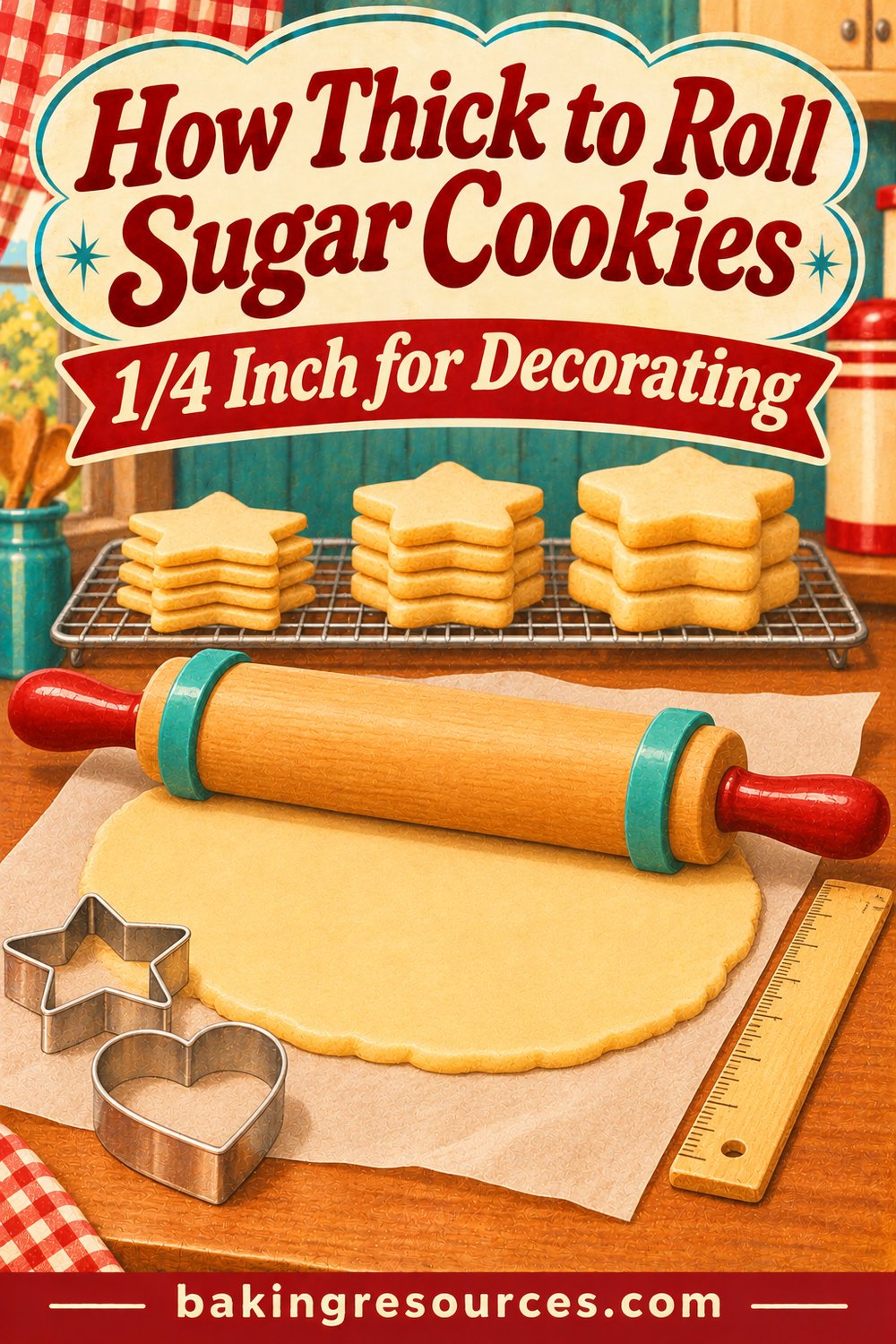
Sugar cookies should be 1/4 inch (6 mm) thick for most cut-outs, and that is the answer most bakers need when they ask how thick to roll sugar cookies. 1/4 inch is the sweet spot. It is thick enough to hold royal icing without bending or snapping, and thin enough to bake through before the edges brown. Thinner and thicker both have their place, though. Here is how each thickness bakes with a 3 inch cutter at 350°F (175°C).
| Thickness | Metric | Texture | Best for | Bake time | Cookies per batch |
|---|---|---|---|---|---|
| 1/8 inch | 3 mm | Thin, crisp, snaps | Sandwich cookies, dunking, light glaze | 6 to 8 min | About 48 |
| 1/4 inch | 6 mm | Sturdy, soft center, crisp edge | Royal icing, gift tins, kids’ decorating | 8 to 10 min | About 24 |
| 3/8 inch | 10 mm | Thick and soft, bakery-style | Buttercream-frosted cookies | 10 to 12 min | About 16 |
| 1/2 inch | 13 mm | Very thick, almost cakey | Big, simple shapes | 12 to 14 min | About 12 |
The yields are for a standard cut-out dough made with 3 cups of flour, like our sugar cookie recipe, with the scraps rerolled once.
1/8 vs 1/4 vs 3/8 inch: which should you roll?
Roll 1/8 inch for crisp cookies, 1/4 inch for decorated cookies and 3/8 inch for thick, soft ones. Pick by how you plan to top and use them:
- 1/8 inch if you want crisp cookies that keep well, or two thin cookies sandwiched with jam or frosting. They brown fast and break easily under a heavy flood of icing.
- 1/4 inch for royal icing, cookies you plan to stack or pack in a tin, and anything kids will handle. It is the thickness most cut-out recipes, including ours, are written for.
- 3/8 inch if you like a soft, thick cookie with a swirl of buttercream on top. Keep the tops pale and pull them as soon as the edges set.
- 1/2 inch only for large, simple shapes like circles and hearts. Fine points and thin arms get dark long before the thick middle is done.
How many cookies does a batch make at each thickness?
One batch of 3-cup-flour cut-out dough makes about 48 three-inch cookies at 1/8 inch, 24 at 1/4 inch and 16 at 3/8 inch. Thickness changes the count as much as the cutter does. Halve the thickness and you double the number of cookies, because the same dough covers twice the area. Use this chart for one batch of 3-cup-flour dough.
| Thickness | 2 inch cutter | 3 inch cutter | 4 inch cutter |
|---|---|---|---|
| 1/8 inch | About 96 | About 48 | About 28 |
| 1/4 inch | About 48 | About 24 | About 14 |
| 3/8 inch | About 32 | About 16 | About 9 |
| 1/2 inch | About 24 | About 12 | About 7 |
Shapes with lots of open space, like stars and snowflakes, can squeeze out a few more than round cutters, and a third reroll of scraps adds a few more cookies but makes them tougher.
Worked example: three dozen thick cookies for a party
Thirty-six thick 3-inch cookies at 3/8 inch take about 2 1/2 batches of dough, while the same 36 at 1/4 inch take only 1 1/2 batches. Say you need 36 soft, frosted cookies with a 3 inch cutter, and you want them thick, at 3/8 inch.
- Find the yield. At 3/8 inch, one batch makes about 16 three-inch cookies.
- Divide. 36 / 16 = 2.25 batches. Round up to 2 1/2 batches so you have a few spares for breakage.
- Scale the recipe. Paste your dough recipe into the recipe converter and multiply by 2.5. Mix it as a double batch plus a half batch rather than one giant bowl.
- Set the timer. Bake at 350°F and check at 10 minutes. Most trays will be done by 12.
Compare that with 1/4 inch: you would need only 1 1/2 batches for the same 36 cookies. If the thickness is not set in stone, rolling a little thinner saves a lot of mixing.
How to roll sugar cookies to an even thickness
The easiest way to roll sugar cookies evenly is to roll the dough between parchment with guide rings or strips that stop the pin at exactly 1/4 inch. Even thickness matters more than the exact number. A sheet that is 1/4 inch at one end and 1/8 inch at the other gives you burnt cookies and raw ones on the same tray. These tools help:
- Rolling pin guide rings. Rubber or silicone rings slip over each end of the pin and hold it a set height above the counter. Most sets include 1/8 and 1/4 inch, and many add 1/16 and 3/8 inch.
- Guide strips or dowels. Two square wooden strips, one on each side of the dough, do the same job. The pin rides on the strips, so the dough cannot get thinner than they are. Measure them first, since the actual size of wood strips can differ from the label.
- Two rulers. In a pinch, lay a ruler or two stacked rulers on each side. Rulers vary in thickness, so measure them against another ruler first and stack until you reach the height you want.
Then follow these steps:
- Divide the dough in half and roll each piece between two sheets of parchment. No flour on the counter means no extra flour in the cookies.
- Roll from the center outward, turning the sheet a quarter turn after every few strokes, until the pin rides on the guides all the way across.
- Slide the rolled sheets onto a tray and chill at least 1 hour. Our page on how long to chill sugar cookie dough explains why rolling before chilling is faster.
- Cut, move the shapes to the baking sheet, and chill them again for about 10 minutes so the edges stay sharp.
- Press scraps together and reroll them once, using the same guides.
Does sugar cookie thickness change the bake time?
Yes, each extra 1/8 inch of thickness adds about 2 minutes at 350°F, which is more than the cutter size changes it. That happens because heat has to travel farther from the top and bottom to reach the middle. Small cutters bake a little faster at the same thickness, and big ones a little slower, so bake same-size shapes together. For dark pans, frozen cut-outs and other changes, see how long to bake sugar cookies.
Mistakes to avoid when rolling sugar cookies
Most rolling mistakes make cookies uneven or tough, and each one is easy to fix next batch.
- Rolling on a floured counter. Every dusting works more flour into the dough, and it bakes up tougher. Parchment avoids it. If your cookies come out like rocks, see why cookies turn hard.
- Rolling too thin for heavy icing. A 1/8 inch cookie under a thick royal icing flood can bend and crack. Use 1/4 inch for decorated cookies.
- Rolling warm dough. Soft dough squashes unevenly and spreads in the oven. Chill it, and if shapes still lose their edges, our page on how to stop cookies spreading has more fixes.
- Mixing thicknesses on one tray. Scraps rerolled without guides often end up thinner and burn first.
How thick to roll other cut-out cookies
Most rolled cookies use the same 1/4 inch as sugar cookies, with 1/8 inch for crisp or sandwich cookies. Here is how common cut-outs compare, using the times from our recipe and bake time pages.
| Cookie | Usual thickness | Oven | Bake time | Why |
|---|---|---|---|---|
| Decorated sugar cookies | 1/4 inch (6 mm) | 350°F | 8 to 10 min (3 inch) | Holds icing, soft center |
| Soft gingerbread men | 1/4 inch (6 mm) | 350°F | 8 to 10 min (4 1/2 inch) | Soft middle, sturdy arms |
| Crunchy gingerbread or ornaments | 1/8 inch (3 mm) | 350°F | 10 to 12 min (4 1/2 inch) | Firm and snappy |
| Rolled shortbread | 1/4 inch (6 mm) | 325°F | 15 to 18 min (2 inch) | Tender, keeps in tins |
| Sandwich or jam cookies | 1/8 inch (3 mm) | 350°F | 6 to 8 min (3 inch) | Two thin layers stack to one normal cookie |
The gingerbread men recipe has a full chart for soft and crunchy gingerbread by thickness.
Second worked example: thin sandwich cookies
Rolling a batch at 1/8 inch with a 3-inch cutter gives about 48 cookies, which make 24 sandwich cookies. Here is how to plan it:
- Count. 48 thin cookies pair up into 24 sandwiches. For 3 dozen sandwiches you need 72 cookies, which is 1 1/2 batches.
- Cut windows. Cut a small shape out of the center of half the cookies for the tops. The tiny centers can be baked as bite-size cookies.
- Bake by size. Bake the whole bottoms and the windowed tops on separate trays, since the tops finish a little sooner. Check at 6 minutes; most are done by 8.
- Fill just before serving if you use jam, so the thin cookies stay crisp.
Troubleshooting rolled sugar cookies
Most rolling problems come from dough temperature or extra flour, and a few minutes of resting or chilling fixes them.
| If this happens | Likely reason | Do this |
|---|---|---|
| Dough cracks at the edges when you roll | Too cold, or too much flour | Let the chilled sheet sit 5 to 10 minutes, then roll |
| Dough sticks to the parchment | Too warm | Chill the rolled sheet 15 minutes, then peel |
| Edges brown before the middle sets | Rolled thinner at the edges | Use guide rings and roll from the center out |
| Cookies bend or crack under icing | Rolled too thin | Roll a full 1/4 inch for decorated cookies |
| Shapes puff and lose sharp points | Dough too warm when baked | Chill the cut shapes about 10 minutes first |
| Some cookies thicker than others | Scraps rerolled without guides | Use the same guides for every reroll |
Rolling between sheets helps a lot here. Our comparison of parchment paper vs a silicone baking mat explains which liner to bake on.
Make ahead: roll the dough now, bake later
Rolled sheets of sugar cookie dough keep 3 to 5 days in the fridge or up to 3 months in the freezer, already at the right thickness. That makes holiday baking much calmer.
- Roll the dough to 1/4 inch between parchment, slide the sheets onto a tray and wrap them well.
- Stack the flat sheets in the fridge or freezer.
- Let frozen sheets sit out a few minutes before cutting so they do not crack.
- Cut, chill the shapes briefly, and bake as usual. Frozen cut-outs need about 1 to 2 extra minutes.
Our guide on how to freeze cookie dough covers wrapping, and the list of Christmas cookies that freeze well helps you plan a whole tray.
How thick should cookies be for gifts and shipping?
Roll gift and shipping cookies 1/4 inch thick, because thin 1/8 inch cookies break easily in a tin or box. A 1/4 inch cookie with fully dried royal icing stacks well between layers of parchment. If you are planning tins for neighbors or teachers, our cookie tin count guide tells you how many cookies to bake.
Quick reference: how thick to roll sugar cookies
This table sums up thickness, bake time at 350°F and yield per 3-cup-flour batch with a 3-inch cutter.
| Goal | Thickness | Bake at 350°F | Cookies per batch |
|---|---|---|---|
| Crisp, sandwich or dunking | 1/8 inch (3 mm) | 6 to 8 min | About 48 |
| Decorated with royal icing | 1/4 inch (6 mm) | 8 to 10 min | About 24 |
| Soft, buttercream-topped | 3/8 inch (10 mm) | 10 to 12 min | About 16 |
| Extra thick, simple shapes | 1/2 inch (13 mm) | 12 to 14 min | About 12 |
Frequently asked questions
How thick should sugar cookies be for royal icing?
Roll them 1/4 inch (6 mm) thick. That thickness is sturdy enough to hold a full flood of royal icing without bending, and it stays soft in the middle. Once iced, plan the drying time with our guide to how long royal icing takes to dry.
How thick do you roll cookies for cookie cutters?
Most cut-out recipes are written for 1/4 inch. Go to 1/8 inch for crisp, thin cookies or 3/8 inch for soft, thick ones, and adjust the bake time by about 2 minutes per 1/8 inch.
What is 1/4 inch in millimeters?
About 6 mm. For the other common thicknesses, 1/8 inch is about 3 mm, 3/8 inch is about 10 mm, and 1/2 inch is about 13 mm.
Do sugar cookies get thicker when they bake?
A little. Cut-out dough has only a small amount of leavening, so the cookies puff slightly and spread very little when the dough goes in cold. If yours puff a lot or lose their shape, the dough was too warm or had extra leavening.
How thick should cookies be for a kids’ decorating party?
Roll them an even 1/4 inch. Thinner cookies break when kids press down with icing bags. Our kids’ cookie decorating party guide has the dough and icing amounts by number of children.
How thick should sandwich cookies be?
Roll sandwich cookies 1/8 inch (3 mm) thick. Two thin layers plus filling end up about as thick as one regular cookie. With a 3-inch cutter they bake in 6 to 8 minutes at 350°F.
Can you roll sugar cookies too thin?
Yes. Below 1/8 inch, cut-outs brown in a few minutes, turn brittle and break when you lift or ice them. For decorated cookies, 1/4 inch is the safest thickness.
How thick should sugar cookies be for buttercream?
About 3/8 inch (10 mm) gives a thick, soft cookie that suits a swirl of buttercream. Bake 3-inch cookies 10 to 12 minutes at 350°F and keep the tops pale.