Why Is My Cookie Dough Too Sticky to Roll?
Free calculator from Baking Resources
Fix My Sticky Cookie Dough
Pick how the dough feels and how warm your kitchen is.
Need more? Open the free Cookie Scoop Calculator.
More free baking tools



Want more options? Open the full Cookie Scoop Calculator.
- Most sticky cookie dough needs 30 to 60 minutes in the fridge before rolling.
- One level tablespoon of all-purpose flour weighs about 8 g, and one cup weighs about 125 g spooned and leveled.
- Add no more than 3 tablespoons (24 g) of extra flour to a dough made with 3 cups (375 g) of flour, or the cookies turn dry.
- Butter at 65 to 67°F (18 to 19°C) holds a dough together. Butter above about 72°F (22°C) turns it greasy and sticky.
- Rolling between two sheets of parchment needs little or no dusting flour.
- Bread dough is meant to be tacky. Cookie dough that sticks to a rolling pin is not, so fix it before you cut.
Why is my cookie dough so sticky to roll?
Your cookie dough is sticky because the fat in it is too soft, there is too little flour for the amount of butter, egg and sugar, or both. Cookie dough is a mix of flour, fat, sugar and egg. When the butter warms up, it melts into the dough and makes it smear instead of hold its shape.
Here are the five usual causes, from most to least common:
- The dough is too warm. Butter melts between 82 and 97°F (28 to 36°C), so a warm kitchen or warm hands can soften it fast.
- The butter was too soft at the start. Butter that was left out all day, or partly melted in the microwave, makes a loose dough from the first minute.
- The flour was under-measured. Spooning flour lightly into the cup gives about 120 to 125 g. Dipping a cup in the bag and leveling packs in 140 to 150 g. A recipe developed with packed cups can leave your spooned-flour dough wet.
- Extra wet ingredients. A large egg, an extra splash of milk or vanilla, or a big spoon of honey or corn syrup adds liquid the flour has to soak up.
- Humid weather. Flour and sugar pull moisture from damp air. Our guide to baking in humid weather explains the small changes that help.
How do you tell which problem you have?
You can tell by the feel: greasy and shiny dough is too warm, tacky dough that peels off your fingers is fine, and wet, gluey dough needs flour. Press a finger into the dough, lift it, and match what you see.
| What the dough looks and feels like | Likely cause | First fix |
|---|---|---|
| Shiny, oily, soft like frosting | Butter too warm | Chill 45 to 60 minutes. Do not add flour yet. |
| Tacky but holds a ball, leaves a little on your fingers | Slightly warm or slightly low on flour | Chill 30 minutes, then roll between parchment. |
| Wet and gluey, looks like thick batter | Too little flour or too much liquid | Add flour 1 tablespoon (8 g) at a time, then chill 1 hour. |
| Fine cold, sticky within 5 minutes of rolling | Warm room or warm hands | Roll small portions and keep the rest in the fridge. |
| Beads of water on the surface | Condensation after a long chill | Let it sit 5 minutes, then pat dry with a paper towel. |
How do you fix sticky cookie dough that is too soft?
To fix sticky cookie dough, chill it 30 to 60 minutes, because cold butter turns a loose dough into a firm one with no extra flour. Chilling is the safest fix since it does not change the recipe.
- Divide the dough. Split it into two flat discs about 1 inch (2.5 cm) thick. Flat discs chill faster than one big ball.
- Wrap each disc in plastic wrap or slide it into a zip-top bag.
- Chill 30 to 60 minutes in the fridge. For a very greasy dough, give it a full hour.
- Test it. Press a finger in. The dough should feel cool and firm, and it should not stick to your skin.
- Roll one disc at a time. Keep the second disc in the fridge until you need it.
In a hurry, the freezer works in about 15 minutes. Set a timer, because dough left in too long freezes hard at the edges and cracks when you roll it. Our page on how long to chill sugar cookie dough has the full timing guide, and why rest cookie dough explains what the wait does inside the dough.
Can you add more flour to sticky cookie dough?
Yes, you can add flour to sticky cookie dough, but only 1 tablespoon (about 8 g) at a time and no more than 3 tablespoons for a standard batch. Too much flour makes cookies dry, pale and crumbly, which is the next problem to chase.
Only reach for flour when chilling has not solved it, or when the dough is wet and gluey from the start. Here is how to do it well:
- Sprinkle the flour over the dough and fold it in with a spatula. Do not knead hard.
- Stop as soon as the dough no longer smears. It should still feel soft and slightly tacky.
- Chill 30 minutes after adding flour, since flour needs a little time to soak up the liquid.
- Write the extra amount in the recipe margin so you can fix it at the start next time.
| Flour in the recipe | Safe extra flour (up to) | Percent added |
|---|---|---|
| 2 cups (250 g) | 2 tablespoons (16 g) | About 6% |
| 3 cups (375 g) | 3 tablespoons (24 g) | About 6% |
| 4 cups (500 g) | 4 tablespoons (32 g) | About 6% |
If your cookies often turn out dry after a fix like this, read why cookies come out hard to check what else might be going on.
How do you roll sticky cookie dough without it sticking?
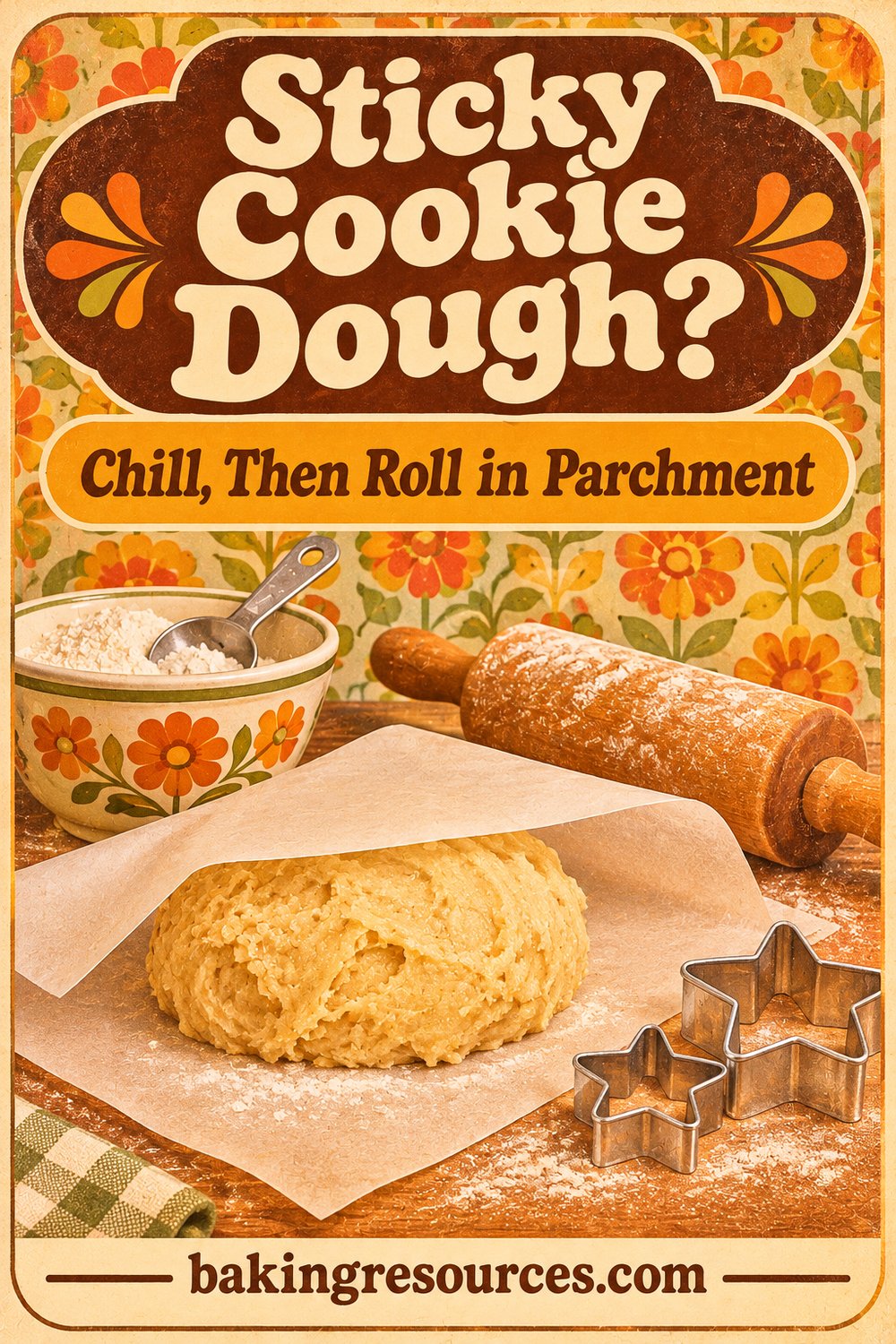
The easiest way to roll sticky cookie dough is between two sheets of parchment paper, because the dough never touches the pin or the counter. You need almost no extra flour this way, so the cookies stay tender.
- Chill the dough until firm, 30 to 60 minutes.
- Lay a sheet of parchment on the counter and set the dough on it.
- Press the dough flat with your palm, then cover it with a second sheet of parchment.
- Roll from the center outward to about 1/4 inch (6 mm) thick. Lift and smooth the top sheet every few passes so it does not wrinkle into the dough.
- Slide the parchment sandwich onto a baking sheet and chill 10 minutes. Cold dough cuts cleanly.
- Peel off the top sheet, cut your shapes, and lift away the scraps.
Prefer a floured counter? Dust it with a thin, even layer, rub a little flour on the pin, and brush the extra off the top of the dough before you cut. A light hand with the flour is what keeps cookies soft. If you wonder whether parchment or a mat is better, see parchment paper vs silicone mat.
Why is my sugar cookie dough sticky?
Sugar cookie dough turns sticky because it holds a lot of butter and sugar, so a few degrees of warmth are enough to soften it. It is the dough most people roll out, so it is the one that causes the most frustration. Some doughs are meant to be tackier than others.
| Dough | How sticky is normal? | Best fix |
|---|---|---|
| Cut-out sugar cookie | Slightly tacky when mixed, smooth and dry-feeling after chilling | Chill 1 hour, roll between parchment |
| Gingerbread or molasses | Quite sticky, because molasses is wet | Chill at least 2 hours, or overnight |
| Peanut butter | Soft and a bit oily | Chill 30 minutes, shape by hand |
| Oatmeal and chocolate chip | Soft and scoopable, never rolled | Chill 30 minutes, then scoop |
| Shortbread | Should be crumbly, not sticky | If sticky, butter was too warm. Chill 1 hour. |
If you use our cut-out sugar cookie recipe or the gingerbread men recipe, follow the chill times written there. They are built for those exact amounts.
Why is my dough sticky after chilling?
Dough that turns sticky after chilling is usually sweating. When cold dough meets warm kitchen air, water beads form on the surface, and they make it feel wet. It also happens when you chill a very soft dough for only 10 or 15 minutes, because the center stays soft while the outside feels firm.
- Let it sit for 5 minutes after you unwrap it, then blot the surface with a paper towel.
- Chill longer. A full hour reaches the center of a 1 inch disc.
- Roll in a cool spot. Away from the stove and dishwasher, the dough stays cooler.
Why is my bread dough sticky?
Bread dough is supposed to be tacky, and it is fixed in a different way: by kneading and resting rather than by adding lots of flour. If you landed here from a bread question, our page on why your dough is too sticky covers yeast dough, and kneading and resting matter more than flour there. The rest of this page is about cookie dough that has to be rolled and cut.
Worked example: sticky sugar cookie dough, step by step
Say you mixed a cut-out dough with 3 cups (375 g) of flour, it is a warm 76°F kitchen, and the dough sticks to the pin.
- Check the feel. It is soft and a bit shiny, so the butter is warm. No flour yet.
- Chill. Split it into two discs, wrap them, and chill 1 hour, since the kitchen is warm.
- Roll the first disc between parchment to 1/4 inch (6 mm).
- Still tacky? Fold in 1 tablespoon (8 g) of flour into the second disc and chill 20 more minutes. That is about 2 percent more flour, a safe nudge.
- Cut and chill the shapes on the pan for 10 minutes, then bake. See how long to bake sugar cookies for times.
How can you stop cookie dough from getting sticky next time?
You can stop cookie dough from getting sticky by weighing the flour, using butter at 65 to 67°F (18 to 19°C), and chilling the dough before you roll it. These three habits fix most sticky doughs before they start.
- Weigh the flour. A kitchen scale removes the packed-cup problem. See how to measure flour.
- Soften butter gently. It should dent when pressed but not feel greasy. Our guide to how to soften butter has safe methods.
- Do not over-cream. Beating butter and sugar for too long warms the butter. See how to cream butter and sugar.
- Use the right egg size. A recipe written for a large egg (about 50 g) gets sticky with an extra-large one.
- Bake in small batches. Roll half the dough while the other half waits in the fridge.
Myths vs facts about sticky cookie dough
The biggest myth is that you should dump flour onto sticky dough until it stops sticking, when a bit of cold does a better job.
- Myth: more flour is always the fix. Fact: chilling fixes most cases, and each extra tablespoon makes cookies drier.
- Myth: sticky dough means a bad recipe. Fact: weather, butter softness and how you measured flour change the result.
- Myth: you must flour the counter heavily. Fact: parchment keeps the dough off the surface, so you need almost none.
- Myth: warm dough rolls more easily. Fact: warm dough stretches and tears. Cool dough cuts clean.
Mistakes that make sticky dough worse
The most common mistake is rolling the dough straight after mixing, because freshly mixed dough is at its softest.
- Adding a big scoop of flour at once. Add it by the tablespoon.
- Kneading dough hard. Cookie dough does not need gluten. Overworking it warms it and toughens it. See what overmixing does.
- Using a warm pan. Cutting shapes onto a hot baking sheet melts the edges before they bake.
- Skipping the second chill. Cut shapes that go into the oven warm will spread. Read how to stop cookies from spreading.
Quick reference: sticky cookie dough
This table sums up what to do for the most common sticky-dough problems.
| Problem | Chill time | Extra flour | Best rolling method |
|---|---|---|---|
| Greasy, shiny dough | 45 to 60 minutes | None | Between parchment |
| Tacky, mostly firm | 30 minutes | None | Between parchment |
| Wet and gluey | 1 hour after adding flour | 1 tablespoon (8 g) at a time, up to 3 | Between parchment |
| Sticky only when warm | 10 minutes between batches | None | Small portions |
| Gingerbread or molasses | 2 hours or overnight | Rarely needed | Between parchment |
Frequently asked questions
Why is my cookie dough too sticky to roll out?
It is usually too warm or a little short on flour. Chill the dough 30 to 60 minutes, then roll it between two sheets of parchment paper.
How much flour do I add to sticky cookie dough?
Add 1 tablespoon (8 g) at a time, up to 3 tablespoons (24 g) for a recipe with 3 cups of flour. More than that makes cookies dry.
Can I chill sticky dough overnight?
Yes. Wrapped dough keeps well in the fridge overnight. Let it sit at room temperature 10 to 15 minutes before rolling so it bends without cracking.
Why is my cookie dough sticky and greasy?
The butter was too warm or the dough was beaten too long. Chill it 45 to 60 minutes before you do anything else.
Should cookie dough be sticky?
Drop cookie dough is soft and slightly sticky. Cut-out dough should feel smooth and slightly tacky, but it should not stick to your hands once chilled.
How do you roll out dough without flour?
Roll it between two sheets of parchment paper or wax paper. The dough never touches the counter or the pin.
Can I fix sticky cookie dough after it is mixed?
Yes. Chill it first, and fold in flour only if it is still wet. Both fixes work after mixing.
Is sticky bread dough the same problem?
No. Bread dough is meant to be tacky and is fixed with kneading and rest. Read our page on why bread dough is too sticky for that.