How Many Tablespoons in 1/3 Cup of Butter?
Free calculator from Baking Resources
Butter Cups to Tablespoons
Pick the cup amount and what you want to see.
Need more? Open the free Butter Converter.
More free baking tools

Want more options? Open the full butter converter.
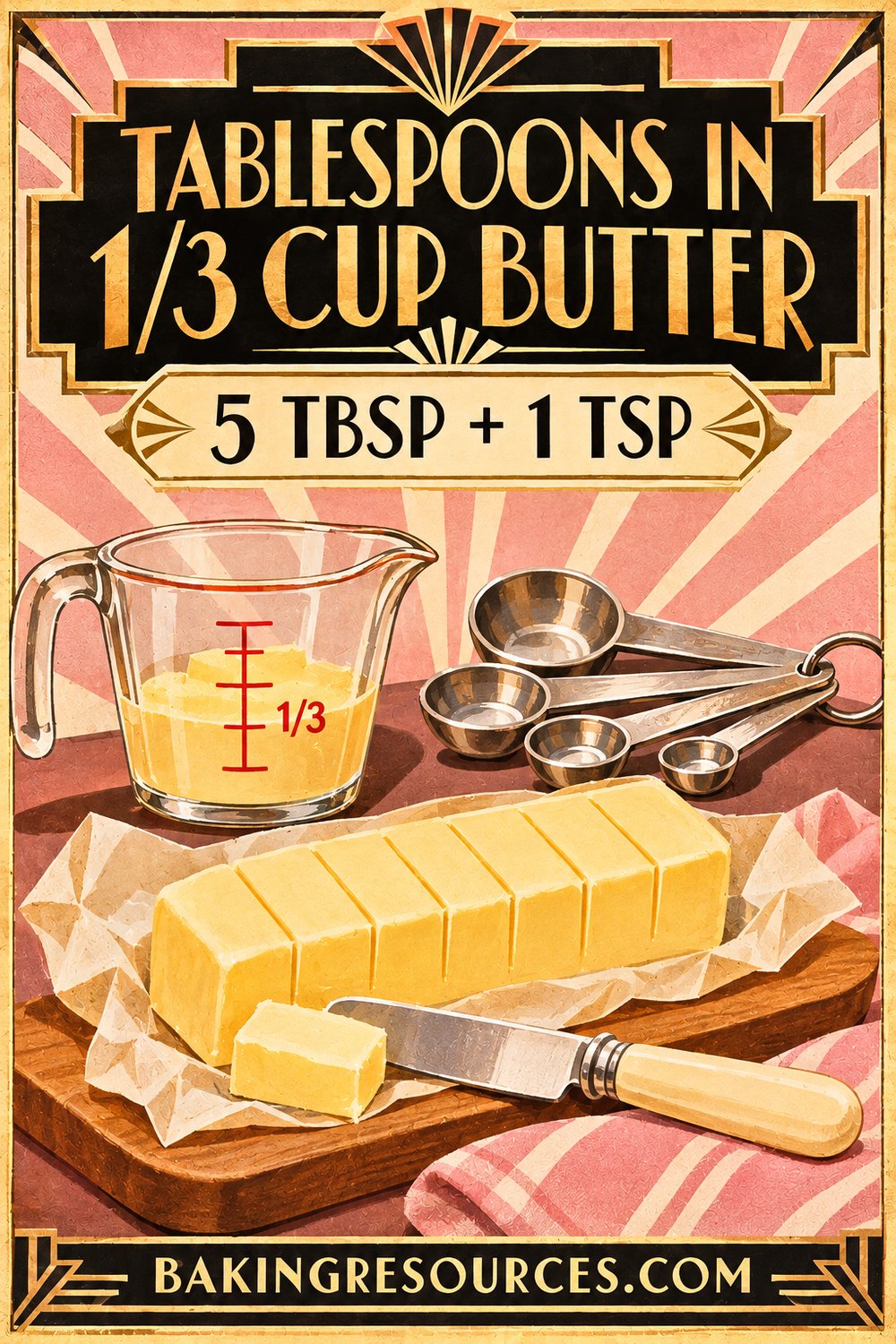
- 1/3 cup of butter = 5 tablespoons + 1 teaspoon (5 1/3 tbsp), about 76 g.
- 1/4 cup of butter = 4 tablespoons (half a stick), about 57 g.
- 2/3 cup of butter = 10 tablespoons + 2 teaspoons (10 2/3 tbsp), about 151 g.
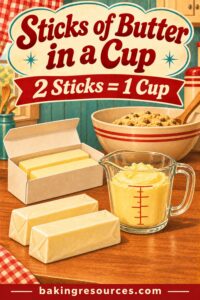
- 1 stick of butter = 1/2 cup = 8 tablespoons = 113 g.
- 1 tablespoon = 3 teaspoons, about 14 g of butter.
- Measure butter cold and solid, then soften or melt it.
How many tablespoons are in 1/3 cup of butter?
There are 5 tablespoons plus 1 teaspoon in 1/3 cup of butter, which is 5 1/3 tablespoons. That is also 16 teaspoons, or about 76 g.
The math is simple. One cup has 16 tablespoons, and 16 divided by 3 is 5 1/3. A tablespoon holds 3 teaspoons, so the leftover third of a tablespoon is exactly 1 teaspoon. Butter does not change with how you scoop it, so the answer is the same every time.
The Baking Resources butter converter uses 8 tablespoons per stick and 113 g per stick, so the numbers on this page match the tool.
How many tablespoons are in 1/4 cup of butter?
There are 4 tablespoons in 1/4 cup of butter, which is half a stick. In grams, that is about 57 g (2 oz).
This is the easiest of the three, because a stick of butter is marked in tablespoons and has a clear halfway line. Cut the stick at the fourth line, and the piece you cut off is 1/4 cup.
How many tablespoons are in 2/3 cup of butter?
There are 10 tablespoons plus 2 teaspoons in 2/3 cup of butter, which is 10 2/3 tablespoons, or about 151 g (5.3 oz). It is one whole stick plus 2 tablespoons and 2 teaspoons from another.
The easiest way is to use a whole stick for 8 tablespoons, then cut 2 more tablespoons from a second stick, and slice off 2 teaspoons more. Another way is to think of 2/3 cup as double the 1/3 cup amount: 2 x (5 tbsp + 1 tsp) = 10 tbsp + 2 tsp.
Butter tablespoons chart for every common fraction of a cup
Here is the whole family of cup fractions in one place, including teaspoons, sticks, grams and milliliters. Find your fraction in the first column and read across.
| Butter | Tablespoons | Teaspoons | Sticks | Grams | Milliliters (mL) |
|---|---|---|---|---|---|
| 1/8 cup | 2 tbsp | 6 tsp | 1/4 stick | 28 g | 30 mL |
| 1/4 cup | 4 tbsp | 12 tsp | 1/2 stick | 57 g | 59 mL |
| 1/3 cup | 5 tbsp + 1 tsp | 16 tsp | 2/3 stick | 76 g | 79 mL |
| 3/8 cup | 6 tbsp | 18 tsp | 3/4 stick | 85 g | 89 mL |
| 1/2 cup | 8 tbsp | 24 tsp | 1 stick | 113 g | 118 mL |
| 5/8 cup | 10 tbsp | 30 tsp | 1 1/4 sticks | 142 g | 148 mL |
| 2/3 cup | 10 tbsp + 2 tsp | 32 tsp | 1 1/3 sticks | 151 g | 158 mL |
| 3/4 cup | 12 tbsp | 36 tsp | 1 1/2 sticks | 170 g | 177 mL |
| 7/8 cup | 14 tbsp | 42 tsp | 1 3/4 sticks | 199 g | 207 mL |
| 1 cup | 16 tbsp | 48 tsp | 2 sticks | 227 g | 237 mL |
For other ingredients, or other cup sizes, the tablespoons to cups and cups to tablespoons pages go through every fraction. For milliliters, see cups to ml.
How do you measure 1/3 cup of butter from a stick?
To measure 1/3 cup of butter, cut 5 tablespoons from a cold stick and add 1 more teaspoon, using the lines on the wrapper. Some wrappers also have a 1/3 cup mark, which is the quickest way if yours does.
| Step | What to do | Result |
|---|---|---|
| 1 | Start with a cold stick, wrapper on | Clean cuts, no smear |
| 2 | Find the 5 tablespoon line and cut straight down | 5 tablespoons (1/3 cup minus 1 tsp) |
| 3 | Cut a thin slice from the next tablespoon, about one-third of its width | 1 teaspoon |
| 4 | Add the slice to the 5 tablespoons | 1/3 cup |
- Keep the stick cold. Soft butter squashes and the wrapper marks move.
- Use a sharp, thin knife. Cut straight down through the paper.
- If the wrapper has no 1/3 cup line, cut at the 5 tablespoon line first.
- For the last teaspoon, look at the width of one tablespoon section. A teaspoon is a third of that. Slice a piece about that wide.
- Peel the paper off and drop the butter into your bowl.
If it is hard to cut that thin, a kitchen scale is easier. Put the bowl on the scale, tare it, and cut butter in until you reach 76 g. That is the whole answer in one step.
How do you measure 1/4 cup and 2/3 cup of butter?
For 1/4 cup, cut the stick at the 4 tablespoon line. For 2/3 cup, use one full stick and add 2 tablespoons plus 2 teaspoons from a second stick. The table sums it up.
| Recipe says | You need | Cut from the stick |
|---|---|---|
| 1/3 cup butter | 5 tbsp + 1 tsp (76 g) | Cut at line 5, add a thin slice |
| 1/4 cup butter | 4 tbsp (57 g) | Half a stick, cut at line 4 |
| 2/3 cup butter | 10 tbsp + 2 tsp (151 g) | 1 full stick, plus 2 tbsp and a thin slice from a second stick |
If your butter comes in a block or tub instead of sticks, pack it into a dry measuring cup, press out air pockets, and level the top. You can also use the water method: fill a liquid measuring cup to 1 cup with water and push butter under the surface until it reads 1 1/3 cups to get 1/3 cup of butter. Our guide on how to measure ingredients has all of the methods.
Worked example: scaling a recipe that uses 1/3 cup of butter
A recipe with 1/3 cup of butter needs 2/3 cup when you double it and 2 tablespoons plus 2 teaspoons when you cut it in half. Here is how that works.
- Original: 1/3 cup = 5 tbsp + 1 tsp = 16 tsp = 76 g.
- Double: 2/3 cup = 10 tbsp + 2 tsp = 32 tsp = 151 g.
- Triple: 1 cup = 16 tbsp = 227 g.
- Half: 8 tsp = 2 tbsp + 2 tsp = 38 g.
Teaspoons are the secret. When you are unsure what to do with fractions, turn the amount into teaspoons first (1/3 cup = 16 tsp), do your multiplying or dividing, and turn it back into tablespoons at 3 tsp each. Our guide on how to scale a recipe shows the rest of the process.
Does it matter if I am off by a teaspoon?
A teaspoon of butter is about 4.7 g, so being off by one teaspoon rarely matters in cookies, bars or sauces. It matters more in delicate bakes like cakes and shortbread, where butter is a big part of the structure.
- Cookies and bars: a teaspoon more or less will not change much. You may notice slightly more spread with extra butter.
- Cakes: try to be accurate to within a teaspoon. Extra butter can make the crumb greasy and heavy.
- Pie crust and biscuits: the butter is what makes them flaky, so measure carefully and keep it cold. See what butter does in baking.
- Sauces and sauteing: a teaspoon is a rounding error. Eyeball it.
What if my butter is soft, melted or from a tub?
Soft and melted butter measure the same by tablespoon as cold butter, but they are harder to measure cleanly. Soft butter squashes and traps air in the spoon, and melted butter is easy to spill.
The best method is to measure butter while it is cold and solid, then soften or melt it. If your butter is already soft, pack it into a measuring spoon with the back of a knife and level it off. For melted butter, it helps to weigh it on a scale in the bowl. Our guide on how to soften butter shows quick safe ways to do it.
Whipped butter and soft tub spreads are different. Whipped butter has air in it, so a tablespoon of it holds less butter than a tablespoon of stick butter. In baking, stick with regular butter, or see the butter substitute in baking page if you need a swap.
Salted or unsalted butter: does it change the tablespoons?
No. Salted and unsalted butter both measure the same, with 8 tablespoons in a stick. The only difference is a little salt, which you can read about in salted vs unsalted butter.
If you use salted butter in a recipe written for unsalted, cut back the added salt by a pinch or two. See how much is a pinch if you want to know how much that is.
Why do recipes use odd amounts like 1/3 cup of butter?
Recipes use odd amounts like 1/3 cup because they were scaled from a bigger batch or tested in grams and then rounded into cups. A recipe that makes 12 muffins might use 1/3 cup of butter, while the 24-muffin version uses 2/3 cup.
That is good news for you. Odd cup amounts are almost always forgiving, because the recipe writer rounded them. If you land within a teaspoon, your bake will turn out fine. When you can, take the grams from the recipe and weigh them, since grams do not need any fraction math at all.
It also helps to keep a small cheat sheet on the fridge: 1/4 cup is 4 tablespoons, 1/3 cup is 5 tablespoons and 1 teaspoon, and 1/2 cup is 8 tablespoons. With those three, you can work out almost anything else by doubling or halving.
Common mistakes with butter tablespoons
- Thinking 1/3 cup is 5 tablespoons. It is a little more, 5 tablespoons plus 1 teaspoon. Five tablespoons is only 1/3 cup minus 1 teaspoon. It is close, but that is the difference.
- Thinking 2/3 cup is 10 tablespoons. It is 10 tablespoons plus 2 teaspoons.
- Using a heaping spoon. Butter should be level. A piled spoon can hold 1 1/2 times as much.
- Confusing a stick with a cup. A stick is 1/2 cup. Two sticks make a cup.
- Measuring a whole stick for 1/3 cup. A stick is 1/2 cup, so a stick is too much. Use 2/3 of a stick.
Quick reference: butter cups to tablespoons
Here is the short answer for the most common amounts.
| Butter | Tablespoons | Teaspoons | Sticks | Grams |
|---|---|---|---|---|
| 1/4 cup | 4 tbsp | 12 tsp | 1/2 | 57 g |
| 1/3 cup | 5 tbsp + 1 tsp | 16 tsp | 2/3 | 76 g |
| 1/2 cup | 8 tbsp | 24 tsp | 1 | 113 g |
| 2/3 cup | 10 tbsp + 2 tsp | 32 tsp | 1 1/3 | 151 g |
| 3/4 cup | 12 tbsp | 36 tsp | 1 1/2 | 170 g |
| 1 cup | 16 tbsp | 48 tsp | 2 | 227 g |
For more conversions, try the butter converter, the kitchen conversion calculator, or the baking conversion chart. If you are about to cream the butter next, see how to cream butter and sugar.
Frequently asked questions
How many tablespoons are in 1/3 cup of butter?
5 tablespoons plus 1 teaspoon (5 1/3 tablespoons). That is 16 teaspoons, or about 76 g.
How many tablespoons of butter are in 1/4 cup?
4 tablespoons, which is half a stick of butter or about 57 g.
How many tablespoons of butter are in 2/3 cup?
10 tablespoons plus 2 teaspoons (10 2/3 tablespoons), which is about 151 g.
How many sticks of butter is 1/3 cup?
Two-thirds of a stick, because a stick is 1/2 cup (8 tablespoons) and 1/3 cup is 5 1/3 tablespoons.
How many sticks of butter is 2/3 cup?
One and one-third sticks, which is 1 whole stick plus 2 tablespoons and 2 teaspoons.
How many tablespoons are in 1/3 of a cup, not butter?
The same, 5 tablespoons plus 1 teaspoon. A tablespoon is a measure of volume, so it holds for water, milk, oil and most other ingredients.
How many grams is 1/3 cup of butter?
About 76 g (2.7 oz), using 227 g per cup.
Can I use 5 tablespoons for 1/3 cup of butter?
Yes, in most recipes. You will be short by 1 teaspoon (about 5 g), which rarely matters in cookies, bars or sauces. In a delicate cake, add the extra teaspoon.