How Many Sticks of Butter Is 1/2, 2/3, 3/4 and 1 Cup?
Free calculator from Baking Resources
Cups of Butter to Sticks Calculator
Pick the cups your recipe asks for and how you will measure.
Need more? Open the free Butter Converter.
More free baking tools


Want more options? Open the full Butter Converter.
- 1 cup of butter = 2 sticks = 16 tablespoons = 8 oz = 227 g.
- 1/2 cup of butter = 1 stick = 8 tablespoons = 4 oz = 113 g.
- 3/4 cup = 1 1/2 sticks = 12 tablespoons = 170 g.
- 2/3 cup = 1 1/3 sticks = 10 tablespoons + 2 teaspoons = 151 g.
- 1/3 cup = 2/3 stick = 5 tablespoons + 1 teaspoon = 76 g.
- 1 lb of butter = 4 sticks = 2 cups = 454 g.
How many sticks of butter is 1 cup?
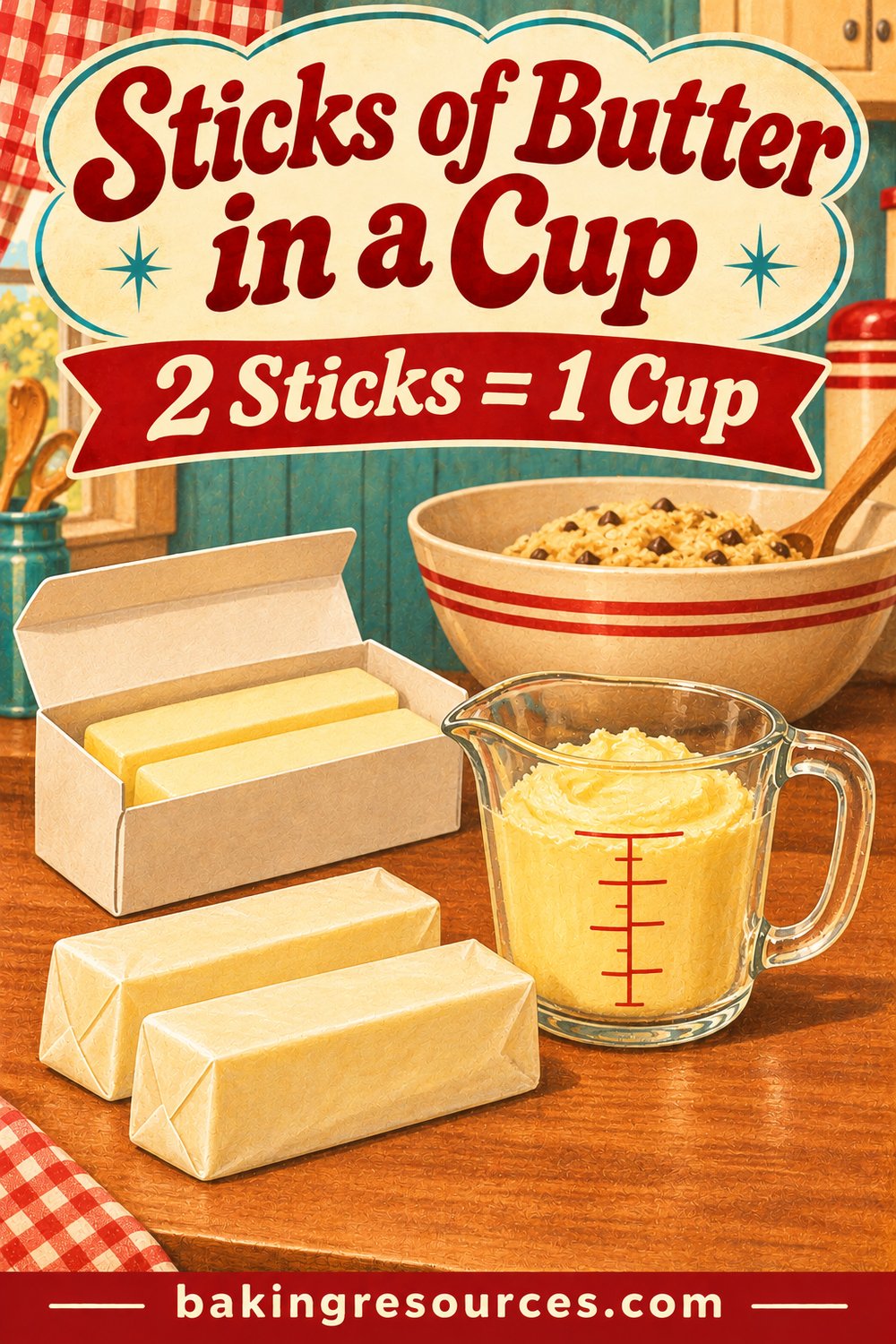
One cup of butter is 2 sticks. A standard US stick is 1/2 cup, so two of them make 1 cup, which is also 16 tablespoons, 8 ounces or 227 g.
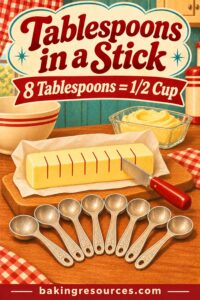
Everything else on this page hangs on one fact: 1 stick = 1/2 cup = 8 tablespoons = 4 oz = 113 g. Once you know that, every cup amount is simple math. The Baking Resources butter converter uses the same numbers, and so does our ingredient weight chart.
Is 1 stick of butter 1/2 cup or 1 cup?
One stick of butter is 1/2 cup, not 1 cup. This is the most common butter mix-up, and it matters.
If a recipe calls for 1 cup of butter and you use only 1 stick, you have half the fat the recipe needs. Cookies turn out dry and cakey, and pie dough won’t hold together.
The reverse mistake is just as bad. Use 2 sticks when the recipe wants 1/2 cup, and cookies melt into thin, greasy puddles. If yours have spread lately, our guide to why cookies go flat starts with this exact problem.
How many sticks of butter is 1/2, 2/3, 3/4 and 1 cup?
1/2 cup of butter is 1 stick, 2/3 cup is 1 1/3 sticks, 3/4 cup is 1 1/2 sticks and 1 cup is 2 sticks. Here is every cup amount you’re likely to see in a recipe, with sticks, tablespoons and weight. Grams are rounded to the nearest gram.
| Cups of butter | Sticks | Tablespoons | Ounces (weight) | Grams |
|---|---|---|---|---|
| 1/4 cup | 1/2 stick | 4 tbsp | 2 oz | 57 g |
| 1/3 cup | 2/3 stick | 5 tbsp + 1 tsp | 2 2/3 oz | 76 g |
| 1/2 cup | 1 stick | 8 tbsp | 4 oz | 113 g |
| 2/3 cup | 1 1/3 sticks | 10 tbsp + 2 tsp | 5 1/3 oz | 151 g |
| 3/4 cup | 1 1/2 sticks | 12 tbsp | 6 oz | 170 g |
| 1 cup | 2 sticks | 16 tbsp | 8 oz | 227 g |
| 1 1/4 cups | 2 1/2 sticks | 20 tbsp | 10 oz | 283 g |
| 1 1/2 cups | 3 sticks | 24 tbsp | 12 oz | 340 g |
| 2 cups | 4 sticks | 32 tbsp | 16 oz (1 lb) | 454 g |
How many sticks of butter is 3/4 cup?
3/4 cup of butter is 1 1/2 sticks, which is 12 tablespoons or 170 g. Use one whole stick, then cut a second stick on the 4 tablespoon line, right in the middle.
This is one of the most searched butter amounts, because lots of cookie and muffin recipes use it. The leftover half stick is 1/4 cup, handy for greasing pans or a quick batch of buttered toast.
How many sticks of butter is 2/3 cup?
2/3 cup of butter is 1 1/3 sticks, which is 10 tablespoons plus 2 teaspoons, or 151 g. This is the tricky one, because it doesn’t land on a wrapper line.
Use one whole stick (8 tablespoons). Then cut a second stick about two thirds of the way between the 2 and 3 tablespoon lines. If you have a scale, just weigh 151 g. That’s faster and exact.
How many sticks of butter is 1/3 cup?
1/3 cup of butter is 2/3 of a stick, which is 5 tablespoons plus 1 teaspoon, or 76 g. Many wrappers print a 1/3 cup mark right where you need to cut, a little past the 5 tablespoon line.
If yours doesn’t, cut about a third of the way from the 5 line toward the 6 line. For melted butter brushed over rolls, 5 tablespoons is close enough. For shortbread or pie dough, where butter is most of the recipe, take the extra teaspoon or weigh it.
How many sticks of butter are in a pound?
A pound of butter is 4 sticks, which is 2 cups, 32 tablespoons or 454 g. A 1 lb box holds 4 sticks, each one a quarter pound.
So if a holiday cookie recipe asks for 1 pound of butter, open a full box. If it asks for 2 cups, that is the same box. Planning a big baking day? Count your boxes by cups: every 2 cups of butter in your recipes is one more box to buy.
How many cups is 1, 2 or 3 sticks of butter?
One stick of butter is 1/2 cup, 2 sticks are 1 cup and 3 sticks are 1 1/2 cups. Going the other way, from sticks to cups, just divide the number of sticks by 2.
| Sticks of butter | Cups | Tablespoons | Grams |
|---|---|---|---|
| 1/2 stick | 1/4 cup | 4 | 57 g |
| 1 stick | 1/2 cup | 8 | 113 g |
| 1 1/2 sticks | 3/4 cup | 12 | 170 g |
| 2 sticks | 1 cup | 16 | 227 g |
| 2 1/2 sticks | 1 1/4 cups | 20 | 283 g |
| 3 sticks | 1 1/2 cups | 24 | 340 g |
| 4 sticks | 2 cups | 32 | 454 g |
If you’d rather think in tablespoons, our tablespoons to cups chart shows that 16 tablespoons make a cup, so 8 make the half cup in each stick.
Worked examples: doubling, halving and tripling butter
To scale butter, multiply the cups first, then divide by 1/2 cup per stick. Here is how that plays out in real recipes.
Doubling 3/4 cup. A cookie recipe calls for 3/4 cup of butter, and you want a double batch for a cookie swap. 3/4 cup x 2 = 1 1/2 cups. Each stick is 1/2 cup, so that is 3 sticks, with no cutting. Check by weight: 3 x 113 g = 339 g, which rounds to 340 g.
Doubling 1 cup. Our chocolate chip cookie recipe uses 1 cup of butter, which is 2 sticks. Double it and you need 2 cups, a full 1 lb box. Halve it and you need 1/2 cup, a single stick.
Halving 2/3 cup. Half of 2/3 cup is 1/3 cup, which is 2/3 of a stick, or 5 tablespoons plus 1 teaspoon. Cut just past the 5 tablespoon line.
Tripling 1/2 cup. A pan of bars needs 1/2 cup of butter, and you’re making three pans for a bake sale. That is 1 1/2 cups, or 3 sticks.
For a whole recipe, the recipe converter scales every ingredient at once, and our guide on how to scale a recipe explains what changes besides the amounts.
Cups of butter in grams, for 250 g blocks
If your butter comes in 250 g blocks, 1 cup of butter (227 g) is about 91 percent of a block. Blocks have no tablespoon marks, so weigh where you can. This table shows how much of a 250 g block each cup amount uses.
| Recipe says | Grams | Share of a 250 g block |
|---|---|---|
| 1/4 cup | 57 g | About 23%, just under a quarter |
| 1/2 cup | 113 g | About 45%, a little under half |
| 3/4 cup | 170 g | About 68%, roughly two thirds |
| 1 cup | 227 g | About 91%, leave 23 g behind |
| 2 cups | 454 g | About 182%, two blocks less 46 g |
A block is an even bar, so a share of its length is the same share of its weight. Cut 45 percent of the way along a 250 g block and you have one stick’s worth, near enough.
Does melted butter change the cup measurement?
A melted stick of butter still weighs 113 g and recipes still treat it as 1/2 cup. The weight never changes, so a scale gives the same answer for cold, soft or melted butter.
The easiest habit: measure the butter by the stick first, then melt it. That saves you scraping a sticky measuring cup. Just remember that recipes choose melted, softened or cold for a reason. Melted butter makes chewier, denser cookies, and creamed soft butter makes lighter ones. Our guide on how to soften butter covers quick ways to get it just right.
Tips for measuring butter by the stick
- Measure cold, then soften. Cut the amount you need while the butter is firm, then let it warm up.
- Skip the measuring cup. Packing butter into a dry cup traps air, so you get less than you think. The wrapper lines or a scale are more accurate; see our kitchen scale vs measuring cups guide.
- Watch out for 250 g blocks. Half a block is 125 g, not the 113 g of a stick.
- Swapping salted for unsalted? Cut about 1/4 teaspoon of salt per stick. Our salted vs unsalted butter guide covers every amount.
- Keep spare sticks in the freezer. Unsalted butter keeps about 6 months frozen, salted about 6 to 9 months, so you’re never short a stick on baking day.
Troubleshooting: when the butter amount went wrong
If a bake turns out greasy or dry, the butter amount is the first thing to check. Here is what each sign usually means.
- If cookies spread thin and greasy, you may have used 2 sticks for 1/2 cup. Next batch, use 1 stick.
- If dough is crumbly and won’t come together, you may have used 1 stick for 1 cup. Add the second stick, softened, and mix again.
- If shortbread tastes greasy and loses its shape, you may have halved a 250 g block for 1/2 cup. That is 12 g too much. Weigh 113 g.
- If a cake is dense, the amount may be right but the butter too warm when creamed. See how to cream butter and sugar.
Myths vs facts about butter cups and sticks
| Myth | Fact |
|---|---|
| 1 stick of butter is 1 cup. | 1 stick is 1/2 cup. 1 cup is 2 sticks. |
| 2/3 cup is about one stick. | 2/3 cup is 1 1/3 sticks; one stick leaves you 2 tbsp + 2 tsp short. |
| A cup of tub spread equals a cup of butter. | Tub spreads hold extra water and air, so they bake differently. |
| A 250 g block is the same as 2 sticks. | 2 sticks are 227 g, so a 250 g block is 23 g more. |
Out of butter altogether? Our butter substitute guide explains which swaps work cup for cup.
Quick reference: sticks of butter in a cup
These are the amounts recipes use most.
| Recipe says | Sticks | Grams |
|---|---|---|
| 1/4 cup | 1/2 | 57 g |
| 1/3 cup | 2/3 | 76 g |
| 1/2 cup | 1 | 113 g |
| 2/3 cup | 1 1/3 | 151 g |
| 3/4 cup | 1 1/2 | 170 g |
| 1 cup | 2 | 227 g |
| 2 cups (1 lb) | 4 | 454 g |
Frequently asked questions
How many sticks of butter is 2 cups?
Four sticks, which is a full 1 lb box. That is 32 tablespoons or 454 g.
How many cups is 2 1/2 sticks of butter?
1 1/4 cups. That is 20 tablespoons, 10 ounces or 283 g.
How many sticks of butter is 1 1/2 cups?
Three sticks. That is 24 tablespoons, 12 ounces or 340 g.
How many cups are in a pound of butter?
Two cups. A pound is 4 sticks, and each stick is 1/2 cup.
How many cups is 3/4 of a stick of butter?
3/8 cup, which is 6 tablespoons or 85 g. On the wrapper, cut on the 6 tablespoon line.
Is half a cup of butter one stick?
Yes. Half a cup of butter is exactly one stick: 8 tablespoons, 4 ounces or 113 g.
How many cups is half a stick of butter?
1/4 cup. Half a stick is 4 tablespoons, 2 ounces or 57 g.
How many grams is 1 cup of butter?
227 g. One cup is 2 sticks of 113 g each, rounded.