How to Thicken Buttercream Frosting (5 Types, 3 Problems)
Free calculator from Baking Resources
Which Fix Thickens My Buttercream?
Pick the frosting and what it looks like, and see the fix.
Need more? Open the free Frosting Calculator.
More free baking tools



Want more options? Open the full Frosting Calculator.
- Chill the bowl 15 to 20 minutes, then re-whip, before you add anything.
- American buttercream: add sifted powdered sugar 1/4 cup (30 g) at a time, at most 1 cup (120 g) extra.
- Meringue buttercream: do not add sugar. Chill, then whip. A curdled look means it is too cold.
- Cream cheese frosting: chill 20 to 30 minutes and stir by hand. Block cream cheese holds best.
- Butter at 65 to 68 F (18 to 20 C) makes the stiffest buttercream. Above 72 F (22 C) it goes soft.
- Add liquid a teaspoon at a time. Powdered sugar weighs about 120 g per cup, spooned and leveled.
How do you thicken buttercream frosting?
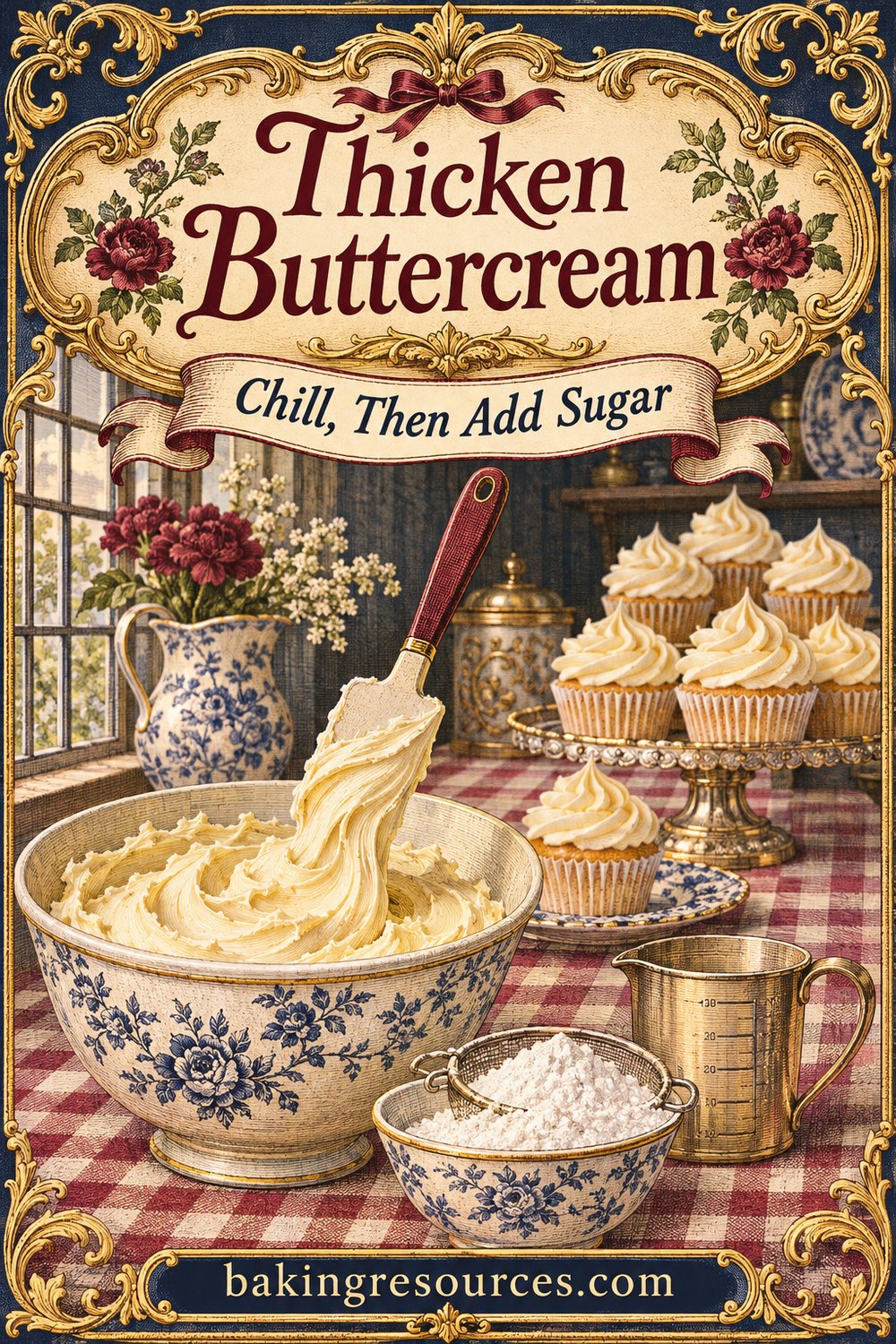
You thicken buttercream frosting by cooling it first and adding dry sugar only if it needs more. Chill the bowl in the fridge for 15 minutes, then beat for 30 seconds. If the frosting still droops off the spatula, sift in 1/4 cup (30 g) of powdered sugar at a time.
Always try cold before sugar. Buttercream is mostly butter, and butter turns soft and shiny above about 72 F (22 C). A warm kitchen, a hot mixer motor or a long beating session can all push the butter past that point. Sugar fixes a recipe problem. Cold fixes a temperature problem, and temperature is the more common one.
Here is the order that works for most batches:
- Look at it. Is it shiny and slick, or just a bit soft? Shiny means warm. Dull and soft means too much liquid.
- Chill 15 minutes. Cover the bowl and put it in the fridge. Do not use the freezer, because the edges freeze hard while the middle stays soft.
- Re-whip. Beat on medium for 30 seconds. It should fluff back up and look matte.
- Add sugar if needed. Sift powdered sugar into the bowl, 1/4 cup (30 g) at a time. Beat 30 seconds between additions.
- Test. Lift the beater. The peak should hold its shape for a few seconds.
If your frosting is thin from the start, our page on why frosting turns runny goes deeper into the causes. This page is the quick set of fixes by frosting type.
How to thicken buttercream icing with powdered sugar
To thicken American buttercream with powdered sugar, add 1/4 cup (30 g) at a time and beat for 30 seconds after each. Powdered sugar weighs about 120 g per cup when spooned and leveled, so 1/4 cup is a small, controlled step. Most soft batches need only 1/4 to 1/2 cup (30 to 60 g) more.
Sift the sugar every time. Lumps will not break down in thick frosting, and you will find them later in the piping tip. A fine-mesh strainer takes 10 seconds.
Watch the sweetness. A usual American buttercream uses 1 cup (227 g) of butter to 3 to 4 cups (360 to 480 g) of powdered sugar. Once you pass about 4 cups, it gets so sweet that it can hurt your teeth. If you need more body than that, switch to chilling or to one of the other fixes below.
| Extra powdered sugar (US) | Weight (g) | What it does to 1 cup (227 g) butter frosting |
|---|---|---|
| 1/4 cup | 30 g | Fixes a slightly soft frosting |
| 1/2 cup | 60 g | Firms a loose frosting so it holds soft peaks |
| 3/4 cup | 90 g | Fixes thin frosting; getting sweet |
| 1 cup | 120 g | Last stop for thin frosting; very sweet |
Need to know how much sugar to buy for a bigger batch? The frosting calculator works out the amounts for the cake or the cupcakes you are making. Our guide on how to soften butter also shows how to get butter to the right 65 to 68 F (18 to 20 C) in the first place.
How do you thicken buttercream without powdered sugar?
You can thicken buttercream without more sugar by chilling it, using colder butter, or adding a small amount of cornstarch, cocoa or meringue powder. The best of these is chilling. It adds nothing, changes nothing in the taste and works on every kind of buttercream.
- Chill the bowl 15 to 20 minutes, then re-whip. This is the first thing to try.
- Beat in cold butter. Add 1 tablespoon of cold, cubed butter at a time. It cools the frosting and adds structure.
- Cocoa powder works for chocolate flavors. 1 tablespoon (about 5 g) sifted in acts as a dry thickener.
- Cornstarch is a last resort. Use 1 tablespoon per 3 cups of frosting, sifted in. Any more can taste chalky.
- Meringue powder adds body to American buttercream. Stir in 1 tablespoon (about 8 g) per 3 cups, and beat for a minute. It is the same ingredient used in royal icing, and our meringue powder substitute page lists what to use if you are out.
One more trick for frosting that sits out: use some high-ratio shortening for part of the butter. A 50/50 mix holds up much better in warm rooms, though you give up the pure butter taste. For outdoor parties, see how to keep buttercream from melting.
How to thicken American buttercream (the classic recipe)
American buttercream is butter beaten with powdered sugar, and it is thickened by chilling and by adding more sugar. It is the easiest type to rescue, since it is sturdy and has little water in it.
If you have not made a batch yet, our guide on how to make buttercream gives the ratios for American, Swiss, Italian, French and German. A good starting point is 1 cup (227 g) butter, 3 to 4 cups (360 to 480 g) sifted powdered sugar, 1 teaspoon vanilla and 1 to 3 tablespoons milk. Add the milk last, a spoonful at a time. You can always thin frosting, and thinning is quicker than fixing a runny batch.
A worked example. You beat 1 cup (227 g) butter and 3 cups (360 g) sugar, then added 3 tablespoons milk because the frosting looked stiff. Now it slumps. The fix is 1/2 cup (60 g) more sugar, beaten in. If it is also shiny, chill 15 minutes first. In 2 minutes you are back to piping texture, with no waste.
How to thicken Swiss or Italian meringue buttercream
Swiss and Italian meringue buttercream thicken with temperature, not with sugar. They are made from cooked egg whites, sugar and a lot of butter, so they are silky and less sweet. Adding powdered sugar to them makes them gritty.
When meringue buttercream looks soupy, the meringue was still warm when the butter went in, or the butter was too soft. Chill the whole bowl for 20 to 30 minutes and whip again. It often looks curdled halfway through. Keep going, and it smooths out.
If it looks curdled and lumpy from the start, it is too cold. Wrap a warm, damp towel around the bowl for 20 to 30 seconds, then whip on medium. Do not heat it in the microwave, because a few seconds is enough to melt the butter and ruin it.
If it is still loose after chilling, beat in cool butter, 1 tablespoon at a time. Each spoonful adds fat that stays solid at room temperature.
How to thicken cream cheese frosting
Cream cheese frosting thickens best by chilling it for 20 to 30 minutes, then stirring in sifted powdered sugar 1/4 cup (30 g) at a time. It is the softest frosting of the group because cream cheese is wet, and it gets looser the more you beat it.
Use full-fat block cream cheese, not the whipped tub kind. The tub style is lighter and softer, and it adds water the frosting never recovers from. Make sure the butter and the cream cheese are cool-soft, not warm. Our how to soften cream cheese page shows the right feel.
Cream cheese frosting needs the fridge, so the thick, chilled version is also the safe version. The cream cheese frosting recipe on this site uses ratios that hold well for spreading on cakes and cinnamon rolls. It is better for spreading than for fine piping work.
How do you thicken chocolate buttercream and whipped cream frosting?
Chocolate buttercream thickens like American buttercream, with chilling first and then a dry ingredient. Sifted cocoa powder is the best choice, since it matches the flavor. Add 1 tablespoon (about 5 g) at a time and beat for 30 seconds. If melted chocolate is the thin part, let it cool to just warm before you beat it in. See our chocolate frosting recipe for a tested ratio.
Whipped cream frosting is a different case. It has no butter to chill, so thickness comes from how long you beat it and how cold it is. Beat cold heavy cream (36 percent fat or more) in a chilled bowl, and stop at stiff peaks. A tablespoon of powdered sugar per cup of cream helps it hold longer. If you beat too far and it looks grainy, fold in a splash of cold cream. Our how to make whipped cream page walks through the stages.
Ganache is also a frosting people thicken. For that, the ratio of cream to chocolate matters most, and we cover it in ganache ratio.
Why does buttercream get too soft in the first place?
Buttercream gets too soft because the butter is too warm, there is too much liquid, or the room is too hot or humid. Knowing which one saves you from fixing it again next time.
| Cause | What you see | Fix |
|---|---|---|
| Butter too warm (over 72 F / 22 C) | Shiny, greasy, slumps | Chill 15 to 20 minutes, re-whip |
| Too much milk or cream | Dull, wet, loose | Add 1/4 cup (30 g) sugar at a time |
| Warm, humid kitchen | Soft again an hour later | Chill the cake between steps |
| Over-beating | Gets loose, warm bowl | Rest in the fridge, then stir by hand |
| Melted butter in the recipe | Will not whip stiff | Start over with cool, soft butter |
| Warm meringue added to butter | Soupy meringue buttercream | Chill 20 to 30 minutes, whip |
Humidity matters too. In damp weather, powdered sugar pulls water out of the air and frosting loosens. Our page on baking in humid weather has the fixes. Food coloring can also thin frosting. Gel color is much stronger than liquid, so it adds less water, as we explain in gel vs liquid food coloring.
What if buttercream is too thick instead?
If buttercream is too thick, beat in milk or cream 1 teaspoon at a time until it spreads. Stiff buttercream tears cake crumbs and is hard to pipe, so a small amount of liquid helps a lot. Go slowly, since a teaspoon too much puts you back at the start.
Other fixes for stiff frosting: let it sit out for 10 minutes if it is cold, or beat it on medium for 30 seconds to warm it with friction. Cold frosting from the fridge needs about 30 minutes at room temperature, then a quick beat, before it is usable. Never microwave the whole bowl. A few seconds on a small scoop of frosting, stirred back in, is the safe way.
When the frosting is ready, our guide on how to frost a cake shows the crumb coat and smooth finish. For storing leftover frosting, check how to store frosting.
Common mistakes when thickening buttercream
- Adding sugar before cooling. It makes the frosting sweet but not stiff if the butter is warm.
- Using a warm mixer bowl. A bowl straight from the dishwasher is a hidden heat source. Use a room-temperature bowl.
- Adding sugar in big scoops. You overshoot and end up thinning with milk, which starts the cycle again.
- Using the freezer. It freezes the edges and leaves the center loose. The fridge is gentler and more even.
- Beating on high. Fast beating adds heat and large air bubbles. Medium speed is better.
- Skipping the sift. You get grit, which our page on why buttercream turns grainy explains.
Quick reference: thickening buttercream by type
| Frosting | First fix | If still soft | Do not |
|---|---|---|---|
| American buttercream | Chill 15 minutes, re-whip | Add 1/4 cup (30 g) powdered sugar at a time | Add more milk |
| Swiss or Italian meringue | Chill 20 to 30 minutes, whip | Beat in 1 tablespoon cool butter at a time | Add powdered sugar |
| Cream cheese frosting | Chill 20 to 30 minutes | Stir in 1/4 cup (30 g) sugar, up to 1/2 cup (60 g) | Over-beat it |
| Chocolate buttercream | Chill 15 minutes, re-whip | Sift in 1 tablespoon (5 g) cocoa | Add hot melted chocolate |
| Whipped cream frosting | Chill bowl, beat to stiff peaks | Add 1 tablespoon powdered sugar per cup | Beat past stiff peaks |
Frequently asked questions
How do you thicken buttercream frosting fast?
Chill the bowl in the fridge for 15 minutes, then beat for 30 seconds. If it is still soft, add 1/4 cup (30 g) of sifted powdered sugar at a time. For American buttercream, those two moves fix most batches.
How do you thicken buttercream without adding more sugar?
Chill it. Butter firms up when cold, and cold is what makes buttercream stiff. Set the bowl in the fridge for 15 to 20 minutes, then re-whip. You can also stir in a tablespoon of cornstarch, but too much leaves a chalky taste, so try cold first.
Can you use cornstarch to thicken buttercream?
You can, in a pinch. Use 1 tablespoon of cornstarch per 3 cups of frosting, sifted in with the sugar. Powdered sugar already holds a little cornstarch, so extra can taste dry or starchy. Chilling or more powdered sugar is better.
How do you thicken buttercream icing for piping?
Make it stiff enough that a peak stands up on its own. Beat in sifted powdered sugar, 1/4 cup (30 g) at a time, then chill the filled piping bag for 10 minutes. A cool bag holds sharp petals and shells.
How do you thicken cream cheese frosting?
Chill it for 20 to 30 minutes first, then add 1/4 cup (30 g) sifted powdered sugar at a time, up to 1/2 cup (60 g). Use block cream cheese, not tub-style. Do not over-beat, because beating makes cream cheese looser.
Why is my buttercream soupy after I added milk?
Extra liquid is a common cause. Butter cannot hold much water, so even 2 tablespoons too many can make it slump. Add powdered sugar to bring the texture back, and add milk only a teaspoon at a time.
Can you fix split or curdled buttercream?
Yes, almost always. If it looks soupy, it is too warm, so chill and re-whip. If it looks lumpy and curdled, it is too cold, so warm the outside of the bowl with a warm towel and whip. Meringue buttercream does this often and it recovers.
How stiff should buttercream be for decorating cakes?
For frosting a cake, you want soft peaks that spread easily, like soft butter. For piping flowers, shells and borders, you want a stiffer frosting that holds a sharp peak. Thin a stiff batch with milk a teaspoon at a time if you need it softer.