How to Get Rid of Muffin Top on Muffins (Fill Level and Temp)
Free calculator from Baking Resources
Muffin Top Fixer: Fill Level and Bake Time
Pick your pan, how full you fill it and your oven temperature.
Need more? Open the free Baking Time Calculator.
More free baking tools



Want more options? Open the full Baking Time Calculator.
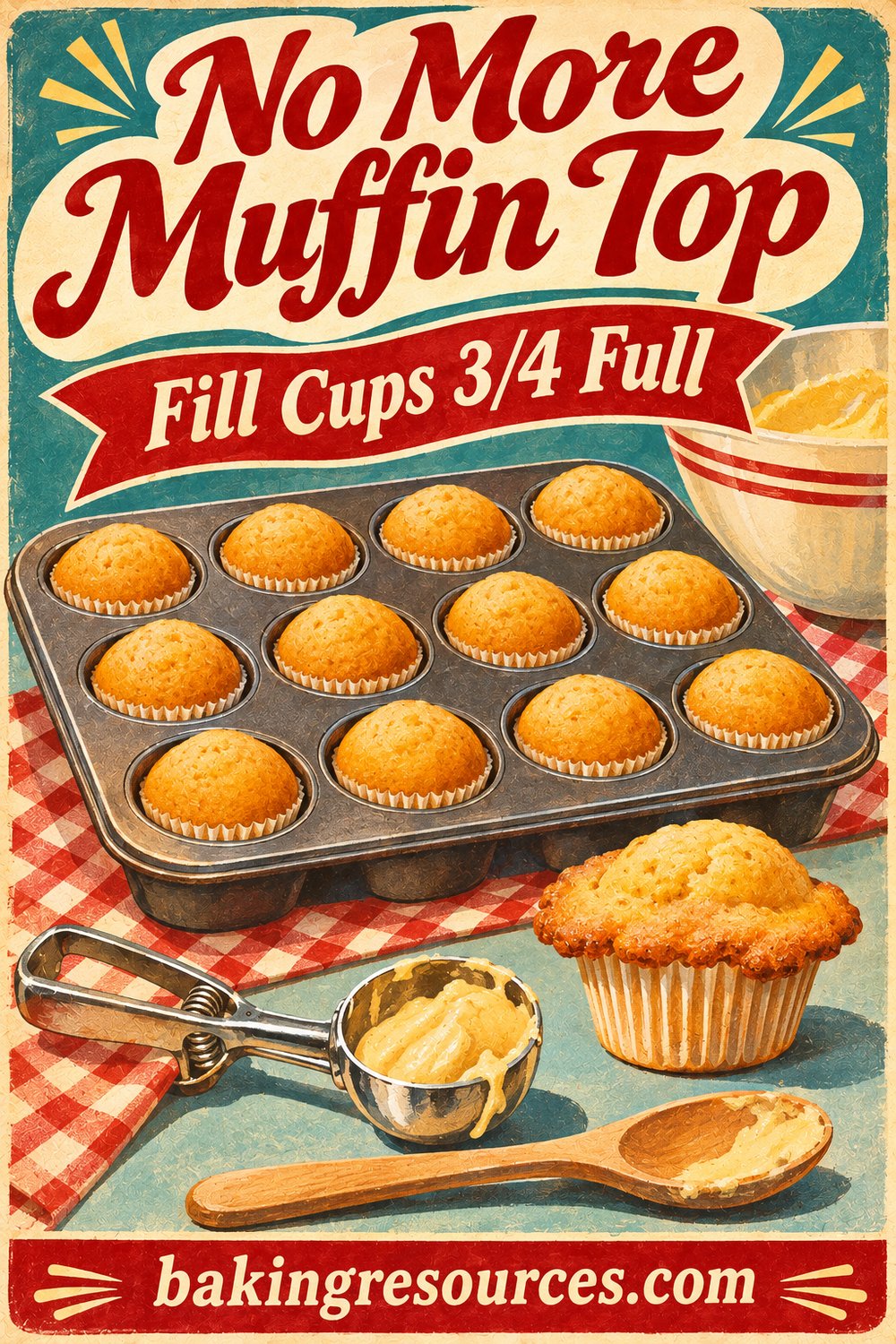
- A muffin top (the wide lip that spills over the pan) comes from overfilling. Fill standard muffin cups about 3/4 full, which is about 1/4 cup (60 ml) of batter.
- Filling to the rim, about 1/3 cup (80 ml), gives a tall crown. Mounded batter, about 1/2 cup (120 ml), spills into a flat lip.
- Standard muffins bake at 375°F (190°C) for 18 to 22 minutes. Mini muffins take 10 to 13 minutes, and jumbo muffins take 24 to 30 minutes.
- Most muffin batters use 1 to 1 1/2 teaspoons of baking powder per cup (125 g) of flour. More than that makes batter rise fast, then spill.
- Stir muffin batter only until the dry streaks vanish. Overmixing makes peaked, tough muffins.
- If you already have muffin tops, trim them with a serrated knife or kitchen scissors, and keep the pieces for snacking.
This page is about baked muffins. If you came looking for the other kind of muffin top, we are sorry to say that we only know about batter and baking pans. In baking, a muffin top is the wide, flat crown that spills over the edge of the pan and bakes into a lip. Some people love it. If you want neat, domed muffins that lift out cleanly, here is how to get them.
How do you get rid of muffin top when baking muffins?
To get rid of muffin top, fill the muffin cups only about 3/4 full (about 1/4 cup or 60 ml of batter for a standard cup), bake at 375°F (190°C), and stir the batter just until the flour disappears. The batter then has room to rise up into a dome instead of flowing sideways over the pan.
A muffin top forms when batter rises faster than it can set. The batter climbs over the rim, spreads across the flat metal and bakes into a thin skirt. Four things control it:
- How full the cups are. This is the biggest factor, by far.
- How thick the batter is. Thin batter spreads, thick batter holds its shape.
- How much leavening it has. Too much baking powder or soda lifts it too fast.
- Oven heat. A hotter oven sets the edges quickly, so batter rises up, not out.
Each of these is easy to fix. The calculator above covers the first one for each pan size, and the sections below go through the rest.
How full should you fill muffin cups?
Fill standard muffin cups about 3/4 full, which is about 1/4 cup (60 ml) of batter. Mini muffin cups take about 1 1/2 tablespoons (22 ml), and jumbo cups take about 3/4 cup (180 ml). Filling to the rim gives a taller crown and fewer muffins, and anything above the rim spills over.
| Pan | Half full | 3/4 full (best for neat muffins) | Level with the rim | Mounded (spills over) |
|---|---|---|---|---|
| Mini (24-cup) | 1 tbsp (15 ml) | 1 1/2 tbsp (22 ml) | 2 tbsp (30 ml) | 3 tbsp (45 ml) |
| Standard (12-cup) | 3 tbsp (45 ml) | 1/4 cup (60 ml) | 1/3 cup (80 ml) | 1/2 cup (120 ml) |
| Jumbo (6-cup) | 1/2 cup (120 ml) | 3/4 cup (180 ml) | 1 cup (240 ml) | 1 1/4 cups (300 ml) |
The easiest way to get an even fill is a spring-loaded scoop. A 1/4 cup scoop (a number 16 scoop) fills a standard cup three-quarters full, and a 1/3 cup scoop (a number 12) fills it to the rim. Level the scoop, drop it in and do not mound. If you do not have a scoop, a 1/4 cup dry measure works, too. Our scoop size calculator lists the scoop sizes by cup. For the same idea with cupcakes, see how much batter per cupcake.
A full-to-the-rim fill gives the tall, bakery-style top, and it can work if the batter is thick and the oven is hot. It also means fewer muffins: a recipe that makes 12 at 3/4 full makes about 9 at the rim. If your recipe says “makes 12” and your cups spill, you are probably overfilling each cup, because the recipe counted on about 1/4 cup each.
Why do my muffins have a muffin top that spills over?
Muffins spill over because the cups are overfilled, the batter is too thin, or the leavening is too strong. The top spreads over the flat pan rim, and the extra batter bakes into a lip that can weld the muffin to the pan.
| What you see | Likely cause | Fix |
|---|---|---|
| Wide, flat lip over the pan | Cups overfilled (mounded) | Fill to 3/4 full; use a 1/4 cup scoop |
| Lip, and the muffin sinks in the middle | Too much baking powder or soda | Use 1 to 1 1/2 tsp baking powder per cup (125 g) flour |
| Wide but low tops | Batter too thin, or oven too cool | Add 2 to 3 tablespoons flour; bake at 375°F (190°C) |
| Spill plus peaks and tunnels | Overmixed batter | Stir 10 to 15 strokes only, until streaks vanish |
| Spill from a jumbo recipe in a standard pan | Wrong pan size | Match fill to the pan, or use fewer cups |
| Muffins stuck to the pan top | Lip glued down | Grease the flat top of the pan, or cool 5 minutes, then run a knife around |
Most of these come down to the same idea: batter that is the right thickness, in the right amount, with the right heat. For a closer look at how leavening works, see our baking soda vs baking powder guide.
Does oven temperature change the muffin top?
Yes. A hotter oven (375 to 400°F or 190 to 205°C) sets the outside of the muffin faster, so the batter rises up into a dome instead of flowing out. A cooler oven (350°F or 175°C) gives flatter, wider, paler tops, which can spill more if the cups are too full.
| Muffin size | 350°F (175°C) | 375°F (190°C) | 400°F (205°C) |
|---|---|---|---|
| Mini (24-cup pan), 3/4 full | 12 to 15 min | 10 to 13 min | 8 to 11 min |
| Standard (12-cup pan), 3/4 full | 20 to 25 min | 18 to 22 min | 15 to 19 min |
| Jumbo (6-cup pan), 3/4 full | 27 to 33 min | 24 to 30 min | 21 to 26 min |
These are the same times as our how long to bake muffins guide. Fill levels change them. A rim-full cup adds about 1 to 3 minutes for standard muffins and about 3 for jumbos. A half-full cup takes less time, so begin checking 2 to 4 minutes early.
The bakery trick for a tall dome is a hot start: bake at 425°F (220°C) for the first 5 minutes, then lower to 350°F (175°C) for the rest. It lifts the top fast. If you do not want any lip, combine the hot start with a 3/4 fill, not a mounded fill, or the dome will become a mushroom. If your oven is uneven, our guide on baking evenly can help. Not sure what the dial is really doing? Use the oven temperature conversion tool to double-check settings.
How do you make the batter the right thickness?
Muffin batter should be thick and lumpy, falling from a spoon in a heavy ribbon instead of pouring. If it pours like pancake batter, it will spread out over the pan. Add 2 to 3 tablespoons of flour, or let it rest 15 to 30 minutes, which allows the flour to absorb liquid and thicken on its own.
- Measure flour well. One cup of flour is 125 g when you spoon it into the cup and level it, but scooping can pack in 145 g or more. Extra flour makes dry muffins, and too little makes thin batter. Our guide to how to measure flour shows the right way, and the grams to cups converter helps with recipes in grams.
- Rest the batter. A 15 to 30 minute rest at room temperature gives a slightly thicker batter and a better dome.
- Do not add extra liquid. Juicy fruit and zucchini release water as they bake. Pat them dry.
- Fold in add-ins last. Toss berries in a spoonful of flour so they do not sink or bleed.
How much baking powder is too much?
Most muffins need 1 to 1 1/2 teaspoons of baking powder per cup (125 g) of flour. More than 2 teaspoons per cup makes the batter rise too fast and collapse, which can send it up and over the cup before it sets, and leave a bitter taste.
Check your recipe before blaming your technique. If a recipe uses a whole tablespoon of baking powder for 2 cups of flour, that is 1 1/2 teaspoons per cup, at the upper limit. If you also add baking soda to an acidic ingredient such as buttermilk, you have two leaveners doing the same job.
Old baking powder is the other side of the coin: it makes flat, wide muffins that lack lift. Test it by stirring 1 teaspoon into 1/2 cup (120 ml) of hot water. It should bubble right away. See how long baking powder lasts for more, and baking powder substitute if you run out.
How do you stop muffins from sticking when they spill?
To stop spilled muffins from sticking, grease or spray the flat top surface of the pan as well as the cups, or use paper liners. After baking, cool the pan for 5 minutes, then run a thin knife around each muffin to cut the lip free.
- Spray only the top of the pan if you use paper liners. The batter in the liners will not touch the pan.
- Do not wait too long. A lip left to cool fully in the pan hardens like candy, especially with sugary batters.
- Fill empty cups in a partly filled pan with 2 tablespoons of water. This protects the pan and keeps the heat even.
- Use a sturdy metal pan, and grease it properly.
Not sure if metal or silicone is better? See silicone vs metal bakeware to compare.
How to fix muffins that already have a muffin top
If your muffins already have a lip, let them cool in the pan for 5 minutes, then slide a thin knife around the edge. Cut off the extra lip with a serrated knife, a pizza cutter or kitchen scissors, and you will have a tidy muffin and a baker’s snack.
- Cool the pan on a rack for 5 minutes. Muffins are fragile when hot.
- Run a thin knife or offset spatula under the lip to free it from the pan.
- Lift the muffins onto a rack to finish cooling.
- Trim the skirt. Cut it flush with the sides of the muffin, using a gentle sawing motion.
- Use the scraps. Crumble them over yogurt, fold them into a trifle, or toast them with a little butter.
Spilled lips are not a failure. Bakeries sell muffin tops by themselves because many people like the crisp, caramelized edge best. If that is you, bake a batch on purpose: see the section below.
How do you make a muffin top on purpose?
To make wide, crisp muffin tops, use a muffin top pan, or fill a standard pan with 1/3 cup (80 ml) of batter per cup and bake at 375°F (190°C) for 18 to 22 minutes. Using the same batter in shallow wells gives the crown with less cake underneath.
The same ideas work in reverse. For a bigger lip, fill the cups fuller, bake at a slightly cooler 350°F (175°C), and use a slightly thinner batter. Bakery-style muffins also use a hot start. Muffin batter and quick bread batter share the same doneness signs, so our guide to how to tell if banana bread is done helps here too.
Why are my muffins dry or flat as well?
Dry muffins come from too much flour or too much mixing, and flat muffins come from old leavening or underfilled cups. If your muffins spill and are also dry, measure flour by weight, stir less and shorten the bake time by 2 to 3 minutes.
These problems have their own guides. See why are my muffins dry, what overmixing does, and blueberry muffins recipe for a full bake with tall, domed tops. Keep leftovers fresh with our guide to freezing muffins.
Quick reference: avoid a muffin top
| Question | Answer |
|---|---|
| Fill level for neat muffins | About 3/4 full |
| Batter per standard cup | About 1/4 cup (60 ml) |
| Scoop to use | 1/4 cup (number 16) |
| Oven temperature | 375°F (190°C) |
| Bake time, standard | 18 to 22 minutes |
| Baking powder | 1 to 1 1/2 tsp per cup (125 g) flour |
| Mixing | Until dry streaks vanish, no more |
| Rest the batter | 15 to 30 minutes |
| Cool before removing | 5 minutes in the pan |
| Fix an existing lip | Trim with a serrated knife or scissors |
For more on timing, use the baking time calculator. If you want a muffin recipe to practice on, the bakery style blueberry muffins are designed for tall, domed tops.
Frequently asked questions
How do I get rid of muffin top on my muffins?
Fill the cups only 3/4 full, about 1/4 cup (60 ml) for a standard pan. Do not mound the batter, bake at 375°F (190°C), and mix just until combined.
What is a muffin top in baking?
It is the crown of a muffin, or the wide flat lip that spills over the edge of the pan when the cups are overfilled. Bakeries also sell the tops on their own, baked in shallow muffin top pans.
Why do my muffins overflow the pan?
Overfilled cups, thin batter, or too much baking powder. Fill to 3/4, thicken the batter with a spoonful or two of flour, and check the baking powder amount.
Should I fill muffin cups to the top?
Only if you want tall, domed muffins and you are using a thick batter. For neat muffins without a lip, stay at 3/4 full. Rim-full gives about 9 muffins from a recipe that says 12.
Does a hotter oven make a bigger muffin top?
A hot oven (375 to 400°F or 190 to 205°C) gives a taller dome, because the outside sets quickly and the middle pushes upward. A cooler oven makes flatter, wider tops that spread more.
How do I keep muffin tops from sticking to the pan?
Grease the flat surface of the pan, not only the cups, or use paper liners. Cool for 5 minutes before running a knife around each muffin.
How do I cut off a muffin top?
Use a serrated knife, scissors or a pizza cutter, and cut flush to the side of the muffin after it has cooled for about 10 minutes. Save the pieces for snacking.
How much batter goes in a jumbo muffin cup?
About 3/4 cup (180 ml) for a neat dome, and no more than 1 cup (240 ml). A jumbo muffin takes 24 to 30 minutes at 375°F (190°C).