Can You Bake Cookies on Aluminum Foil?
Free calculator from Baking Resources
Can I Bake These Cookies on Foil?
Pick your cookie and the foil you have.
Need more? Open the free Cookie Scoop Calculator.
More free baking tools



Want more options? Open the full Cookie Scoop Calculator.
- Cookies bake fine on aluminum foil set on a baking sheet at the usual 350 to 375°F (175 to 190°C).
- Check 1 to 2 minutes earlier than the recipe’s time on parchment; bottoms brown faster on foil.
- Buttery doughs need no grease; thin, sticky or low-fat doughs need lightly greased or nonstick foil.
- Shiny or dull side up makes no real difference on regular foil; on nonstick foil, the coated side goes up.
- Never bake on foil without a pan, and don’t line the oven floor with foil.
Can you bake cookies on aluminum foil?
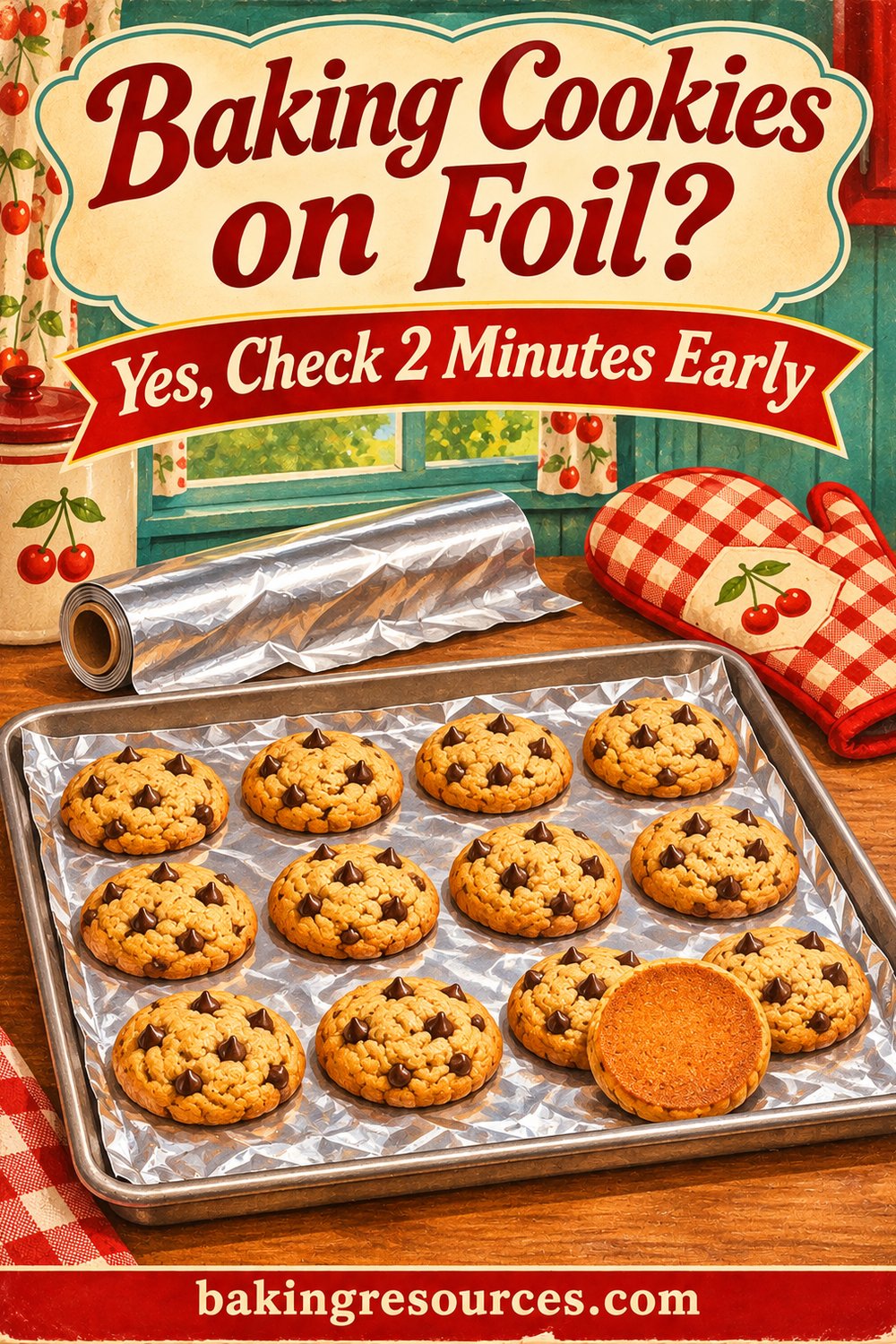
Yes, you can bake cookies on aluminum foil, as long as the foil sits on a baking sheet and you check the cookies 1 to 2 minutes early. Foil is a common stand-in when you run out of parchment, and it’s safe at normal baking temperatures. It just behaves a bit differently.
Foil is thin metal, so it passes heat straight from the pan into the bottom of the cookie. Parchment slows that heat a little, and a silicone mat slows it a lot. The result on foil: bottoms brown faster, edges set a bit sooner, and cookies can stick if the dough is lean or sugary. None of that is a problem once you know to grease when needed and pull the tray a little early.
Is it safe to bake cookies on aluminum foil?
Yes, it’s safe to bake cookies on aluminum foil, because household foil is made for cooking and holds up well past the 350 to 375°F (175 to 190°C) most cookies need. Foods that are very acidic or salty, like tomato sauce, can pull a small amount of aluminum from foil, which is why some people avoid using it for those. Cookie dough isn’t acidic, so that isn’t a concern here.
The real safety rules are about how you use it. Always set the foil on a baking sheet, not straight on the oven rack, where flimsy foil can sag and drip butter onto the oven floor. And don’t line the bottom of your oven with foil. Many oven makers warn against it because it can block airflow and damage the finish.
Do you grease aluminum foil for cookies?
You only need to grease aluminum foil for thin, sticky or low-fat cookies; buttery doughs like shortbread and chocolate chip release on their own after 5 minutes of cooling. Foil has no coating, so whether cookies release comes down to how much fat is in the cookie itself.
- No grease needed: shortbread, butter cookies, most chocolate chip and peanut butter cookies, cut-out sugar cookies. They have enough butter to release once they cool for a few minutes.
- Grease lightly: thin crisp cookies, oatmeal raisin, jam or toffee cookies, and low-fat recipes. A light film of butter or baking spray is enough.
- Skip foil if you can: meringues and lace cookies. They stick hard. Parchment or a silicone mat is the better choice.
Greasing also adds spread. That’s fine for drop cookies but blurs the edges of cut-out shapes. If your cookies are already spreading too much, see how to stop cookies spreading before adding grease.
Which side of the foil should face up for cookies?
For regular foil, either side can face up, because the shiny and dull sides bake cookies almost exactly the same. The two finishes come from how the foil is rolled at the factory, and the difference in heat is too small to notice in a cookie.
Nonstick foil is the exception. Only one side is coated, and the package tells you which. Put the coated side up, touching the dough.
Regular vs heavy-duty vs nonstick foil for cookies
Heavy-duty foil is the best plain foil for cookies because it lies flat and resists wrinkles, while nonstick foil is the best for sticky doughs. Regular foil works too; just smooth it carefully.
| Foil type | Lies flat | Release | Best for |
|---|---|---|---|
| Regular | Wrinkles easily | Fair; grease for lean doughs | Buttery drop cookies |
| Heavy-duty | Yes | Fair; grease for lean doughs | Cut-outs, sliding sheets on and off pans |
| Nonstick | Yes | Very good, coated side up | Sticky, thin or sugary cookies |
Foil vs parchment vs silicone mat vs bare pan
On foil, a drop cookie bakes about 1 to 2 minutes faster than on parchment and comes out with a darker bottom. Here’s how the same cookie behaves on each surface, all on a light aluminum sheet at 350°F.
| Surface | Bottom color | Spread | Sticking | Bake time vs parchment |
|---|---|---|---|---|
| Parchment paper | Even light gold | Normal | None | Same |
| Plain foil | Darker, crisper | Normal | Some, with lean doughs | 1 to 2 min shorter |
| Greased foil | Darker | A little more | Rare | 1 to 2 min shorter |
| Nonstick foil | Darker | Normal | Rare | 1 to 2 min shorter |
| Silicone mat | Pale, soft | More | None | 1 to 2 min longer |
| Bare greased pan | Darkest | Most | Rare | About 1 to 2 min shorter |
For a closer look at parchment and mats, see parchment paper vs silicone mat.
Does pan color matter when you bake cookies on foil?
Yes, pan color matters even with foil on top: a dark pan under foil can brown cookie bottoms 2 to 3 minutes sooner than a light pan. Foil is too thin to block the extra heat a dark pan soaks up.
- Light aluminum pan: the best partner for foil. Check 1 to 2 minutes early.
- Dark or nonstick pan: lower the oven 25°F (about 15°C), or check 2 to 3 minutes early.
- Insulated pan: browning evens out, so the usual time usually works.
Our guide to silicone vs metal bakeware explains how pan material changes browning.
How to bake cookies on foil, step by step
To bake cookies on foil, smooth the foil flat on a cool baking sheet, grease only if the dough is lean, bake on the middle rack, and check 1 to 2 minutes early.
- Set the foil on a cool baking sheet and smooth out every wrinkle. Creases print onto the cookie and make hot spots.
- Grease only if your dough is lean, sticky or thin.
- Scoop or cut evenly sized cookies so they finish together.
- Bake on the middle rack. See which oven rack to use if your oven browns unevenly.
- Check 1 to 2 minutes before the recipe’s earliest time.
- Cool a few minutes before lifting, then finish cooling on a rack.
A handy foil trick for big batches: scoop the next batch onto a second sheet of foil while the first bakes. When the tray comes out, slide the baked cookies off on their foil and let the pan cool a few minutes before sliding the new sheet on. Never put dough on a hot pan. It starts melting and spreading before it reaches the oven. For more ways to keep batches even, see how to bake evenly in your oven.
Worked example: chocolate chip cookies on foil
A chocolate chip cookie that bakes 10 to 12 minutes at 350°F on parchment needs checking at 8 to 9 minutes on foil. Here’s how it goes with our chocolate chip cookie recipe when you only have foil.
- Prep: tear a sheet of foil to fit the pan and smooth it flat with your hand. No grease. The dough is buttery.
- Time: 10 to 12 minutes minus 1 to 2 means checking at 8 to 9 minutes.
- Rack: middle. A low rack plus foil is the fastest way to scorch the bottoms.
- At 9 minutes: edges golden, centers soft and puffy. Lift one with a spatula. The bottom is golden brown, so they’re done.
- Cool: 5 minutes on the foil, then move to a rack. If they cling, give them another minute. They release as they firm up.
Not sure what “done” looks like? How to tell when cookies are done walks through the signs.
Worked example: cut-out sugar cookies on foil
Cut-out sugar cookies rolled 1/4 inch (6 mm) thick bake on plain, ungreased foil just fine; check them about 1 minute early. Say your sugar cookie recipe calls for 8 to 10 minutes at 350°F.
- Foil: heavy-duty, smoothed perfectly flat, no grease, so the edges stay sharp.
- Chill: cut the shapes, set them on the foil and chill the whole sheet 15 minutes.
- Bake: check at 7 minutes. Pull them when the edges are set and the bottoms just turn light gold.
- Cool: 5 minutes on the foil, then slide each one off with a thin spatula.
Troubleshooting cookies baked on foil
The two most common foil problems are burnt bottoms and sticking, and both have quick fixes.
| If this happens | Why | Do this next batch |
|---|---|---|
| Bottoms too dark | Foil passes heat fast | Check 2 minutes early, use the middle rack, or a light pan |
| Cookies stuck | Lean or sugary dough | Grease the foil, use nonstick foil, or cool 2 to 3 minutes longer |
| Foil pieces stuck to the bottoms | Lifted while hot, or thin foil tore | Cool first; use heavy-duty foil |
| Wavy, uneven bottoms | Wrinkled foil | Smooth it flat before scooping |
| Cookies spread too much | Greased foil or warm pan | Skip the grease and start with a cool pan |
More fixes for dark bottoms are in why cookies burn on the bottom.
Myths vs facts about baking on foil
The most common myth is that the shiny side of foil must face down; in fact, on regular foil the two sides bake cookies the same.
- Myth: foil works just like parchment. Fact: foil browns bottoms faster and can stick. Parchment is gentler.
- Myth: foil can replace the baking sheet. Fact: foil alone is too flimsy. Always use a pan underneath.
- Myth: greasing always helps. Fact: grease makes buttery cookies spread more and blurs cut-out edges.
- Myth: foil makes cookies bake much faster. Fact: only about 1 to 2 minutes faster than parchment.
Mistakes to avoid
The biggest mistake is baking the full recipe time, because cookies on foil usually finish 1 to 2 minutes sooner and burnt bottoms follow.
- Foil with no pan underneath. It bends, cookies slide, and butter drips onto the oven floor.
- Wrinkled foil. Uneven bottoms, uneven browning.
- Peeling cookies off too hot. Hot cookies are soft and tear. A few minutes of rest makes them release cleanly.
- Reusing hot foil. Dough on hot foil starts melting before it’s in the oven.
Quick reference: baking cookies on aluminum foil
This table sums up how to bake the most common cookies on aluminum foil.
| Cookie | Grease the foil? | Best foil | Time change vs parchment |
|---|---|---|---|
| Chewy drop cookies | No | Any, nonstick best | 1 to 2 min shorter |
| Thin and crisp cookies | Yes, lightly | Nonstick | 1 to 2 min shorter |
| Shortbread, butter cookies | No | Plain or nonstick | 1 to 2 min shorter |
| Cut-out sugar cookies | No | Heavy-duty or nonstick | About 1 min shorter |
| Sticky cookies (oatmeal raisin, jam, toffee) | Yes | Nonstick | 1 to 2 min shorter |
| Meringues | Use parchment or a silicone mat instead | ||
Frequently asked questions
Can I bake cookies on tin foil?
Yes. What people call tin foil today is aluminum foil. Set it on a baking sheet and check the cookies 1 to 2 minutes early.
Do cookies stick to aluminum foil?
Buttery cookies usually release once they cool a few minutes. Thin, sticky or low-fat cookies can stick, so grease the foil or use nonstick foil.
Is it better to bake cookies on foil or parchment paper?
Parchment gives more even, lighter bottoms and never sticks, so it’s the better first choice. Foil works well when you watch the time.
Can you bake cookies on foil without a pan?
It’s not a good idea. Foil alone is too flimsy, the cookies can slide, and butter can drip onto the oven floor.
Does foil make cookies bake faster?
A little. Foil passes heat straight into the bottoms, so plan on 1 to 2 minutes less than the recipe’s time on parchment.
Can you bake cookies with aluminum foil instead of parchment paper?
Yes. Use it the same way, smoothed flat on the pan, grease it for lean or sticky doughs, and check the cookies a little early.
Which side of aluminum foil is nonstick?
Regular foil has no nonstick side. On nonstick foil, the coated side is marked on the box and goes up, touching the dough.