Bleached vs Unbleached Flour: What’s the Difference?
Free calculator from Baking Resources
Bleached or Unbleached Flour Checker
Pick what you are baking and the all-purpose flour you have.
Need more? Open the free Ingredient Weight Chart.
More free baking tools



Want more options? Open the full Ingredient Weight Chart.
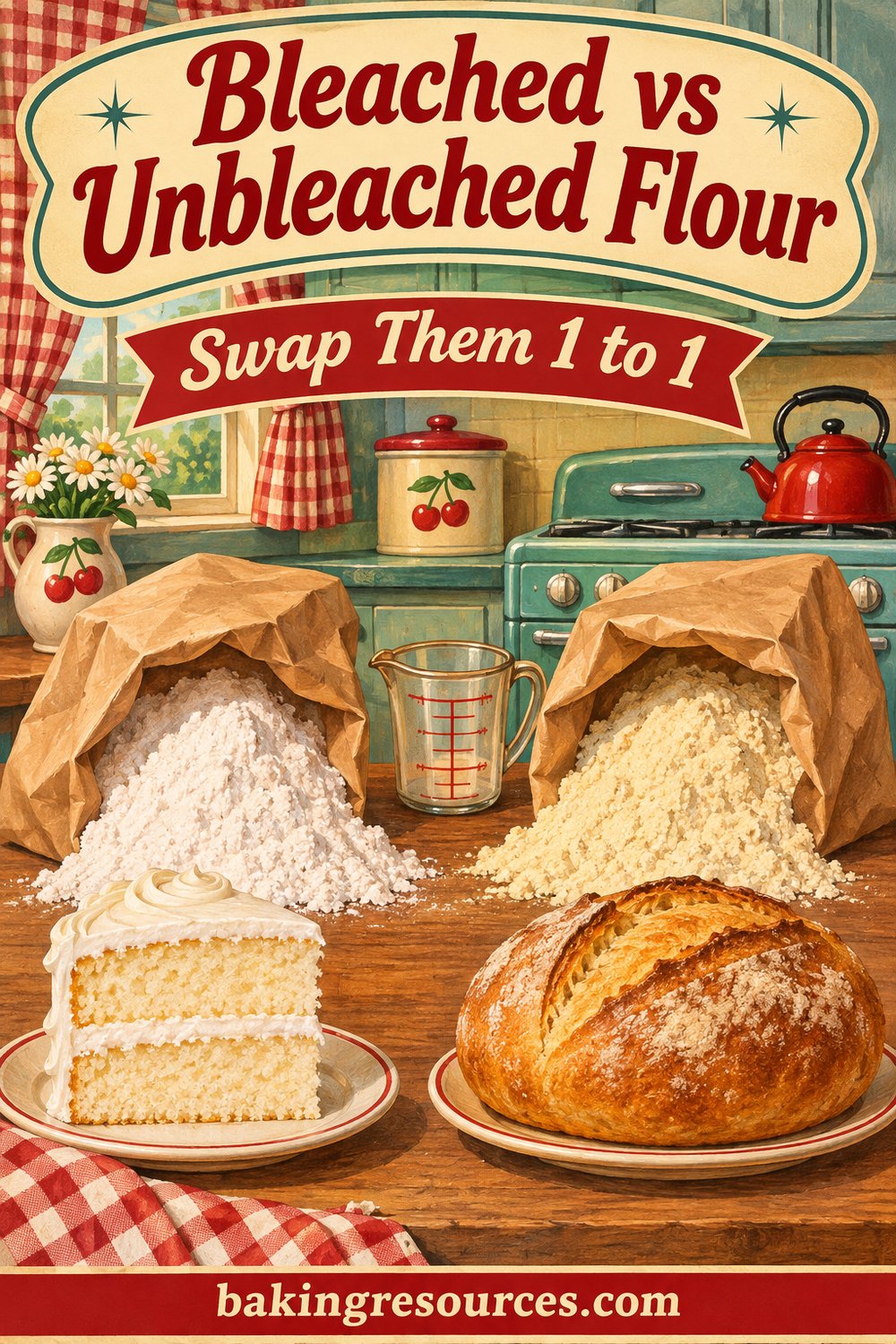
- Bleached and unbleached all-purpose flour both weigh 125 g (4.4 oz) per cup, spooned and leveled.
- They swap 1:1 by cup or by weight in almost any recipe.
- Both all-purpose types run about 10 to 12 percent protein.
- US bleached all-purpose is usually treated with benzoyl peroxide; cake flour is often chlorine-treated.
- Bleached cake flour (114 g per cup) is not a 1:1 match for unbleached cake flour in very sweet cakes.
- Neither kind is safe to eat raw; bleaching does not kill germs.
What’s the difference between bleached and unbleached flour?
The difference between bleached and unbleached flour is how it is aged: bleached flour is whitened in a day or two with a bleaching agent, while unbleached flour ages naturally over a few weeks. Fresh flour is a little yellow and makes weak dough. As it rests in air, it whitens on its own and its gluten (the stretchy network that gives dough structure) gets stronger.
In the US, bleached all-purpose flour is usually treated with benzoyl peroxide, which mostly just changes the color. Cake flour is often treated with chlorine gas, which also changes how the flour bakes. Both agents are allowed by the FDA for use on flour.
Here is how the two all-purpose flours compare side by side.
| Bleached all-purpose | Unbleached all-purpose | |
|---|---|---|
| Color | Bright white | Creamy, off-white |
| How it’s aged | Fast, with a bleaching agent | Slowly, by resting in air |
| Texture in the bag | Very fine and soft | Fine, a little less silky |
| Typical protein | About 10 to 12 percent | About 10 to 12 percent |
| Weight per cup (spooned and leveled) | 125 g (4.4 oz) | 125 g (4.4 oz) |
| Baked crumb | Softer, whiter, more tender | A bit firmer, with more wheat flavor |
| Best for | Layer cakes, pie crust, biscuits, pancakes | Yeast bread, pizza, rolls, cookies |
| Works for everything else? | Yes | Yes |
Protein is the number that really predicts how flour bakes, and it varies more between brands than between bleached and unbleached. To check yours, look at the nutrition label. About 3 g of protein per 30 g serving is a softer flour, and 4 g per 30 g is a stronger one. Our guide to types of flour sorts every flour by protein if you want the bigger picture.
Can you use unbleached flour instead of bleached flour?
Yes, you can use unbleached all-purpose flour instead of bleached, cup for cup or gram for gram. Both weigh about 125 g per cup when spooned and leveled, so nothing else in the recipe needs to change.
Expect small changes in looks more than taste. Cakes come out a shade more golden and slightly firmer. Cookies brown a little more. Most people at the table will never know.
Can you use bleached flour instead of unbleached?
Yes, bleached all-purpose flour swaps 1:1 for unbleached in any recipe. If a bread recipe asks for unbleached and you have bleached, use it. The loaf will still rise and bake, just a little softer and less chewy.
For pizza and crusty bread, you can help bleached flour along. Knead a couple of minutes longer and give the dough its full rise. If chew really matters, our bread flour vs all-purpose guide explains when bread flour is worth buying.
Bleached vs unbleached cake flour: the one swap that matters
Bleached cake flour is the one case where bleached vs unbleached really changes the result. Chlorine-treated cake flour soaks up liquid differently and sets faster in the oven, which lets very sweet, tender cakes hold their shape.
| Bleached cake flour | Unbleached cake flour | |
|---|---|---|
| Protein | About 7 to 9 percent | About 7 to 9 percent |
| Weight per cup | About 114 g | About 114 g |
| Treatment | Usually chlorine | None |
| High-sugar layer cakes | Tall, fine, stays risen | May sink in the middle |
| Sponge, chiffon, angel food | Very good | Good |
A high-sugar cake made with unbleached cake flour can sink in the middle. Use a recipe written for unbleached cake flour, or make your own cake flour from all-purpose and cornstarch. Our cake flour substitute gives the amounts for any size batch.
Which flour is best for cakes, cookies and bread?
Bleached all-purpose is slightly better for tender cakes and pie crust, unbleached is slightly better for yeast bread and pizza, and either works for cookies and muffins. Here is the breakdown.
- Layer cakes and cupcakes: Bleached gives a softer, whiter crumb, which is why many classic cake recipes call for it. Unbleached works fine, just a touch denser and more golden.
- Cookies: Either one. Unbleached cookies come out a little more golden and chewy. Bleached cookies are slightly paler and softer. If yours spread too much, flour usually isn’t the cause; see how to stop cookies spreading.
- Muffins, pancakes and quick breads: Either one. These are mixed so briefly that the small difference disappears.
- Pie crust and biscuits: Bleached makes a slightly more tender crust. Unbleached works well too. Rest the dough in the fridge so it rolls without shrinking. Our all-butter pie crust recipe works with both.
- Yeast bread, rolls and pizza: Unbleached is the better pick. It builds a bit more stretch and has a fuller wheat flavor.
Are other flours bleached or unbleached?
Most bread flour and all whole wheat flour are unbleached, while cake flour is usually bleached. The label always tells you. Here is what you’ll usually find on US shelves.
| Flour | Usually sold as | Notes |
|---|---|---|
| All-purpose | Both | Swap 1:1, 125 g per cup |
| Cake flour | Mostly bleached | Unbleached versions exist; see above |
| Bread flour | Mostly unbleached | Bleached versions exist and still work |
| Pastry flour | Mostly unbleached | Can be made from all-purpose and cake flour |
| Self-rising flour | Often bleached | Has baking powder and salt added |
| Whole wheat flour | Unbleached | Bran and germ keep it brown |
Need pastry flour? Our pastry flour substitute mixes all-purpose and cake flour 2 to 1.
Worked example: a cake recipe that wants bleached flour
If a cake recipe calls for 2 1/2 cups of bleached all-purpose and you only have unbleached, use 2 1/2 cups (312 g) of unbleached. Here are the steps, plus an optional tweak for a softer crumb.
- Measure the same amount. 2 1/2 x 125 g = 312 g. That is the same weight the bleached flour would be.
- Bake it as written if you’re happy with a slightly sturdier, more golden cake. It will be good.
- Or soften it. Take out 2 tablespoons of flour per cup and add 2 tablespoons of cornstarch. For 2 1/2 cups, that’s 5 tablespoons swapped. Whisk them together well, or sift; see how to sift flour.
- Measure with care. Spoon the flour into the cup and level it. Scooping straight from the bag can pack in 20 g or more extra per cup. Our guide on how to measure flour shows the right way.
Worked example: pizza dough with bleached flour
If a pizza dough recipe wants unbleached flour and you have bleached, use the same amount and give the dough a little more kneading. Say the recipe uses 3 cups (375 g) of flour.
- Use 3 cups (375 g) of bleached all-purpose, no change in water.
- Knead 1 to 2 minutes longer than the recipe says, until the dough is smooth and springs back when poked.
- Let it rise fully. If you can, rest it in the fridge overnight; slow rising builds more flavor.
- Expect a softer, more tender crust. It’s still a great pizza.
Our pizza dough recipe walks through the full method.
Is bleached flour safe to eat?
Yes, bleached flour is safe to bake with: the bleaching agents used on US flour are approved by the FDA for flour and are used in very small amounts. The main effects you’ll notice are color and texture, not anything you can taste in a finished bake.
One safety point applies to both kinds. Bleaching does not kill germs, so neither bleached nor unbleached flour is safe to eat raw. The FDA and CDC advise against tasting raw dough or batter made with flour, since raw flour can carry harmful bacteria. Bake it first.
If you’d rather avoid bleached flour, look for the word “unbleached” on the bag. Flour sold in the UK and the European Union is not chlorine-bleached, which is one reason cake recipes from there are built a little differently.
Does bleached or unbleached flour last longer?
Bleached and unbleached white flour keep about the same time when stored well. Both are refined, so they last far longer than whole wheat flour, whose natural oils can turn stale.
Store either kind in an airtight container in a cool, dry spot, away from the stove. Our guide on how to store flour covers pantry and freezer times and how to keep bugs out.
Troubleshooting: when the swap didn’t go as planned
If a bake turned out differently after a flour swap, the cause is usually measuring or mixing, not bleaching. Here’s what to check.
- If your cake is dense or dry, you may have scooped instead of spooned. Weigh 125 g per cup next time. Our guide to why a cake turns out dense covers other causes.
- If a very sweet cake sank, you may have used unbleached cake flour in a recipe built for bleached. Use the all-purpose and cornstarch mix instead.
- If cookies look a little darker than usual, that’s normal with unbleached flour. Pull them a minute earlier if you like them pale.
- If bread is soft and squat with bleached flour, knead longer and let it rise fully, or switch to bread flour next time.
- If pie dough shrinks in the pan, rest it 30 minutes in the fridge before rolling and again before baking.
Myths vs facts about bleached and unbleached flour
| Myth | Fact |
|---|---|
| Unbleached flour weighs more per cup. | Both all-purpose types weigh 125 g per cup, spooned and leveled. |
| Bleached flour is a different type of flour. | Bleached all-purpose is still all-purpose; only the aging method differs. |
| Bleaching makes flour safe to eat raw. | It doesn’t. Raw flour of any kind should be baked before eating. |
| You need different recipes for each. | For all-purpose, the same recipe works with either. |
| Unbleached is always better. | Bleached has a small edge in tender cakes and pie crust. |
Mistakes to avoid
- Using more unbleached flour to “make up” for it. The weight per cup is the same. Adding extra makes dry, tough bakes.
- Swapping unbleached cake flour into a high-sugar cake. Very sweet, very tender cakes count on chlorine-treated cake flour to hold up.
- Mixing up “unbleached” and “self-rising.” Unbleached describes how flour was aged. Self-rising flour has baking powder and salt added. If your recipe wants self-rising, see how to make self-rising flour.
- Converting grams to cups by guesswork. Use our grams to cups converter when a recipe gives flour in grams.
Quick reference: bleached vs unbleached flour
| You’re baking | Better pick | Can you swap 1:1? |
|---|---|---|
| Layer cake, cupcakes | Bleached all-purpose | Yes |
| Very sweet, high-ratio cake | Bleached cake flour | Not with unbleached cake flour |
| Cookies | Either | Yes |
| Muffins, quick bread, pancakes | Either | Yes |
| Pie crust, biscuits | Bleached, slightly | Yes |
| Yeast bread, rolls, pizza | Unbleached | Yes, a bit softer |
Frequently asked questions
Is bleached or unbleached flour better?
Neither is better for everything. Bleached all-purpose has a slight edge in tender cakes and pie crust. Unbleached has a slight edge in yeast bread and pizza. For cookies, muffins and most everyday baking, use whichever you have.
Is unbleached flour the same as all-purpose flour?
Unbleached all-purpose flour is all-purpose flour. “Unbleached” only tells you it was aged naturally. You can also find unbleached bread flour and unbleached cake flour.
Can I use unbleached flour for cake?
Yes, swap it 1:1. The cake will be a little firmer and more golden. For a softer crumb, replace 2 tablespoons per cup with cornstarch.
Can I use bleached flour for bread?
Yes. The bread will rise and bake fine, just a bit softer with less chew. Unbleached or bread flour gives a chewier loaf.
Why is unbleached flour off-white?
Wheat has natural yellow pigments. Unbleached flour keeps a little of that creamy color, while bleaching turns it bright white.
Does bleached flour taste different?
Barely. Some bakers notice a slightly flatter flavor in plain bakes like white bread, but in cakes and cookies it is hard to tell.
How much does a cup of bleached or unbleached flour weigh?
Both weigh about 125 g (4.4 oz) per cup when spooned and leveled. Scooping straight from the bag packs in more.