What Is Lamination in Pastry?

Short answer to what is lamination in pastry: it's the technique of trapping a solid sheet of butter inside a sheet of dough, then rolling and folding the two together so the butter splits into hundreds of paper-thin layers separated by paper-thin layers of dough. In the oven the water in that butter turns to steam, the steam has nowhere to go but up, and it blows the dough layers apart into the flakes you see in a croissant or a palmier.
No chemical leavening is involved. No yeast is required either, though croissants use both. The lift comes from the butter's own water, which is why butter temperature is most of the technique.
Roll-in butter is usually sold as an unmarked block, so weigh it rather than guessing. Our free butter converter turns sticks, cups and tablespoons into grams and shows you where to cut a 250 g block.
Updated September 2026
What is lamination in pastry, exactly? The two components
Every laminated dough is built from two separate things that get married together.
| Component | French name | What it is | Job |
|---|---|---|---|
| The dough | détrempe | Flour, water or milk, salt, a little fat, sometimes yeast | The structure. It has to stretch without tearing |
| The butter | beurrage (or butter block) | Butter pounded and rolled into a flat, even slab | The barrier and the steam source |
The whole craft is keeping those two at the same firmness at the same time. If the butter is harder than the dough, it shatters into shards and the layers break. If the butter is softer than the dough, it smears into the flour and the layers vanish.
That's it. Everything else on this page is downstream of that one sentence.
How the layer count multiplies
Lamination is exponential, and that's the part that surprises people. You are not adding layers, you are multiplying them.
Two folds do almost all the work in Western pastry:
- The letter fold (single turn): fold the dough in thirds like a business letter. Multiplies layers by 3.
- The book fold (double turn): fold both ends to the middle, then close it like a book. Multiplies layers by 4.
Start with one sheet of butter enclosed in dough. After each fold, multiply.
| Folds completed | Letter folds only (x3) | Book folds only (x4) | What this is typically used for |
|---|---|---|---|
| 1 | 3 | 4 | Nothing yet, the butter is still a slab |
| 2 | 9 | 16 | Rough puff halfway |
| 3 | 27 | 64 | Croissants and danish |
| 4 | 81 | 256 | Rough puff, blitz puff |
| 5 | 243 | 1,024 | Rarely used |
| 6 | 729 | 4,096 | Classic puff pastry |
Bakers count butter layers, so "729 layers" for a six-turn puff means 729 sheets of butter and 730 sheets of dough sandwiched around them.
Worked example: how thin is one layer of puff pastry?
Take a classic puff rolled out to a final thickness of 3 mm before baking, with 6 letter folds behind it.
- Butter layers: 3 to the power of 6 = 729
- Dough layers: 729 + 1 = 730
- Total layers: 1,459
- Thickness of one layer: 3 mm ÷ 1,459 = about 0.002 mm, which is roughly 2 micrometers
Two micrometers is thinner than a sheet of kitchen foil by a wide margin. That is why a single warm fingerprint or one aggressive rolling pass wrecks a laminated dough: at that scale, the dough and butter sheets have almost nothing holding them apart.
It also explains why more folds is not better. Push past about 7 letter folds and the butter layers get so thin that they merge into the dough, and you end up with what pastry chefs call bread, not puff. Six is the classic number for a reason.
The three families of laminated pastry
Not everything laminated is puff pastry. The differences come down to three things: is there yeast, how much butter, and how many folds.
Classic puff pastry (pâte feuilletée). No yeast. Roughly equal weights of roll-in butter and flour. Six letter folds. Rises purely on steam and can more than triple in height. Used for vol-au-vents, palmiers, mille-feuille and turnovers.
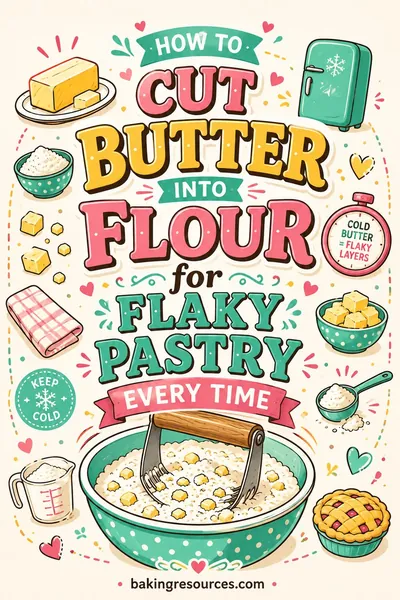
Rough puff (blitz puff). No yeast. Instead of enclosing a butter block, you cut cold butter into the flour in large flat pieces, add water, and start folding immediately. Four folds is typical. You get maybe 60 to 70 percent of the rise of a classic puff for about 20 percent of the work. Very good for tarts and pot pie lids. The technique for getting the butter into the flour in usable pieces is the same one covered in how to cut butter into flour.
Yeasted laminated dough (croissants, danish, kouign-amann). Yeast plus lamination. Only three letter folds, because the yeast is doing part of the lifting and too many layers would collapse under proofing. Enriched with milk, sugar and egg, which makes the dough softer and the lamination harder.
There is also a fourth family worth naming: water dough laminations like Chinese flaky pastry and Indian parathas, where a soft oil or ghee paste replaces the butter block. Same principle, different fat.
Temperature: the whole ballgame
Butter is only workable inside a narrow band. Outside it, lamination fails in one of two predictable ways.
| Butter temperature | Behavior | What happens in the dough |
|---|---|---|
| Under 50°F | Hard and brittle, snaps when bent | Shatters into shards. Layers break, butter pokes through |
| 55 to 65°F | Plastic. Bends without cracking, does not smear | This is the working window |
| 68 to 72°F | Soft, shiny, smears under a finger | Absorbs into the dough. No layers form |
| Above 90°F | Melting, oil separating | Greasy, dense pastry. Butter pools in the pan |
The test bakers use is simple: bend a corner of the butter block. If it cracks, it's too cold. If it leaves a greasy mark on your finger, it's too warm. If it bends into a curve and stays there, it's ready.
The dough has to match. A cold stiff détrempe against soft butter squeezes the butter out the sides. A warm slack détrempe against cold butter tears. Both should feel about equally firm when you press them.
Practical rules that follow from this:
- Rest in the fridge, not the freezer, between folds. Fridge temperature (38 to 40°F) firms the butter without freezing it hard. 30 to 45 minutes is usually enough.
- If your kitchen runs above 75°F, work in shorter bursts and put the dough back in the fridge more often. Two folds then a rest, rather than trying to power through.
- A cold work surface helps a lot. Marble or a chilled sheet pan flipped upside down both work.
- Never microwave or warm a butter block to soften it. How to soften butter covers the safe methods, though for lamination you want it firm, not soft in the creaming sense.
The lamination process, step by step
This is the generic sequence. Specific doughs vary in resting times and fold counts, but the order never changes.
- Make the détrempe and rest it. The dough needs a rest, usually at least an hour cold, so the gluten relaxes. A tight dough fights the rolling pin and springs back.
- Make the butter block. Pound cold butter with a rolling pin between two sheets of parchment until it's pliable, then roll it to an even square or rectangle. Even thickness matters more than exact dimensions.
- Match the temperatures. Both components go back in the fridge until they feel equally firm. This step is skipped constantly and it's the main cause of failure.
- Enclose (the lock-in). Roll the dough larger than the butter, set the butter on it, and fold the dough over to seal the butter completely. No gaps, no trapped air pockets.
- Roll and fold. Roll in one direction only, to roughly three times the length, then fold. Brush off loose flour before folding, or it creates dry seams.
- Rest, rotate, repeat. Chill 30 to 45 minutes between folds. Turn the dough 90 degrees before each new roll so it stretches evenly in both directions.
- Final rest, then shape. A minimum 1 hour cold rest before cutting keeps the layers from pulling out of shape.
- Cut cleanly. A sharp knife or pizza wheel in one press. Sawing or pressing with a dull blade seals the layer edges shut and they cannot open in the oven.
- Bake hot. Steam has to be generated fast, before the fat melts and runs out. Puff pastry usually goes in at 400 to 425°F. Yeasted laminated doughs start around 400°F and often drop to 375°F once the layers have set.
A note on the flour. Laminated doughs need enough protein to survive repeated rolling without tearing, but not so much that they fight back. All-purpose is usually fine, and many bakers use a blend with a little bread flour. Bread flour vs all-purpose covers the protein difference and what it does.
Worked example: sizing a butter block from an unmarked block
Roll-in butter is almost always sold as a plain block outside the US, and the numbers don't line up the way people assume.
- A 250 g European block is not 2 US sticks. Two sticks are 227 g.
- If your method calls for 1 cup of roll-in butter, that's 227 g, which is about 91 percent of a 250 g block. Cut just under the halfway point of the last quarter, or weigh it.
- Halving the 250 g block to get "one stick" gives you 125 g instead of 113 g, which is about 11 percent too much fat. In a butter block that extra fat has to go somewhere, and it goes out the sides during the first roll.
Higher-fat European style butter (82 to 86 percent fat versus the 80 percent US minimum) is genuinely better for lamination, because less water means a more pliable block that cracks less when cold. That's one of the few places the premium block earns its keep, as covered in what does butter do in baking.
Troubleshooting laminated dough
| What went wrong | Most likely cause | Fix next time |
|---|---|---|
| Butter leaked out during baking | Butter was too warm, or the seal broke and butter reached the edge | Chill longer between folds. Seal the lock-in completely, no butter at the cut edges |
| No layers, dense and bready | Butter smeared into the dough, or too many folds | Keep everything colder. Stop at 6 letter folds for puff, 3 for croissants |
| Layers on one side only | Uneven butter block, or rolling from the center outward unevenly | Roll the butter to a truly even thickness. Roll dough in one direction, rotate 90 degrees each turn |
| Dough springs back and won't roll | Gluten is tight from not enough rest | Rest cold 30 more minutes. Never force it, you'll tear the butter layers |
| Butter cracked and poked through | Butter too cold and brittle | Let the block sit 5 to 10 minutes before rolling. Pound it pliable first |
| Pastry shrank badly in the oven | Not enough rest after shaping | Rest the cut shapes cold for 30 minutes before baking |
| Pale and soft on the bottom | Oven not hot enough, or the pan absorbed too much heat | Bake hotter, and preheat fully. Use a light metal sheet, not glass |
| Croissants proofed then collapsed | Proofed too warm, so butter melted before the bake | Proof at 75 to 78°F maximum. Above 80°F the butter starts leaking |
One more that catches everyone: flour left between the folds. Every time you brush loose flour off before folding, you're preventing a dry, chalky seam that refuses to separate. Use a dry pastry brush, not your hand.
Can you freeze laminated dough?
Yes, and it's one of the best reasons to make it at home, since the work is front-loaded.
- Freeze after the final fold, before shaping. Wrap tightly, freeze flat, and it keeps well for a couple of months. Thaw overnight in the fridge, never on the counter.
- Freeze shaped and unproofed for yeasted doughs. Thaw in the fridge overnight, then proof as normal.
- Do not freeze proofed croissants. The structure collapses on thaw.
Wrapping technique is the same as for any butter-heavy dough, and how to freeze pie dough covers the double-wrap that stops freezer burn.
Frequently asked questions
How many layers does puff pastry have?
Classic puff pastry with six letter folds has 729 butter layers and 730 dough layers, because each letter fold multiplies the count by three. Rough puff with four folds has 81 butter layers. Croissants have only 27, since the yeast provides part of the lift and more layers would collapse during proofing.
What is the difference between a letter fold and a book fold?
A letter fold folds the dough in thirds like a letter going into an envelope, multiplying layers by three. A book fold brings both ends to the center then closes the whole thing, multiplying by four. Book folds build layers faster with fewer rolling passes, which means less handling and less chance of warming the butter, but they're harder to keep even.
Why is butter leaking out of my croissants?
Either the butter was too warm when you laminated, or the proof was too warm. Butter starts flowing around 90 to 95°F, and a proofing box above 80°F is already pushing it. Some butter loss during baking is normal and even a sign of good lamination, but a pool in the pan means the layers broke before the oven set them.
Do I need European butter for lamination?
You don't need it, but it helps more here than anywhere else in baking. European style butter runs 82 to 86 percent fat against the 80 percent US minimum, so it holds less water and stays pliable at a colder temperature. That means it cracks less during the first roll and gives you a wider working window. For cakes and cookies the difference is hard to detect.
What's the difference between rough puff and real puff pastry?
Real puff encloses a single solid butter block and gets six folds, so the layers are uniform and the rise is dramatic and even. Rough puff starts with large flat pieces of cold butter cut into the flour and gets about four folds, so the layers are irregular. It rises less and less evenly, but it takes a fraction of the time and is more than good enough for tart bases, turnovers and pie lids.
How long does laminated dough need to rest between folds?
Usually 30 to 45 minutes in the fridge, and the goal is two things at once: firm the butter back up and let the gluten relax. If the dough is fighting the rolling pin, it needs more rest, not more force. In a hot kitchen you may need a rest after every single fold rather than every two.
Can you laminate dough without a rolling pin?
Not really, and not well. Lamination depends on rolling the whole sheet to an even thickness in one direction, which hands and bottles can't do consistently. A straight wooden or French style pin is the standard tool. What you can skip is the marble slab, since a chilled upside-down sheet pan does the same job.
Why did my laminated pastry come out tough instead of flaky?
Too much water, too much gluten development, or butter that vanished into the dough. Laminated doughs are mixed only until they come together, never kneaded like bread, since the folding itself develops plenty of gluten. If the butter smeared instead of staying in sheets, you get a tough, bready result rather than flakes. Why is my pie crust tough covers the same failure in an unlaminated crust.
Related guides: How to cut butter into flour | What does butter do in baking | How to freeze pie dough | Bread flour vs all-purpose | Butter converter