Types of Chocolate for Baking

Every bar of chocolate is the same three-part equation: cocoa solids for flavor, cocoa butter for melt, and sugar for sweetness. Change the ratio and you get a different type. Unsweetened is all solids and fat with no sugar. Semisweet and bittersweet sit in the middle. Milk chocolate adds dairy. White chocolate drops the solids entirely and keeps only the butter.
Once you can read a bar as a ratio instead of a brand name, substituting becomes arithmetic. A recipe calling for 1 oz of unsweetened chocolate wants 3 tablespoons of cocoa powder plus 1 tablespoon of butter, because that rebuilds the same solids-to-fat balance.
Updated September 2026
Missing the bar the recipe wants? Our free baking substitutions finder gives you the exact swap for unsweetened, semisweet and chips, including the sugar adjustment each one needs.
The types of chocolate, sorted by what's inside
The percentage on the front of a bar tells you one thing only: how much of that bar came from the cacao bean, counting both the solids and the cocoa butter together. Everything else is sugar, plus milk if it's a milk bar. A 70 percent bar is 70 percent bean, 30 percent sugar. That's the whole code.
| Type | Cacao percent | Sugar | Melts at | What it's for |
|---|---|---|---|---|
| Unsweetened (baking chocolate) | 99 to 100 | None | About 115°F | Brownies, deep chocolate cakes, controlling total sugar |
| Bittersweet | 60 to 85 | Low | About 115 to 120°F | Ganache, mousse, glossy glazes, adult desserts |
| Semisweet | 35 to 60 | Moderate | About 115 to 120°F | The default for cookies, ganache, general baking |
| Sweet dark | 30 to 45 | High | About 115°F | Sweeter cookies, kid-friendly bakes |
| Milk | 10 to 40, plus milk solids | High | About 110°F | Mix-ins, coating, rarely the base of a batter |
| White | 0 solids, 20 percent plus cocoa butter | High | About 110°F | Frostings, blondies, coating, decoration |
| Ruby | Around 47 | Moderate | About 110°F | Novelty and color, fruity and tart |
Two numbers to hold onto from that table. Dark chocolate stops at about 120°F. Milk and white burn much sooner, around 110°F, because milk solids scorch. Push past those and you get a grainy, dull paste that no amount of stirring recovers, which our guide to melting chocolate covers in detail.
Those same temperature limits decide what a ganache does on the side of a cake, and how to get a drip effect on a cake works from the cooled end of the range.
Semisweet vs bittersweet, the one people ask about most
There's no legal line between them in the United States. The FDA's standard of identity for sweet chocolate sets a floor of 15 percent chocolate liquor for sweet chocolate and 35 percent for bittersweet and semisweet, and then leaves the two words interchangeable above that floor.
So in practice, brands use "bittersweet" for their darker bars and "semisweet" for their milder ones, but one company's semisweet can be darker than another's bittersweet. Read the percentage, ignore the adjective.
For baking purposes, swap them one for one by weight. The bake will be slightly less sweet with bittersweet, which most people prefer. If the recipe is already very sweet, bittersweet is usually an improvement rather than a compromise.
Unsweetened chocolate: the one that isn't candy
Unsweetened chocolate, sometimes labeled baking chocolate or chocolate liquor, is just ground cocoa bean: roughly half cocoa solids, half cocoa butter, zero sugar. It's inedible on its own and unbeatable in a brownie, because it lets the recipe control every gram of sugar separately.
The classic swap works in both directions:
- No unsweetened chocolate? For each ounce called for, use 3 tablespoons unsweetened cocoa powder plus 1 tablespoon butter or oil. Stir into a paste first.
- Only unsweetened, recipe wants semisweet? For each ounce of semisweet, use 1 oz unsweetened plus 4 teaspoons granulated sugar, melted together.
- Only unsweetened, recipe wants cocoa powder? For each cup of cocoa, use about 5.33 oz of unsweetened chocolate melted, and cut the recipe's fat by about 1 tablespoon per ounce of chocolate you used.
That last adjustment is the one people skip. Melted chocolate brings its own cocoa butter to the party, so if you don't pull an equivalent amount of butter or oil out, the batter goes greasy and the crumb collapses.
The cocoa-plus-fat swap works beautifully inside a batter and fails completely outside one. It will not temper, it will not snap, and it will never set into a shiny shell. Our unsweetened baking chocolate substitute guide has the full list of what each option can and can't do.
Chocolate chips vs bar chocolate
Chips are engineered to fail at melting. That's a feature, not a defect.
Manufacturers pull cocoa butter out and add stabilizers so the chip holds its shape through an oven cycle. It's exactly what you want in a cookie, where you're after neat dots of chocolate, and exactly what you don't want in a ganache, where you need the chocolate to flow and set with a shine.
| Job | Use chips | Use chopped bar |
|---|---|---|
| Cookies with visible chips | Yes | Only if you want pools |
| Cookies with melty layers | No | Yes, chop coarsely |
| Ganache and truffles | No, sets dull and thick | Yes |
| Coating, dipping, bark | No, won't temper | Yes, use couverture if possible |
| Stirred into a batter | Yes | Yes, either works |
| Melted into a frosting | Workable, slightly stiff | Better |
Swapping by weight is straight across: 1 cup of chips is 170 g, and a standard 12 oz bag is 340 g, which is about 2 cups. Chop bar chocolate to roughly chip-sized pieces and it'll behave close enough in any batter. Those weights match our ingredient weight chart if you'd rather scale by grams.
Couverture is the professional tier. It carries at least 31 percent cocoa butter, which makes it fluid when melted and gives it a hard snap when tempered. If you're making shells, dipped strawberries, or anything that has to look glossy, this is the one to hunt down. The tempering method is in our how to temper chocolate guide.
Cocoa powder counts as a type of chocolate too
Cocoa powder is what's left when the cocoa butter is pressed out of chocolate liquor. Almost all fat gone, all the flavor solids concentrated. It weighs 85 g per cup, or 5.31 g per tablespoon.
The split that matters is natural versus Dutch-process.
| Natural cocoa | Dutch-process cocoa | |
|---|---|---|
| Treated with alkali | No | Yes |
| pH | About 5.0 to 5.5, acidic | About 6.8 to 8.0, neutral to alkaline |
| Color | Reddish brown | Dark brown to nearly black |
| Flavor | Fruity, sharp, bright | Smooth, mellow, deeply chocolate |
| Pairs with | Baking soda | Baking powder |
Get this pairing wrong and the bake tells on you. Natural cocoa plus baking soda is a leavening reaction. Drop Dutch-process into that recipe unchanged and the soda has no acid to work with, so the cake stays flat and tastes faintly soapy.
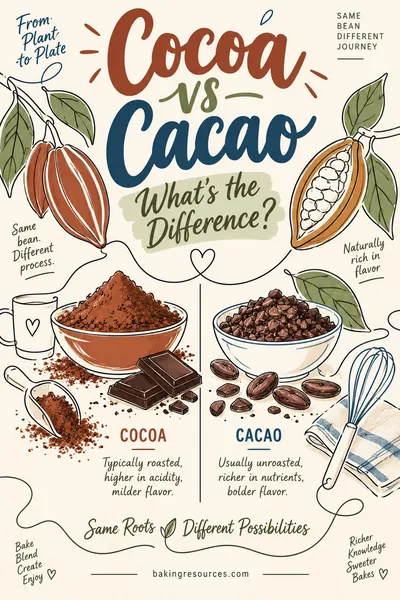
The fix is a swap ratio: for every 3 tablespoons of cocoa in the recipe, trade 1/8 teaspoon of baking soda for 1/2 teaspoon of baking powder when you move from natural to Dutch. Reverse it going the other way. Our Dutch-process vs natural cocoa piece walks through both directions, and cocoa vs cacao sorts out the labeling side.
Worked example: converting a brownie recipe
Say the recipe calls for 4 oz unsweetened chocolate and 1 cup butter, and all you have is semisweet chips and cocoa powder.
Option A, cocoa plus fat. 4 oz unsweetened equals 12 tablespoons cocoa powder plus 4 tablespoons butter. Add those 4 tablespoons to the 1 cup already in the recipe, so you're now using 1 cup plus 4 tablespoons of butter total. Sugar stays as written. This is the reliable route.
Option B, semisweet chips. Semisweet is roughly half sugar, so 4 oz of unsweetened is closer to 6 oz of semisweet. Use 6 oz of chips, then cut about 4 tablespoons of sugar from the recipe to compensate for what the chips brought in. The brownies come out slightly softer because of the extra cocoa butter, and slightly sweeter even after the cut.
What you'd never do: substitute white chocolate. It has no cocoa solids at all, so there's no chocolate flavor and no structure. You'd be making blondies, which is fine, just not what the recipe promised. If the brownies come out wrong for other reasons, why are my brownies cakey covers the fat and egg ratios that decide fudgy versus cakey.
Milk, white, and ruby: the ones that need different handling
Milk chocolate contains milk solids and more sugar, both of which scorch. It melts at a lower temperature, seizes more easily, and makes a much softer ganache. If you want a milk chocolate ganache, shift the ratio: where dark chocolate takes roughly equal weights of chocolate and cream, milk needs closer to twice as much chocolate as cream to set firm. The full ratios are in our ganache ratio guide.
White chocolate has zero cocoa solids. Legally it needs at least 20 percent cocoa butter and 14 percent milk solids, and anything sold as "white baking chips" without cocoa butter is really a confectionery coating made with vegetable fat. It'll melt, but it won't taste like much and it won't temper. Check the ingredient list for cocoa butter before you buy, and see white chocolate vs candy melts for when that coating is actually the better pick.
White chocolate is also the most fragile thing you'll melt. Keep it under about 110°F, stir constantly, and pull it while lumps are still visible.
Ruby chocolate is made from specially processed beans that keep a pink color and a tart, berry-like edge. Treat it like white chocolate for handling: low heat, extra care. It's a garnish and a novelty, not a workhorse.
Storing chocolate so it stays usable
Chocolate wants a cool, dry, dark cupboard and nothing else. Around 60 to 70°F is ideal.
The refrigerator is the enemy. Cold chocolate picks up moisture when it comes back to room temperature, and moisture makes sugar bloom: that dusty gray film on the surface. Fat bloom, the other kind, happens when chocolate gets warm and the cocoa butter migrates out. Neither is dangerous and both taste dull, but bloomed chocolate melts unevenly and will not temper.
- Wrap it tight. Chocolate absorbs odors from everything nearby, especially onions and spices.
- Skip the freezer for anything you'll temper. Freezing is fine for chips you'll bake into a cookie, useless for couverture.
- Dark keeps longest. Two years or more when stored properly. Milk and white carry dairy, so they go stale much sooner, usually within a year.
If a bar has bloomed, don't throw it out. Melt it into a batter or a ganache where appearance doesn't matter. It's still perfectly good chocolate, just cosmetically wrecked. The same storage logic applies to your finished bakes, which our guide on how to store baked goods covers.
FAQ
What are the main types of chocolate for baking?
Unsweetened, bittersweet, semisweet, milk, and white, plus cocoa powder in its natural and Dutch-process forms. They differ by how much of the bar came from the cacao bean and how much is sugar. Unsweetened has no sugar at all, white has no cocoa solids at all, and everything else sits between those two poles.
Can I substitute semisweet for bittersweet chocolate?
Yes, one for one by weight. The two terms have no fixed legal boundary above 35 percent cacao, so brands use them loosely. Bittersweet will make the finished bake a little less sweet and a little more intense, which is usually a good trade.
Why won't my chocolate chips melt smoothly?
Because they aren't supposed to. Chips are made with less cocoa butter plus added stabilizers so they hold their shape in the oven. That same design makes them thick and dull when melted. Use chopped bar chocolate for ganache, coating, or anything that needs to flow.
What does the percentage on a chocolate bar mean?
It's the total share of the bar that came from the cacao bean, counting cocoa solids and cocoa butter together. The rest is sugar, plus milk solids in a milk bar. A 70 percent bar is 30 percent sugar. Higher percentage means less sweet and more intense, not necessarily better quality.
Is white chocolate really chocolate?
It's made from cocoa butter, which comes from the cacao bean, so it's a real cocoa product. It has no cocoa solids, though, which is why it has no chocolate flavor. Check the label for cocoa butter: products made with vegetable fat instead are confectionery coating, not white chocolate.
What is couverture chocolate and do I need it?
Couverture carries at least 31 percent cocoa butter, so it flows thinly when melted and snaps cleanly when tempered. You need it for dipped, molded, or coated work where appearance matters. For cookies, brownies, and cakes, regular baking chocolate is fine and the extra cocoa butter would be wasted.
How much does a cup of chocolate chips weigh?
170 g per cup, and a standard 12 oz bag is 340 g, which works out to about 2 cups. Chopped bar chocolate lands close to the same weight per cup if you chop it to a similar size, so you can swap by volume without much drift.