Christmas Baking Schedule: What to Bake 4 Weeks Ahead
Free calculator from Baking Resources
When Should I Bake It for Christmas?
Pick how many weeks you have and the kind of cookie to see when to bake it.
Need more? Open the free Cookie Exchange Planner.
More free baking tools



Want more options? Open the full Cookie Exchange Planner.
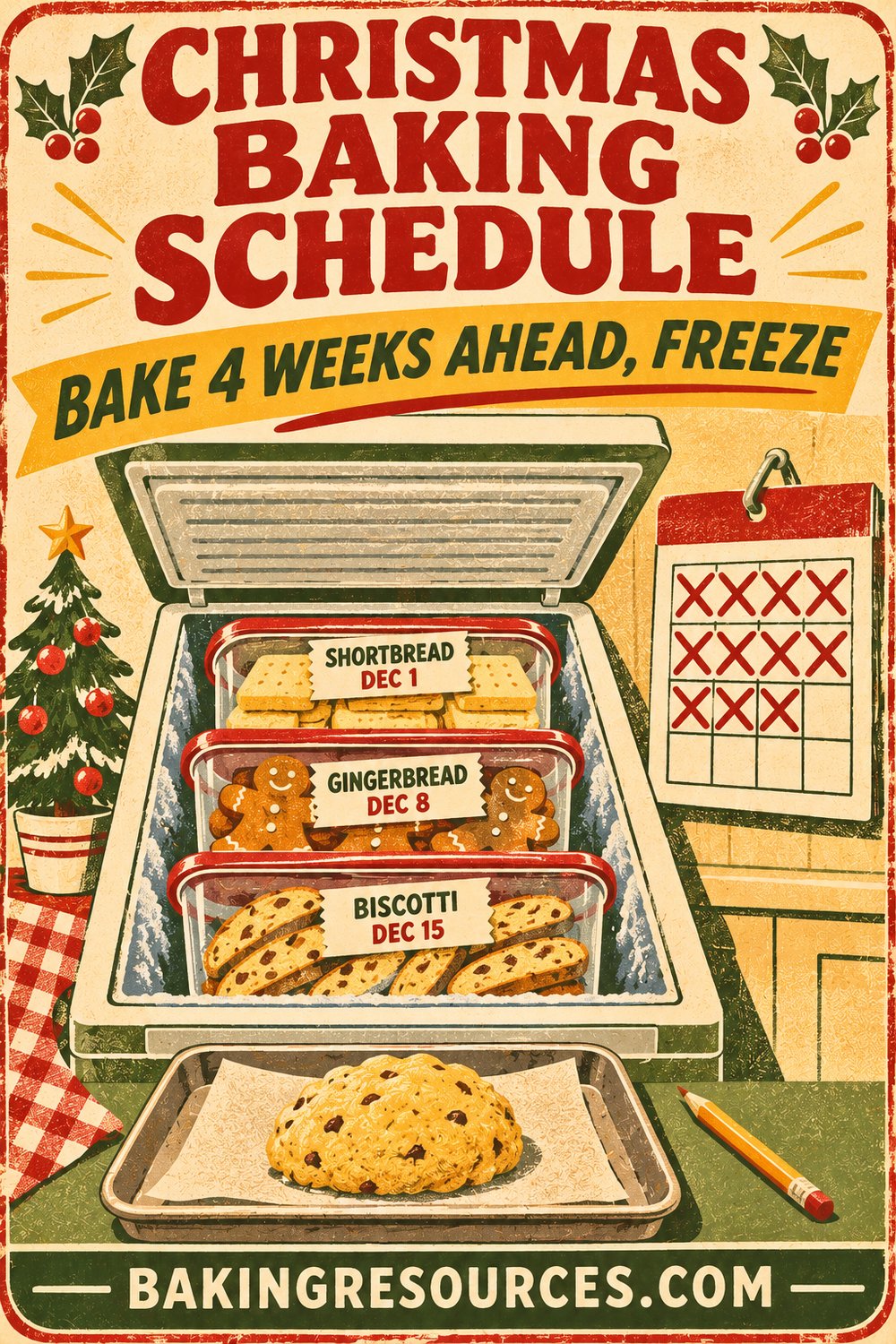
- Shortbread, gingerbread and biscotti keep up to 3 months frozen, so bake them 4 weeks ahead.
- Chewy cookies are best within 3 to 5 days, so freeze the dough and bake in the last week.
- Royal icing needs about 24 hours to cure, so ice 2 to 3 days before the event.
- Frozen dough balls bake from frozen with 2 to 4 extra minutes.
- 144 cookies is 12 trays and about 2 1/2 hours of oven time.
- Thaw frozen cookies sealed so moisture forms on the container.
What can you bake 4 weeks before Christmas?
Four weeks before Christmas you can bake shortbread, gingerbread, biscotti and plain sugar cookies, then freeze them, because dry, buttery cookies keep up to 3 months in the freezer. You can also scoop and freeze the dough for cookies you want fresh.
That’s the heart of a calm Christmas baking schedule: do the sturdy, freezer-friendly work first and save the soft, fragile cookies for the last few days. Cookies with a high fat to water ratio freeze best, because fat doesn’t form ice crystals. Our guide to Christmas cookies that freeze well has the full ranking.
The tool at the top of this page lets you pick your time left and cookie type, and the Cookie Exchange Planner counts how many cookies you need.
How far ahead can you bake Christmas cookies?
You can bake sturdy Christmas cookies up to 3 months ahead if you freeze them, about 2 weeks ahead if you keep them in an airtight tin, and only 3 to 5 days ahead for chewy or filled ones. The kind of cookie decides the window.
| Cookie | Counter (airtight) | Freezer | Best time to bake |
|---|---|---|---|
| Biscotti | Up to 1 month | Up to 3 months | 4 or more weeks ahead |
| Shortbread | Up to 2 weeks | Up to 3 months | 4 or more weeks ahead |
| Gingerbread (crisp) | Up to 2 weeks | Up to 3 months | 4 or more weeks ahead |
| Plain cut-out sugar cookies | About 2 weeks | Up to 3 months | 3 to 4 weeks ahead |
| Snowball cookies | Up to 2 weeks | Up to 3 months | 3 weeks ahead (coat after thawing) |
| Chocolate chip | 3 to 5 days | Up to 3 months | Freeze dough, bake in the last week |
| Royal-iced sugar cookies | Up to 2 weeks | 1 to 2 months | Bake plain early, ice in the last week |
| Jam thumbprints | Up to 5 days | Up to 2 months | Last week |
| Cookies with buttercream | Up to 2 days | Up to 2 months | Last 1 to 2 days |
These match the shelf-life numbers in our how long Christmas cookies last guide. They’re for best quality, not hard expiration dates, so a cookie a few days past its window is usually stale, not unsafe.
What is a good Christmas baking schedule, week by week?
A good schedule starts 4 weeks out with freezer-friendly cookies, moves to decorating at 2 weeks, and finishes with fresh chewy cookies and bars in the last 3 to 5 days. Counting back from December 25, it looks like this.
- 4 weeks ahead (about November 27): bake shortbread, gingerbread and biscotti. Freeze them. Make and freeze a batch of pie dough too, see how to freeze pie dough.
- 3 weeks ahead: bake plain cut-out sugar cookies, chocolate crinkles and snowballs (undusted). Freeze those too.
- 2 weeks ahead: scoop and freeze the dough for chocolate chip cookies and snickerdoodles. Order any boxes or tins you still need.
- 1 week ahead: thaw the sugar cookies sealed and ice them. The icing needs about 24 hours to cure.
- 3 to 5 days ahead: bake the chewy cookies from frozen dough, plus thumbprints and brownies.
- 1 to 2 days ahead: frost anything that needs frosting, and build the trays and tins.
- The day of: pull frozen cookies from the freezer, still sealed, and refresh any that need a lift in a 300 degree F oven.
Shift the whole list earlier or later to fit your own December. Counting backward from the date of your party works exactly the same way.
What should you bake first and what should you leave for last?
Bake dry, buttery cookies first, and leave soft, filled, frosted and chewy ones for the last week. The drier the cookie, the longer it keeps and the less it cares about the freezer.
- First: shortbread, biscotti, gingerbread, plain sugar cookies, spritz.
- Middle: chocolate crinkles, snowballs, peanut butter cookies, undecorated cut-outs you plan to ice later.
- Last: chocolate chip, thumbprints with jam, brownies, anything with buttercream or cream cheese.
Cookies with fillings add moisture. Jam soaks into the cookie, and buttercream needs cold storage after a couple of days. That’s why those two sit at the bottom of the schedule.
How do you freeze Christmas cookies the right way?
To freeze cookies, cool them completely, pack them in an airtight container with parchment between layers, label them with the date and freeze them for up to 3 months. Thaw them sealed so the moisture forms on the container, not on the cookies.
- Cool fully. At least an hour. Warm cookies make steam, and steam makes ice crystals.
- Freeze flat first. Put cookies on a tray for 30 to 60 minutes to firm up so they don’t stick.
- Pack with parchment. One kind per container, parchment between layers.
- Leave minimal air. Use containers that fit the cookies or press out the air from a freezer bag.
- Label and date. Write the kind and the date on the lid.
- Thaw sealed. Leave the container closed on the counter for a few hours or overnight.
For more on dough, see how to freeze cookie dough. Frozen dough balls bake straight from frozen with 2 to 4 extra minutes.
Should you freeze the dough or the baked cookies?
Freeze baked cookies for sturdy, dry kinds like shortbread and gingerbread, and freeze the dough for cookies you want warm and fresh, like chocolate chip. Both keep about 3 months.
| Freeze baked cookies | Freeze dough | |
|---|---|---|
| Best for | Shortbread, gingerbread, biscotti, sugar cookies | Chocolate chip, snickerdoodles, peanut butter |
| Freezer life | Up to 3 months | Up to 3 months |
| Work on the day | Thaw and serve | Bake from frozen, add 2 to 4 minutes |
| Texture result | Same as baked, sealed thaw | Fresh-baked, warm and chewy |
| Freezer space | More | Less, balls pack tight |
Most bakers use both. They bake the dry cookies early and freeze the dough for the ones that are best warm, which splits the work across the month.
How long does it take to bake a batch for the freezer?
Baking 144 cookies, which is 12 dozen, takes about 12 trays and roughly 2 1/2 hours of oven time at 13 minutes per tray, including swapping the pans. Add mixing, scooping and cooling, and it’s a day of work if you do it all at once, or three easy 1 hour sessions if you spread it out.
Our baking marathon guide shows the full math: 10 dozen cookies come to 10 trays, about 130 minutes in the oven. If your recipe makes a different number, the recipe converter will scale it.
- Chill dough ahead. It scoops and bakes better.
- Use two pans in rotation. One bakes while the other cools and is scooped.
- Bake one kind at a time. It keeps the oven temperature steady and avoids mixed-up cookies.
How much should you bake for Christmas?
For a typical household, plan 12 dozen cookies in 6 kinds (24 of each) for gifts, parties and the family, with 12 per gift tin. Your own number depends on who is on the list.
Count the tins first. A gift tin takes about 12 cookies, and the cookie tin count guide adds a 10 percent buffer and splits the total across flavors. Then count the party, using 3 to 5 cookies per person, and add what the family will eat over the holidays.
If you only have time for one dough, easy Christmas cookies shows how to turn it into three kinds.
What about desserts other than cookies?
Pie dough, quick breads and many candies also make ahead. Pie dough discs and unbaked shells freeze well, and sturdy candy like peppermint bark keeps about 2 months frozen. Cakes, custards and anything with whipped cream are best made the day before.
Sort your dessert list into what can be made ahead and what needs to wait. Keep each kind in its own container, because strong flavors travel in the freezer.
Worked example: a 4 week plan for 12 dozen cookies
A plan for 12 dozen cookies in 6 kinds takes three baking sessions of about 4 trays each, which is 52 minutes of oven time per session. Here it is.
- Total: 6 kinds x 24 cookies = 144 cookies, which is 12 trays at 12 per tray.
- Week 4 session: shortbread and gingerbread, 4 trays. Freeze them baked.
- Week 3 session: plain sugar cookies and chocolate crinkles, 4 trays. Freeze them.
- Week 2 session: scoop chocolate chip and snickerdoodle dough, freeze the balls. No oven time.
- Week 1: ice the sugar cookies (24 hours to cure), then bake snickerdoodles and chocolate chip from frozen, 4 trays, adding 2 to 4 minutes.
- Final days: thaw everything sealed, pack tins and trays.
That’s 12 trays across 3 baking sessions, about 2 1/2 hours of oven time in total, split into pieces you can fit between other things.
Mistakes that wreck a Christmas baking schedule
The biggest mistake is baking everything in the last week, because the oven becomes the bottleneck and the cooling racks fill up. Spread the work and let the freezer do the waiting.
- Freezing warm cookies. Steam turns to ice crystals and the cookies come out soggy.
- Dusting before freezing. Powdered sugar melts into the cookie. Freeze snowballs undusted and coat them after thawing.
- Mixing kinds in one container. Flavors and moisture travel.
- Opening the container while thawing. Moisture lands right on the cookies. Thaw sealed.
- Forgetting the date label. After 3 months the cookies slowly dry out and pick up freezer smells.
- Icing too early. Do it 2 to 3 days ahead so it stays crisp. For storage basics see how to store baked goods.
Quick reference: Christmas baking schedule
This table sums up what to bake and when, counting back from December 25.
| When | What to do | Storage |
|---|---|---|
| 4 weeks ahead | Bake shortbread, gingerbread, biscotti | Freezer, up to 3 months |
| 3 weeks ahead | Bake plain sugar cookies, chocolate crinkles, snowballs (undusted) | Freezer, up to 3 months |
| 2 weeks ahead | Scoop and freeze dough for chocolate chip and snickerdoodles | Freezer, up to 3 months |
| 1 week ahead | Ice sugar cookies, 24 hours to cure | Airtight tin, up to 2 weeks |
| 3 to 5 days ahead | Bake chewy cookies, thumbprints and brownies | Airtight, room temperature |
| 1 to 2 days ahead | Frost anything that needs it, build trays and tins | Fridge for buttercream |
| Day of | Thaw sealed, refresh at 300 degrees F if needed | Serve |
Move the dates to fit your own calendar. The order, dry cookies first and chewy ones last, always stays the same.
Frequently asked questions
What can you bake 4 weeks before Christmas?
Shortbread, gingerbread, biscotti and plain sugar cookies. Freeze them baked, because dry, buttery cookies keep up to 3 months in the freezer.
How far ahead can you bake Christmas cookies?
Up to 3 months if you freeze them, about 2 weeks in an airtight tin for dry cookies, and 3 to 5 days for chewy or filled ones.
Which Christmas cookies freeze well?
Shortbread, gingerbread, biscotti, undecorated sugar cookies, snowballs and chocolate crinkles. Meringues and cream-filled cookies do not freeze well.
Should you freeze cookie dough or baked cookies?
Freeze baked cookies for dry, sturdy kinds, and freeze the dough for cookies you want fresh and warm, like chocolate chip. Both keep about 3 months.
How do you thaw frozen Christmas cookies?
Leave them in a sealed container on the counter for a few hours or overnight, so any moisture forms on the container and not on the cookies.
When should you ice Christmas cookies?
2 to 3 days before you need them. Royal icing needs about 24 hours to cure, so do not stack or pack them sooner.
How many cookies should you bake for Christmas?
A typical plan is 12 dozen in 6 kinds, with 12 cookies per gift tin and 3 to 5 cookies per party guest. Add a 10 percent buffer.
How long does it take to bake 12 dozen cookies?
About 12 trays, roughly 2 1/2 hours of oven time at 13 minutes per tray, plus mixing, scooping and cooling time.