What Is a Scone? British vs American Scones
Free calculator from Baking Resources
Scone Amounts for British and American Styles
Pick the style and how much flour you are using.
Need more? Open the free Ingredient Weight Chart.
More free baking tools



Want more options? Open the full Ingredient Weight Chart.
- A scone is a quick bread: baking powder lifts it, so there is no yeast and no long rise.
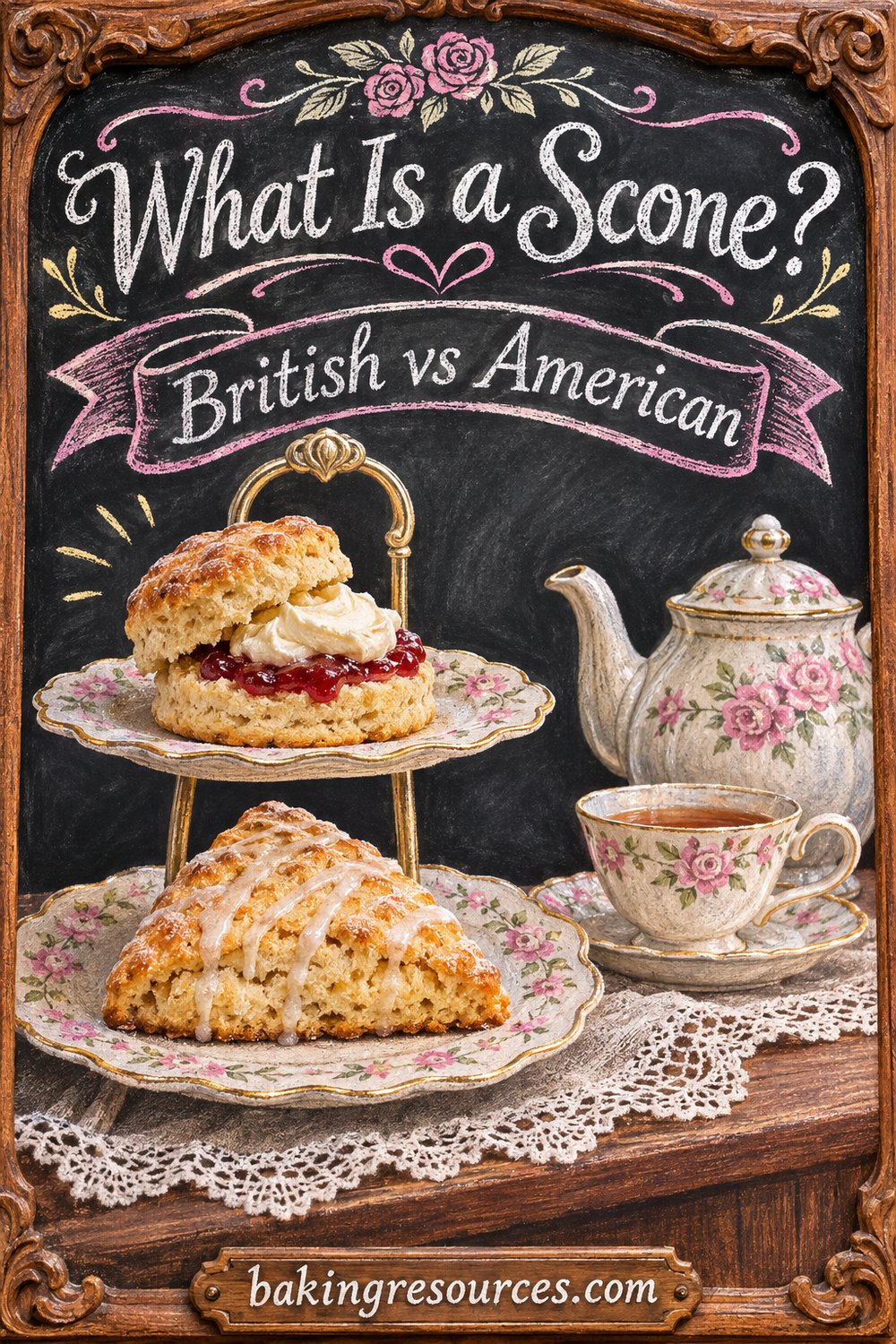
- British scones are round, plain and only lightly sweet, served with jam and cream.
- American scones are triangular, richer and sweeter, with more butter, cream and add-ins.
- Typical base: 2 cups (250 g) flour with 4 to 8 tablespoons (57 to 113 g) cold butter.
- British scones bake at about 425°F (220°C) for 10 to 14 minutes, American wedges at 400°F (200°C) for 15 to 20 minutes.
- Pronunciation varies. Both “skon” and “skone” are used and accepted.
What is a scone?
A scone is a small, lightly sweet baked treat made from flour, cold butter, a little sugar, baking powder and milk or cream. It is a quick bread, so it rises with baking powder instead of yeast, and the dough is mixed and baked in under an hour. The result is tender and crumbly inside with a golden top.
Scones are eaten at breakfast, at tea time and with coffee. They are halfway between a biscuit and a cake: richer than a biscuit but less sweet than a muffin. The dough is stiff and a little dry, then patted out and cut into shapes, rather than poured or scooped.
The key to a good scone is cold butter. Small pieces of butter melt in the oven and make steam, and that steam lifts the dough into flaky layers. See how to cut butter into flour for the steps.
What is the difference between British and American scones?
British scones are round, plain and only lightly sweet, with a tall, soft crumb meant to be split and topped with jam and cream. American scones are richer, sweeter and denser, usually cut into triangles, with more butter and cream and often fruit, nuts or chocolate chips mixed in.
The same word covers two different treats, which causes a lot of confusion. This table shows the main differences:
| Feature | British scone | American scone |
|---|---|---|
| Shape | Round, cut with a cutter | Triangle wedge, or drop |
| Sweetness | Lightly sweet, plain | Sweeter, often glazed |
| Butter per 2 cups (250 g) flour | 4 tablespoons (57 g) | 8 tablespoons (113 g) |
| Sugar per 2 cups (250 g) flour | 2 tablespoons (25 g) | 1/3 cup (65 g) |
| Liquid | Milk | Cream, plus an egg |
| Add-ins | Raisins or currants, or none | Berries, chocolate chips, nuts, glaze |
| Texture | Tall, soft, a little dry | Dense, crumbly, rich |
| How it is eaten | Split, with jam and cream | On its own or with butter |
| Oven | 425°F (220°C), 10 to 14 minutes | 400°F (200°C), 15 to 20 minutes |
Neither is “more right.” If you grew up with one, the other might feel like a different food. Use the calculator above to get the amounts for either style and any flour size, and see the ingredient weight chart for the weights behind them.
What are scones made of?
Scones are made of flour, butter, baking powder, sugar, salt and a liquid such as milk or cream. Eggs are added in many American recipes and brushed on top as a wash in British ones. Each ingredient does a different job.
| Ingredient | Typical amount per 2 cups (250 g) flour | What it does |
|---|---|---|
| All-purpose flour | 2 cups (250 g, at 125 g per cup) | Structure |
| Cold butter | 4 to 8 tablespoons (57 to 113 g) | Flakiness, flavor, tenderness |
| Baking powder | 2 1/2 teaspoons to 1 tablespoon | Rise |
| Sugar | 2 tablespoons to 1/3 cup (25 to 65 g) | Sweetness, browning, softness |
| Salt | 1/4 to 1/2 teaspoon | Flavor |
| Milk or cream | 1/2 to 2/3 cup (120 to 160 mL) | Moisture, binds the dough |
| Egg | 0 to 1 | Richness and structure |
British recipes often use self-raising flour, which already has baking powder in it. If you have plain flour, see how to make self-rising flour. If you need to change the baking powder, the baking powder substitute page has options. Flour matters too. Our types of flour guide explains why all-purpose is the usual pick, and why bread flour makes tough scones. See also bread flour vs all-purpose.
How do you pronounce scone?
Scone is pronounced either “skon” (rhymes with “gone”) or “skone” (rhymes with “cone”). Both are accepted. In the United States, “skone” is the most common. In Britain, it depends on the region and even on the family, and friendly arguments about it are a tradition.
There is no wrong way, so say it the way you grew up saying it. The food tastes the same either way.
What is the difference between a scone and a biscuit?
A scone is sweeter and richer than a biscuit, with more butter, some sugar and often an egg or cream, while an American biscuit is plain, savory and flaky. A British “biscuit” means a cookie, so the word means something different in Britain.
| Feature | Scone | American biscuit |
|---|---|---|
| Sugar | Some (2 tablespoons to 1/3 cup per 2 cups flour) | None, or a teaspoon |
| Butter | 4 to 8 tablespoons per 2 cups flour | 4 to 6 tablespoons per 2 cups flour |
| Liquid | Milk or cream, often with egg | Buttermilk or milk |
| Eaten | Breakfast, tea, with jam | With meals, gravy, sandwiches |
| Texture | Crumbly, tender | Flaky, layered, fluffy |
The methods are close, so you can see how closely they are related. Try our buttermilk biscuits recipe to see the difference. Biscuits and scones also share the same trouble spots, such as dough that spreads. Read why scones go flat for fixes.
What do you eat with scones?
Traditional British scones are served split in half and topped with jam and clotted cream, a thick, rich cream, as part of a “cream tea.” Butter works too. American scones are often eaten plain, with butter, or with a drizzle of glaze.
A few ways to serve them:
- Cream tea: Split the scone, then add jam and a spoonful of clotted or whipped cream. Where the jam goes first or second is a friendly debate between two English counties.
- Breakfast: Eat it warm with butter and a cup of tea or coffee.
- Brunch: Serve fruit scones with lemon curd.
- Savory: Cheese scones go well with soup. Leave out the sugar and add 1/2 cup (about 55 g) of shredded cheese.
If you are out of cream, see heavy cream substitutes, or make whipped cream for topping.
What are the different types of scones?
The main types are plain, fruit (such as currant or blueberry), chocolate chip, cheese and savory herb, and cream scones. All of them use the same basic dough. Only the add-ins change.
- Plain: The classic. Best with jam and cream.
- Fruit: Currants, raisins, blueberries or dried cranberries. Use about 1/2 to 3/4 cup (75 to 110 g) per 2 cups (250 g) flour.
- Chocolate chip: About 1/2 cup (85 g) chips per 2 cups flour.
- Cheese: Cheddar, with a little mustard or herbs. Skip the sugar or cut it back.
- Cream scones: Replace the butter and milk with heavy cream. Easy, tender and a little less flaky.
- Oat scones: Replace up to 1/2 cup (about 45 g) of the flour with rolled oats for a chewier bite. Related is Irish soda bread, which is a close cousin in method.
How do you bake scones so they rise tall?
For tall scones, use very cold butter, handle the dough as little as possible, pat it 1 inch (2.5 cm) thick and bake in a hot oven, 400°F to 425°F (200°C to 220°C). Hot heat makes the butter steam quickly and lifts the dough before it spreads.
- Heat the oven and put the rack in the middle. See which oven rack to use if you are not sure.
- Whisk the dry ingredients, then cut in cold butter until it looks like coarse crumbs with some pea-size lumps.
- Add the liquid all at once and stir just until the dough comes together. How to fold ingredients covers the gentle motion.
- Pat the dough out on a floured counter to 1 inch (2.5 cm) thick. Do not knead it.
- Cut straight down with a cutter. Do not twist, because twisting seals the edges and stops the rise.
- Brush the tops with milk or beaten egg. See what an egg wash is. Keep the wash off the cut sides.
- Bake until golden. Rotate the pan halfway through if your oven has hot spots.
If you have the time, chill the cut scones in the fridge for 15 to 30 minutes before baking. This keeps the butter cold and helps them rise. For general oven help, our how to bake evenly guide covers hot spots.
Worked example: a half batch of American scones
Say you want 6 American wedge scones. In the calculator, pick American and 1 1/2 cups (188 g) flour.
- Whisk 1 1/2 cups (188 g) flour, 1/4 cup (50 g) sugar, 2 1/4 teaspoons baking powder and a pinch of salt.
- Cut in 6 tablespoons (85 g) cold butter until you have coarse crumbs.
- Beat 1 egg with 1/3 cup (80 mL) cream, pour it in and stir to a shaggy dough.
- Pat it into a circle 1 inch (2.5 cm) thick and cut it into 6 wedges.
- Bake at 400°F (200°C) for 15 to 20 minutes, until golden.
That makes 6 scones. If you want a bigger batch, the calculator gives you amounts for 12 or 16. Butter is easier to scale with the butter converter, since 1 stick is 8 tablespoons (113 g).
How do you store scones?
Scones are best the day you bake them. Store them in an airtight container at room temperature for up to 2 days, or freeze them for up to 3 months. They go stale faster than most baked goods because they have no fat-heavy crumb to keep them soft.
- Room temperature: Keep in a sealed container. Warm for 5 minutes at 350°F (175°C) before serving.
- Freezing baked: Wrap each scone and freeze. Thaw on the counter, then warm in the oven.
- Freezing unbaked: Freeze cut scones on a tray, then bag them. Bake straight from frozen, adding 3 to 5 minutes.
More tips are in how to store baked goods.
Quick reference: what is a scone
| Question | Answer |
|---|---|
| What is it? | A lightly sweet quick bread, lifted with baking powder |
| British scone | Round, plain, tall, served with jam and cream |
| American scone | Wedge, richer and sweeter, often with add-ins |
| Base for 2 cups (250 g) flour | 4 to 8 tablespoons butter, 2 tablespoons to 1/3 cup sugar, 2 1/2 teaspoons to 1 tablespoon baking powder |
| Oven, British | 425°F (220°C), 10 to 14 minutes |
| Oven, American | 400°F (200°C), 15 to 20 minutes |
| Pronunciation | “skon” or “skone” |
| Storage | 2 days airtight, 3 months frozen |
Frequently asked questions
What is a scone?
A scone is a small, lightly sweet quick bread made with flour, cold butter, baking powder, a little sugar and milk or cream. It is tender and crumbly, and is usually eaten with jam, cream or butter.
What is the difference between a British and an American scone?
British scones are round, plain and lightly sweet, served with jam and cream. American scones are richer and sweeter, usually cut into wedges, and often have fruit or chocolate mixed in.
Is a scone a biscuit or a cookie?
Neither. It is a quick bread, close to an American biscuit but sweeter and richer. In Britain, a “biscuit” is what Americans call a cookie.
What is a scone made of?
Flour, cold butter, baking powder, sugar, salt and milk or cream. American versions usually add an egg.
How do you pronounce scone?
Either “skon” (like “gone”) or “skone” (like “cone”). Both are common and accepted.
What is a scone usually served with?
Jam and clotted cream in a British cream tea. Butter, lemon curd or a simple glaze are also common.
Why are my scones flat?
Warm butter, too much liquid or old baking powder are the usual causes. See why scones go flat.
Can you freeze scones?
Yes. Freeze baked scones for up to 3 months, or freeze cut unbaked scones and bake them from frozen with a few extra minutes.