Sugar Cookie Frosting vs Royal Icing: Which Should You Use?
Free calculator from Baking Resources
Frosting or Royal Icing for My Cookies?
Pick what matters most and when the cookies will be eaten, and see which topping fits.
Need more? Open the free Frosting Calculator.
More free baking tools



Want more options? Open the full Frosting Calculator.
- Royal icing is touch-dry in 1 to 2 hours, hard in 6 to 8 hours and fully cured in 24.
- Royal icing cookies keep 1 to 2 weeks at room temperature in an airtight container.
- Buttercream cookies keep about 2 days covered at cool room temperature, and cream cheese frosting needs the fridge.
- A dozen 3 inch (7.5 cm) cookies take about 1 cup (240 ml) of royal icing or buttercream, or about 1/2 cup (120 ml) of thin glaze.
- One batch of royal icing from 4 cups (about 450 g) of powdered sugar covers about 3 dozen 3 inch cookies.
- Only royal icing hardens enough to stack, bag or mail.
What is the difference between sugar cookie frosting and royal icing?
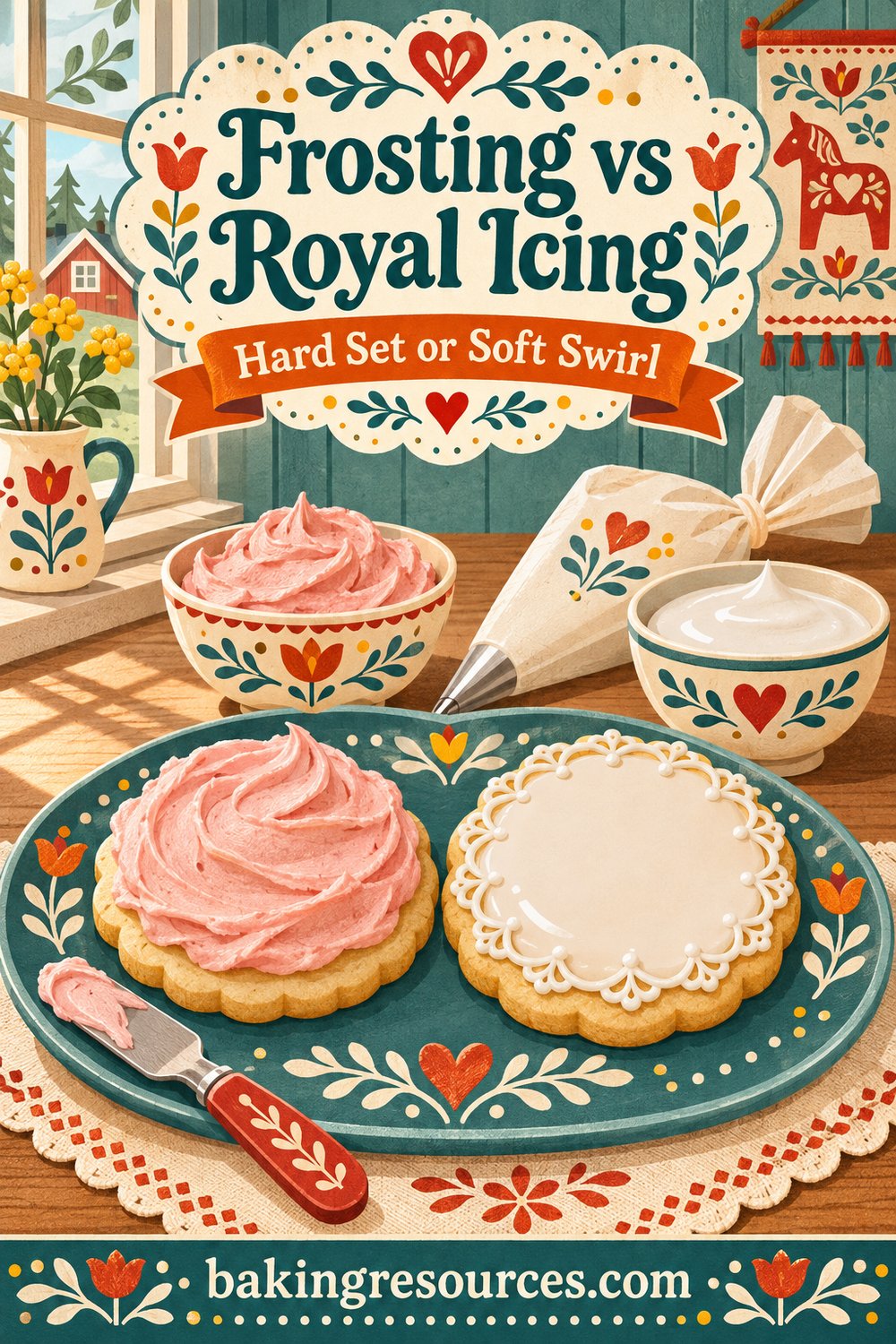
The difference between sugar cookie frosting and royal icing is fat and texture: royal icing is made from powdered sugar, water and meringue powder, has no fat and dries hard, while sugar cookie frosting is made with butter, stays soft and tastes creamy. That one difference decides almost everything else, including looks, storage and how you pack them.
Think of royal icing as a paint that turns into a thin sweet shell. Think of buttercream as a soft cushion on top of the cookie. Both start with powdered sugar, so both are sweet, but they behave very differently on the cookie.
People also say “sugar cookie icing” for a third, simpler topping: a thin glaze of powdered sugar and milk. We cover it below, because it is the easiest of the three for beginners and a good middle road.
Which is better for sugar cookies, frosting or royal icing?
Royal icing is better for decorated cut-out sugar cookies, and buttercream is better for soft, thick, drop-style sugar cookies. Neither one is better everywhere, so match the topping to the job. Here is the side-by-side.
| Question | Royal icing | Buttercream | Simple glaze |
|---|---|---|---|
| Texture when set | Hard, crisp shell | Soft and creamy | Thin and slightly firm |
| Time to set | Hard in 6 to 8 hours | Crusts in 15 to 30 minutes, stays soft | Sets in 1 to 2 hours |
| Fine detail | Excellent | Good with a stiff batch | Poor |
| Can you stack them? | Yes, after 24 hours | No | Yes, once fully set overnight |
| Mailing | Yes | No | Short trips only |
| Keeps (airtight) | 1 to 2 weeks | About 2 days, covered | 4 to 5 days |
| Taste | Plain and sweet | Rich, buttery | Light and sweet |
| Skill level | Takes practice | Beginner friendly | Easiest |
If you only need to pick one, pick royal icing for anything you plan to decorate in detail, and buttercream for anything you plan to eat the same day. For a basic cut-out dough that holds its edges under either topping, try our sugar cookie recipe.
What is royal icing, and how do you make it for cookies?
Royal icing is a thin sugar paste made from powdered sugar, meringue powder and water that dries hard and matte, and one batch of 4 cups (about 1 pound or 450 g) of powdered sugar makes roughly 3 cups. It is the icing on most bakery-style decorated cookies. Meringue powder is dried egg white with a stabilizer, so there is no raw egg to worry about.
Here is the basic recipe for about 3 dozen 3 inch (7.5 cm) cookies:
- Combine: 4 cups (about 450 g) of sifted powdered sugar and 3 tablespoons of meringue powder in a clean bowl.
- Add water: pour in about 6 tablespoons (90 ml) of warm water.
- Beat: mix on low speed for about 5 minutes, until the icing holds a stiff peak. This is your piping icing.
- Thin it: for flooding, add water a few drops at a time until a ribbon disappears back into the bowl in about 10 seconds.
- Cover: press a damp towel or plastic wrap over the bowl, because royal icing crusts in minutes.
Everything must be grease free. A trace of butter or oil on the bowl, spatula or beaters keeps royal icing from setting properly. Our royal icing consistency guide shows every thickness from stiff to flood, and if you are out of meringue powder, our meringue powder substitute page lists the options.
How do you make frosting for sugar cookies?
To make frosting for sugar cookies, beat 1 cup (227 g, 2 sticks) of softened butter with 4 cups (about 450 g) of powdered sugar, 2 to 4 tablespoons of milk, 1 teaspoon of vanilla and a pinch of salt for about 3 minutes. That makes roughly 2 1/2 to 3 cups, enough for about 2 1/2 dozen 3 inch cookies at a thin spread.
- Soft butter: it should dent under a finger but not be greasy. About 65°F (18°C) is right.
- Add milk slowly: start with 2 tablespoons and add more a teaspoon at a time. A swirl should hold its shape on a knife.
- Add salt: a small pinch cuts the sweetness.
- Cool the cookies fully: frosting on warm cookies melts and slides.
Our how to make buttercream guide has more flavors and ratios. If you like the tang of cream cheese, our cream cheese frosting recipe works well on soft sugar cookies, as long as you keep them cold.
How do you make a simple powdered sugar glaze for cookies?
To make simple cookie icing with powdered sugar, stir 2 cups (about 225 g) of powdered sugar with 3 to 4 tablespoons of milk or water, 2 teaspoons of light corn syrup and 1/2 teaspoon of vanilla until smooth. It makes about 1 1/4 cups, enough to dip about 2 dozen 3 inch cookies. The corn syrup gives it a soft shine and a cleaner bite.
The glaze should run off a spoon in a thick ribbon. Dip the top of each cookie, let the extra drip off for a few seconds, and add sprinkles before it sets. It dries in 1 to 2 hours. It will not do fine lines, but it is lovely for plain rounds, hearts and drop cookies. If you do not have powdered sugar at all, see our powdered sugar substitute for frosting page.
How long does each one take to set?
Royal icing is touch-dry in 1 to 2 hours and hard in 6 to 8, simple glaze sets in 1 to 2 hours, and buttercream forms a light crust in 15 to 30 minutes but never gets hard. The times shift with humidity and with how thick you spread it.
| Topping | Light crust or touch-dry | Firm enough to handle | Fully set |
|---|---|---|---|
| Royal icing (flood) | 1 to 2 hours | 6 to 8 hours | 24 hours |
| Royal icing (piped lines) | 30 to 60 minutes | 2 to 4 hours | 12 to 24 hours |
| Simple glaze | 30 to 60 minutes | 1 to 2 hours | Overnight |
| Crusting buttercream | 15 to 30 minutes | Stays soft | Never hardens |
| Cream cheese frosting | Never crusts | Stays soft | Never hardens |
Humid days slow everything. Our guide on how long royal icing takes to dry has the timing by humidity and thickness.
Can you stack or ship cookies with frosting or royal icing?
You can stack and ship royal icing cookies once the icing has cured for 24 hours, but you cannot stack or ship buttercream or cream cheese cookies. Icing that feels dry on top can still be soft underneath, and that soft layer dents when another cookie touches it.
- Royal icing: wait 24 hours, then bag each cookie, or layer with parchment. Pack flat in a tin.
- Buttercream: carry in a single layer in a rigid box with the lid set above the frosting. Do not mail it.
- Glaze: stack only after it has set overnight, and put parchment between layers.
- Cream cheese: keep in the fridge until serving. It is not for a cookie tin.
For the full mailing routine, see our guides on how long Christmas cookies last and how to store baked goods.
Which is easier for beginners and kids?
Simple glaze and buttercream are the easiest for beginners and kids, because you can spread them with a butter knife and there is no consistency to dial in. Royal icing is more fussy, since it needs two thicknesses, piping bags and patience while it dries.
For a kids decorating party, glaze or buttercream in small bowls with sprinkles on the side keeps things simple and hands busy. If you want royal icing for the older kids, pipe the outlines yourself and let them flood and add sprinkles. Our kids cookie decorating party planner shows how much dough and icing to make per child.
Can you put frosting on top of royal icing?
Yes, you can pipe buttercream on top of fully hardened royal icing, but eat the cookies within a day or two. The fat in buttercream slowly seeps into royal icing and leaves dull, greasy-looking spots after a day or two. Let the royal icing cure for 24 hours first so it forms a firm barrier.
The reverse does not work. Royal icing will not set on top of buttercream, because the fat prevents it from drying. If you want both on one cookie, do the royal icing base first and the soft details last.
Is royal icing safe to eat?
Royal icing made with meringue powder or pasteurized egg whites is safe to eat, because the egg white is already pasteurized. The USDA advises against eating raw, unpasteurized egg whites, so skip old recipes that call for fresh whites unless you buy pasteurized ones. Buttercream with only butter and sugar can sit out covered in a cool room for about 2 days, while cream cheese frosting follows the 2-hour rule: refrigerate after 2 hours, or 1 hour above 90°F (32°C).
Our guide on how to store frosting covers fridge and freezer times for every kind.
How do you color frosting and royal icing?
Use gel food coloring for both, adding a drop at a time on a toothpick, because liquid coloring thins the icing and can stop royal icing from setting. Colors deepen over several hours, so stop at one shade lighter than you want. Our gel vs liquid food coloring page explains why gel wins.
Buttercream shows colors truer once it rests for an hour. Dark reds and blacks use a lot of gel, so start from chocolate or a deep base if you can, and check the batch the next morning.
Worked example: 2 dozen cookies for a school party
Two dozen 3 inch (7.5 cm) cookies for a school party need about 2 cups (480 ml) of buttercream or royal icing, or 1 cup (240 ml) of glaze. Say the party is on Friday and the cookies are for 24 kids.
- Choose: the teacher says no refrigeration, and you want them to look nice, so choose royal icing on plain rounds.
- Math: 2 dozen cookies at 1 cup per dozen is 2 cups of icing. That is two thirds of one 3 cup batch, with a little left to practice and fix mistakes.
- Thursday: make one batch, outline and flood. Leave them uncovered overnight.
- Friday morning: add details if you like. Bag each cookie, or layer with parchment in a tin.
- Result: the cookies arrive hard and unsmeared and sit on a desk for hours without any issue.
If the party is tonight, switch to glaze or buttercream, and serve within a few hours. A batch of cookies is easier to plan with the cookie scoop calculator or the cookie exchange planner.
Common mistakes when choosing a topping
The most common mistake is stacking frosted cookies before they are ready, because even 1 hour too soon leaves a dent or smear.
- Using butter-based frosting for mailing: it never hardens and smears in transit.
- Greasy bowl for royal icing: any fat can keep it from setting. Wipe tools with a little vinegar and dry them.
- Icing warm cookies: they melt buttercream and make royal icing run.
- Making royal icing too thin: it floods past the outline and takes longer to dry. Use the 10-second test.
- Skipping the cover: uncovered icing crusts in minutes and clogs the tip.
- Leaving cream cheese cookies out: 2 hours is the limit.
If your icing is soft, our page on why frosting is runny has the fixes, and our guide to keeping buttercream from melting helps on warm days.
Quick reference: sugar cookie frosting vs royal icing
This table sums up which topping to use for the 5 most common needs.
| You want | Use | Per dozen 3 in (7.5 cm) cookies | Keeps |
|---|---|---|---|
| Detailed designs, lettering | Royal icing | 1 cup (240 ml) | 1 to 2 weeks |
| Stack, bag or mail | Royal icing, cured 24 hours | 1 cup (240 ml) | 1 to 2 weeks |
| Soft and creamy | Buttercream | 1 cup (240 ml) | About 2 days covered |
| Fast and easy | Simple glaze | 1/2 cup (120 ml) | 4 to 5 days |
| Tangy flavor | Cream cheese frosting | 1 cup (240 ml) | 3 to 4 days in the fridge |
Frequently asked questions
Can you use buttercream instead of royal icing on sugar cookies?
Yes. Buttercream works well on sugar cookies you plan to eat within 2 days, but it never hardens, so it cannot be stacked or mailed and it will not hold fine detail the way royal icing does.
Is royal icing the same as frosting?
No. Royal icing is powdered sugar, water and meringue powder with no fat, and it dries hard. Frosting is usually butter and powdered sugar and stays soft.
What is the best icing for decorating sugar cookies?
Royal icing is the best icing for decorating sugar cookies, because it pipes crisp lines, floods smooth and hardens in 6 to 8 hours so the cookies can be handled.
How much royal icing do you need for a dozen sugar cookies?
About 1 cup (240 ml) for a dozen 3 inch (7.5 cm) cookies. One batch of 4 cups (about 450 g) of powdered sugar makes roughly 3 cups, enough for about 3 dozen.
Do sugar cookies with frosting need to be refrigerated?
Not if the frosting is butter and powdered sugar and the room is cool, since these keep about 2 days covered. Cream cheese frosting needs the fridge after 2 hours.
Which icing sets hard on cookies?
Royal icing sets hard. A simple powdered sugar glaze sets firm but thin, while buttercream and cream cheese frosting stay soft.
Can you freeze frosted sugar cookies?
Yes. Freeze buttercream cookies in a single layer until firm, then wrap airtight, or freeze undecorated cookies and ice them after thawing. Royal icing can also be frozen once cured, though the colors may bleed when thawed in a humid kitchen.
Why does my royal icing look dull?
Royal icing dries to a matte finish, and drying slowly in a warm, humid room can turn it dull and slightly blotchy. A fan on low and a dry room help it dry with a light sheen.