How to Caramelize Sugar (Temperature, Time and Colors)
Free calculator from Baking Resources
Caramelize Sugar: Temperature and Time
Pick the color, the method and how much sugar you have.
Need more? Open the free Oven Temperature Conversion.
More free baking tools



Want more options? Open the full Oven Temperature Conversion tool.
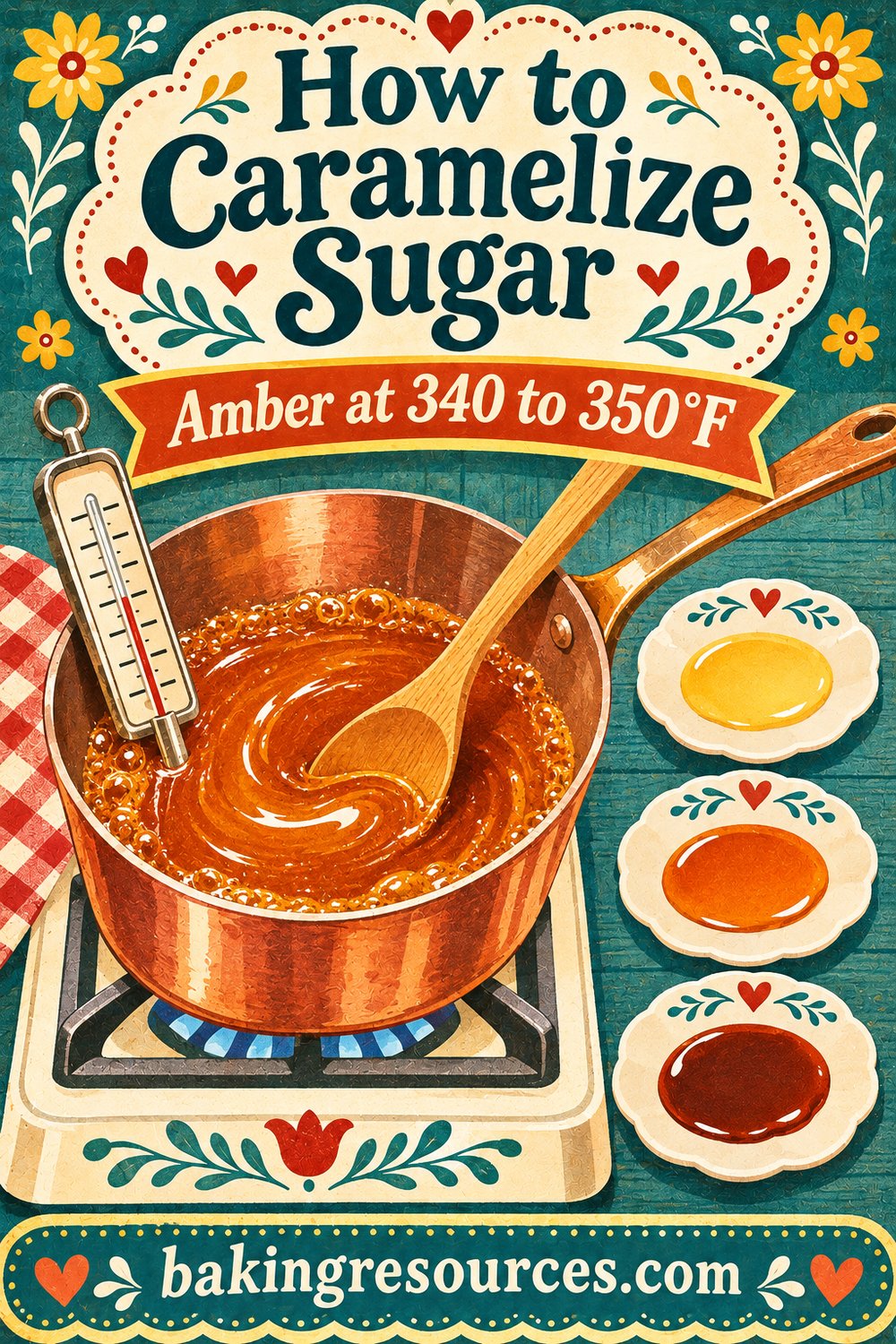
- Plain sugar starts to turn into caramel at about 320°F (160°C). Medium amber caramel is 340 to 350°F (170 to 175°C).
- Caramel tastes burnt and bitter past about 360°F (182°C), and there is no way to rescue it.
- The dry method (sugar only) takes about 8 to 12 minutes for 1 cup (200 g) of sugar. The wet method (sugar plus water) takes about 10 to 15 minutes.
- For the wet method, use about 1/4 cup (60 ml) of water for every 1 cup (200 g) of granulated sugar.
- Molten caramel is far hotter than boiling water and sticks to skin. Keep a bowl of ice water nearby and never touch it.
- For a caramel sauce, stir in about 1/2 cup (120 ml) of warm cream per 1 cup (200 g) of sugar once the color is right.
Caramelizing sugar sounds like a chef skill, but it is only two things: heat and watching. You melt sugar until it turns from clear to gold to amber, then stop it at the color you want. The trick is knowing what the color means, and knowing when to take the pan off the heat. That moment comes fast.
How do you caramelize sugar?
To caramelize sugar, heat plain granulated sugar in a heavy, light-colored saucepan over medium heat until it melts and turns amber, which happens at about 320 to 350°F (160 to 175°C). Do not stir at the start. Swirl the pan gently once the edges melt, and pull it off the heat when the color is a shade lighter than you want.
There are two ways to do it. The dry method uses sugar alone and is quick. The wet method adds a little water first, which dissolves the sugar so it heats evenly and is harder to scorch. Both end at the same place: a golden to deep amber liquid. Both work for sauces, flan, brittle and decorations. Pick wet if you are new to this, and dry once you are comfortable.
Before you start, set up. Caramel moves fast, and you will not have time to look for a spoon. Have these ready:
- A heavy-bottomed saucepan, light in color so you can see the sugar change. A dark nonstick pan hides the color.
- A heatproof silicone spatula or a long wooden spoon.
- A pastry brush and a small cup of water (for the wet method).
- Warm cream, butter and salt measured out if you are making a sauce.
- A bowl of ice water in the sink. If you spill caramel on your skin, cool it right away under cold running water.
How to caramelize sugar on the stove, step by step (dry method)
The dry method takes about 8 to 12 minutes for 1 cup (200 g) of sugar. It needs no water and only one pan, but the sugar can melt unevenly, so watch the edges.
- Add the sugar. Spread 1 cup (200 g) of granulated sugar in an even layer in a medium saucepan.
- Heat over medium. Medium heat is enough. High heat burns the edges before the middle melts.
- Wait for the first melt. After 3 to 5 minutes, the sugar at the edges turns clear and liquid. Do not stir yet.
- Draw it in. Use a spatula to gently push melted sugar from the edges toward the middle. Keep doing this every 30 seconds or so, so unmelted sugar meets the heat.
- Swirl. When most of the sugar is liquid, swirl the pan instead of stirring. This avoids splashes on the sides of the pan.
- Watch the color. The liquid goes from clear to pale gold, then honey, then amber. Once it starts to color, it goes quickly, often in less than 2 minutes.
- Stop at the right shade. Pull the pan off the heat when the color is just lighter than your target. The pan holds heat and the caramel keeps darkening for a minute or two.
How to make caramelized sugar with water (wet method)
For the wet method, stir 1 cup (200 g) of sugar with 1/4 cup (60 ml) of water in a saucepan over medium heat until the sugar dissolves, then stop stirring and boil without touching it until the syrup turns amber, about 10 to 15 minutes in all.
- Combine. Stir the sugar and water together until it looks like wet sand.
- Dissolve. Heat over medium, stirring once or twice, until the liquid is clear and the sugar has dissolved.
- Stop stirring. Once the syrup comes to a boil, do not stir again. Stirring pushes sugar crystals up the sides, and they seed the whole pan with crystals.
- Wash down the sides. Brush the sides of the pan with a wet pastry brush to melt away any stray crystals.
- Boil until amber. The syrup first bubbles thick and clear. After 8 to 10 minutes, the water boils off, the temperature climbs past 320°F (160°C) and the color starts to change. Swirl the pan occasionally.
- Stop at your color. Remove it from the heat as soon as it reaches the shade you want.
A candy thermometer takes the guesswork out. Clip it to the pan, keep the tip off the bottom, and read it at eye level. For help with thermometer accuracy and stage names, see our candy temperature chart.
What temperature does sugar caramelize?
Granulated sugar begins to caramelize at about 320°F (160°C), reaches a medium amber at 340 to 350°F (170 to 175°C), and burns past about 360°F (182°C). These are sea-level numbers. At higher elevations, lower every temperature by about 1°F for each 500 feet.
| Stage | Temperature (°F) | Temperature (°C) | What you see | Best for |
|---|---|---|---|---|
| Hard crack (before caramel) | 300 to 310 | 149 to 154 | Clear syrup, brittle when cooled | Toffee, lollipops, brittle |
| Light caramel | 320 to 338 | 160 to 170 | Pale gold to honey | Decorations, flan, shards |
| Medium caramel | 340 to 350 | 171 to 177 | Deep amber | Caramel sauce, topping |
| Dark caramel | 350 to 360 | 177 to 182 | Reddish mahogany, light smoke | Dark sauce, glazes, bold flavor |
| Burnt | Above 360 | Above 182 | Near black, sharp smoke | Nothing: start over |
The jump from honey to dark is only about 20°F. That is why color matters as much as the number. For a longer guide to the temperatures for dairy caramels, which stop much lower at about 245°F, see our caramel temperature guide. Need to convert a recipe from Celsius? The oven temperature conversion tool also covers candy temperatures.
How can you tell what color caramel to stop at?
Stop caramel at pale gold for delicate sweetness, at amber for classic caramel flavor, and at deep brown for a bittersweet taste. A white spoon or a white plate lets you check the true color: dip the spoon in and look at a drop on a white plate.
Here is what each shade tastes like and when it works:
- Pale gold (about 320 to 330°F, 160 to 165°C): mild and sweet, barely different from sugar. Good for spun sugar and clear decorations.
- Honey to light amber (about 335 to 345°F, 168 to 174°C): buttery and balanced. This is the safe choice for first-timers and for most dessert sauces.
- Deep amber (about 345 to 355°F, 174 to 179°C): richer, with a slight bitter edge that makes sauces taste less sweet.
- Dark mahogany (about 355 to 360°F, 179 to 182°C): bold, bittersweet and a little smoky. It is one wisp of smoke away from burnt, so keep the pan moving.
If you see wisps of smoke from the whole surface, you are past the point of a good flavor. If it smells like burnt toast instead of toasted sugar, throw it out.
How long does it take to caramelize sugar?
It takes about 8 to 12 minutes to caramelize 1 cup (200 g) of sugar by the dry method and about 10 to 15 minutes by the wet method. Larger amounts take longer, but the last 2 minutes always go fast.
| Sugar amount | Water for wet method | Dry method (minutes) | Wet method (minutes) |
|---|---|---|---|
| 1/2 cup (100 g) | 2 tbsp (30 ml) | 6 to 9 | 8 to 12 |
| 1 cup (200 g) | 1/4 cup (60 ml) | 8 to 12 | 10 to 15 |
| 2 cups (400 g) | 1/2 cup (120 ml) | 12 to 18 | 15 to 22 |
These times are for medium heat and a wide saucepan. A narrow pan, a lower flame or a thick pan adds time. Use the times to know when to start paying attention, not to replace watching the color.
How do you stop caramelized sugar from crystallizing?
To stop caramel from crystallizing, keep stray sugar crystals out of the pan: do not stir after the syrup boils, wash down the sides of the pan with a wet pastry brush, and add a small amount of an acid or an invert sugar, such as 1 tablespoon of corn syrup or a few drops of lemon juice per cup of sugar.
Crystallization happens when a single grain of undissolved sugar falls into the syrup and teaches the rest to turn back into crystals. You see it as a grainy, cloudy mass in the pan. Here is how to prevent it:
- Start with a clean pan, with no old sugar crusted on it.
- Do not stir once the syrup boils. Swirl the pan instead.
- Brush the sides with water so no crystals cling above the syrup.
- Add 1 tablespoon (15 ml) of corn syrup per 1 cup (200 g) of sugar, or a squeeze of lemon juice. These get in the way of crystals forming. If you have no corn syrup, see our corn syrup substitute guide.
- Put a lid on the pan for the first minute of boiling. Steam washes the sides clean.
If it does crystallize anyway, add 1/4 cup (60 ml) of water, return the pan to medium heat, and stir gently until the crystals dissolve. Then boil again without stirring. It adds about 5 minutes but saves the batch.
How do you make caramel sauce from caramelized sugar?
To turn caramelized sugar into a sauce, take the pan off the heat when the sugar reaches your color, then slowly pour in about 1/2 cup (120 ml) of warm cream per 1 cup (200 g) of sugar. It will bubble up hard and steam, so pour slowly and stand back. Stir until smooth, then add butter and salt to taste.
A few details that make a difference:
- Warm the cream. Cold cream makes the hot sugar seize into a hard lump. If that happens, return the pan to low heat and stir; it melts again.
- Add butter at the end. About 2 to 4 tablespoons (28 to 57 g) per cup of sugar gives a richer, silky sauce. Cut it up so it melts quickly.
- Season. A pinch of salt turns plain sweet into proper caramel. Add 1/4 to 1/2 teaspoon and taste.
If you do not have heavy cream, see the heavy cream substitute guide. For a caramel sauce made with a pantry shortcut, the sweetened condensed milk guide may help too. Want a coating that grips? See how to keep caramel from sliding off apples.
What can go wrong when caramelizing sugar?
| Problem | Likely cause | Fix |
|---|---|---|
| Sugar turns grainy and white | Crystals started from a stray grain | Add 1/4 cup (60 ml) water, dissolve and boil again without stirring |
| Burns at the edges before the middle melts | Heat too high, or the pan is uneven | Lower the heat to medium and draw melted sugar toward the middle |
| Tastes bitter and burnt | Cooked past about 360°F (182°C) | Throw it out. Pull the next batch earlier |
| Seizes into a hard lump when cream goes in | Cream was cold | Return to low heat and stir until smooth |
| Hardens in the pan | Cooled before use | Warm gently on low heat for a minute |
| Uneven color | Hot spots in the pan | Swirl the pan, and use a heavier pan next time |
To clean a hardened pan, fill it with water and simmer for 5 to 10 minutes. The caramel dissolves on its own, and you do not need to scrub.
Can you caramelize sugar on top of a dessert?
Yes. For a crisp caramel top, sprinkle a thin, even layer of granulated sugar, about 1 to 2 teaspoons (4 to 8 g) per ramekin, then melt it with a kitchen torch held 2 inches (5 cm) above, or place it under a hot broiler for 1 to 2 minutes. This is how crème brûlée gets its crackly top.
Use dry, fine sugar, and blot any moisture from the surface first, or the sugar will melt into a puddle instead of a glass. Broil on the top rack and stay at the oven the whole time, because it can go from golden to burnt in 30 seconds. Let the sugar cool for a minute, and it hardens into a shell.
How do you store caramelized sugar?
Caramel sauce keeps in a covered jar in the fridge for about 2 weeks, and hard caramel decorations keep for a day or two in a dry, airtight container. Humidity makes caramelized sugar soft and sticky quickly.
- Sauce with cream and butter: refrigerate in a clean jar, up to 2 weeks. Warm it in a microwave in 10-second bursts, stirring each time.
- Plain caramelized sugar (no cream): pour it on parchment or a silicone mat, cool, break it up and store airtight at room temperature in a dry kitchen.
Quick reference: caramelizing sugar
| Question | Answer |
|---|---|
| Temperature to start caramelizing | About 320°F (160°C) |
| Temperature for medium amber | 340 to 350°F (170 to 175°C) |
| Temperature where it burns | Above about 360°F (182°C) |
| Time for 1 cup (200 g) sugar, dry | 8 to 12 minutes |
| Time for 1 cup (200 g) sugar, wet | 10 to 15 minutes |
| Water for the wet method | 1/4 cup (60 ml) per 1 cup (200 g) sugar |
| Anti-crystal helper | 1 tbsp (15 ml) corn syrup per cup of sugar |
| Cream for a sauce | 1/2 cup (120 ml) warm, per 1 cup (200 g) sugar |
| Pan | Heavy, light-colored saucepan |
Understand what sugar does in a recipe? Our guide to what sugar does in baking explains why it browns, and types of sugar shows which ones caramelize best. For the brown butter cousin of this technique, see how to brown butter.
Frequently asked questions
How do you caramelize sugar without burning it?
Use medium heat, a light-colored pan and your eyes. Pull the pan off the heat when the color is a shade lighter than you want, because the sugar keeps cooking in the hot pan for another minute or two.
Can you caramelize sugar without water?
Yes. That is the dry method. It is faster, but it needs more attention because the sugar can melt unevenly and the edges can scorch before the center melts.
What is the best sugar for caramelizing?
Plain white granulated sugar. It is pure sucrose, so the color is easy to read and the flavor is clean. Brown sugar has molasses and moisture, so it browns early and scorches more easily.
Why did my caramelized sugar turn hard and grainy?
Crystals formed. A stray grain, a stirred pan, or sugar on the sides of the pot started the chain. Add 1/4 cup (60 ml) of water, heat until the crystals dissolve, and boil again without stirring.
How hot does caramel get?
Caramel at sauce color is 340 to 350°F (170 to 175°C), much hotter than boiling water at 212°F (100°C). It sticks to skin and burns deeply, so keep children away and use long utensils.
Can you fix burnt caramel?
No. The bitter taste comes from the sugar breaking down, and nothing masks it well. Start a new batch, and next time take the pan off the heat earlier.