Imitation Vanilla vs Pure Vanilla Extract: What’s the Difference?
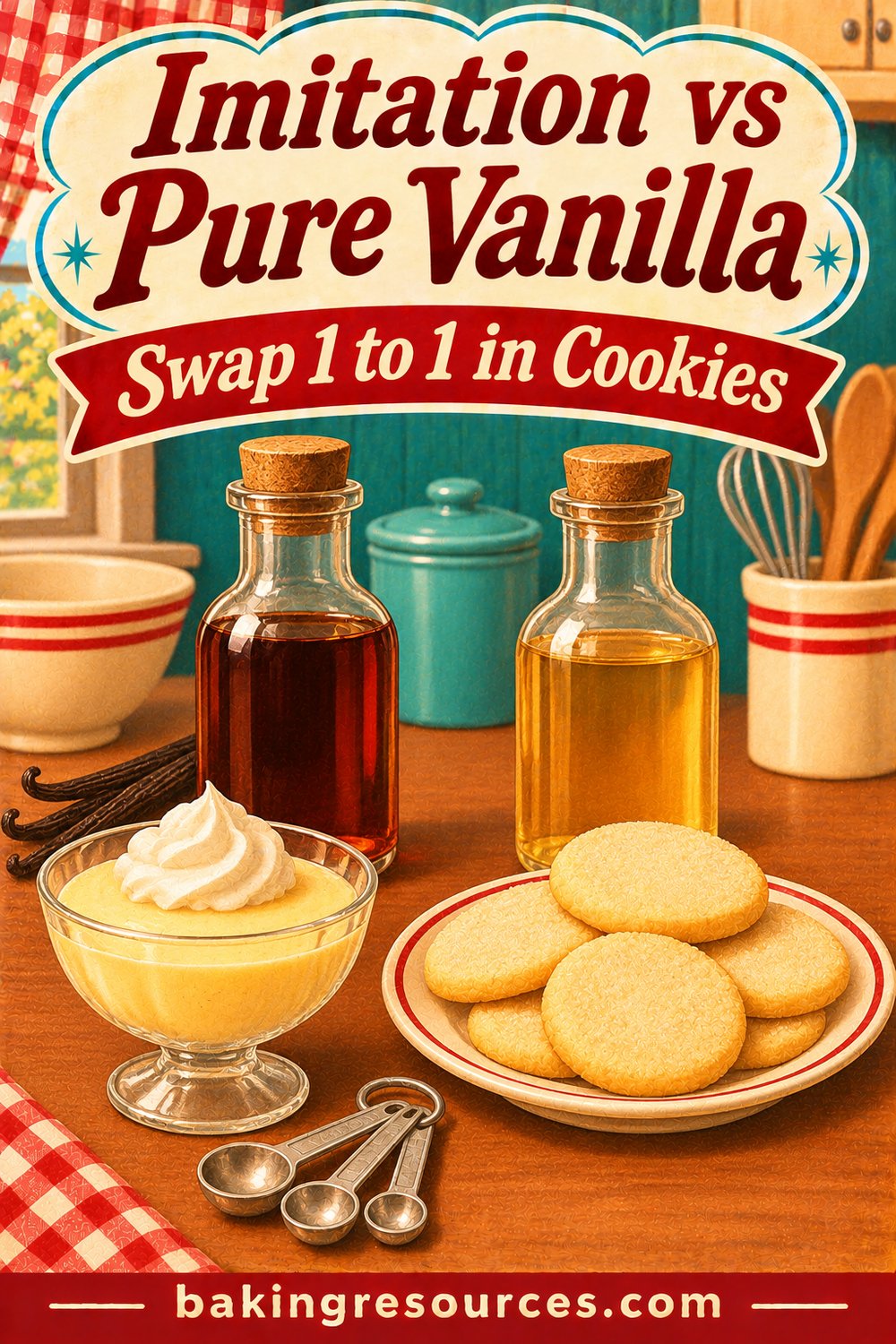
Free calculator from Baking Resources
Imitation or Pure Vanilla Calculator
Pick what you are making, the vanilla you have and how much the recipe asks for.
Need more? Open the free Baking Substitutions.
More free baking tools


Want more options? Open the full Baking Substitutions tool.
- Imitation vanilla swaps 1:1 for pure vanilla extract in baked goods.
- In cold or no-bake recipes, use about 1 1/4 tsp imitation for every 1 tsp pure extract.
- Double-strength vanilla goes in at half the amount.
- Pure vanilla extract has hundreds of flavor compounds; imitation is built mostly on one, vanillin.
- Vanilla bean paste swaps 1:1 for extract; vanilla powder at 1/2 tsp per 1 tsp extract.
- Pure extract keeps for years sealed in a dark cupboard; use imitation by its best-by date.
What’s the difference between imitation vanilla and pure vanilla extract?
The difference between imitation vanilla and pure vanilla extract is the source of the flavor: pure extract comes from real vanilla beans, while imitation vanilla is built on vanillin made without the bean. That one change explains everything else, from taste to how each behaves in the oven.
Pure vanilla extract is made by soaking cured vanilla beans until their flavor moves into the liquid. In the US, the FDA sets a standard for it, including a minimum amount of vanilla beans per gallon. It tastes rich and rounded, with floral, woody and creamy notes, because the bean holds hundreds of aroma compounds.
Imitation vanilla tastes clearly of vanilla, but flatter and sweeter, without those background notes.
| Pure vanilla extract | Imitation vanilla | |
|---|---|---|
| Made from | Cured vanilla beans | Vanillin made without the bean |
| Flavor compounds | Hundreds | Mostly one |
| Flavor | Deep, rounded, floral | Sweet, simple, a bit sharp |
| In baked cookies and cakes | Very good | Very close to pure |
| In frosting, custard, whipped cream | Clearly better | Thinner; use about 1/4 more |
| Swap ratio | 1 tsp | 1 tsp baked, about 1 1/4 tsp cold |
| Shelf life | Keeps for years, sealed and dark | Use by the best-by date |
| Comes in clear? | No, always brown | Yes, clear versions are common |
What is imitation vanilla made from?
Imitation vanilla is made mostly from vanillin, the main flavor compound in vanilla, mixed with water and often caramel coloring. The vanillin is usually made in a lab from other plant or industrial sources rather than taken from vanilla beans.
Vanillin itself is the same molecule whether it comes from a bean or a lab. What imitation lacks is everything else a bean offers: the hundreds of smaller compounds that give pure vanilla its depth. Some imitation bottles also add a related compound called ethyl vanillin, which is stronger, so always follow the label if it says double strength.
Is imitation vanilla the same as vanilla extract?
No, imitation vanilla is not the same as vanilla extract, though it does the same job in a recipe. Labels tell you which one you have:
- “Pure vanilla extract” is the real thing, made only from vanilla beans.
- “Vanilla flavoring” or “vanilla flavor” is still made from real vanilla beans. It just doesn’t meet the full legal standard for extract. It tastes close to pure extract.
- “Imitation vanilla” or “artificial vanilla” gets its flavor from vanillin that didn’t come from the bean.
- “Clear vanilla” is almost always imitation. Its colorless look is handy for bright white frosting.
Vanilla bean paste is another real-vanilla option. It is extract thickened with the seeds, and it swaps 1:1. Our guide to vanilla bean paste explains how to use it.
Can I use imitation vanilla instead of pure vanilla extract?
Yes, you can use imitation vanilla instead of pure vanilla extract at 1:1 in baked goods, and in most cookies and cakes you won’t notice. Two exceptions change the amount:
- Cold or no-bake recipes. In buttercream, glaze, whipped cream and no-bake fillings, imitation tastes thinner. Use about 1 1/4 teaspoons for every teaspoon the recipe lists, then taste.
- Double-strength bottles. If the label says double strength or concentrated, use half as much.
Don’t keep adding imitation to chase a stronger flavor. Past a point it turns harsh and a little bitter instead of richer. A tiny pinch of salt often brings vanilla forward better than more vanilla does.
Vanilla types compared: how much replaces 1 teaspoon of pure extract?
One teaspoon of pure vanilla extract can be replaced by 1 teaspoon of imitation vanilla, vanilla flavoring or vanilla bean paste, or 1/2 teaspoon of vanilla powder. Here is every common form side by side.
| Vanilla form | Amount for 1 tsp pure extract | Best in |
|---|---|---|
| Imitation vanilla | 1 tsp baked; about 1 1/4 tsp cold | Cookies, cakes, brownies |
| Clear imitation vanilla | 1 tsp baked; about 1 1/4 tsp cold | White frosting and white cakes |
| Double-strength vanilla | 1/2 tsp | Anywhere; follow the label |
| Vanilla flavoring (real beans) | 1 tsp | Anywhere |
| Vanilla bean paste | 1 tsp | Custards, frosting, ice cream |
| Vanilla powder | 1/2 tsp | Dry mixes, white frosting |
| Whole vanilla bean | About 1/3 bean, seeds scraped | Custards, panna cotta, pastry cream |
Out of every kind? Our vanilla extract substitute guide lists nine swaps with amounts, including maple syrup.
When is imitation vanilla fine, and when is pure worth it?
Imitation vanilla is fine in anything baked in a hot oven, and pure vanilla is worth it in cold, creamy or barely cooked desserts. Much of pure vanilla’s delicate aroma bakes off in the oven, and what’s left is mostly vanillin, the same compound imitation is built on.
Imitation is fine in:
- Cookies of all kinds, such as chocolate chip cookies and sugar cookies
- Cakes and cupcakes
- Brownies and chocolate cake, where chocolate covers most of the vanilla
- Muffins, quick breads and pancakes
- Spiced bakes like pumpkin bread and gingerbread
Pure is worth it in:
- Custards, pastry cream, vanilla pudding and the vanilla sauce for bread pudding
- Buttercream and glazes; see how to make buttercream
- Whipped cream, panna cotta and ice cream bases
- Very plain bakes where vanilla is the star, like shortbread or vanilla pound cake
A simple rule: if you’re baking it at 350°F for 10 minutes or more and it has other flavors, imitation is fine. If it’s cold, creamy or vanilla is the main flavor, reach for pure.
Imitation vs pure vanilla, recipe by recipe
This table shows which vanilla to choose for popular bakes, and how much imitation to use if that’s all you have.
| Recipe | Best pick | Imitation amount per 1 tsp pure |
|---|---|---|
| Chocolate chip cookies | Either | 1 tsp |
| Sugar cookies | Either | 1 tsp |
| Brownies, chocolate cake | Imitation is fine | 1 tsp |
| Vanilla layer cake | Either; pure a little rounder | 1 tsp |
| Cheesecake | Pure, slightly | 1 tsp, taste the batter |
| Custard, pastry cream | Pure | 1 tsp, then taste |
| Buttercream, cream cheese frosting | Pure | About 1 1/4 tsp |
| Whipped cream, no-bake fillings | Pure | About 1 1/4 tsp |
Making frosting for a cake? Our cream cheese frosting recipe is a good place to let pure vanilla shine.
Worked example: cookies and frosting from one recipe card
If your cookie dough needs 2 teaspoons of vanilla and your frosting needs 1, use imitation in the dough and pure in the frosting. Say you’re making cut-out sugar cookies and a batch of buttercream to decorate them, with a little pure extract and a big bottle of imitation.
- Cookie dough: use imitation, 2 teaspoons. The cookies bake at about 350°F, so imitation tastes almost the same as pure here.
- Buttercream: use pure, 1 teaspoon. The frosting is never cooked, so pure vanilla’s full flavor shows.
- Out of pure? Use 1 1/4 teaspoons of imitation in the frosting, beat it in, and taste. Add a tiny pinch of salt if it tastes flat.
- Want bright white frosting? Clear imitation vanilla keeps buttercream snowy, while brown pure extract tints it ivory.
Worked example: a double batch of pastry cream
If a double batch of pastry cream calls for 2 teaspoons of vanilla and you only have imitation, start with 2 teaspoons, stirred in off the heat, then taste and add up to 1/2 teaspoon more.
- Cook the pastry cream until thick, then take the pot off the burner.
- Stir in 2 teaspoons of imitation vanilla. Adding it off the heat keeps more of the aroma.
- Taste once it has cooled a little. If it’s flat, add 1/4 teaspoon at a time, up to 1/2 teaspoon more (2 1/2 teaspoons in all).
- Add a small pinch of salt if it still tastes thin. Salt lifts sweet flavors.
Holiday baking: where to spend your pure vanilla
For holiday baking, use imitation vanilla in the big cookie batches and save pure vanilla for frostings, custards and eggnog-style sauces. Cookie trays use a lot of vanilla, and in a 350°F oven imitation holds up just as well.
- Cut-out cookies, spritz and snickerdoodles: imitation, 1:1.
- Royal icing and buttercream: clear imitation keeps them white; pure gives the best taste.
- Bread pudding sauce, custard pies, whipped cream for pie: pure.
How to store pure and imitation vanilla
Pure vanilla extract keeps for years if it is tightly capped in a cool, dark cupboard, while imitation vanilla should be used by the best-by date on the bottle. Heat and light fade both.
- Keep bottles away from the stove and sunny windows.
- Screw the cap on tight after every use.
- Write the opening date on imitation bottles.
- Toss imitation vanilla that turns cloudy and doesn’t clear, smells sour or grows anything.
Our guide on how long vanilla extract lasts covers the signs a bottle has faded. Buy from a store you trust: the FDA has warned that some imitation vanilla sold outside the US has contained coumarin, which isn’t allowed in food here.
Troubleshooting vanilla flavor
If vanilla tastes too faint, too harsh or off, the fix is usually the amount or the timing, not the brand. Here’s what to try.
- If your cookies don’t taste of vanilla, that’s normal; heat drives most of it off. Add a pinch more salt rather than more vanilla.
- If frosting tastes chemical, too much imitation went in. Beat in more butter and sugar to dilute it, or switch to pure next time.
- If custard tastes flat, the vanilla went in while it was boiling. Add a few drops more after it cools a little.
- If white frosting turned ivory, brown extract tinted it. Use clear imitation or vanilla powder.
Myths vs facts about imitation vanilla
| Myth | Fact |
|---|---|
| Imitation is stronger, so use less. | Use it 1:1 in baking, unless the label says double strength. |
| You can always taste imitation in cookies. | Oven heat makes the two taste very close in baked goods. |
| Vanilla flavoring is the same as imitation. | Vanilla flavoring is made from real beans; imitation is not. |
| More imitation makes a richer flavor. | Too much tastes harsh and bitter. |
Mistakes to avoid
- Doubling imitation for “more flavor.” Stay at 1:1 for baking and about 1 1/4 for cold recipes.
- Swapping almond extract 1:1 for vanilla. Almond extract is about four times stronger. Use 1/4 teaspoon per teaspoon of vanilla. See our almond extract guide for more.
- Using brown extract in white wedding frosting. Even a teaspoon of pure extract tints it.
- Saving pure vanilla “for good” until it fades. Its aroma dulls after years open. Use it.
Quick reference: imitation vanilla vs pure vanilla extract
| Recipe calls for | Baked goods | Cold or no-bake |
|---|---|---|
| 1/2 tsp pure extract | 1/2 tsp imitation | A generous 1/2 tsp imitation |
| 1 tsp pure extract | 1 tsp imitation | 1 1/4 tsp imitation |
| 2 tsp pure extract | 2 tsp imitation | 2 1/2 tsp imitation |
| 1 tsp, double-strength bottle | 1/2 tsp | 1/2 tsp, then taste |
Frequently asked questions
Is vanilla flavoring the same as vanilla extract?
Almost. Vanilla flavoring is made from real vanilla beans but doesn’t meet the full legal standard for extract. It swaps 1:1 and tastes close to pure. Imitation vanilla is different, since its flavor doesn’t come from the bean.
What is imitation vanilla extract made from?
Mostly vanillin, the main flavor compound in vanilla, made without vanilla beans. It is mixed with water and often caramel coloring. Clear versions skip the coloring.
How much imitation vanilla equals 1 teaspoon of pure?
One teaspoon in baked goods. In cold recipes like frosting or whipped cream, use about 1 1/4 teaspoons. If the bottle says double strength, use half.
Can you taste the difference in cookies?
Most people can’t. Oven heat drives off much of what makes pure vanilla special, so the two taste very close in cookies, cakes and brownies.
Is clear vanilla imitation?
Almost always, yes. Pure vanilla extract is naturally brown. Clear vanilla is popular for white frostings and cakes because it doesn’t tint them.
Is imitation vanilla flavor the same as vanilla extract?
No. Imitation vanilla flavor is built on vanillin made without the bean, while vanilla extract comes from real beans. They swap 1:1 in baking.
How long does imitation vanilla last?
Use it by the best-by date on the bottle, kept tightly capped in a cool, dark cupboard. Pure extract keeps for years.
Which vanilla is best for frosting?
Pure vanilla extract or vanilla bean paste gives the best taste. Clear imitation vanilla is best if you need the frosting bright white.