How to Tell When Shortbread Is Done
Free calculator from Baking Resources
Shortbread Bake Time and Doneness Check
Pick your shape, how thick it is, and your oven temperature.
Need more? Open the free Baking Time Calculator.
More free baking tools


Want more options? Open the full Baking Time Calculator.
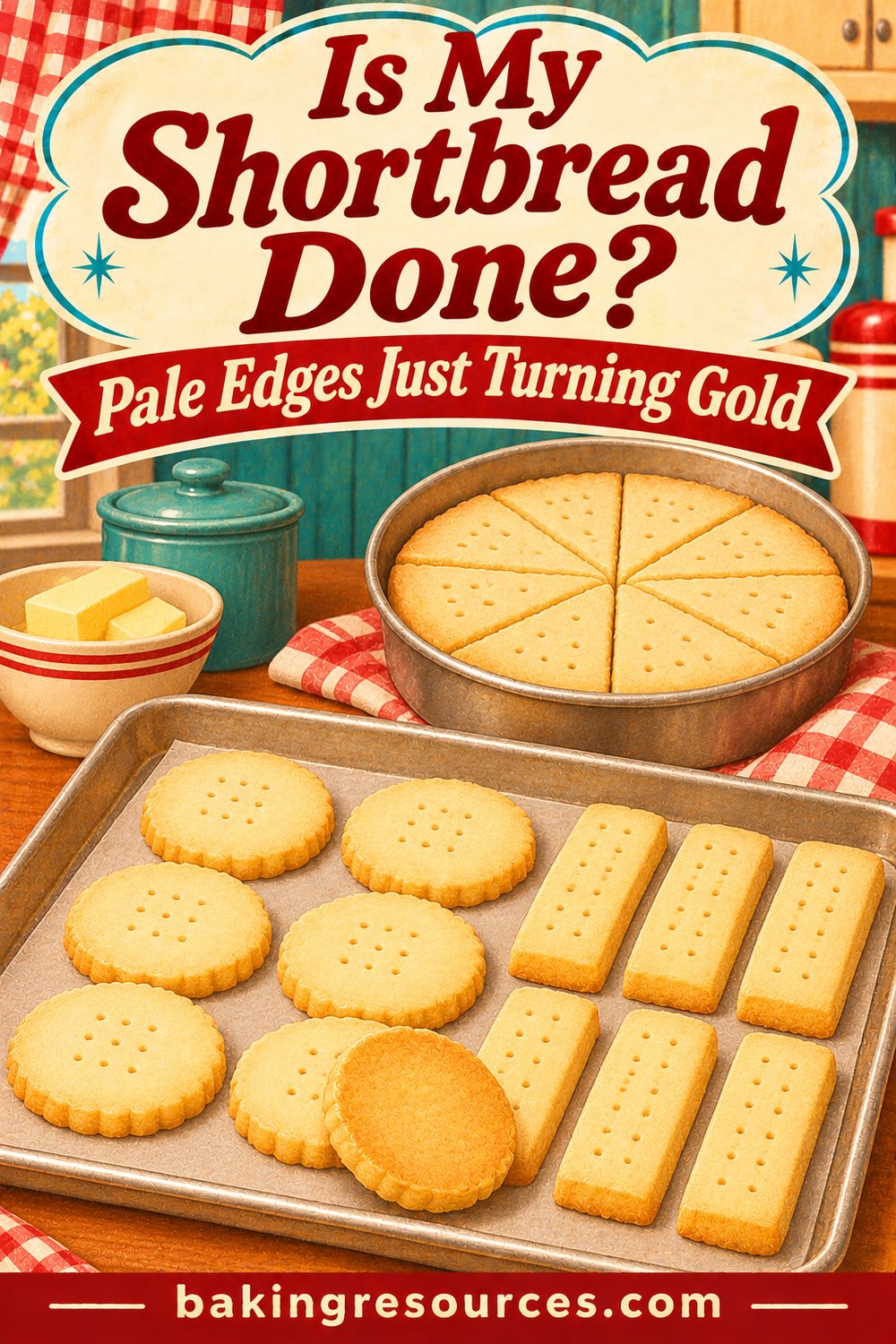
- Shortbread is done when the edges are light golden and the top is dry and matte, not shiny.
- At 325°F (165°C): 1/4 inch (6 mm) rounds take 15 to 20 minutes.
- At 325°F (165°C): 1/2 inch (13 mm) fingers take 22 to 28 minutes.
- At 325°F (165°C): pan shortbread in an 8 or 9 inch pan takes 30 to 40 minutes.
- Shortbread firms up as it cools, crisping within 15 to 30 minutes.
- Cut pan shortbread within about 5 minutes of leaving the oven.
How do you know when shortbread is done?
You know shortbread is done when the edges turn just light golden, the top looks dry and matte, the bottom is a light sandy gold, and the center feels firm to a light press. That usually happens at 15 to 20 minutes for 1/4 inch rounds at 325°F.
Shortbread is tricky because it barely changes color. There’s no egg and very little sugar to brown, and it bakes at a low temperature on purpose. If you wait for the cookie to look golden all over, it’s already overbaked. Check these signs, in this order:
- The edges. The very rim turns from cream to a pale, light gold. This is the first and most reliable sign.
- The top. It goes from slightly shiny and buttery to dry and matte. Look across it at an angle and the shine is gone.
- The bottom. Lift one cookie with a thin spatula. The underside should be an even, light sandy gold, not white and not brown.
- The feel. Press the center gently with a fingertip. It should feel firm and leave little or no dent. It will not feel crisp yet. That comes as it cools.
- The inside. Break one test cookie. The crumb should look even and sandy all the way through. A darker, dense, buttery-looking band in the middle means it needs a few more minutes.
How long to bake shortbread, by shape and thickness
At 325°F (165°C), bake shortbread 15 to 20 minutes for 1/4 inch rounds, 22 to 28 minutes for 1/2 inch fingers, and 30 to 40 minutes for 1/2 inch pan shortbread. Thickness sets the clock more than anything else. These times assume a light-colored metal pan on the middle rack.
| Shape | Thickness | At 325°F (165°C) | At 300°F (150°C) |
|---|---|---|---|
| Rounds or cut-outs | 1/4 in (6 mm) | 15 to 20 min | 18 to 24 min |
| Rounds or cut-outs | 1/2 in (13 mm) | 20 to 25 min | 25 to 30 min |
| Fingers, about 1 x 3 in | 1/2 in (13 mm) | 22 to 28 min | 28 to 34 min |
| Fingers, about 1 x 3 in | 3/4 in (2 cm) | 28 to 35 min | 34 to 42 min |
| Pan shortbread, 8 or 9 in pan | 1/2 in (13 mm) | 30 to 40 min | 40 to 50 min |
| Pan shortbread, thick | 3/4 in (2 cm) | 40 to 50 min | 50 to 60 min |
Most shortbread recipes bake at 325°F, including our easy shortbread cookies recipe. Some traditional Scottish recipes go lower, around 300°F, for an even paler, more tender cookie. If your recipe uses a different temperature or pan, the Baking Resources baking time calculator adjusts the time, and the oven temperature converter covers Celsius, fan and gas mark.
What color should shortbread be when it’s done?
Done shortbread should be pale cream on top with just a thin line of light gold at the edges and a light sandy gold underneath. Use this color guide when you peek in the oven.
| Where you look | Underbaked | Just right | Overbaked |
|---|---|---|---|
| Edges | Same cream as the top | Thin line of light gold | Wide golden brown band |
| Top | Shiny, damp or greasy | Dry, matte, pale cream | Golden all over |
| Bottom | White or pale | Light sandy gold | Brown |
| Inside | Dense, darker, pasty band | Even and sandy | Dry and hard |
Brown sugar and chocolate shortbread hide color, so judge those by the matte top and firm feel instead.
Should shortbread be soft when it comes out of the oven?
Yes, shortbread should feel a little soft when it comes out of the oven, and it firms up and turns crisp within 15 to 30 minutes as the butter sets. Hot shortbread is fragile and feels softer than the finished cookie. Fully baked shortbread can bend slightly if you lift it hot.
The difference between “hot and soft” and “underbaked” is the surface. A done cookie is dry and matte on top even when hot. An underbaked one still looks shiny, damp or greasy in the middle. For the general carryover rule that applies to all cookies, see how to tell when cookies are done.
Underbaked vs overbaked shortbread
Underbaked shortbread has a shiny center and white bottom and can go back in the oven; overbaked shortbread is golden all over and tastes toasty. This table shows what to do in each case.
| What you see | What it means | What to do |
|---|---|---|
| Shiny or greasy center, white bottom | Underbaked | Bake 3 to 5 minutes more |
| Dense, pasty band in the middle once cool | Underbaked | Return to a 300°F oven for 5 to 10 minutes |
| Pale top, matte surface, light gold edges | Just right | Cool on the pan 5 minutes, then a rack |
| Golden all over, brown bottom | Overbaked | Tastes toasty. Pull earlier next time |
| Hard and dry, dark edges | Well overbaked | Lower the temperature or move up a rack |
Can you rebake underbaked shortbread?
Yes, you can rebake underbaked shortbread, even once it’s cool: put it back in a 300°F (150°C) oven for 5 to 10 minutes. Because there’s no egg or leavening, it finishes baking without any harm.
Overbaked shortbread can’t be undone, but it’s still good crumbled over ice cream or pressed into a crust. If your cookies came out hard even though the color looked right, why cookies turn hard covers the other causes, like packed flour.
How to tell when pan shortbread is done
Pan shortbread is done when a pale golden ring about 1/2 inch (1 cm) wide shows around the edge, the center is dry and matte, and it feels equally firm at the edge and the center, usually after 30 to 40 minutes at 325°F. A thick slab is harder to judge because the center lags behind the edges. Look for:
- The golden ring where the dough meets the pan.
- A dry, matte center with no greasy sheen.
- Firmness all the way across. Press near the center and the edge with a fingertip. They should feel the same.
- The fork pricks holding their shape, not filling back in with butter.
Cut pan shortbread within about 5 minutes of leaving the oven, while it’s still warm. Once cool it gets too crisp to slice and shatters. The same signs work for shortbread crusts under bars, like the base for our lemon bars.
Shortbread variations: how the doneness signs change
Most shortbread variations bake in the same time at 325°F, but brown sugar, chocolate and gluten-free versions need you to judge by feel rather than color.
| Variation | Time change | Best doneness sign |
|---|---|---|
| Brown sugar shortbread | About the same | Matte top and firm feel; it starts darker |
| Chocolate shortbread | About the same | Matte top and firm edges; color hides browning |
| Cornstarch (melt-away) shortbread | About the same | Edges set and just colored; very fragile hot |
| Gluten-free shortbread | Often 2 to 3 min longer | Firm center; GF flours stay pale longer |
| Sprinkle or zest shortbread | Same | Usual light gold edges |
Our shortbread recipe lists these swaps with exact amounts.
Worked example: shortbread fingers for a gift tin
Shortbread fingers 1/2 inch thick take 22 to 28 minutes at 325°F, and in this example they’re done at 25. You’ve rolled the dough and cut 1 x 3 inch fingers.
- Time from the table: 22 to 28 minutes. Set a timer for 22.
- At 22 minutes: the tops are still a little shiny and the ends are cream colored. Not yet.
- At 25 minutes: the ends show a faint gold line, the tops are matte, and a gentle press leaves no dent. Lift one. The bottom is light sandy gold. Done.
- Cool: 5 minutes on the pan, then move to a rack. They turn crisp as they cool.
Worked example: pan shortbread wedges
A 9 inch round pan of shortbread pressed 1/2 inch thick takes 30 to 40 minutes at 325°F and is usually done around 35. Here’s how it looks along the way.
- Before baking: press the dough evenly, crimp the edge with a fork, prick all over, and score 12 wedges lightly.
- At 30 minutes: the edge has a thin gold line, but the center still has a slight shine. Keep going.
- At 35 minutes: the center is matte and feels as firm as the edge. Out it comes.
- Within 5 minutes: cut along the scored lines with a sharp knife, then let it cool in the pan.
Tips for evenly baked shortbread
For evenly baked shortbread, roll the dough to one even thickness, chill it 30 minutes, and bake one tray at a time on the middle rack of a 325°F oven.
- Roll to an even thickness. Thin spots brown while thick ones stay raw. Rolling between two guide sticks helps.
- Chill before baking. Cold shapes hold their edges and bake more evenly.
- Use a light metal pan and parchment. Dark pans brown the bottoms before the tops are set. Parchment is better than a silicone mat for shortbread, as explained in parchment paper vs silicone mat.
- Bake one tray at a time on the middle rack. See how to bake evenly in your oven if one side always browns first.
- Measure the flour by weight. Extra flour makes shortbread dry and pale even when it’s done. How to measure flour shows the 125 g per cup method.
Myths vs facts about shortbread doneness
The biggest myth is that shortbread should be golden brown; in fact, good shortbread is pale, with only light gold at the edges and bottom.
- Myth: if it’s soft, it’s underbaked. Fact: hot shortbread is always a little soft. Judge by the matte top.
- Myth: a toothpick test works. Fact: shortbread has no batter to cling to a toothpick. Use the color and press tests.
- Myth: a hotter oven saves time. Fact: at higher heat the edges brown before the center bakes. Stick with 300 to 325°F.
- Myth: underbaked shortbread is ruined. Fact: you can return it to a 300°F oven for 5 to 10 minutes.
How to store shortbread once it’s baked
Store fully cooled shortbread in an airtight container at room temperature for about 2 weeks, or freeze it for up to 3 months. Keep it away from soft cookies, which make it lose its snap. See how long Christmas cookies last for the full chart and Christmas cookies that freeze well for freezing and thawing.
Quick reference: when is shortbread done?
This table sums up shortbread bake times and doneness signs at 325°F (165°C) for the most common shapes.
| Shape | Thickness | Time at 325°F | Pull it when |
|---|---|---|---|
| Rounds or cut-outs | 1/4 in (6 mm) | 15 to 20 min | Edges just light gold, top matte |
| Rounds or cut-outs | 1/2 in (13 mm) | 20 to 25 min | Edges just light gold, firm to a press |
| Fingers | 1/2 in (13 mm) | 22 to 28 min | Ends light gold, sides firm |
| Pan shortbread | 1/2 in (13 mm) | 30 to 40 min | Gold ring at edge, center matte and firm |
Frequently asked questions
How long do you bake shortbread cookies?
About 15 to 20 minutes at 325°F for 1/4 inch rounds, 22 to 28 minutes for 1/2 inch fingers, and 30 to 40 minutes for pan shortbread.
Should shortbread be brown?
No. Good shortbread is pale, with just a hint of light gold at the edges and on the bottom. Brown all over means it’s overbaked.
Why is my shortbread soft in the middle?
It may still be warm, since shortbread firms as it cools. If it’s still soft and pasty once cool, it was underbaked. Return it to a 300°F oven for 5 to 10 minutes.
Can you overbake shortbread?
Yes. It turns golden brown, tastes toasty instead of buttery, and gets hard. Pull it as soon as the edges show color.
Why is my shortbread crumbly and falling apart?
Usually too much flour or not enough baking. Weigh the flour, and make sure the center is dry and firm before you take it out.
How long to cook shortbread in a pan?
Pan shortbread about 1/2 inch thick in an 8 or 9 inch pan takes 30 to 40 minutes at 325°F, or 40 to 50 minutes at 300°F.
Does shortbread harden as it cools?
Yes. It goes from slightly soft to crisp within 15 to 30 minutes as the butter sets, so don’t bake it until it feels hard.