How to Heat Treat Flour (Oven and Microwave)
Free calculator from Baking Resources
Heat Treat Flour Timer
Pick your method and how much flour you need to heat.
Need more? Open the free Ingredient Weight Chart.
More free baking tools



Want more options? Open the full ingredient weight chart.
- Heat flour to 165°F (74°C) in several spots, checked with a thermometer.
- Oven: 350°F (175°C) for about 5 to 10 minutes, stirring halfway.
- Microwave: 30 second bursts, about 1 1/2 to 2 minutes for 1 cup (125 g).
- 1 cup of all-purpose flour is 125 g, spooned and leveled.
- Spread the flour thinner than 1/4 inch (6 mm), then cool and sift.
- Raw eggs are a separate risk, so use pasteurized eggs or none in edible dough.
How do you heat treat flour?
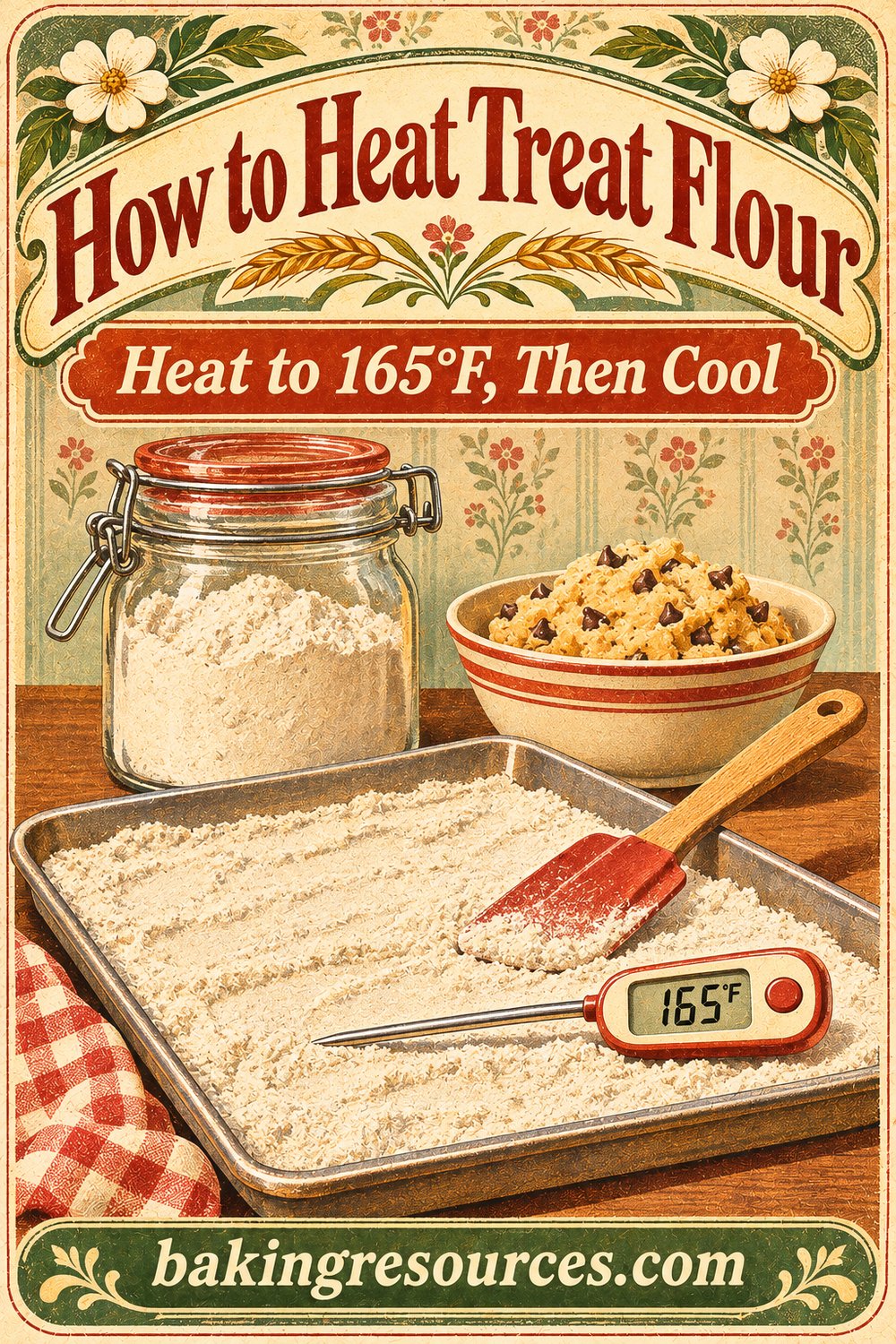
To heat treat flour, spread it in a thin layer and heat it until a thermometer reads 165°F (74°C) in several spots, which takes about 5 to 10 minutes in a 350°F (175°C) oven or 1 to 2 minutes in a microwave for 1 cup. Then cool it completely and sift it. That is the whole trick, and it takes about 15 minutes with cooling.
You do this when you are making something you will eat without baking, like edible cookie dough, no-bake bars or a cookie-dough dip. If you are baking the dough, you do not need to heat treat the flour, because the oven does the job.
The temperature is the point. Heating “for a few minutes” is not enough on its own. A thermometer tells you when the flour is really ready.
Why does flour need to be heat treated?
Flour needs to be heat treated before you eat it raw because it is a raw product that is not treated to kill germs, and it can carry bacteria such as E. coli and Salmonella. Flour is milled from grain grown in fields, and milling does not make it safe to eat raw. The CDC and FDA both warn against eating raw dough or batter for this reason.
Normal baking kills those germs, because the inside of a cookie or cake gets hot enough. A spoonful of raw dough never does. If you have ever licked the spoon, you are in good company, but the safe way is to heat treat the flour first.
One more thing to know. Flour is not the only risk in raw dough. Raw eggs can carry Salmonella too, so an edible dough also needs pasteurized eggs or no eggs at all. Heat treating the flour fixes only half the problem.
How do you heat treat flour in the oven?
To heat treat flour in the oven, bake it on a rimmed sheet pan at 350°F (175°C) for about 5 to 10 minutes, stirring halfway, until it reads 165°F (74°C). A thin layer is the secret, because thick piles stay cool in the middle.
Here is the step-by-step:
- Heat the oven to 350°F (175°C). Line a rimmed baking sheet with parchment.
- Weigh or measure the flour. Spread it in a thin, even layer, about 1/4 inch (6 mm) deep or less.
- Bake for 5 minutes, then stir with a spatula and spread it back out.
- Check the temperature in 4 or 5 spots with an instant-read thermometer. You want 165°F (74°C) everywhere.
- If any spot is cooler, bake 1 to 2 more minutes and check again.
- Slide the parchment onto a rack and let the flour cool completely, about 20 to 30 minutes.
- Sift it to break up any small lumps, then measure again before you use it.
A lower oven, 300°F (150°C), works too. It takes about 8 to 10 minutes for 1 cup, but it is gentler and less likely to toast the flour. Our guide to baking evenly in your oven helps if your oven has hot spots, and the oven temperature conversion tool turns the numbers into Celsius for you.
How do you heat treat flour in the microwave?
To heat treat flour in the microwave, put 1 cup (125 g) in a microwave-safe bowl and heat in 30 second bursts, stirring well each time, for about 1 1/2 to 2 minutes total, until it reads 165°F (74°C). It is faster than the oven for small amounts.
- Use a wide, microwave-safe glass bowl and no more than 1 cup (125 g) at a time.
- Heat for 30 seconds, then stir very well, scraping the edges where the flour heats fastest.
- Repeat in 30 second bursts. After the third burst, start taking its temperature.
- Check 3 or 4 different spots. Stop when every spot reads 165°F (74°C).
- Spread the flour on a plate to cool, then sift it.
Microwaves heat in hot and cool pockets, which is why stirring matters. Stop right away if you smell anything toasty or see the flour turn tan. For anything over 1 cup, the oven is a safer choice.
How long does it take to heat treat flour?
It takes about 4 to 12 minutes in a 350°F (175°C) oven, depending on the amount, and 1 to 2 minutes per cup in the microwave. These are starting guides, since the thermometer reading is what counts. Use the timer tool above for your exact amount.
| Amount of flour | Oven 350°F (175°C) | Oven 300°F (150°C) | Microwave |
|---|---|---|---|
| 1/2 cup (63 g) | 4 to 6 min | 6 to 8 min | 1 to 1 1/2 min |
| 1 cup (125 g) | 5 to 7 min | 8 to 10 min | 1 1/2 to 2 min |
| 2 cups (250 g) | 7 to 9 min | 10 to 12 min | 2 batches of 1 cup |
| 4 cups (500 g) | 9 to 12 min (2 pans) | 12 to 15 min (2 pans) | Use the oven |
These times are estimates for a thin layer on a rimmed sheet. A thick layer, a cold pan or a dark pan can all change them.
How do you know the flour is hot enough?
You know the flour is hot enough when an instant-read thermometer reads 165°F (74°C) in several spots, since that is the temperature recommended by food safety agencies to kill germs. Color is not a reliable clue, because properly heated flour looks almost the same as raw flour.
Take readings in the middle, near the edges and in any lumps. Wipe the probe between checks. If you do not own a thermometer, they are a handy kitchen tool, and you will use it for bread, custards and meat too. Without one, you are guessing.
How much flour should you heat treat for a recipe?
Heat treat the exact amount the recipe needs by weight, using 125 g per cup of all-purpose flour (spooned and leveled). Weighing is easier than measuring, and the ingredient weight chart lists the numbers. If you are not sure how to measure, see how to measure flour and kitchen scale versus measuring cups.
| Flour (US) | Grams | Ounces |
|---|---|---|
| 1/4 cup | 31 g | 1.1 oz |
| 1/3 cup | 42 g | 1.5 oz |
| 1/2 cup | 63 g | 2.2 oz |
| 3/4 cup | 94 g | 3.3 oz |
| 1 cup | 125 g | 4.4 oz |
| 1 1/2 cups | 188 g | 6.6 oz |
| 2 cups | 250 g | 8.8 oz |
Heating dries the flour a tiny bit, so it can weigh slightly less afterward. For best accuracy, weigh the flour after it has cooled and been sifted, or heat a small extra amount. If you need grams for other ingredients, try the grams to cups converter.
What is a worked example for edible cookie dough?
For an edible cookie dough recipe that uses 1 1/2 cups (188 g) of flour, heat that amount for about 6 to 8 minutes at 350°F (175°C) on one sheet pan, stirring halfway, until it reads 165°F (74°C). Here is how the math and steps work:
- 1 1/2 cups of flour at 125 g per cup is 187.5 g, about 188 g.
- Spread 188 g on a parchment-lined rimmed sheet in a layer under 1/4 inch (6 mm).
- Bake at 350°F (175°C), stirring at 4 minutes. Test from 6 minutes on.
- When all spots read 165°F (74°C), cool the flour for 20 to 30 minutes and sift it.
- Mix the dough only when the flour is cool, or it will melt the butter. Leave out eggs, or use pasteurized ones.
Our chocolate chip cookies recipe is made to be baked. Use these steps only if you plan to eat a dough raw. If you are baking, you can skip heat treating completely.
What can you make with heat-treated flour?
Heat-treated flour is used in foods you eat without baking, such as edible cookie dough, no-bake cookie bars, cookie dough truffles, cake batter dips and cheesecake-style fillings. Never use it as a way to make raw batter safe if it also contains raw eggs.
It is also a good idea for cream cheese frostings or fillings that call for flour. See our cream cheese frosting recipe and no-bake cookies recipe for treats that never see the oven. If you freeze balls of edible dough, how to freeze cookie dough shows how, and how long cookie dough lasts in the fridge covers timing.
Does heat treating change the flour?
Heat treating changes flour only slightly: it can clump a little, taste a touch toasty, and lose some of its ability to build gluten. For a no-bake dough that is fine. For bread or anything that needs strong structure, use regular flour, because those recipes bake anyway.
If the flour clumps, sift it. If it picks up color, the oven was too hot, and it is better to start again with fresh flour than to use a scorched batch. Whole wheat and bread flours can be treated the same way. For the difference between types, read types of flour and bread flour versus all-purpose.
How do you store heat-treated flour?
Store heat-treated flour in an airtight container in the refrigerator and use it within about 3 months. Label it with the date, so nobody confuses it with plain flour. Cool it fully first, because warm flour makes steam and moisture inside the container.
Many bakers heat treat a big batch, for example 4 cups (500 g), and keep it in a jar for the holidays. Go by the same rules for storing any flour, which our guide on how to store flour covers. The 3-month figure is a practical rule of thumb, not a lab-tested number, so use your nose, and toss it if it smells off.
What mistakes should you avoid?
The biggest mistake is guessing instead of taking the flour’s temperature. These are the others to watch:
- Piling flour too thick. Thick piles stay cold inside. Spread it thin.
- Skipping the stir. The edges heat first and the center lags.
- Using hot flour right away. It melts butter and makes the dough greasy.
- Forgetting the eggs. Raw eggs need to be pasteurized or left out.
- Heating too hot. Above 350°F (175°C) the flour toasts and tastes burnt.
- Trusting the microwave with a big batch. Do 1 cup at a time.
Quick reference: heat treating flour
The one number to remember is 165°F (74°C); everything else is just how you get there. This table sums it up.
| Question | Answer |
|---|---|
| Target temperature | 165°F (74°C) in several spots |
| Oven method | 350°F (175°C), 5 to 10 minutes, stir halfway |
| Gentler oven method | 300°F (150°C), 8 to 15 minutes |
| Microwave method | 30 second bursts, 1 1/2 to 2 minutes for 1 cup (125 g) |
| Layer thickness | Under 1/4 inch (6 mm) |
| Flour weight | 125 g per cup, spooned and leveled |
| Cool before using | 20 to 30 minutes, then sift |
| Storage | Airtight, refrigerated, about 3 months |
| Needed for baked cookies? | No, the oven heats it enough |
For more kitchen math, the kitchen conversion calculator and the baking conversion chart keep numbers like these in one place.
Frequently asked questions
How do you heat treat flour in the oven?
Spread it thin on a rimmed sheet and bake at 350°F (175°C) for about 5 to 10 minutes, stirring halfway, until it reads 165°F (74°C).
How do you heat treat flour in the microwave?
Heat 1 cup (125 g) in 30 second bursts, stirring each time, for about 1 1/2 to 2 minutes, until a thermometer reads 165°F (74°C).
What temperature should heat-treated flour reach?
165°F (74°C), measured in several spots with an instant-read thermometer.
Is it safe to eat raw cookie dough if you heat treat the flour?
It lowers the risk from flour, but raw eggs are a risk too. Use pasteurized eggs or leave them out.
Do you need to heat treat flour for baked cookies?
No. The oven heats the dough well past 165°F (74°C), so regular flour is fine for anything you bake.
How long does heat-treated flour last?
About 3 months in an airtight container in the fridge is a good rule of thumb. Toss it if it smells off.
Can you heat treat any kind of flour?
Yes. All-purpose, bread, cake and whole wheat flours can all be heat treated the same way.
Why is raw flour not safe to eat?
Flour is a raw product that is not treated to kill germs, so it can carry bacteria like E. coli. Heating it to 165°F (74°C) reduces that risk.