Puff Pastry Substitute: 4 Easy Swaps That Work
Free calculator from Baking Resources
Puff Pastry Substitute Picker
Pick what you are making and what you have in the kitchen.
Need more? Open the free Baking Substitutions.
More free baking tools



Want more options? Open the full baking substitutions tool.
- Replace 1 puff pastry sheet with 1 crescent dough sheet, 1 pie crust round, or 6 to 8 buttered phyllo sheets.
- Phyllo needs about 4 tbsp (57 g) melted butter per puff pastry sheet replaced.
- Rough puff and pie crust bake at 400°F (200°C); crescent dough and phyllo at 375°F (190°C).
- One frozen puff pastry sheet is about 8 to 10 oz (225 to 285 g); sizes vary by box.
- Only rough puff rises close to real puff pastry; the others flake or crisp instead.
- Unbaked shaped pastries freeze up to 1 month and bake from frozen.
What is the best substitute for puff pastry?
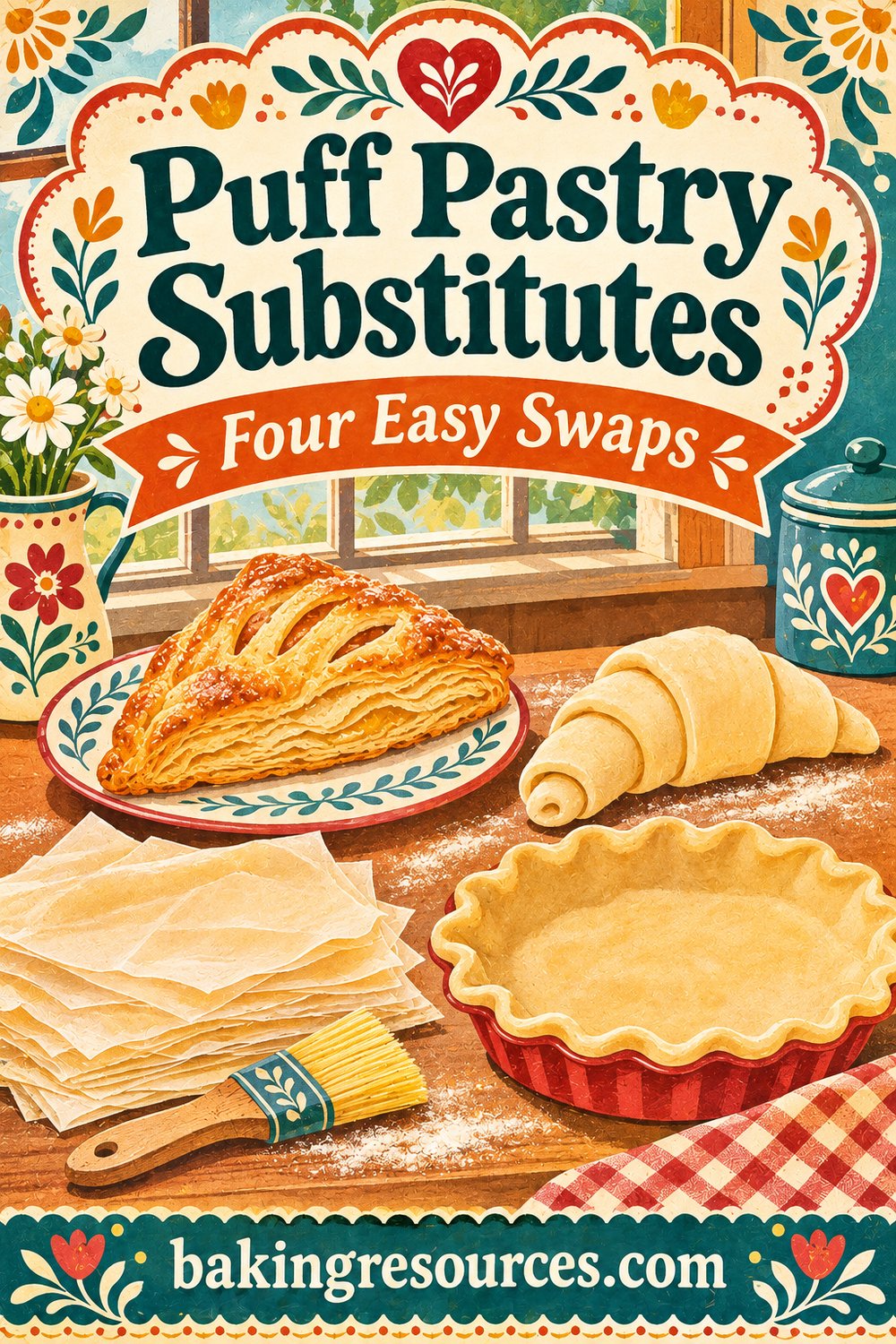
The best substitute for puff pastry is homemade rough puff, and the best store-bought swap is refrigerated crescent dough used sheet for sheet. If you came here with a recipe open and a missing box of puff pastry, take a breath. You have four good options and one of them is probably in your fridge.
Here is the short list, from closest match to most different:
- Rough puff: cold butter, flour and a few folds. It flakes like the real thing and rises almost as tall.
- Refrigerated crescent dough: a soft, buttery sheet that puffs a little. Easiest for turnovers, wraps and appetizers.
- Refrigerated or homemade pie crust: sturdy and tender. Best for pot pie lids, tarts and galettes.
- Phyllo dough brushed with butter: crisp, shattery layers that do not puff. Best for napoleons, strudel-style pastries and pie lids you want crunchy.
The right pick depends on the job. Use the picker above to match what you are making with what you have, and read on for the details and oven temperatures.
Why is puff pastry hard to replace?
Puff pastry is hard to replace because it is made of hundreds of paper-thin layers of dough and butter that turn to steam in a hot oven and push the layers apart. That process is called lamination, which is just a fancy word for folding butter into dough again and again. You can read more in our guide to what lamination in pastry means.
Two things have to happen for real puff: the butter must stay cold and solid until it hits the oven, and the oven must be hot enough, usually 400°F (200°C), to make steam fast. Most substitutes copy only one of these. Crescent dough has butter and layers but also yeast, so it bakes soft. Pie crust has cold butter but no layers, so it flakes but does not puff. Phyllo has layers but no butter inside, so you add the butter yourself.
Once you know that, you can choose with your eyes open. Do you need height, crunch, or a sturdy crust that holds wet filling? Pick the swap that gives you that one thing.
Can you use crescent roll dough instead of puff pastry?
Yes, you can use refrigerated crescent dough instead of puff pastry, one sheet for one sheet, and bake it at 375°F (190°C) for 12 to 25 minutes depending on the shape. It is the easiest swap for turnovers, sausage rolls, wrapped brie and pot pie tops.
Use the seamless sheet if you can find it. If you only have the perforated triangles, press the seams together firmly and roll the dough a little thinner so the joins disappear. Keep it cold. Crescent dough turns sticky fast, and cold dough is much easier to cut and fold.
What changes? The crumb is softer and breadier because crescent dough contains yeast. It browns faster too, thanks to a little sugar, so watch the top. It will not give you the tall, shattering layers of true puff pastry, but most people are happy with the buttery flavor.
Can you use pie crust instead of puff pastry?
Yes, you can use pie crust instead of puff pastry for pot pie lids, tarts, galettes and hand pies, baked at 400°F (200°C). It will not puff, but it flakes and stays crisp under wet fillings.
Pie crust is actually the better choice for anything with a juicy filling, because it is sturdier. Roll it to about 1/8 inch (3 mm) thick for tarts and a little thicker for lids. If you make your own, our pie crust recipe and the guide to cutting butter into flour cover the technique. For an empty tart shell, see how to blind bake a pie crust.
One refrigerated crust (a 9 inch round) covers about one puff pastry sheet. For wraps and turnovers, press two scraps together and re-roll once. Rolling more than that makes it tough.
Can you use phyllo dough instead of puff pastry?
Yes, you can use phyllo dough instead of puff pastry by stacking 6 to 8 sheets and brushing each one with melted butter, which gives a crisp, shattery result that does not puff. Plan on about 4 tablespoons (57 g, half a stick) of melted butter for each puff pastry sheet you replace. That is an estimate, and the exact amount depends on sheet size.
Phyllo is paper-thin and dries out in minutes, so work fast. Keep the stack under a barely damp towel, brush edge to edge, and do not worry about tiny tears, because the layers hide them. Bake at 350 to 375°F (175 to 190°C). Phyllo browns quickly, so check at 12 to 15 minutes.
It is a great swap for napoleons, apple strudel-style rolls and pie lids. It is a poor swap for anything that needs height. The butter converter turns sticks into tablespoons and grams, which helps when you are measuring the butter for brushing.
How do you make a quick puff pastry substitute at home?
A quick homemade substitute is rough puff: cold butter cut into big, pea-to-walnut-sized pieces, mixed into flour and folded three or four times. It takes about 20 minutes of hands-on time plus chilling, and it behaves like puff pastry in most recipes.
Here is the idea in plain steps, not a full recipe:
- Freeze the butter for 15 minutes, then cut it into large chunks. Do not rub it in. You want visible pieces.
- Mix with flour, a pinch of salt and just enough ice water to hold the dough together. It will look shaggy. That is correct.
- Pat into a rectangle, fold in thirds like a letter, turn it a quarter turn and roll again. Do this three or four times.
- Chill the dough for 30 minutes between folds if the butter softens or the dough fights back.
- Chill the shaped pastries for 15 minutes before baking, then bake hot at 400°F (200°C).
The butter chunks are what make the layers. If they melt into the flour, you get pie crust. If the dough feels greasy, put it in the fridge and walk away for 20 minutes.
How do the substitutes compare side by side?
Crescent dough and rough puff are the closest to puff pastry for flavor and flakiness, while pie crust and phyllo give a different but still delicious texture. This table compares them on the things that matter at the oven.
| Substitute | Puff (rise) | Texture | Best for | Oven |
|---|---|---|---|---|
| Rough puff | High | Flaky, tender | Anything puff pastry does | 400°F (200°C) |
| Crescent dough | Low to medium | Soft, buttery, bready | Turnovers, wraps, pot pie tops | 375°F (190°C) |
| Pie crust | None | Flaky, sturdy | Tarts, galettes, pot pie lids | 400°F (200°C) |
| Phyllo plus butter | None | Crisp, shattery | Napoleons, strudels, crunchy lids | 350 to 375°F (175 to 190°C) |
How much of each substitute replaces one puff pastry sheet?
One frozen puff pastry sheet, usually 8 to 10 ounces (225 to 285 g) depending on the box, is replaced by one crescent dough sheet, one 9 inch pie crust, or 6 to 8 phyllo sheets with 4 tablespoons (57 g) of melted butter. Check your package, because sheet sizes vary.
| Swap for 1 puff pastry sheet | Amount | Extra needed |
|---|---|---|
| Crescent dough | 1 sheet (about 8 oz, 227 g) | None |
| Pie crust | 1 round (9 inch) | Roll slightly larger for a square sheet |
| Phyllo | 6 to 8 sheets | 4 tbsp (57 g) melted butter, about 1/2 stick |
| Rough puff | About 8 oz (225 g) dough | 3 to 4 folds, 30 minutes chill |
What is a worked example of swapping puff pastry in a recipe?
Say a recipe makes 8 apple turnovers from 2 puff pastry sheets, and you have only phyllo. You need 12 to 16 phyllo sheets in total, which is 6 to 8 per sheet, and about 8 tablespoons (113 g, 1 stick) of melted butter. Here is how it works out:
- 2 puff pastry sheets become 16 phyllo sheets (8 each).
- Butter at 4 tablespoons per puff pastry sheet is 8 tablespoons, which is exactly 1 stick, or 113 g.
- Cut the stack into squares, fill, fold into triangles and brush the tops with butter.
- Bake at 375°F (190°C) for 15 to 20 minutes, until deep golden.
With crescent dough, the same recipe needs 2 sheets, cut into 4 squares each, baked at 375°F (190°C) for 12 to 15 minutes. If you are unsure about the butter math, the butter converter turns sticks, tablespoons and grams in one step.
What oven temperature and time should you use for each substitute?
Bake puff pastry substitutes between 350 and 400°F (175 to 200°C): 400°F for rough puff and pie crust, 375°F for crescent dough and phyllo. Time depends on the shape and the filling, so use color as your guide.
| Shape | Crescent dough | Pie crust | Phyllo (buttered) | Rough puff |
|---|---|---|---|---|
| Turnovers | 375°F, 12 to 15 min | 400°F, 20 to 25 min | 375°F, 15 to 20 min | 400°F, 20 to 25 min |
| Pot pie lid | 375°F, 15 to 20 min | 400°F, 30 to 40 min | 375°F, 20 to 25 min | 400°F, 25 to 30 min |
| Wrapped brie | 375°F, 20 to 25 min | 400°F, 25 to 30 min | 375°F, about 25 min | 400°F, 25 to 30 min |
| Palmiers | 375°F, 10 to 14 min | 400°F, 12 to 15 min | 375°F, 12 to 15 min | 400°F, 12 to 16 min |
Ovens run hot or cold, so give yours a check. Our guide to baking evenly in your oven and the one on which oven rack to use help here. If you bake with a fan, read about convection versus conventional ovens, because a convection oven usually needs about 25°F (15°C) less. Need Celsius or Fahrenheit? Try the oven temperature conversion tool.
What tips give the best results with any substitute?
The best results come from cold dough, a hot oven and a brush of egg wash. These five habits help every swap in this article.
- Keep dough cold. If it turns soft or sticky while you work, slide it onto a tray and chill it for 10 to 15 minutes.
- Preheat fully. A cold oven melts the butter before it can make steam.
- Brush with egg wash for shine and color, but keep it off the cut edges, which can glue the layers shut.
- Cut with a sharp knife or a pizza cutter. A dull blade squashes the edges.
- Cut small steam vents in lids and wraps, and bake on parchment so the bottoms brown evenly.
What mistakes should you avoid?
The most common mistake is working with warm dough, which makes every substitute greasy and flat. Others are easy to fix:
- Skipping the butter on phyllo. Dry sheets bake into brittle paper. Brush every layer.
- Overworking pie crust. Re-rolling more than once makes it tough.
- Underbaking crescent dough. The center can stay doughy. Look for deep golden, not pale tan.
- Filling too wet. Cool hot fillings and drain fruit or the bottom turns soggy.
- Ignoring the sheet size. A sheet that is too small tears when you wrap it. Roll it larger first.
Are there dairy-free or vegan options?
Yes. Phyllo is usually made without dairy or eggs, and you can brush it with olive oil or melted plant-based butter instead. Check the label, since ingredients vary. For crescent dough and pie crust, look for labels that say dairy-free, or make a crust with firm plant butter. Our dairy-free baking substitutions page lists swaps for butter and milk, and butter versus oil in baking explains what changes when you use oil.
Can you make the pastries ahead and freeze them?
Yes, you can shape most of these pastries ahead and freeze them unbaked for up to 1 month, then bake straight from frozen with 5 to 10 extra minutes. Freeze them on a tray first, then bag them. Do not thaw them or the butter will soften. Pie crust dough keeps well too, as described in how to freeze pie dough. Phyllo-based pastries are best baked within a few hours, because the layers soften in the freezer.
Quick reference: which swap should you pick?
For most recipes, pick crescent dough for wraps, pie crust for lids and tarts, phyllo for crunch, and rough puff when you need real height.
| If you are making | Pick | Bake at |
|---|---|---|
| Turnovers or hand pies | Crescent dough or rough puff | 375 to 400°F (190 to 200°C) |
| Pot pie lid | Pie crust | 400°F (200°C) |
| Tart or galette | Pie crust | 400°F (200°C) |
| Wrapped brie or sausage rolls | Crescent dough | 375°F (190°C) |
| Palmiers or cheese straws | Rough puff | 400°F (200°C) |
| Napoleons | Phyllo and butter | 375°F (190°C) |
| Needs real height | Rough puff | 400°F (200°C) |
For other swaps, browse our baking substitutions tool, and try the biscuit recipe if you want a tender, flaky topping for a casserole.
Frequently asked questions
What can I use instead of puff pastry?
Use refrigerated crescent dough sheet for sheet, pie crust, phyllo brushed with butter, or homemade rough puff. Rough puff is the closest match.
Can I use crescent rolls instead of puff pastry?
Yes. Use one crescent dough sheet for each puff pastry sheet and bake at 375°F (190°C). It is softer and puffs less.
Can I use pie crust instead of puff pastry?
Yes, for pot pie lids, tarts and galettes. It flakes but does not puff. Bake at 400°F (200°C).
How many phyllo sheets equal one puff pastry sheet?
Use 6 to 8 phyllo sheets with about 4 tablespoons (57 g) of melted butter between them.
Is phyllo the same as puff pastry?
No. Phyllo is a paper-thin dough with almost no fat that you layer with butter yourself. Puff pastry has butter folded into the dough and puffs when it bakes.
Can I make a substitute for puff pastry at home?
Yes. Rough puff uses big chunks of cold butter in flour, folded three or four times, and bakes at 400°F (200°C).
What temperature do you bake puff pastry substitutes?
Most bake between 350 and 400°F (175 to 200°C). Use 400°F for rough puff and pie crust, and 375°F for crescent dough and phyllo.
Can I freeze pastries made with a substitute?
Yes, unbaked ones freeze for up to 1 month. Bake from frozen and add 5 to 10 minutes.