
How to Tell When Apple Pie Is Done: 5 Signs to Check

Apple pie is done when the filling reaches about 195°F to 205°F (91°C to 96°C), the juices bubble slowly and thickly through the vents in the middle of the pie, the apples feel tender when you poke a knife through a vent, and the crust is deep golden on top and on the bottom. Until the juice in the center bubbles, the thickener hasn't done its job, and the filling will be runny.
Already took a reading? Enter it in the calculator below and it tells you what to do next. Further down, you'll find all five signs, how to check the bottom crust, and a Thanksgiving plan for baking apple pie ahead.
Free calculator
Apple pie doneness checker
Slide your thermometer through a vent into the middle of the filling and type the reading to see if the pie is ready.
More free baking tools



Why apple pie needs to get so hot
Apple pie isn't a custard, so it doesn't have the tight window that pumpkin pie or cheesecake does. The challenge is different. As the apples bake, they let go of a lot of juice. To turn that juice into a glossy, sliceable filling, the thickener in the pie, usually cornstarch, flour, or tapioca, has to get hot enough to swell and thicken.
Cornstarch and flour don't fully thicken until the liquid is close to a boil, which is why the target is about 195°F to 205°F (91°C to 96°C) in the middle of the pie. The center is the last place to get there. The juice at the edges will bubble first, and that's what fools people. If the edges bubble but the middle doesn't, the filling in the center is still thin and starchy.
At the same time, the apples need to soften, and the crust needs to bake all the way through, including the bottom. A done apple pie is the moment all three line up.
The 5 signs apple pie is done
1. The filling temperature
Slide an instant-read thermometer through a vent into the middle of the filling, halfway down. You're looking for 195°F to 205°F. This is the most reliable sign, especially for a pie with a full top crust where you can't see much.
2. Thick, slow bubbling at the center vents
Look through the slits or the gaps in a lattice. Thin, fast, watery bubbles mean the juice hasn't thickened yet. Thick, slow, lazy bubbles that look like syrup, right in the center of the pie, mean it has. Bubbling only around the edge doesn't count.
3. Tender apples
Slip a thin knife or skewer through a vent into the apples. It should slide in with almost no push, like a baked potato. If you feel crunch or resistance, the apples need more time.
4. A deep golden top crust
Go for golden brown, not pale tan. A pale crust usually means the butter in the dough hasn't fully cooked out, and it'll taste doughy. An egg wash helps the top brown evenly.
 Baking guideWhat Is an Egg Wash? When and How to Brush It OnTake a look →
5. A browned bottom crust
This is the one most people skip, and it's why so many apple pies have a pale, soggy bottom. If you're using a glass pie plate, carefully lift the pie with oven mitts and look underneath. The bottom crust should be golden brown, not white or gray-looking.
Apple pie doneness at a glance
| Sign | Not done | Done |
|---|---|---|
| Filling temperature | Under 195°F | 195°F to 205°F |
| Bubbles | Only at the edges, or thin and fast | Thick and slow, in the center vents |
| Apples | Firm, a knife meets resistance | A knife slides in easily |
| Top crust | Pale or light tan | Deep golden brown |
| Bottom crust (glass dish) | Pale, damp looking | Golden brown and dry looking |
| Smell | Mostly buttery dough | Strong cinnamon and caramel |
How long apple pie usually bakes
Most double-crust apple pies take longer than people expect, often well over an hour. Many recipes start hot to set and brown the crust, then lower the heat so the filling can catch up.
| Pie | Oven | Start checking at | Usual total time |
|---|---|---|---|
| 9 inch, double crust | 425°F for 20 min, then 375°F | 55 minutes total | 60 to 80 minutes |
| 9 inch, lattice top | 425°F for 20 min, then 375°F | 50 minutes total | 55 to 75 minutes |
| 9 inch, deep dish | 400°F for 20 min, then 375°F | 65 minutes total | 75 to 90 minutes |
| Dutch apple, crumb top | 375°F | 50 minutes | 55 to 70 minutes |
| Unbaked pie, from frozen | 425°F for 25 min, then 375°F | 75 minutes total | 80 to 100 minutes |
Set the pie on a sheet pan to catch drips, and bake on the lower third of the oven so the bottom crust gets plenty of heat. Our guide on which oven rack to use explains why. If you have a convection setting, it browns crust faster, so read convection vs. conventional ovens before you switch it on.
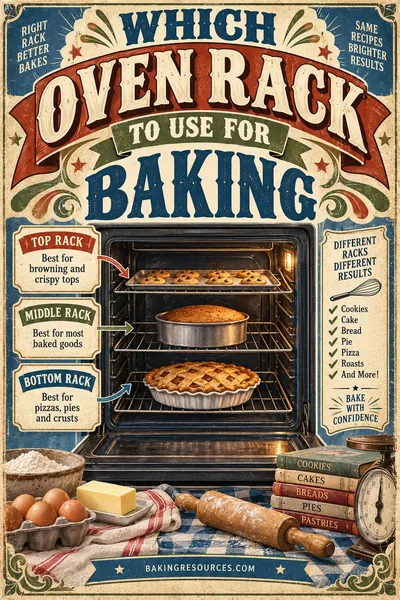 Baking guideWhich Oven Rack to Use for Baking: Top, Middle, LowRead it next →
 Baking guideConvection vs Conventional Oven: When to Use WhichRead the guide →
Glass, metal, or ceramic: checking the bottom crust
Your pie plate changes how you check the bottom. A glass plate is the easiest, since you can see right through it. Lift the pie and look: you want even golden brown, all the way across the middle.
A metal pie pan heats up fast and browns the bottom well, but you can't see through it. Use the bake time and the other signs, and check that the crust edge where it meets the pan is browned. Ceramic heats slowly, so pies in ceramic often need 10 to 15 extra minutes and benefit from that lower oven rack. If you're picking a plate, our pie pan size guide covers the common sizes and depths.
 Baking guidePie Pan Sizes: Standard, Deep Dish and Tart Pan GuideFind my pan size →
If the top is browning faster than the bottom, cover the top loosely with foil and keep going. The bottom crust and the filling are what you're waiting on.
How your apples change the timing
Not all apples bake the same way, and that affects how long it takes for sign number three, tender apples, to show up. Firm, tart apples like Granny Smith hold their shape well but take the longest to soften. Sweet, crisp apples like Honeycrisp or Golden Delicious soften faster and give off more juice. Softer apples like McIntosh break down quickly and can turn to sauce if the pie bakes long.
Many bakers use a mix, such as half Granny Smith and half a sweeter apple, so some slices hold their shape while others melt into the filling. With a mix, check the firmest slices with your knife, since those finish last. Juicier apples also mean more liquid for the thickener to handle, so lean on the 195°F reading and the center bubbles rather than the clock.
A worked example
You're baking a 9 inch double-crust apple pie in a glass pie plate, 20 minutes at 425°F, then 375°F. The recipe says 60 to 70 minutes total.
- At 40 minutes: the top is turning golden and juice is bubbling around the edges. The center vents are quiet. Not done.
- At 55 minutes: the top is golden brown, so you tent it with foil. Thin bubbles show in the center vents. Thermometer through a vent: 186°F. A knife meets a little crunch.
- At 65 minutes: the center vents show slow, thick bubbles. Reading: 199°F. The knife slides through the apples easily. You lift the pie and see a golden bottom. Done.
- The pie goes on a wire rack for 4 hours before cutting.
The slices come out with filling that holds together instead of pooling in the dish.
Apple pie mistakes (and how to fix them)
Going by the edges
Juice bubbles at the rim long before the middle is ready. Wait for bubbling in the center vents.
A runny pie even though it baked long enough
Two common causes: the center never got to 195°F, or the pie was cut warm. The juices thicken a lot as the pie cools. Give it at least 3 to 4 hours. If you're out of cornstarch, here's a cornstarch substitute guide, and arrowroot is another option for a clear filling.
 Baking guideCornstarch Substitute: 9 Swaps and When to Use EachFind my swap →
 Baking guideArrowroot Substitute: What Works and What Turns SlimyGet the swap chart →
A big gap under the top crust
Raw apples shrink as they bake while the top crust sets in place. Pile the apples high and pack them tight, or cook the filling briefly on the stove first. It doesn't change the target temperature.
Apples still crunchy
Thick slices and firm apples like Granny Smith take longer. Cut slices about 1/4 inch thick and keep baking until a knife slides in.
A tough or pale crust
Overworked dough bakes up tough no matter how long it's in the oven. Our guides on cutting butter into flour and why pie crust turns tough help with that.
 Baking guideHow to Cut Butter Into Flour for Flaky Pastry Every TimeShow me how →
 Baking guideWhy Is My Pie Crust Tough? Causes and Fixes That WorkSee what went wrong →
Cooling and storing apple pie
Unlike custard pies, a baked apple pie can sit at room temperature, loosely covered, for up to 2 days. After that, move it to the fridge, where it keeps about 2 more days. If your pie has a cream cheese or custard layer, refrigerate it once it cools, like any egg or dairy pie.
To freeze a baked pie, cool it fully, wrap it well, and freeze for up to 2 months. Reheat slices at 350°F for about 15 minutes to crisp the crust. More tips are in how to store baked goods.
 Baking guideHow to Store Baked Goods: Counter, Fridge or FreezerGet the storage times →
Thanksgiving apple pie: timing it for the big day
Apple pie needs a long bake and a long cool, which makes it a smart one to bake early. It also tastes best at room temperature, so there's no rush to keep it in the fridge overnight.
- A week or two ahead: Assemble the whole pie unbaked, wrap it well, and freeze it. Or just freeze the dough; our guide on freezing pie dough covers both.
- Tuesday or Wednesday: Bake the pie, either fresh or straight from frozen (no thawing, just add the extra time from the chart above). Check for 195°F to 205°F and center bubbles.
- Same day: Cool on a rack for at least 4 hours, then cover loosely and leave it on the counter.
- Thursday: Serve at room temperature, or warm the whole pie at 350°F for 15 to 20 minutes while dinner plates are cleared.
 Baking guideHow to Freeze Pie Dough: Discs, Shells, and ThawingCheck the rise times →
Baking pies alongside other dishes on Thanksgiving Day? A full oven bakes less evenly, so rotate the pie halfway and give it extra time. Our page on baking evenly in your oven has more on that.
Questions people ask
What temperature is apple pie done?
The filling should reach about 195°F to 205°F (91°C to 96°C) in the center. Slide an instant-read thermometer through a vent into the middle of the filling, halfway down, without touching the dish. That temperature is what cornstarch and flour need to fully thicken the juices. Below about 190°F, the filling will usually be thin and runny.
Should apple pie be bubbling when done?
Yes. Look for thick, slow bubbles in the vents near the center of the pie, not just around the edge. Thin, fast bubbles mean the juice hasn't thickened yet. Bubbling at the rim happens early and can trick you into pulling the pie too soon, so always check the middle.
How do I know if the bottom crust is done?
If you bake in a glass pie plate, lift the pie carefully with oven mitts and look underneath. The bottom should be golden brown across the center, not pale or damp looking. In metal or ceramic, you can't see it, so bake on a lower rack, give it the full time, and make sure the filling has reached at least 195°F.
Why is my apple pie runny?
Most often the center of the filling never got hot enough for the thickener to work, or the pie was sliced while warm. Bake until the middle reaches 195°F to 205°F with thick bubbles in the center vents, then cool it for 3 to 4 hours. Very juicy apples may also need a little more thickener.
Can I put apple pie back in the oven if it's underdone?
Yes, apple pie handles a second bake well. Cover the top loosely with foil so it doesn't over-brown, then bake at 375°F until the center reaches 195°F and bubbles thickly. A fully cooled pie will need 30 minutes or more. Let it cool again before slicing so the juices can set.
Does apple pie need to be refrigerated?
Not right away. A plain baked apple pie can stay at room temperature, loosely covered, for up to 2 days. After that, keep it in the fridge for about 2 more days. Pies with a custard, cream, or cream cheese layer are different: refrigerate those once they cool.