How Many Grams in a Cup of Peanut Butter?
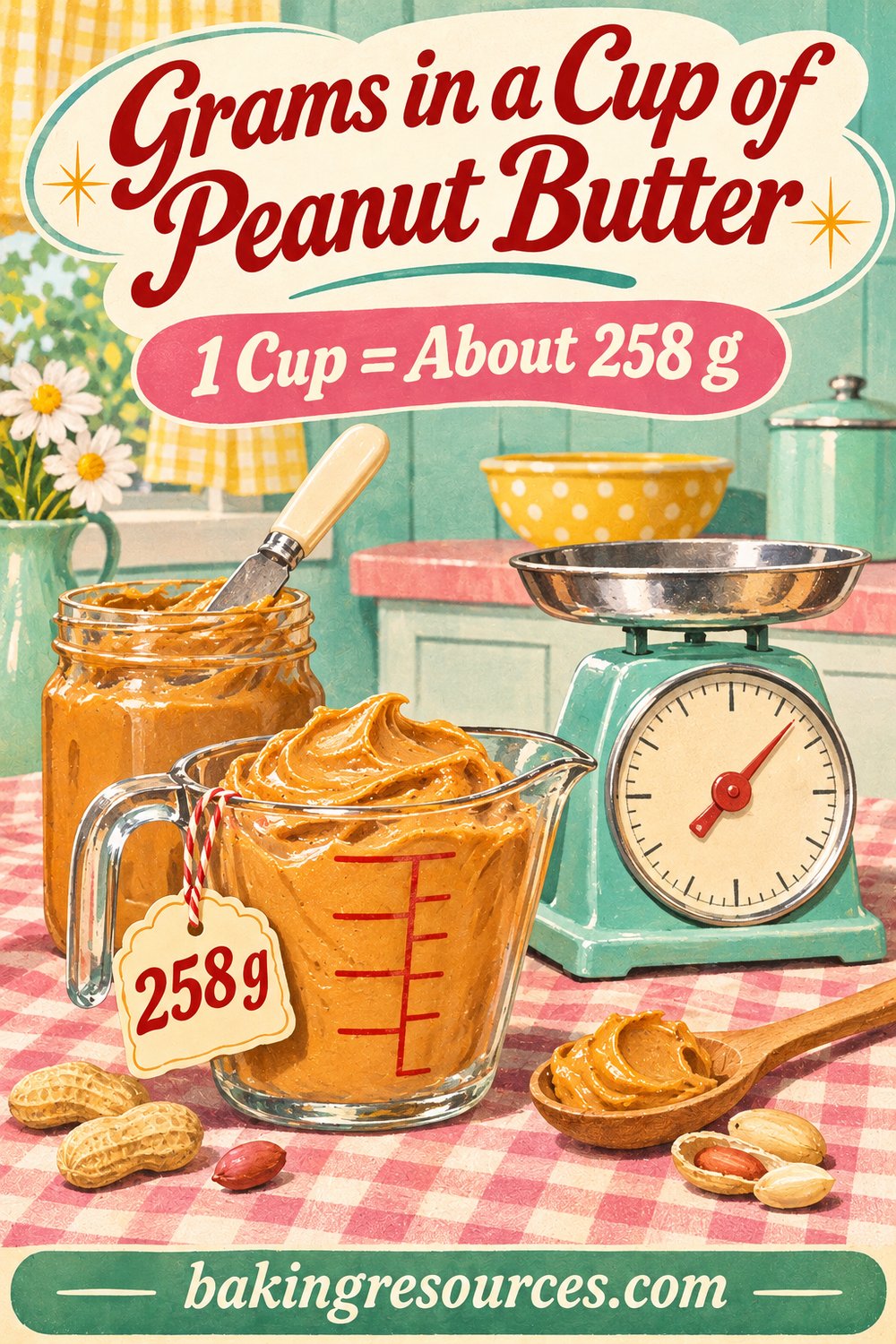
Free calculator from Baking Resources
Peanut Butter Cups to Grams
Pick the amount and the type of peanut butter.
Need more? Open the free Grams to Cups Converter.
More free baking tools



Want more options? Open the full grams to cups converter.
- 1 cup of regular peanut butter = about 258 g (9.1 oz).
- 1/2 cup = about 129 g; 1/4 cup = about 65 g.
- 1 level tablespoon = about 16 g; the label serving of 2 tablespoons = 32 g.
- A 16 oz jar holds about 1 3/4 cups.
- Natural peanut butter, well stirred, is about 250 g per cup.
- For the best accuracy, weigh it on a scale instead of packing a cup.
How many grams are in a cup of peanut butter?
A cup of peanut butter weighs about 258 g, which is 9.1 oz. That number is for regular creamy or crunchy peanut butter, spooned into the cup and leveled off.
You will see other numbers online, usually between 250 g and 260 g. Nobody is wrong. Peanut butter is thick and sticky, so how much you press it into the cup changes the weight a little. The Baking Resources grams to cups converter uses 258 g per cup so every page on the site gives you the same answer.
If your recipe lists peanut butter in grams, you do not need a cup at all. Put your bowl on a scale, press the tare button to zero it, and spoon the peanut butter straight in. It is faster, it is more accurate, and you wash one less cup.
Peanut butter grams chart for common amounts
This chart gives the weight of peanut butter for every common measuring size, from one teaspoon up to two cups. All numbers use 258 g per cup.
| Amount of peanut butter | Grams (g) | Ounces (oz) |
|---|---|---|
| 1 teaspoon | 5 g | 0.2 oz |
| 1 tablespoon | 16 g | 0.6 oz |
| 2 tablespoons (label serving) | 32 g | 1.1 oz |
| 1/4 cup | 64 g | 2.3 oz |
| 1/3 cup | 86 g | 3.0 oz |
| 1/2 cup | 129 g | 4.6 oz |
| 2/3 cup | 172 g | 6.1 oz |
| 3/4 cup | 194 g | 6.8 oz |
| 1 cup | 258 g | 9.1 oz |
| 1 1/2 cups | 387 g | 13.7 oz |
| 2 cups | 516 g | 18.2 oz |
A quick way to remember it: 1 tablespoon is about 16 g, and 1/4 cup is about 65 g. From there you can scale up in your head. Eight tablespoons make 1/2 cup, which is about 129 g.
How many grams is a tablespoon of peanut butter?
A level tablespoon of peanut butter weighs about 16 g, or a little over half an ounce. A heaping tablespoon, the kind you scoop straight from the jar, can easily weigh 20 g or more.
That is why the nutrition label on the jar says one serving is 2 tablespoons (32 g). The label is built on level spoons. If you eat a big rounded spoonful, you are eating more than the label says.
For baking, use level spoons. Scoop, then drag the back of a butter knife across the top so it is flat with the rim.
How many cups of peanut butter are in a jar?
A standard 16 oz jar of peanut butter holds about 1 3/4 cups (454 g). The weight printed on the front of the jar is the net weight of the peanut butter, so you can divide it by 258 g to find the cups.
| Jar size (net weight) | Grams (g) | Cups of peanut butter |
|---|---|---|
| 12 oz jar | 340 g | 1.3 cups (about 1 3/8 cups) |
| 16 oz jar | 454 g | 1.8 cups (about 1 3/4 cups) |
| 18 oz jar | 510 g | 2.0 cups (about 2 cups) |
| 28 oz jar | 794 g | 3.1 cups (about 3 1/8 cups) |
| 40 oz jar | 1134 g | 4.4 cups (about 4 3/8 cups) |
These are rounded, and your jar may sit a few percent either way. If a recipe needs 1 1/2 cups and you have one 16 oz jar, you will use most of it. If it needs 2 cups, grab a second jar or an 18 oz one.
Does natural peanut butter weigh the same as regular?
Natural peanut butter, stirred well, weighs about the same as regular, usually 245 g to 255 g per cup. The calculator at the top uses 250 g for it. Natural jars are not all the same, so treat that as a close estimate, not a promise.
The trick with natural peanut butter is the oil on top. If you scoop from the top of an unstirred jar, your first cups are runny and oily, and the last cups at the bottom are stiff and dry. Stir the whole jar until it looks the same all the way through, then measure.
Crunchy and creamy weigh nearly the same. The nut pieces fill a bit of air space, but the difference is only a few grams per cup. For most cookies, bars and fudge, you will never notice it.
How do you measure peanut butter without the mess?
The cleanest way to measure peanut butter is on a kitchen scale, straight into your mixing bowl. If you only have cups, a little water or oil on the cup makes it slide out.
- Scale method: place the bowl on the scale, tare it to zero, and spoon in peanut butter until you reach the grams in your recipe.
- Cup method: use a dry measuring cup. Spoon in the peanut butter in two or three layers, tapping the cup on the counter so there are no air pockets, then level the top with a knife.
- Slippery cup trick: rinse the cup with hot tap water and shake it out before you measure, or give it a light coat of cooking spray. The peanut butter slides right out.
- Water method: fill a liquid measuring cup with 1/2 cup cold water, then add peanut butter until the water rises to the 1 cup line. You added 1/2 cup. Pour off the water and the peanut butter comes out without a fight.
- Measure in the right order: if a recipe also uses honey or oil, measure the peanut butter first, then use the same cup for the oil or honey. The oily film left behind helps the next sticky ingredient slide out too.
Our guide to how to measure ingredients covers dry cups, liquid cups and level spoons in more detail, and kitchen scale vs measuring cups explains why bakers love scales.
Worked example: turning a cups recipe into grams
A recipe calling for 1 1/4 cups of peanut butter needs about 323 g. Here is how to get there, so you can do it with any amount.
- Write the amount as a decimal. 1 1/4 cups is 1.25 cups.
- Multiply by 258 g per cup. 1.25 x 258 = 322.5 g.
- Round to the nearest gram. That is 323 g.
Now go the other direction. A recipe from a British or European site calls for 200 g of peanut butter. Divide by 258 g per cup: 200 / 258 = 0.78 cups. That is a little more than 3/4 cup, or 12 tablespoons plus about 1 teaspoon. If you are scooping, a generous 3/4 cup is close enough for cookies and bars.
Want to double-check any other ingredient? The ingredient weight chart lists flour, sugar, honey, oats and more in grams per cup.
How much peanut butter do common recipes use?
Most peanut butter treats use between 1/2 cup and 1 1/2 cups of peanut butter per batch, so it helps to have the matching grams handy. Recipes vary by cook, so always follow your own recipe, and use this table to switch between cups, tablespoons and grams.
| Recipe amount | Grams (g) | Tablespoons | Handy picture |
|---|---|---|---|
| 1/4 cup | 65 g | 4 tbsp | A small ramekin, level |
| 1/3 cup | 86 g | 5 tbsp + 1 tsp | Use a 1/3 cup measure if you own one |
| 1/2 cup | 129 g | 8 tbsp | Half of a standard 1 cup scoop |
| 3/4 cup | 194 g | 12 tbsp | Three 1/4 cup scoops |
| 1 cup | 258 g | 16 tbsp | A little over half of a 16 oz jar |
| 1 3/4 cups | 452 g | 28 tbsp | About one 16 oz jar |
As a rough guide, a batch of peanut butter cookies usually asks for about a cup, no-bake cookies often use half a cup or more, and big mix-in batches like monster cookies can go over a cup. For candy-style treats such as buckeyes and fudge, a few extra grams will not hurt, but too much peanut butter makes them greasy and hard to shape.
What if my peanut butter is cold, hot or runny?
Cold peanut butter weighs the same as warm peanut butter, but it measures differently in a cup. Cold, stiff peanut butter traps air pockets, so a cup of it can weigh a little less than 258 g. Warm, runny peanut butter fills every gap and can weigh slightly more.
The fix is simple. Let the jar sit on the counter for 15 to 20 minutes if it has been in the fridge, stir it, and then measure. If you are using a scale, temperature does not matter at all, because grams do not change.
Melted peanut butter is also fine to weigh. Microwave it for 15 to 20 seconds, stir, and pour it onto the scale. Do not heat it so hot that the oil separates and splashes.
Mistakes that throw off peanut butter measurements
- Pressing too hard. Packing the cup like brown sugar can add 20 g or more. Peanut butter should be pressed in just enough to remove air gaps.
- Using a liquid measuring cup. The pitcher-style cup with a spout is built for liquids. A dry cup that you level at the top gives a better count for thick spreads.
- Skipping the stir on natural jars. The top of the jar is mostly oil, and the bottom is mostly paste. Cookies made from oily peanut butter spread flat. Cookies made from dry paste crumble.
- Counting a heaped spoon as one tablespoon. A rounded tablespoon is closer to 1 1/2 tablespoons, which is how a 1/2 cup recipe turns into a 3/4 cup recipe by accident.
- Mixing up other spreads. Chocolate peanut spread, cookie butter and powdered peanut butter do not weigh the same. Check the label or weigh a cup yourself before you swap.
Is powdered peanut butter the same as regular?
No. Powdered peanut butter is a much lighter, drier product, and it does not convert to cups the same way. Most labels list about 12 g for a 2 tablespoon serving, which is roughly a third of the weight of the same spoons of regular peanut butter.
If a recipe is written for regular peanut butter, do not swap powdered peanut butter in by the cup. You will end up with a dry, crumbly dough. Rehydrate it with water following the package directions, and even then expect a different texture. When in doubt, use the amount of regular peanut butter the recipe asks for.
Quick reference: peanut butter cups to grams
Use this table when you just need the answer. It is for regular peanut butter at 258 g per cup.
| Peanut butter | Grams | Ounces | Tablespoons |
|---|---|---|---|
| 1/4 cup | 65 g | 2.3 oz | 4 tbsp |
| 1/3 cup | 86 g | 3.0 oz | 5 tbsp + 1 tsp |
| 1/2 cup | 129 g | 4.5 oz | 8 tbsp |
| 2/3 cup | 172 g | 6.1 oz | 10 tbsp + 2 tsp |
| 3/4 cup | 194 g | 6.8 oz | 12 tbsp |
| 1 cup | 258 g | 9.1 oz | 16 tbsp |
| 1 1/2 cups | 387 g | 13.7 oz | 24 tbsp |
| 2 cups | 516 g | 18.2 oz | 32 tbsp |
If you want to convert other things, try the grams to cups converter, the cups to ounces converter, or the baking conversion chart. For tablespoon math, see tablespoons to cups and cups to tablespoons.
Frequently asked questions
How many grams are in a cup of peanut butter?
About 258 g (9.1 oz) for regular creamy or crunchy peanut butter, spooned and leveled. Natural peanut butter, stirred well, is about 250 g.
How many grams is 1/2 cup of peanut butter?
About 129 g, or 4.5 oz. That is 8 tablespoons.
How many grams is 1/4 cup of peanut butter?
About 65 g, which is 4 tablespoons or 2.3 oz.
How many tablespoons of peanut butter are in 100 g?
100 g is about 6 1/4 tablespoons (100 / 16 g per tablespoon). In practice, use 6 level tablespoons and a small extra spoonful, or just weigh it.
How many cups is a 16 oz jar of peanut butter?
A 16 oz (454 g) jar holds about 1 3/4 cups of peanut butter.
Do I measure peanut butter in a liquid or dry measuring cup?
Use a dry measuring cup, press the peanut butter in gently so there are no air pockets, and level the top. For the most accurate result, weigh it on a scale.
Can I use natural peanut butter instead of regular in baking?
Usually yes, if you stir it well first. Natural peanut butter is a bit oilier and less sweet, so cookies may spread more and taste less sweet. Chilling the dough for 30 minutes helps.
Is a serving of peanut butter really 2 tablespoons?
Yes. The label serving is 2 level tablespoons, which is about 32 g.
Related guides: cup sizes for cooking and how to scale a recipe.