Can You Microwave Cookie Dough? Safe Ways and Times
Free calculator from Baking Resources
Microwave Cookie Dough Timer
Pick what you want to do and your microwave power.
Need more? Open the free Cookie Scoop Calculator.
More free baking tools



Want more options? Open the full Cookie Scoop Calculator.
- One cookie (2 tablespoons, about 35 g of dough) takes 35 to 45 seconds at 1000 watts.
- A mug cookie (3 tablespoons, about 55 g) takes 45 to 60 seconds at 1000 watts.
- A 700 watt microwave needs about 40 percent more time, and a 1200 watt one about 15 percent less.
- Raw flour and raw eggs can carry germs, and only cooking kills them. A microwave heats a lump of dough unevenly.
- Heat-treated flour must reach 165 F (74 C), checked with a thermometer in several spots.
- Microwave cookies do not brown, and they turn hard within minutes of cooling.
Can you microwave cookie dough?
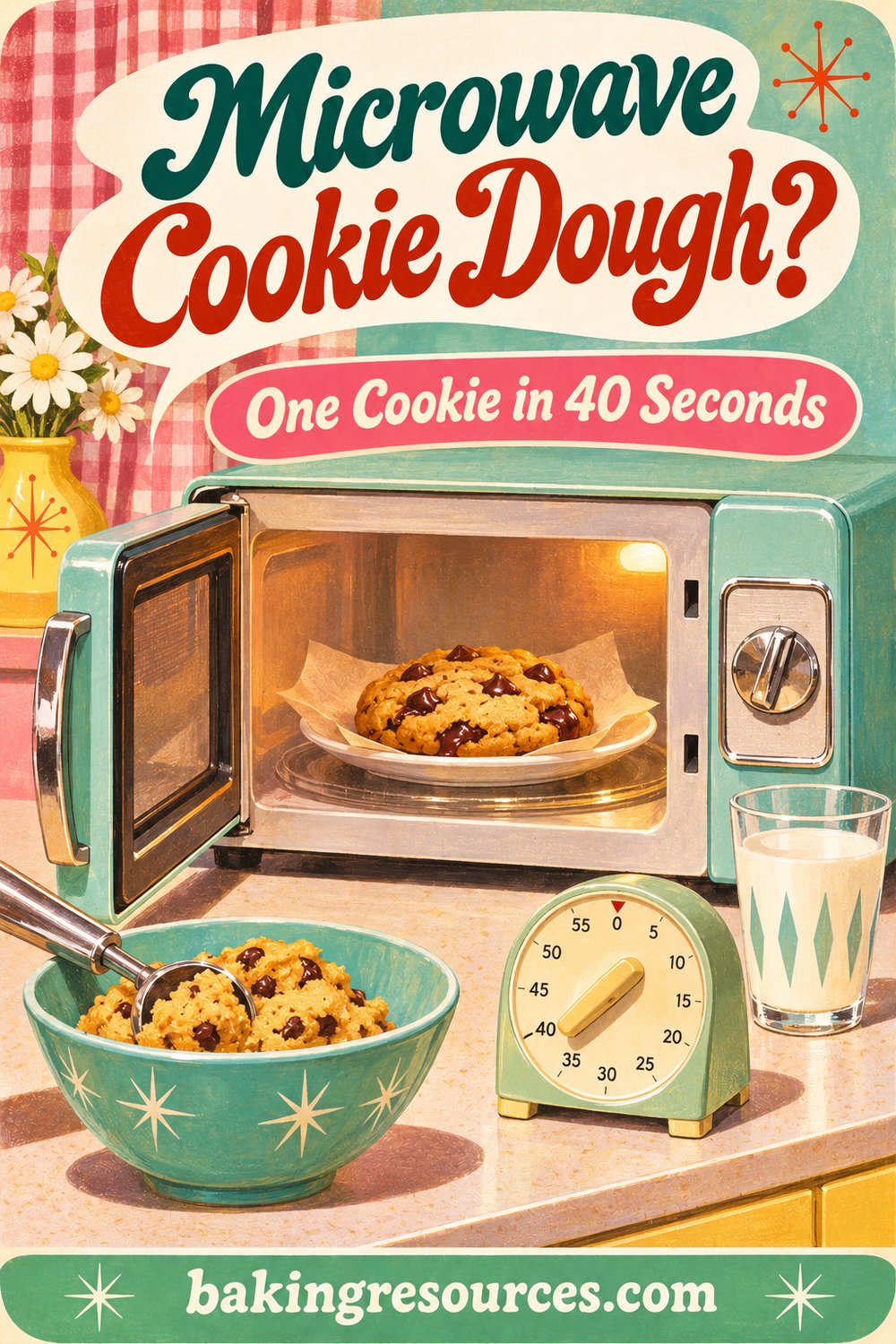
Yes, you can microwave cookie dough, and a single cookie cooks in under a minute: 2 tablespoons of dough on a plate takes 35 to 45 seconds in a 1000 watt microwave. The cookie comes out soft, pale and a little cakey, more like a warm muffin top than a golden bakery cookie.
That is because a microwave cooks by shaking the water molecules in the dough, not by drying and browning the outside the way a hot oven does. There is no crisp edge and no caramelized color. What you get is a warm, gooey cookie in about the time it takes to pour a glass of milk.
There is a second meaning to this question, and it matters more. Lots of people ask whether microwaving dough makes it safe to eat raw. It does not, and the sections below explain why and what to do instead. If you only want a quick warm cookie, jump to the steps. If you are thinking of eating dough, read the food safety part first.
How to bake cookies in the microwave, step by step
To bake one cookie in the microwave, scoop 2 tablespoons of dough onto a parchment-lined, microwave-safe plate, flatten it slightly, and cook it on high for 35 to 45 seconds at 1000 watts. Then let it stand for 1 minute so the center can finish setting.
- Portion the dough. Use a level 2 tablespoon scoop (a number 30 scoop) for one large cookie. Our cookie scoop calculator shows what scoop size gives what size cookie.
- Line a plate. Use a microwave-safe plate with a small square of parchment paper. Never use metal, foil or a plate with metallic trim.
- Flatten the dough. Press it to a round about 2 1/2 inches (6 cm) across and 1/2 inch (1 cm) thick. Dough left as a ball cooks on the outside long before the middle.
- Cook in short bursts. Start at 30 seconds, check, then add 5 seconds at a time. The top should look puffed and a little dry, and the center can still look soft.
- Stand for 1 minute. The cookie keeps cooking from the heat inside it. Skip this step and the middle can stay raw.
- Eat it warm. A microwave cookie hardens as it cools, so serve it right away.
Every microwave is different, so treat the times in this article as starting points. The first cookie is your test: write down the seconds that worked and use them every time after.
How long do you microwave cookie dough, by watts?
The lower the wattage, the longer the cookie needs: 50 to 60 seconds at 700 watts, 35 to 45 seconds at 1000 watts, and 30 to 35 seconds at 1200 watts. You can find your microwave’s wattage on a label inside the door or on the back.
| Microwave power | 1 cookie, 2 tbsp (35 g) | Mug cookie, 3 tbsp (55 g) | 2 cookies on one plate |
|---|---|---|---|
| 700 W | 50 to 60 seconds | 60 to 75 seconds | 80 to 95 seconds |
| 1000 W | 35 to 45 seconds | 45 to 60 seconds | 55 to 70 seconds |
| 1200 W | 30 to 35 seconds | 40 to 50 seconds | 45 to 55 seconds |
Two cookies take about 1 1/2 times as long as one, not twice as long. Keep them at least 2 inches (5 cm) apart, and turn the plate halfway if your microwave has no turntable. More than 2 cookies at a time cook unevenly, so do them in rounds. If you want a real oven-baked cookie instead, see how long to bake chocolate chip cookies.
Can you eat raw cookie dough?
No, it is not safe to eat raw cookie dough made with regular flour and raw eggs. Raw flour can carry germs such as E. coli, and raw eggs can carry Salmonella, and neither is killed until the dough is cooked. The FDA and FoodSafety.gov both say to avoid eating raw dough or batter.
Many people think the eggs are the only risk. They are not. Flour is a raw farm product that is not treated to kill germs, so the flour itself can make you sick, even in an eggless dough. Several outbreaks have been traced to raw flour for exactly this reason.
Illness from raw dough usually shows up as stomach cramps and diarrhea, and sometimes vomiting and fever. Children, pregnant women, older adults and anyone with a weakened immune system are at higher risk. If you ate a nibble and feel fine, there is no need to panic, because most small tastes do not make people ill. Just do not make it a habit, and call a doctor if you get symptoms.
Does microwaving cookie dough make it safe to eat?
No. Microwaving a bowl of cookie dough does not make it reliably safe, because microwaves heat unevenly and leave cold spots that can stay raw. To kill germs, every bit of the dough has to reach a safe temperature, and with dough you cannot tell that by looking or by a single temperature reading.
There is a second problem. A dough that gets hot enough to be safe all the way through is already cooking: the butter melts, the egg sets, the flour clumps, and you end up with a rubbery blob instead of scoopable dough. At that point you are better off just baking it.
| Method | Makes raw dough safe? | Why |
|---|---|---|
| Microwaving the finished dough | No | Cold spots stay raw and the texture is ruined |
| Microwaving only the flour first | Handles the flour | Works when it reaches 165 F (74 C) in every spot |
| Using pasteurized eggs, or no eggs | Handles the egg | Pasteurized eggs are heated to kill Salmonella |
| Baking the dough | Yes | Oven heat reaches the whole cookie |
The bottom line is simple. If the dough was never going to be baked, build it to be eaten raw from the start, the way the next section shows.
How to make edible cookie dough with heat-treated flour
To make edible cookie dough, heat-treat the flour to 165 F (74 C), leave out the eggs, and use a little milk for moisture. Heat-treating flour in the microwave works if you stir often and check the temperature with a thermometer in several spots.
- Spread 1 cup (125 g) of all-purpose flour in a wide, microwave-safe bowl.
- Microwave in 30 second bursts, stirring well each time, until a food thermometer reads 165 F (74 C) in at least 3 different spots. That usually takes 1 to 2 minutes in all, depending on your microwave.
- Stop right away if the flour smells toasted or starts to turn brown.
- Cool it completely, about 15 to 20 minutes, or the warm flour will melt your butter.
Heat-treating flour at home is a common method, but it is not a guarantee. It works only as well as your stirring and your thermometer. Some people prefer to buy flour that the maker has already labeled as heat-treated.
Here is a simple dough built to be eaten raw. It makes about 1 1/2 cups, enough for 4 small servings.
| Ingredient | Amount |
|---|---|
| Butter, softened | 1/2 cup (113 g) |
| Packed brown sugar | 3/4 cup (150 g) |
| Salt | 1/4 teaspoon |
| Vanilla extract | 1 teaspoon |
| Heat-treated all-purpose flour, cooled | 1 cup (125 g) |
| Milk | 2 to 3 tablespoons |
| Mini chocolate chips | 1/2 cup (85 g) |
Cream the butter, sugar, salt and vanilla until fluffy (our cream butter and sugar guide shows how). Mix in the cooled flour, add the milk a tablespoon at a time until it holds together, then stir in the chips. Keep it in the fridge and eat it within 3 to 4 days. This dough is for eating, not baking, since it has no egg and no leavening.
What about the eggs in cookie dough?
Raw eggs can carry Salmonella, and the USDA says eggs should be cooked to 160 F (71 C). For a dough you plan to eat raw, leave the eggs out entirely or use pasteurized eggs, which are gently heated to kill germs before they are sold.
You cannot simply drop the eggs from a regular baking recipe and expect a good cookie, because eggs hold the dough together. For baked cookies without eggs, our egg substitute guide and egg substitutes for muffins, cookies and brownies give swaps that work. Those are for baking, though, not for eating raw.
Can you microwave cookie dough in a mug?
Yes, a mug cookie works well: press 3 tablespoons (about 55 g) of dough into a microwave-safe mug or ramekin and microwave it 45 to 60 seconds at 1000 watts. It makes a deep, gooey, spoonable cookie, like a mini skillet cookie.
- Use a wide mug or ramekin. A wide one cooks more evenly than a tall, narrow one.
- Press the dough flat in the bottom. Leave about 1 inch (2.5 cm) of space above it, because it puffs.
- Add a few chips on top. They melt into a pool as it stands.
- Stand 1 minute. The center is hot and goes on cooking.
The cookie is done only when the middle is steaming hot and set. If it is still wet and raw in the center, put it back for 10 seconds and check again. Never eat a mug cookie with a raw middle, since the dough has raw flour and egg in it.
Can you microwave cookie dough to soften it?
Yes, but only for 5 to 10 seconds at 50 percent power, because butter melts fast and melted butter makes cookies spread. Chilled dough that is too stiff to scoop usually just needs 10 minutes on the counter instead.
Microwaving a whole bowl of cold dough also warms the outer edge long before the middle, so you get greasy edges and a cold core. If you must use the microwave, work in 5 second bursts and stir between each one. For frozen dough, let it thaw in the fridge overnight. Our guides on freezing cookie dough and on how long cookie dough lasts in the fridge cover storage so you know what is still good.
It also helps to know why resting cookie dough matters: chilled dough baked in the oven makes thicker, better cookies than dough that was warmed up and baked fast.
Which cookie doughs work best in the microwave?
Soft, thick doughs work best in the microwave, such as chocolate chip, oatmeal and peanut butter dough, because they hold moisture. Thin, crisp doughs such as sugar cookies and shortbread turn tough and pasty, since they need dry oven heat to crisp up.
| Dough type | Microwave result |
|---|---|
| Chocolate chip | Good: soft and gooey |
| Oatmeal | Good: chewy, a little cakey |
| Peanut butter | Good: tender, may crumble |
| Snickerdoodle | Fair: soft, but no crackly top |
| Cut-out sugar cookie | Poor: tough and pale |
| Shortbread | Poor: dense and pasty |
For a dough to start with, see our chocolate chip cookies recipe or peanut butter cookies recipe, and keep some of the dough chilled for single cookies later.
Worked example: one warm cookie after dinner
You have a bowl of chilled chocolate chip dough, a 1000 watt microwave and a craving. One cookie should take about 2 minutes from fridge to plate.
- Scoop 2 level tablespoons of dough (about 35 g) onto a parchment-lined plate.
- Press it to a 2 1/2 inch (6 cm) round that is 1/2 inch (1 cm) thick.
- Microwave 35 seconds. The top looks puffed but a little wet in the middle.
- Add 5 seconds if the center is still glossy and wet. Do not go past 45 seconds.
- Let it stand for 1 minute, then eat it while warm.
If you want 2 cookies, scoop them 2 inches apart and give them 55 to 70 seconds in all. The rest of the dough stays in the fridge for 3 to 5 days, or in the freezer for up to 3 months.
Mistakes to avoid when microwaving cookie dough
The biggest mistake is cooking too long, because even 10 extra seconds can turn a soft cookie into a hard disc. Most microwave cookie problems come down to time and shape.
- Cooking until it looks done. It keeps cooking as it stands, so pull it when the center still looks a touch soft.
- Leaving the dough as a ball. Flatten it so the heat reaches the middle.
- Using metal or foil. Metal can spark in a microwave.
- Cooking several cookies at once. More than 2 cook unevenly.
- Skipping the stand time. The center stays raw.
- Treating the microwave as a food safety step. It is not one for whole dough.
If your microwave cookie came out rock hard, our guide on why cookies turn hard lists causes that apply here too, and how to tell when cookies are done shows what to look for.
Quick reference: microwaving cookie dough
This table sums up what to do in the five most common situations.
| What you want | How | Time at 1000 W | Safe? |
|---|---|---|---|
| One cookie | 2 tbsp, flattened, on parchment | 35 to 45 seconds, stand 1 minute | Yes, when cooked through |
| Mug cookie | 3 tbsp, pressed in a wide mug | 45 to 60 seconds, stand 1 minute | Yes, when cooked through |
| Heat-treat flour | 1 cup, stir between bursts | 1 to 1 1/2 minutes in all | Only at 165 F (74 C) in every spot |
| Warm chilled dough | 50 percent power | 5 to 8 seconds | Not a safety step |
| Make raw dough edible | Does not work | Not applicable | No |
Planning a big batch for a party instead? The cookie exchange planner works out how much dough you need, and the baking time calculator helps with oven times.
Frequently asked questions
Can you microwave cookie dough?
Yes. Flatten 2 tablespoons of dough on a parchment-lined plate and microwave it 35 to 45 seconds at 1000 watts. Let it stand for 1 minute.
How long do you microwave cookie dough?
One cookie takes 35 to 45 seconds at 1000 watts, a mug cookie takes 45 to 60 seconds, and a 700 watt microwave needs about 40 percent longer.
Can you eat raw cookie dough?
Not safely. Raw flour can carry E. coli and raw eggs can carry Salmonella, and the FDA and FoodSafety.gov advise against eating raw dough or batter.
Does microwaving cookie dough make it safe to eat?
No. Microwaves heat unevenly, so cold spots can stay raw. To eat dough raw, use flour heated to 165 F (74 C) and pasteurized eggs or no eggs.
How do you heat-treat flour in the microwave?
Spread 1 cup (125 g) of flour in a bowl, heat in 30 second bursts and stir well each time until a thermometer reads 165 F (74 C) in several spots. Cool it completely before using.
What happens if you eat raw cookie dough?
Most of the time, nothing. But it can cause stomach cramps, diarrhea, vomiting or fever if germs are present. See a doctor if symptoms are severe or last more than a few days.
Can you make a single cookie in the microwave?
Yes. Microwave 2 tablespoons of flattened dough for 35 to 45 seconds at 1000 watts and let it stand 1 minute. It will be soft and pale, with no browning.
Why is my microwave cookie hard?
It was cooked too long, or it cooled. Microwave cookies firm up fast, so pull them while the center still looks slightly soft and eat them warm.