Using Baking Powder as an Egg Substitute

Baking powder on its own is not an egg. Using baking powder as an egg substitute only works when you pair it with liquid and fat: 2 tablespoons water plus 1 tablespoon neutral oil plus 2 teaspoons baking powder, whisked together, stands in for one large egg. That three-part mix covers lift, moisture and a little richness, which is most of what an egg was doing in a muffin or a quick bread.
What it will not do is bind. An egg sets into a protein web as it heats, and no amount of baking powder builds that web. So this swap belongs in batters that already hold themselves together with flour and gluten, not in custard, meringue, or anything where the egg is the structure.
Need a different swap for the eggs you have left, or for the cream and butter in the same recipe? Our free baking substitutions finder gives you exact per-ingredient ratios and tells you straight when a swap won't work.
Updated September 2026
What an egg actually does, and which part baking powder covers
An egg does four separate jobs. Working out which one your recipe cares about is the whole trick, because every substitute covers some jobs and fails at others.
| Egg's job | What it means in the bowl | Does baking powder cover it? |
|---|---|---|
| Leavening | Trapped air and steam that lifts the crumb | Yes, this is the one thing it does well |
| Binding | Protein sets and glues crumb together | No, not at all |
| Moisture | About 3 tablespoons of liquid per large egg | Only if you add the water |
| Richness and tenderness | Yolk fat and lecithin, an emulsifier | Only partly, and only with the oil |
A large egg is roughly 50 g out of the shell: about 30 g white, 18 g yolk, and it is close to three quarters water. So when you pull an egg out of a batter you are not just removing lift. You are removing about 3 tablespoons of liquid and a teaspoon and a half of fat, and the batter notices.
That is exactly why the three-part formula exists. The water refills the liquid, the oil refills the fat, and the baking powder refills the gas.
Using baking powder as an egg substitute: the ratios
Here is the full chart, in the units you will actually be measuring with. One teaspoon of baking powder weighs about 4 g, which is the figure our ingredient weights chart uses.
| Eggs replaced | Water | Neutral oil | Baking powder | Weight of powder |
|---|---|---|---|---|
| 1 large egg | 2 tbsp | 1 tbsp | 2 tsp | 8 g |
| 2 large eggs | 4 tbsp (1/4 cup) | 2 tbsp | 4 tsp | 16 g |
| 3 large eggs | 6 tbsp | 3 tbsp | 2 tbsp (6 tsp) | 24 g |
Three eggs is past the sensible limit for most recipes, and the next section explains why. It's in the chart so you can see the arithmetic, not as a recommendation.
How to mix it. Whisk the water, oil and baking powder together in a small bowl right before you need it. It will fizz and foam a little. Pour it into the wet ingredients, stir the batter, and get it in the oven promptly. Baking powder starts working the moment it gets wet.
There's a second, quieter version of this swap that matters just as much:
Add 1/4 teaspoon of baking powder per egg whenever you replace an egg with a binder that doesn't lift. Flax eggs, chia eggs, applesauce, banana, silken tofu and yogurt all bind or moisten without adding a scrap of gas. That quarter teaspoon puts the lift back. It is the single most useful line in this article, and it is the reason so many flax-egg cakes come out dense when people skip it.
Our guide to the full range of egg substitutes sorts every option by which of the four jobs it covers.
The ceiling: how much baking powder is too much
This is where the swap goes wrong, and it goes wrong quietly.
Standard leavening for a plain batter is 1 to 1 1/4 teaspoons of baking powder per cup of flour (one cup of all-purpose flour is 125 g, spooned and leveled). Go much past that and three things happen: a bitter, faintly metallic, soapy taste; a cake that rises fast and then collapses in the middle; and a coarse, crumbly, tunneled crumb.
Now do the math on a two-egg recipe. If it already contains 2 teaspoons of baking powder for 2 cups of flour, and you replace both eggs with 4 more teaspoons, you land at 6 teaspoons for 2 cups of flour. That is 3 teaspoons per cup, nearly triple the safe rate. The bake will taste of chemicals and it will sink.
| Flour in the recipe | Safe total baking powder | Room for egg swapping |
|---|---|---|
| 1 cup (125 g) | 1 to 1 1/4 tsp | Very little. Use a binder swap instead |
| 2 cups (250 g) | 2 to 2 1/2 tsp | One egg, if the recipe has little of its own |
| 3 cups (375 g) | 3 to 3 3/4 tsp | One egg comfortably, two at a stretch |
| 4 cups (500 g) | 4 to 5 tsp | Two eggs |
Read that table as a hard budget. The recipe's own baking powder and your egg-swap baking powder come out of the same allowance.
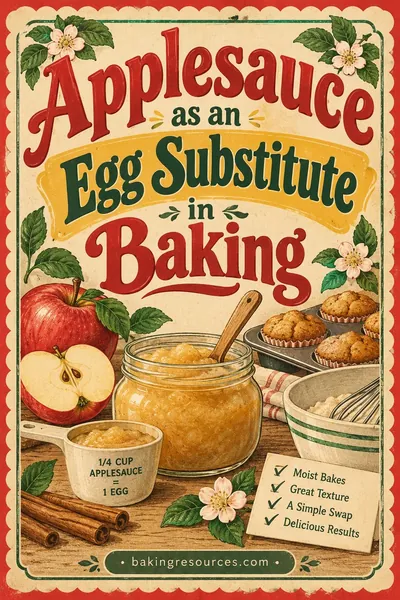
The practical rule: replace one egg this way, and use a different substitute for any others. For a two-egg cake, do one egg with the water-oil-powder mix and the other with 1/4 cup of unsweetened applesauce plus 1/4 teaspoon of baking powder. You get the lift without blowing the budget. Our applesauce egg substitute guide has the ratios for that half of the job.
Worked example: egg-free blueberry muffins
The recipe you have: 2 cups all-purpose flour (250 g), 2 teaspoons baking powder, 1/2 teaspoon salt, 3/4 cup sugar, 1 cup milk, 1/3 cup oil, 2 large eggs.
Step 1. Count the flour and the existing leavening. Two cups of flour, so your total budget is 2 to 2 1/2 teaspoons of baking powder. The recipe already uses 2. You have about 1/2 teaspoon of headroom, not 4 teaspoons.
Step 2. Work out what the eggs were contributing. Two large eggs are about 100 g total: roughly 75 g of water, 12 g of fat, and the protein that was binding the crumb. Muffins are a forgiving, flour-heavy batter, so the binding is the least critical piece here.
Step 3. Split the swap. Replace egg one with the standard mix: 2 tablespoons water, 1 tablespoon oil, 2 teaspoons baking powder. But you only have half a teaspoon of headroom, so cut the recipe's own baking powder from 2 teaspoons down to 1/2 teaspoon. Total leavening: 2 1/2 teaspoons, right at the top of the safe band.
Step 4. Replace egg two with a binder. Use 1/4 cup unsweetened applesauce. It brings about 60 g of moisture and holds the crumb together. Do not add its usual 1/4 teaspoon of baking powder here, because your budget is already spent.
Step 5. Check the liquid balance. The eggs supplied about 75 g of water. Your swaps supply 30 g (2 tbsp water) plus 60 g (applesauce), so 90 g. You're 15 g heavy. Pull the milk back by 1 tablespoon and you're level.
Step 6. Bake. Same temperature, 400°F for muffins, and start checking 2 minutes early. Egg-free muffin batter sets slightly faster because there's less protein to coagulate.
What you get: a muffin with a proper dome and an open crumb, a touch more tender and a touch more crumbly than the original, and it will stale a day sooner. Store it in a sealed container, and see how to store baked goods if you're keeping them past day two.
Worked example: cookies, where this swap struggles
Cookies are the honest test, because they show every flaw.
The recipe: 2 1/4 cups flour, 1 cup butter, 1 cup brown sugar, 1/2 cup white sugar, 1 egg, 1 teaspoon baking soda.
Notice the soda, not powder. Soda needs acid, and brown sugar brings it. Swapping in 2 teaspoons of baking powder alongside 1 teaspoon of soda gives you a puffy, cakey, pale cookie that spreads oddly and tastes faintly of the leavening. Not a disaster, but not the cookie you wanted.
Better plan for cookies: replace the egg with 3 tablespoons of aquafaba or a flax egg, and add just 1/4 teaspoon of baking powder. You keep the binding, you keep the chew, and you don't hand the dough a chemical shove it doesn't need.
If you're chasing a specific cookie texture, our guides on chewy versus crispy cookies and why cookies spread flat cover what each ingredient is actually controlling.
Where the baking powder swap works and where it fails
| Bake | Verdict | Notes |
|---|---|---|
| Muffins and quick breads | Works well | Flour-heavy, already leavened, forgiving |
| Pancakes and waffles | Works well | Batter is loose anyway, watch the flour budget |
| Cake from a box mix | Works | Mixes carry their own leavening, so use a lower dose |
| Layer cake from scratch | Works for 1 egg | Two or more and the crumb turns coarse |
| Cookies | Poor | Cakey and pale. Use a binder instead |
| Brownies | Poor | You want fudgy density. Powder fights that |
| Quiche, custard, curd, flan | Never | The egg is the structure and nothing replaces it |
| Meringue, angel food, chiffon | Never | Built out of egg protein, not flavored with it |
| Enriched bread dough | Skip it | Yeast is doing the lifting. Just add liquid and fat |
That bottom band is not negotiable. A four-egg sponge is not a cake with eggs in it. It's a foam held up by egg protein, and pouring baking powder into the bowl makes bubbles with nothing to hold them. Look for a recipe designed without eggs instead of forcing a swap.
Baking powder versus soda and vinegar
The other classic chemical egg swap is 1 teaspoon of baking soda plus 1 tablespoon of white vinegar. Both do the same job by different routes, so it's worth knowing which to reach for.
| Baking powder mix | Soda plus vinegar | |
|---|---|---|
| Per egg | 2 tsp powder, 2 tbsp water, 1 tbsp oil | 1 tsp soda, 1 tbsp vinegar |
| Adds moisture | Yes, the water | Barely |
| Adds fat | Yes, the oil | No |
| Timing | Double acting, so you get a second lift in the oven | Single hit. Mix last and bake at once |
| Taste risk | Soapy if overdosed | Slightly sharp if overdosed |
| Best for | Muffins, quick breads, pancakes | Vegan chocolate cake, where the cocoa masks it |
Baking powder is double acting: it releases gas once when it gets wet and again from oven heat. Soda plus vinegar fires once and it's spent, which is why a batter using it must go in the oven straight away. Our baking soda versus baking powder guide breaks down the chemistry, and the baking powder substitute chart covers what to do when the tin is empty.
Check your baking powder before you trust it with an egg's job
Old baking powder is the most common reason this swap fails, and it fails silently. There's no egg protein as a backup, so a dead tin means a flat bake with nothing holding it up.
The test: drop 1/2 teaspoon into 1/4 cup of hot water. It should fizz hard and immediately. A slow trickle of bubbles means it's on its way out. No fizz means bin it.
Baking powder is generally good for six to twelve months after opening, less in a humid kitchen. Write the opening date on the tin with a marker. Our guide on how long baking powder lasts has the storage details, including why the fridge is a bad idea.
Adjustments that make the swap taste better
Cut back on mixing. With no egg protein to set, an overworked batter goes tough on gluten alone. Stir until the flour disappears and stop. What overmixing does explains the damage.
Bake it right away. Every minute the batter sits, gas escapes. Egg-based batters can wait; this one cannot.
Add a pinch of acid. A quarter teaspoon of lemon juice or a tablespoon of yogurt sharpens the flavor and takes the edge off any soapy note. It also gives the batter a little tang that reads as richness.
Drop the oven 15°F and add a few minutes for cakes over 1 1/2 inches deep. Egg-free batters set later, so a hot oven browns the outside before the middle is done. Use our oven temperature converter if your recipe is in Celsius or gas marks.
Let it cool fully in the pan. Egg-free crumb is fragile while warm and firms up as it cools. Turning it out early is how it cracks. How to cool a cake covers the timings.
Frequently asked questions
How much baking powder replaces one egg?
Two teaspoons of baking powder, mixed with 2 tablespoons of water and 1 tablespoon of neutral oil, replaces one large egg for lift, moisture and a little fat. Baking powder alone, with no added liquid or fat, leaves the batter dry and does not bind anything.
Can I use baking powder instead of egg in cookies?
You can, but you probably shouldn't. Cookies come out cakey, pale and puffy because the powder inflates dough that was meant to spread. A flax egg or 3 tablespoons of aquafaba plus 1/4 teaspoon of baking powder gives a much closer result.
Does baking powder work as an egg substitute in cake mix?
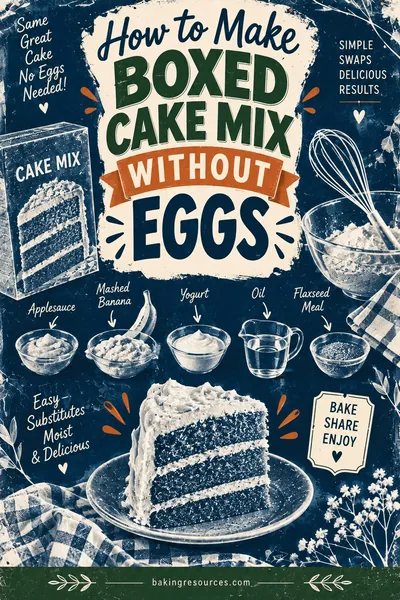
Yes, for one egg, and box mixes are among the best candidates because the flour is already blended with leavening. Use the water-oil-powder mix for one egg and applesauce or yogurt for any others, and cut the mix's own leavening if you're stacking doses.
How many eggs can I replace with baking powder?
One comfortably, two only in a recipe with 3 or more cups of flour and little baking powder of its own. Past that, you break the 1 to 1 1/4 teaspoons per cup of flour limit and the bake tastes soapy and sinks in the middle.
Will baking powder make my bake taste bitter?
Only if you overdose it. The bitter, soapy note comes from unreacted leavening, so it shows up when the total goes past about 1 1/4 teaspoons per cup of flour, or when the batter has no acid to react with. A splash of lemon juice or a spoon of yogurt cleans it up.
Is baking powder or baking soda better for replacing eggs?
Baking powder, in most cases, because it works without needing acid in the batter and it lifts twice. Baking soda plus vinegar is the better pick for vegan chocolate cake, where the cocoa is acidic and dark enough to hide any sharpness.
Do I need to change the bake time when I skip the eggs?
Usually by a few minutes, not more. Muffins and thin layers often finish 2 to 3 minutes early because there's less protein to set. Deep cakes go the other way and can need 5 extra minutes at 15°F lower, since the structure sets later.
What can I use if I have no baking powder and no eggs?
Self-rising flour already contains baking powder and salt, so swap it in and skip both. Failing that, 1/4 teaspoon of baking soda plus 1/2 teaspoon of cream of tartar makes 1 teaspoon of single-acting baking powder, and our homemade self-rising flour guide has the flour-side version of the same fix.
Related guides: Egg substitutes for baking | Applesauce as an egg substitute | Baking soda vs baking powder | Baking powder substitute | Baking substitutions finder