
How Long to Bake Banana Bread at 350°F, by Pan and Size

Bake banana bread in a 9x5 inch loaf pan at 350°F for 55 to 65 minutes. A narrower 8.5x4.5 pan makes a taller loaf that needs 60 to 70 minutes, mini loaves take 28 to 35 minutes, and an 8x8 square pan takes 30 to 40. The loaf is done when the center reads 200 to 205°F, or a skewer comes out with a few moist crumbs and no wet batter.
The pan material matters too. Dark nonstick pans finish sooner, and glass or ceramic dishes do best with the oven turned down to 325°F. Pick your pan size and material in the calculator below and it gives you the minutes and the sign to look for before you take the loaf out.
Free calculator
Banana bread bake time calculator
Pick your pan size and what the pan is made of to see the bake time and the sign that the loaf is done.
More free baking tools



Banana bread bake times at a glance
Most banana bread recipes make one loaf from about 2 cups of flour and 3 ripe bananas, and they are written for a light metal 9x5 pan at 350°F. Here is how long that same batter takes in other pans and at the two oven temperatures that work best.
| Pan (light metal) | Batter depth | At 350°F | At 325°F |
|---|---|---|---|
| 9x5 inch loaf pan | About 2 inches | 55 to 65 min | 65 to 75 min |
| 8.5x4.5 inch (8x4) loaf pan | About 2 1/2 inches | 60 to 70 min | 70 to 80 min |
| Mini loaf pans, 5.75x3 inch (3 to 4 loaves) | About 1 1/2 inches | 28 to 35 min | 33 to 40 min |
| 8x8 inch square pan | About 1 inch | 30 to 40 min | 35 to 45 min |
| Standard muffin cups (about 12) | Cups filled 3/4 full | 18 to 22 min at 375°F | |
Start checking 10 minutes before the low end for loaves, and 5 minutes before for minis and squares. That early look costs nothing, and it is the only way to learn how your own oven behaves. Banana bread is forgiving in flavor but not in texture: five minutes short leaves a gummy streak, and ten minutes too long dries out the edges.
Notice that time follows batter depth, not pan volume. A shallow 8x8 holds about the same batter as a 9x5 loaf but bakes in about half the time, because heat only has to travel half as far to reach the middle.
Why 350°F is the standard temperature
Banana bread is a thick, wet batter baked deep. Mashed banana holds a lot of water and sugar, and that combination browns quickly. At 350°F, the outside of the loaf sets and colors at a pace that gives the center enough time to rise and cook through. Go much hotter and the crust darkens long before the middle is ready.
Baking at 325°F
Turning the oven down 25°F is a smart move for deep loaves, dark pans, glass dishes, and loaves loaded with extra banana or mix-ins. The loaf takes about 10 minutes longer, but the crust stays a softer brown, the edges stay moist, and the center has time to catch up. If your banana bread always comes out dark outside and damp inside, 325°F is often the fix.
Baking at 375°F
This is too hot for a full loaf. The top cracks hard, the sides go dark, and the middle is often still wet when the outside looks done. The one place 375°F works well is banana muffins, which are small enough to bake through quickly. For loaves, stay at 350°F or 325°F.
Convection ovens
With the fan on, set the oven 25°F lower than the recipe and start checking 10 minutes early. Moving air dries the top of a tall loaf, so many bakers turn the fan off for quick breads and save it for cookies. Our guide to convection vs conventional ovens explains the difference. If your recipe is in Celsius or uses gas marks, the oven temperature conversion chart gives the matching setting.
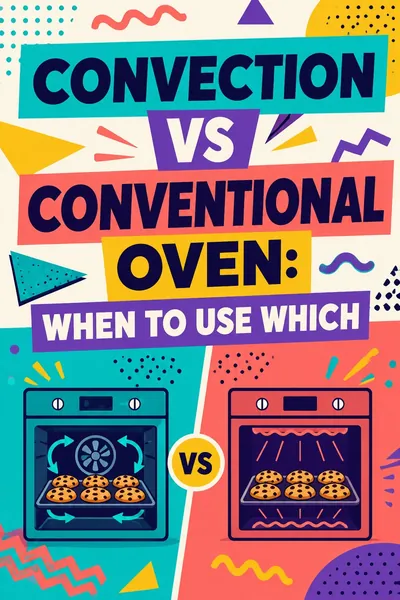 Baking guideConvection vs Conventional Oven: When to Use WhichRead the guide →
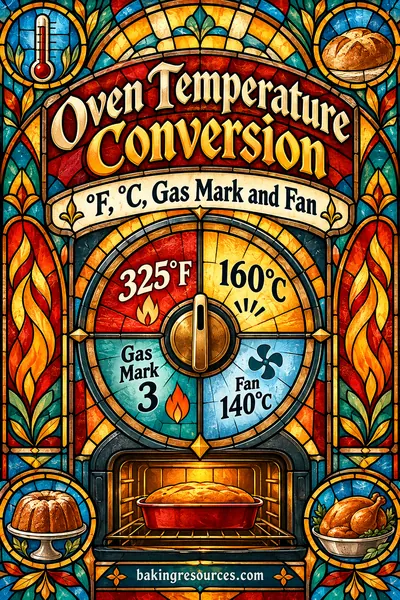 Free toolOven Temperature Conversion: °F, °C, Gas Mark and FanRun my numbers →
Loaf pan size: why an 8x4 takes longer than a 9x5
The two common loaf pans look nearly the same, but they bake differently. A 9x5 pan has about 45 square inches of floor. An 8.5x4.5 pan has about 38. Pour the same batter into the smaller pan and it sits roughly half an inch deeper, which means the center needs about 5 more minutes to get hot enough.
The smaller pan also makes a taller, prettier loaf with a better dome. The trade-off is that the batter can come close to the rim. If yours is filled past about three quarters, set the pan on a sheet pan to catch any drips. Our guide to what size pan to use for banana bread compares the two pans side by side, including how much batter each one holds safely.
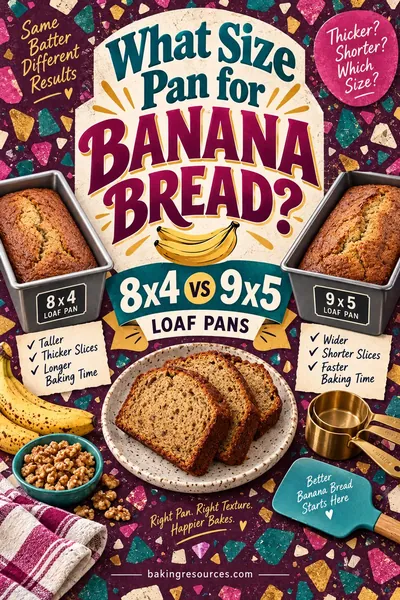 Baking guideWhat Size Pan for Banana Bread? 8x4 vs 9x5 Loaf PansCheck the pan chart →
Two other things change the clock along with size:
- Pan shape. Pans with straight sides bake slightly faster than pans that flare out, since the batter is a little shallower at the top.
- Glass pans labeled 9x5. Many measure closer to 8.5x4.5 inside, so they act like the smaller pan. Measure across the inside top edge to be sure.
If you are working from an unusual pan, our chart of loaf pan sizes lists the real dimensions and volumes for standard, large and specialty pans.
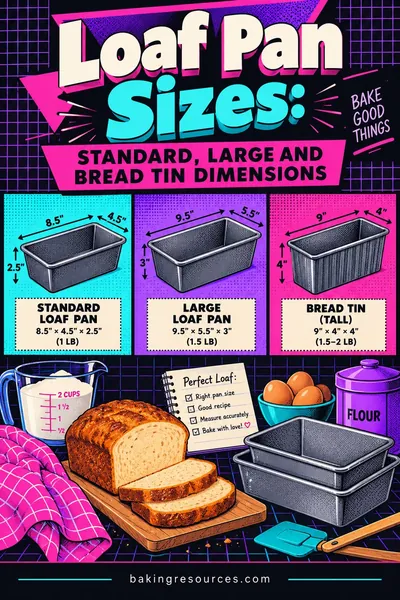 Baking guideLoaf Pan Sizes: Standard, Large and Bread Tin DimensionsFind my pan size →
Pan material: metal, dark nonstick, glass and ceramic
What the pan is made of changes how fast heat moves into the batter. Light metal is the baseline for every recipe. The others need a small correction to either the oven or the clock.
| Pan material | Oven | 9x5 loaf | 8.5x4.5 loaf | Mini loaves | 8x8 square |
|---|---|---|---|---|---|
| Light metal (aluminum) | 350°F | 55 to 65 min | 60 to 70 min | 28 to 35 min | 30 to 40 min |
| Dark or nonstick metal | 350°F | 50 to 60 min | 55 to 65 min | 25 to 32 min | 27 to 35 min |
| Glass or ceramic | 325°F | 60 to 70 min | 65 to 75 min | 30 to 38 min | 33 to 42 min |
Dark and nonstick pans
Dark surfaces soak up more heat, so the sides and bottom brown faster and the loaf finishes about 5 minutes sooner. Start checking 15 minutes before the recipe's low end. If you always get a thick, dark bottom crust, lower the oven to 325°F and keep the regular time instead.
Glass and ceramic dishes
Glass and stoneware take longer to heat up, but once hot they hold heat well and brown the edges hard. That is why the usual advice is to lower the oven 25°F to 325°F when you use them. The bake time ends up a little longer than metal at 350°F. You can see the batter through a glass pan, which makes the bottom easy to check: you want an even golden brown, not a pale, wet-looking layer.
Silicone loaf pans
Silicone heats slowly and does not brown well. Set it on a metal sheet pan before filling, keep the oven at 350°F, and expect 5 to 10 extra minutes. The crust will be paler and softer than a metal-pan loaf.
How to tell banana bread is done
A deep, moist loaf is the hardest thing in quick bread baking to judge by eye. The top can look completely finished while a wet band still runs through the middle. These are the checks, from most reliable to least.
- Internal temperature. Push an instant-read thermometer into the center from the top, through the crack. 200 to 205°F means done. Under 195°F, give it 5 more minutes.
- The skewer. A long wooden skewer or thin knife into the center should come out with a few moist crumbs and no streaks of wet batter. Melted chocolate chips can fool you, so test a second spot if you see smears of chocolate.
- The crack. The split along the top should look dry inside, not shiny or pasty.
- The spring-back. Press gently near the center. It should spring back instead of leaving a dent.
- The sides. The loaf starts to pull away from the sides of the pan.
The thermometer is the one that saves loaves. It stops you from pulling a loaf that looks done five minutes early, which is where most gummy centers come from. For a full walk-through of each check, see our guide on how to tell if banana bread is done.
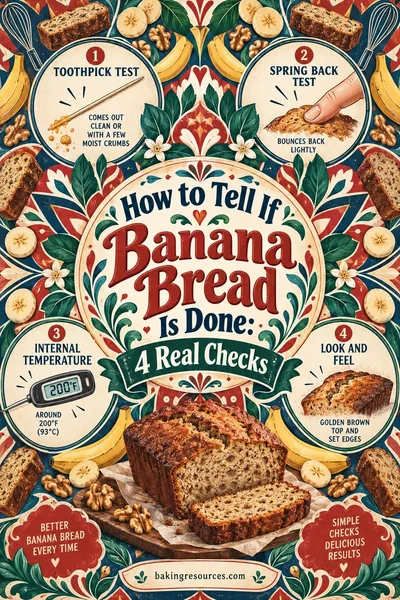 Baking guideHow to Tell If Banana Bread Is Done: 4 Real ChecksSee the doneness test →
When to tent with foil
Banana bread is full of sugar from the fruit and the recipe, so the top browns early. If the top is already deep brown with 20 minutes or more still to go, lay a loose sheet of foil over the pan. Do not crimp it around the edges. You just want to shade the top from direct heat while the inside finishes.
For a 9x5 loaf at 350°F, check the color around the 40 minute mark. Loaves with a sugar or streusel topping often need foil by then. Dark pans and loaves near the top of the oven brown faster still. Our page on which oven rack to use explains why the center rack is the right spot for a tall loaf: it keeps the top far enough from the upper element and the bottom far enough from the lower one.
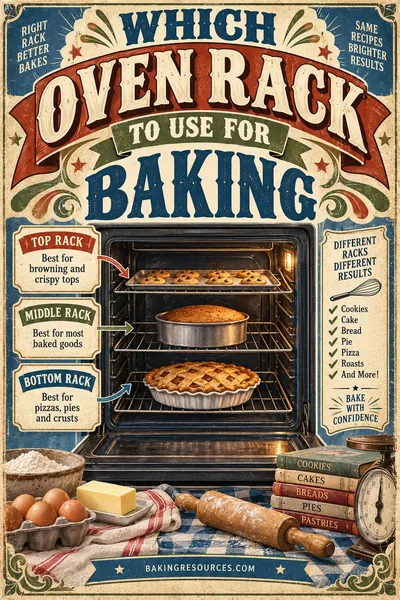 Baking guideWhich Oven Rack to Use for Baking: Top, Middle, LowSee the chart →
Batter temperature, frozen bananas and mix-ins
Freshly mixed vs chilled batter
Banana bread batter is best baked right after mixing. The baking soda starts working as soon as it meets the wet ingredients, and the batter slowly loses lift the longer it waits. If you must hold it, keep it covered in the fridge and bake within a few hours. Cold batter takes 5 to 10 minutes longer in a 9x5 pan, and the loaf will rise a little less.
Cold ingredients
Eggs, milk, sour cream or yogurt straight from the fridge cool the batter down, and melted butter can firm into little lumps when it hits them. That adds a few minutes and can leave the crumb uneven. Letting cold ingredients sit out for 30 minutes first gives you a smoother batter and a more predictable bake.
Frozen bananas
Frozen bananas are great for banana bread, but thaw them fully first. They release a lot of brown liquid as they thaw. Most bakers mash the bananas with that liquid, which is fine, but it makes the batter wetter. A wetter batter needs the high end of the time range, and sometimes 5 minutes past it. If the batter looks loose and soupy, pour off a tablespoon or two of the liquid.
Mix-ins
A cup of chocolate chips or chopped nuts adds volume and makes the loaf deeper. Plan on 5 to 10 extra minutes in a 9x5 pan. Lots of extra banana (4 or 5 instead of 3) does the same. If the loaf keeps coming out heavy and wet in the middle even when you bake it long enough, the problem is more likely the recipe or the mixing than the clock. Our guide on why banana bread turns out dense covers those causes, and our page on what overmixing does to batter explains why quick bread batter should still look a little lumpy.
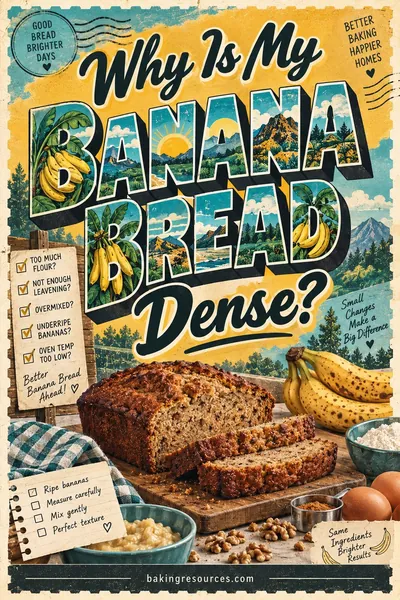 Baking guideWhy Is My Banana Bread Dense? 6 Causes and the FixesSee what went wrong →
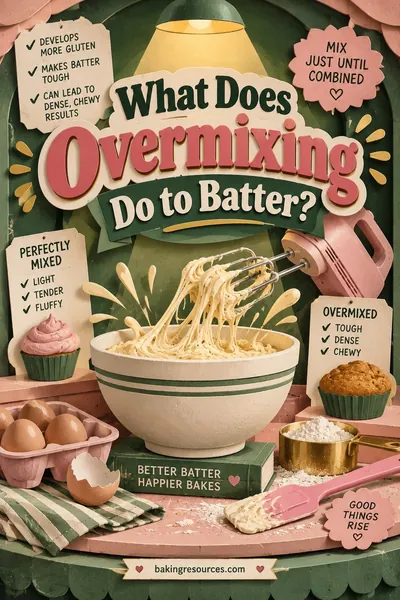 Baking guideWhat Does Overmixing Do to Batter? Tunnels and ToughnessTake a look →
Recipe changes that shift the bake time
Banana bread recipes vary a lot, and some of those differences show up on the clock. If your loaf never matches the time in the recipe, one of these is often the reason.
Oil vs butter
Oil-based banana bread stays liquid in the oven longer than a butter batter, so it can take 5 minutes more to set in the center. It also stays softer and moister after baking. Butter versions brown a little faster on top and firm up sooner.
More sugar or honey
Sugar holds onto water and browns quickly. A recipe with a full cup of sugar, or with honey or maple syrup, will color well before a lighter recipe and often needs foil sooner. The bake time inside stays about the same, but you will judge it by the thermometer, not the crust.
Whole wheat or oat flour
Swapping some of the white flour for whole wheat or oat flour makes the batter thicker and thirstier. The time usually stays close, but the loaf can seem set on top while staying dense in the middle. Test the center, and give the batter a 10 minute rest before baking so the bran can soak up some liquid.
Sour cream, yogurt or buttermilk
These add moisture and a little tang. They often push the bake to the high end of the range, especially if they go in cold. Let them sit out briefly before mixing.
A sugar or streusel topping
A crunchy topping adds a layer that browns fast and slows down heat getting to the top of the loaf. Expect to tent with foil around 35 to 40 minutes and to need the full 65 minutes in a 9x5 pan.
Mini loaves, muffins and banana bread bars
The same batter bakes into smaller shapes in much less time. Here is how to plan each one from a single 9x5 recipe.
| Shape | How many from one 9x5 recipe | Fill | Oven | Time | Done sign |
|---|---|---|---|---|---|
| Mini loaves (5.75x3) | 3 to 4 | 2/3 full | 350°F | 28 to 35 min | 200 to 205°F; skewer with moist crumbs |
| Standard muffins | About 12 | 3/4 full | 375°F | 18 to 22 min | Tops spring back; toothpick with a few crumbs |
| Mini muffins | About 36 to 40 | Nearly full | 375°F | 10 to 13 min | Tops spring back and look dry |
| 8x8 square pan (bars) | 16 squares | About 1 inch deep | 350°F | 30 to 40 min | Center springs back; edges pull away |
| 9x13 pan (double recipe) | 24 squares | About 1 1/4 inches deep | 350°F | 35 to 45 min | Center springs back; 200 to 205°F |
Mini loaves are the classic gift size. Always set them on a sheet pan so you can move them in and out of the oven in one go. If your mini pans are a different size from the common 5.75x3, our guide to mini loaf pan sizes lists how much batter each one holds and how long it bakes.
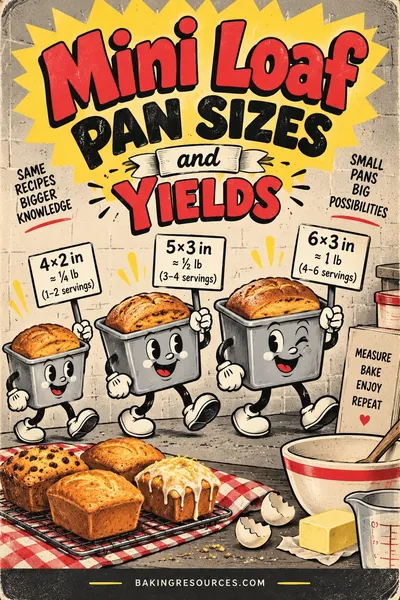 Baking guideMini Loaf Pan Sizes and Yields: Batter and Bake TimesGet the measurements →
Moving any recipe from one pan to another is easier with the baking time calculator, which works out a new time from the change in pan size and depth.
 Free toolBaking Time Calculator: New Pan, New TimePlug in my recipe →
High altitude banana bread
Above about 3,000 feet, quick breads rise faster, then often sink, and the crust dries out before the center is done. The usual changes are small and work together:
- Raise the oven 15 to 25°F, to about 365 to 375°F, so the structure sets before the batter over-rises.
- Because the oven is hotter, start checking 10 to 15 minutes earlier. A 9x5 loaf often finishes in about 45 to 55 minutes. Tent with foil early if the top darkens.
- Cut the baking soda a little, by about a quarter at 5,000 feet.
- Reduce the sugar by 1 to 2 tablespoons per cup and add a tablespoon or two of extra liquid.
The internal target is a touch lower at altitude, because water boils at a lower temperature. Around 5,000 feet, a loaf reading 198 to 200°F that passes the skewer test is done. Our high altitude baking chart gives the full set of changes for each elevation.
Worked example: one recipe, two pans, one oven
Say your recipe is written for a 9x5 loaf at 350°F for 60 minutes. You want to give away mini loaves, but you also want a loaf for home. You have one dark nonstick 8.5x4.5 pan and four light metal mini pans.
- Split the batter. A full recipe fills the 8.5x4.5 pan alone, so make a double batch. Put one recipe into the loaf pan and divide the other among the four mini pans, about 2/3 full each.
- Set the oven. Both pans can bake at 350°F. Put the mini pans on a sheet pan, and set both on the center rack with space between them.
- Find the windows. The light metal minis need 28 to 35 minutes. The dark 8.5x4.5 loaf needs 55 to 65 minutes. That is one timer at 28 minutes and a second at 50.
- Check the minis. At 28 minutes the center of one mini reads 196°F. At 31 minutes it reads 203°F. Out they come.
- Check the loaf. At 40 minutes the top is deep brown, so a loose sheet of foil goes on. At 50 minutes the center reads 188°F. At 57 minutes it reads 202°F and a skewer comes out with moist crumbs. Done.
- Cool. Minis rest in their pans 5 to 10 minutes, the big loaf 10 to 15, then everything goes onto a rack.
The calculator near the top of this page gives the same windows for any pan size and material, so you can plan a mixed bake like this in a few seconds.
Troubleshooting: gummy middle, sunken loaf, burnt bottom
| Problem | Likely cause | Fix next time |
|---|---|---|
| Gummy or wet stripe in the middle | Pulled a few minutes early, or sliced while hot | Bake to 200 to 205°F; cool at least 1 hour before slicing |
| Dark crust, raw center | Oven too hot, dark or glass pan, top rack | Bake at 325°F; center rack; tent with foil at 40 minutes |
| Sunken middle after cooling | Underbaked, too much leavening, or very wet batter | Bake to temperature; measure soda level; drain extra banana liquid |
| Flat, pale top with no crack | Old baking soda, batter sat too long, oven too cool | Fresh soda; bake right after mixing; check the oven with a thermometer |
| Big peaked dome that splits wide | Small pan filled too full, or oven too hot | Use a 9x5 or fill no more than 3/4; bake at 350°F or lower |
| Burnt or thick bottom crust | Dark pan, bottom rack, oven heat from below | Lower to 325°F; middle rack; slide an empty sheet pan on the rack below |
| Dry, crumbly loaf | Baked too long or too much flour | Pull at 205°F, not later; spoon and level flour or weigh it |
A gummy center is the most common complaint, and it often has nothing to do with the oven. A loaf sliced while still hot will look wet in the middle even if it reached 205°F, because steam is still moving through the crumb. Give it at least an hour on the rack, and the same slice will look fine.
If you do cut into a loaf and find a truly raw center, you can still save it. Slide it back into its pan, cover the top loosely with foil, and return it to a 325°F oven for 10 to 15 minutes, then check the temperature again. The texture right around the cut will be a little firmer, but the rest of the loaf will be fine. A loaf that has already cooled completely is harder to rescue, so the best habit is still to check the center with a thermometer before it ever leaves the oven.
Holiday baking and gift batches
Banana bread is a favorite for Thanksgiving breakfast, Christmas morning and winter gift baskets, mostly because it travels well and tastes better the next day. A few planning tips make a big batch smoother.
Plan the oven time
Most ovens fit two 9x5 loaves side by side on the center rack, or four to six mini pans on one sheet pan. Two full loaves bake in about the same 55 to 65 minutes as one, maybe a few minutes more, as long as they are not touching each other or the oven walls. For a dozen mini loaves from three or four recipes, plan two or three rounds of about 35 minutes each, plus cooling and reloading time.
Bake ahead and freeze
Banana bread freezes very well. Cool it completely, wrap it tightly in plastic wrap and then foil or a freezer bag, and freeze. It keeps its best quality for about 2 to 3 months. Thaw it in the wrapping at room temperature so the moisture that forms stays on the outside of the bread. Our guide on how to freeze bread walks through wrapping and thawing in more detail. Mini loaves wrapped one at a time are easy to pull out as gifts on short notice.
Gift wrapping and storage
Plain banana bread keeps at room temperature, well wrapped, for about 2 to 3 days, and in the fridge for about a week, though it dries a little faster there. If you add a cream cheese swirl or frosting, it has to be kept in the fridge and should not sit out more than 2 hours. Let loaves cool completely before wrapping, or trapped steam makes the top sticky. Our page on how to store baked goods has the full counter and fridge guidance.
Common banana bread timing mistakes
- Using the recipe time without checking the pan. A recipe written for a 9x5 will be underbaked at that time in an 8x4 pan.
- Trusting a clean-looking top. The top sets well before the center. Always test the middle.
- Testing too close to the edge. The outer inch is done first. Go into the very center, through the crack.
- Raising the oven to speed things up. This burns the outside and leaves the inside wet. Lower and a little longer works better for loaves.
- Opening the oven often. Each opening drops the temperature. Do not check before the first 40 minutes for a full loaf.
- Not knowing your oven. Many home ovens run 25°F hot or cold. An oven thermometer on the center rack is the cheapest fix for a loaf that is always over or under.
- Slicing too soon. A hot loaf looks gummy even when it is done. Wait at least an hour.
Questions people ask
How long do you bake banana bread at 350°F?
In a light metal 9x5 inch loaf pan, banana bread takes 55 to 65 minutes at 350°F. A narrower 8.5x4.5 pan takes 60 to 70 minutes, mini loaves take 28 to 35 minutes and an 8x8 square pan takes 30 to 40 minutes. Start checking early and pull the loaf when the center reads 200 to 205°F.
How long do you bake banana bread at 325°F?
At 325°F, a 9x5 loaf in a light metal pan takes about 65 to 75 minutes, and an 8.5x4.5 loaf about 70 to 80 minutes. In a glass or ceramic dish at 325°F, plan on 60 to 70 minutes for a 9x5. The lower oven is a good choice for deep loaves, dark pans and very wet batters.
What internal temperature should banana bread be?
Banana bread is done at 200 to 205°F in the very center. Push an instant-read thermometer in from the top, through the crack. If it reads below 195°F, give the loaf about 5 more minutes and check again. At high altitude the target is a few degrees lower, because water boils at a lower temperature there.
Why is my banana bread still raw in the middle after an hour?
The most common reasons are a smaller or deeper pan than the recipe expects, an oven that runs cool, very wet batter from extra or thawed bananas, or a cup of mix-ins that made the loaf deeper. Check the oven with a thermometer, measure your pan, and keep baking to 200 to 205°F with foil over the top.
Should I cover banana bread with foil while baking?
Only if the top gets dark before the inside is done. Check the color at about 40 minutes for a 9x5 loaf. If it is already deep brown, lay a loose sheet of foil over the top without sealing the edges, and keep baking. The foil shades the crust while the center finishes cooking.
How long do banana bread muffins take?
Standard banana muffins filled about three quarters full bake in 18 to 22 minutes at 375°F. Mini banana muffins take 10 to 13 minutes at the same temperature. They are done when the tops spring back and a toothpick in the center comes out with a few moist crumbs. One 9x5 recipe makes about 12 standard muffins.
Can I bake two loaves of banana bread at once?
Yes. Two loaf pans fit side by side on the center rack in most ovens, as long as they do not touch each other or the oven walls. They bake in about the same time as one loaf, sometimes a few minutes longer. Test each loaf separately, since one may finish before the other.