How to Bake Bread in a Dutch Oven: Temps, Times and Tips

Here is how to bake bread in a Dutch oven: preheat the empty pot with its lid in a 450 to 500 °F oven for 30 to 60 minutes, lower your shaped and scored loaf in on a parchment sling, bake with the lid on for about 20 to 30 minutes, then remove the lid and bake another 15 to 25 minutes until the crust is deep brown. The lid traps steam from the dough for a tall rise, and taking it off lets the crust crisp and color.
A heavy lidded pot is the closest thing a home baker has to a professional steam-injected bread oven, and learning how to bake bread in a Dutch oven is one of the simplest upgrades you can make. It gives round loaves a big rise, an open crumb and a crackly, blistered crust with almost no fuss.
This guide walks through the full method: choosing a pot, preheating, loading safely with parchment, lid-on and lid-off times and temperatures, how to check doneness, how to stop the bottom from burning, and how to adjust for different loaf types.
Quick Reference: Dutch Oven Bread Times and Temps
| Step | Temperature | Time |
|---|---|---|
| Preheat oven with pot and lid inside | 450 to 500 °F | 30 to 60 minutes |
| Bake, lid on | 450 to 475 °F | 20 to 30 minutes |
| Bake, lid off | 425 to 450 °F | 15 to 25 minutes |
| Internal temperature (lean bread) | About 205 to 210 °F | Check at end |
| Cool before slicing | Room temperature | At least 1 hour |
These ranges cover a typical round loaf made with about 500 grams of flour. Smaller loaves need less time and larger ones need more. For timing other sizes, the baking time calculator helps you adjust.
Why a Dutch Oven Works So Well
When bread first goes into a hot oven, it expands quickly. This is called oven spring. Moisture around the loaf keeps the outer skin soft for those first minutes so the loaf can stretch and rise as tall as possible. If the crust sets too early, the loaf stays squat and may split in odd places.
A lidded pot solves this in a simple way:
- It traps steam. As the dough heats, it releases moisture. The lid holds that steam right around the loaf.
- It holds heat. Heavy pots store a lot of heat and pass it into the dough quickly and evenly.
- It shapes the loaf. The walls support the dough so it rises up instead of spreading out.
Once the loaf has risen and set, taking the lid off lets the steam escape so the crust can dry, brown and crisp.
Choosing a Pot
| Pot type | Works for bread? | Notes |
|---|---|---|
| Bare cast iron Dutch oven | Yes | Holds heat very well; season to prevent rust |
| Enameled cast iron Dutch oven | Yes | Easy to clean; check the knob's heat rating |
| Cast iron combo cooker (shallow base, deep lid) | Yes, very easy to load | Load the dough onto the shallow side |
| Heavy oven-safe stockpot with lid | Sometimes | Thinner metal; more likely to burn the bottom |
| Ceramic bread cloche | Yes | Made for bread; handle gently when hot |
Size
A pot that holds about 5 to 7 quarts suits a typical round loaf. Too small and the loaf presses against the sides; too large and the dough can spread out flat. Oval pots suit oval loaves.
Check the lid knob
Some lid knobs, especially plastic or phenolic ones, are not rated for very high oven temperatures. Check what your pot is rated for before preheating it empty at 500 °F. A metal knob, or removing the knob and plugging the hole with foil, avoids the problem. Also check your pot's care instructions about preheating empty, since some enameled pots have specific guidance.
How to Bake Bread in a Dutch Oven, Step by Step
Step 1: Shape and proof the loaf
Shape your dough into a round (boule) or oval (batard) and let it proof in a floured basket or a towel-lined bowl. Aim for a loaf that is puffy and passes the poke test: a gentle fingertip press leaves a dent that springs back slowly.
Step 2: Preheat the oven and pot
- Place the oven rack in the lower third of the oven, so the pot has room and the bottom is not right under the upper element. If you are not sure where your rack should go, see which oven rack to use.
- Put the empty pot and its lid in the oven. You can set the lid upside down beside the pot or on top.
- Heat the oven to 450 to 500 °F.
- Let the pot preheat for 30 to 60 minutes after the oven reaches temperature. Heavy cast iron takes a while to heat all the way through.
If your recipe gives temperatures in Celsius, the oven temperature conversion chart has the Fahrenheit equivalents.
Step 3: Make a parchment sling
Cut a piece of parchment paper a little wider than the loaf, with long ends that stick out on two sides to act as handles. Parchment is the easiest and safest way to get dough into a hot pot. It handles high oven temperatures for this kind of bake, though the edges may darken. (A silicone mat is not a good fit here; see parchment paper vs silicone mat for where each one shines.)
Step 4: Turn out and score the loaf
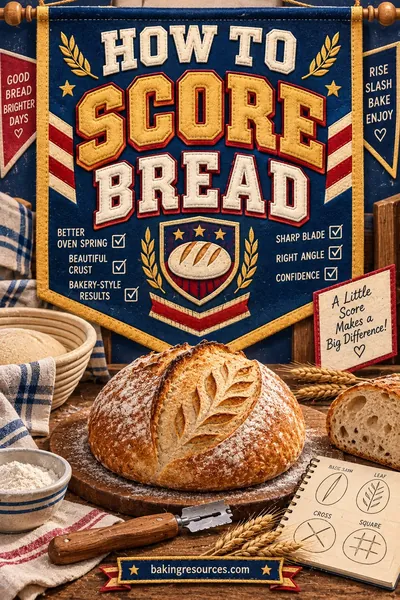
Turn the proofed dough out of its basket onto the parchment, seam side down. Brush off excess flour if you like. Score the top with a sharp blade or razor in one confident stroke, or a simple pattern. Scoring gives the loaf a controlled place to expand. The how to score bread guide covers angles, depth and patterns.
Step 5: Load the loaf safely
- Wear thick, dry oven mitts that cover your wrists and forearms.
- Pull the oven rack out partway and take off the lid, or carefully lift the hot pot out onto a heatproof surface.
- Holding the parchment handles, lower the loaf gently into the pot.
- Put the lid on.
- Slide the pot back into the oven.
Work steadily, keep your arms clear of the pot's rim, and never touch the pot or lid with bare hands. Everything is extremely hot.
Step 6: Bake with the lid on
Bake for about 20 to 30 minutes with the lid on. Many bakers lower the oven temperature slightly at this point, for example from 500 °F to 450 or 475 °F, so the loaf does not scorch.
Step 7: Remove the lid and finish baking
Carefully remove the lid. The loaf should be tall and set, but still pale. Bake uncovered for another 15 to 25 minutes, until the crust is deep golden brown and the score has opened into a crisp ridge (often called the ear).
Step 8: Check doneness and cool
Lift the loaf out with the parchment, peel the paper away, and check that the bread is done:
- The crust is deep brown all over.
- Tapping the bottom gives a hollow sound.
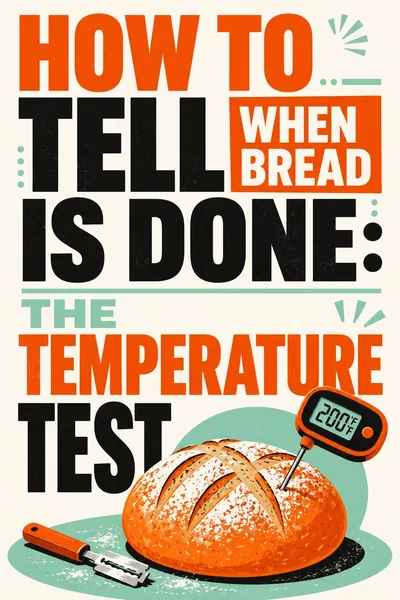
- An instant-read thermometer in the center reads about 205 to 210 °F for a lean loaf.
The how to tell when bread is done guide covers each test in more detail. Cool the loaf on a rack for at least an hour before slicing. Cutting too soon can make the crumb gummy because the inside is still finishing.
Lid-On and Lid-Off Times by Loaf Type
Different breads need slightly different treatment. Use this as a guide, and adjust for your oven and recipe.
| Loaf | Oven temp | Lid on | Lid off | Notes |
|---|---|---|---|---|
| Sourdough boule (about 500 g flour) | 475 to 500 °F, lower to 450 °F | 20 to 25 min | 20 to 25 min | Classic, dark, crackly crust |
| No-knead white loaf | 450 to 475 °F | 30 min | 15 to 20 min | Very wet dough; parchment essential |
| Whole wheat loaf | 450 °F | 25 to 30 min | 15 to 20 min | Browns faster; watch the bottom |
| Rye-heavy loaf | 450 °F | 25 to 30 min | 20 to 30 min | Dense; needs full bake and long cool |
| Enriched loaf (milk, butter, sugar) | 375 to 400 °F | 20 min | 15 to 20 min | Lower heat; sugar browns fast |
| Small loaf (about 250 to 300 g flour) | 450 to 475 °F | 15 to 20 min | 10 to 15 min | Shorter time overall |
How to Avoid a Burnt Bottom Crust
A dark or burnt bottom is the most common complaint once people learn how to bake bread in a Dutch oven. Cast iron conducts a lot of heat right into the base of the loaf. Here are the fixes, from easiest to most involved:
- Move the rack up. If the pot sits close to the bottom heating element, the base gets too much direct heat. Try the middle rack or one notch below.
- Put a sheet pan on the rack below. A baking sheet under the pot acts as a heat shield.
- Lower the temperature after the lid comes off. Drop it by 25 °F for the uncovered part of the bake.
- Add a layer under the loaf. A sprinkle of coarse cornmeal or semolina under the parchment, or a second sheet of parchment, adds a little insulation.
- Take the loaf out of the pot for the last part. Once the lid comes off, lift the loaf out and bake it directly on the oven rack for the final 10 to 15 minutes.
- Shorten the preheat. If you preheat for a full hour at 500 °F, try 30 to 40 minutes instead.
Other crust problems
| Problem | Likely cause | Fix |
|---|---|---|
| Pale, soft crust | Lid off too short, or oven too cool | Bake longer uncovered; check oven temp |
| Crust too thick and hard | Bake too long or too hot | Shorten uncovered time; lower temp slightly |
| Loaf flat and spread out | Under-shaped or over-proofed dough | Shape tighter; proof less |
| Burst on one side | Shallow or missing score | Score deeper with one quick stroke |
| Gummy center | Underbaked or sliced too soon | Bake to the target internal temp; cool fully |
If your loaves keep coming out gummy inside even when the crust looks right, the why is my bread gummy guide works through the other causes.
Cold Pot vs. Preheated Pot
Most methods call for a preheated pot, but you can also start in a cold pot. In a cold start, you proof the loaf on parchment, place it in the cold pot, cover it, and put it into a cold or preheating oven.
| Method | Pros | Cons |
|---|---|---|
| Preheated pot | Biggest oven spring, best crust | Handling a very hot pot |
| Cold pot | Safer and easier to load | Less oven spring; longer bake; results vary |
If you are nervous about handling a hot pot, a cold start is a fine way to begin. For the tallest loaf and best crust, the preheated method usually wins.
Safety Tips
- Use long oven mitts that cover your forearms. Thin pot holders are not enough.
- Have a landing spot ready. Put a trivet or a thick towel on the counter before you take the pot out.
- Keep the handles in mind. Every part of the pot, including the handles and knob, is hot.
- Remind others in the kitchen that the pot and lid are hot, even after it is turned off.
- Lift the lid away from you so the burst of steam goes toward the back of the oven, not your face.
Common Mistakes to Avoid
Skipping the preheat. A cold pot in a hot oven gives a flatter loaf. Preheat the pot fully unless you are deliberately using the cold-start method.
Dropping the dough in by hand. It deflates the loaf and risks burns. Use a parchment sling.
Leaving the lid on too long. The crust stays pale and soft. Take the lid off after about 20 to 30 minutes.
Taking the lid off too early. The loaf has not finished rising. Wait until it is set.
Ignoring the bottom. If the base is getting too dark, move the rack up or add a sheet pan underneath.
Using a pot that is too big or too small. Pick a pot that leaves a little room around the loaf.
Slicing right away. Let the loaf cool for at least an hour so the crumb sets.
FAQ
What temperature should I use for how to bake bread in a Dutch oven?
Most lean loaves bake at 450 to 500 °F. Preheat the pot at the higher end, bake lid-on at 450 to 475 °F, and finish uncovered at 425 to 450 °F. Enriched breads with milk, butter or sugar need a lower range, around 375 to 400 °F.
How long do I bake bread with the lid on?
For a typical round loaf, about 20 to 30 minutes with the lid on, then another 15 to 25 minutes uncovered. Smaller loaves need less time.
Do I need to preheat the Dutch oven?
For the best rise and crust, yes. Preheat the empty pot and lid for 30 to 60 minutes. A cold-pot start also works, with less oven spring.
Can I use parchment paper in a Dutch oven?
Yes. A parchment sling is the easiest way to lower dough into a hot pot. The edges may darken at high heat, which is normal.
Why is the bottom of my Dutch oven bread burnt?
The pot is probably too close to the bottom heating element or the oven is too hot. Move the rack up, place a sheet pan on the rack below, and lower the temperature once the lid comes off.
Can I bake two loaves one after the other?
Yes. After the first loaf comes out, put the empty pot and lid back in the oven and let them reheat for about 10 to 15 minutes before loading the second loaf.
Do I need to add water or ice to the pot?
Usually not. The lid traps steam from the dough itself. Some bakers add an ice cube beside the parchment for extra steam, but it is optional and is not needed for a good crust.
Want the answer for your size? Our how many slices in a loaf of bread guide has a free tool that looks it up for you.