
Gelatin Substitute: Agar, Pectin and Cornstarch Amounts That Set

The best gelatin substitute is agar agar, a plant-based gelling agent made from seaweed. Use about 1 teaspoon of agar powder in place of 1 tablespoon of powdered gelatin, or about 3/4 teaspoon of agar powder for one packet. Unlike gelatin, agar has to boil for a minute or two before it will set.
Agar is also the go-to swap for vegan and vegetarian baking, since gelatin comes from animals. For softer jobs like puddings and jams, cornstarch, pectin and chia seeds can step in too. Pick how much gelatin your recipe calls for and what you have, and the calculator below works out the exact amount for you.
Free calculator
Gelatin substitute calculator
Pick how much powdered gelatin your recipe calls for and the swap you have, and see the exact amount to use.
More free baking tools



What gelatin does, and why agar is different
Gelatin is a protein made from animal collagen. One standard packet holds about 2 1/4 teaspoons (around 7 grams) of powder, and that's enough to firmly set about 2 cups of liquid. You bloom it in cold liquid, warm it gently to dissolve, and it sets in the fridge into that soft, wobbly gel that melts right in your mouth.
Agar agar comes from red seaweed. It's a carbohydrate, not a protein, and it behaves differently in three big ways:
- It's stronger. You need much less agar powder than gelatin for the same set.
- It needs a boil. Agar only dissolves fully when it boils. Warm liquid isn't enough.
- It sets warm and stays set. Agar firms up as it cools to about 90°F to 104°F, so it sets on the counter in under an hour. It won't melt again until it's heated close to 185°F. Gelatin sets only when chilled and melts near body temperature.
That last point changes the texture. Agar gels are firmer and break more cleanly, less bouncy and less melty than gelatin. For most desserts that's fine, and you can soften the set by using a little less agar.
Gelatin substitute chart by amount
Here are the swaps for the most common amounts recipes call for. A packet means one standard envelope of about 2 1/4 teaspoons.
| Gelatin in recipe | Agar powder | Agar flakes | Cornstarch (soft set only) |
|---|---|---|---|
| 1 tsp | 1/3 tsp | 1 tsp | 4 tsp (1 tbsp + 1 tsp) |
| 1 packet (about 2 1/4 tsp) | 3/4 tsp | 2 1/4 tsp | 3 tbsp |
| 1 tbsp (3 tsp) | 1 tsp | 1 tbsp | 1/4 cup |
| 2 packets (about 4 1/2 tsp) | 1 1/2 tsp | 1 1/2 tbsp | 6 tbsp |
Small amounts matter here, so use proper measuring spoons and level them off. Our guide on measuring ingredients accurately shows how. A slightly heaped 1/3 teaspoon of agar can turn a creamy panna cotta into a firm block.
 Baking guideHow to Measure Baking Ingredients Accurately Every TimeSee how it's done →
Agar powder: the closest swap
Agar powder is the strongest and easiest form to use. The rule of thumb is 1 teaspoon of agar powder for 1 tablespoon of gelatin. That works out to about 3/4 teaspoon for one packet.
How to use it
- Whisk the agar powder into the cold liquid from your recipe, such as juice, milk or coconut milk. Don't bloom it like gelatin.
- Bring it to a full boil while stirring, then simmer for 1 to 2 minutes so it dissolves completely.
- Stir in any sugar, fruit puree or flavorings, then pour into molds or cups right away.
- Let it set at room temperature for 30 to 60 minutes, then chill.
Work fairly quickly once it's off the heat, because agar starts to set as soon as it cools a bit. If it sets in the pot, just warm it up again.
Agar with acid and fruit
Acidic liquids like lemon, lime and cranberry juice weaken agar's set. If you can, boil the agar in the less acidic part of the recipe, then stir in the tart juice after it comes off the heat. For very tart desserts, add a little extra agar, such as a generous measure rather than a level one.
Here agar has a real advantage. Fresh pineapple, kiwi, papaya, mango, figs, guava and fresh ginger all contain enzymes that break down gelatin, so gelatin desserts made with them never set. Agar isn't a protein, so those enzymes don't touch it.
Agar flakes and bars
Agar flakes are about a third as strong as the powder. Use 1 tablespoon of flakes in place of 1 tablespoon of gelatin, or 1 teaspoon of flakes per teaspoon of gelatin. Flakes take longer to dissolve, so let them soak in the liquid for 10 to 15 minutes first, then simmer for 5 to 10 minutes, stirring, until no bits remain. Any undissolved flakes mean a weak set.
Agar bars (sometimes sold as kanten) vary a lot in strength from brand to brand, so follow the package for them. If you can, buy powder. It's the most consistent and the easiest to measure.
Cornstarch, pectin and chia for softer jobs
Cornstarch
Cornstarch doesn't make a gel you can unmold, but it does thicken. It's a fair swap when gelatin is only there to firm up a pudding, a cream pie filling or a fruit filling. Use about 4 teaspoons of cornstarch per teaspoon of gelatin, or 3 tablespoons for a packet's worth of liquid (about 2 cups). Whisk it into cold liquid first, then bring it to a boil and cook for 1 minute until glossy and thick. Our cornstarch substitute guide covers what to do if you're out, and arrowroot works similarly in fruit fillings; see our arrowroot substitute page.
 Baking guideCornstarch Substitute: 9 Swaps and When to Use EachSee the swaps →
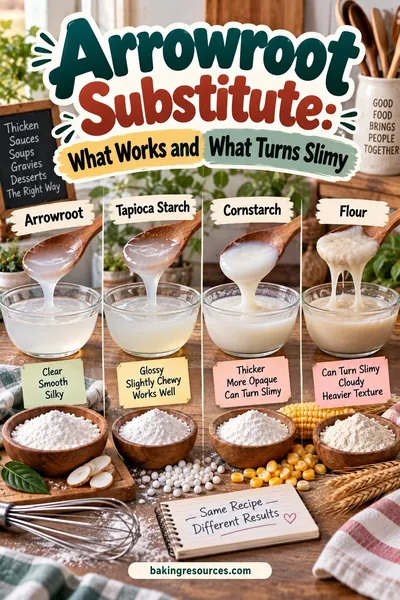 Baking guideArrowroot Substitute: What Works and What Turns SlimyGet the swap chart →
Pectin
Pectin is a fruit-based gelling agent made for jams, jellies and fruit glazes. It needs the right mix of sugar and acid to set, unless you buy low-sugar pectin, so there's no simple gelatin-to-pectin ratio. Follow the pectin package for the amount of fruit you have.
Chia seeds
For quick fruit jams, stir 1 to 2 tablespoons of chia seeds into each cup of mashed or cooked fruit and chill for about 30 minutes. It thickens into a spoonable jam with little seeds you can see.
Which swap for which dessert
| Dessert | Best swap | Tip |
|---|---|---|
| Fruit gel cups and molds | Agar powder | Add tart juice after boiling |
| Panna cotta | Agar powder, a little under the chart | Use slightly less for a softer, creamier set |
| No-bake cheesecake | Agar powder | Boil agar in part of the cream, cool slightly, then mix in fast |
| Cream pie and pudding fillings | Cornstarch | Boil 1 minute so it thickens fully |
| Jams and fruit glazes | Pectin or chia seeds | Follow the pectin package |
| Mousse | Agar powder, small amount | Fold into the whipped part before it sets |
| Marshmallows | Agar plus aquafaba | Texture is firmer than gelatin marshmallows |
Whipped desserts are the hardest to switch, because gelatin stays soft enough to fold while agar firms up fast. For vegan marshmallows and meringue-style toppings, agar works with whipped aquafaba; our guide to vegan egg white substitutes covers the whipping. To steady whipped cream without gelatin, our tips on making whipped cream are a simpler path.
 Baking guideVegan Egg White Replacer: Aquafaba Ratios That WorkWhat can I use? →
 Baking guideHow to Make Whipped Cream: Cold Cream, Perfect PeaksShow me how →
Vegan and vegetarian baking
Gelatin is made from pork or beef skin and bones, so it isn't vegetarian, and it may not fit kosher or halal diets unless labeled. Agar, pectin, cornstarch and chia are all plant-based. Some store gel dessert mixes and gummy candies hide gelatin in the ingredients, so check the label when baking for someone who avoids it.
For a fully plant-based panna cotta or no-bake cheesecake, pair agar with full-fat coconut milk or a rich cashew cream. Our list of vegan heavy cream substitutes has the best bases, and our dairy-free baking substitutions guide handles the rest of the recipe.
 Baking guideVegan Substitute for Double Cream: 7 That Actually WorkPick a substitute →
 Baking guideDairy Free Baking Substitutions: Milk, Butter, CreamFind my swap →
Worked example: a holiday cranberry panna cotta
Say your Christmas panna cotta uses 3 cups of cream and milk, 1/2 cup of sugar and 1 packet of gelatin, topped with a cranberry layer. You want it vegetarian.
- Find the agar amount. 1 packet of gelatin becomes 3/4 teaspoon of agar powder. For a softer, silkier set, use a scant 3/4 teaspoon.
- Boil it in the dairy. Whisk the agar into the cold milk and cream with the sugar, bring it to a boil, and simmer 2 minutes while stirring.
- Flavor and pour. Off the heat, stir in vanilla extract and pour into cups. It will start to set within 30 minutes at room temperature.
- Add the cranberry layer. Make the topping with its own agar, boiled in water, and stir the tart cranberry juice in after boiling. Pour it over the set cream once it has cooled a little.
- Chill and store. Keep it in the fridge, serve within 3 to 4 days, and don't leave dairy desserts out longer than 2 hours.
Thanksgiving and Christmas ideas
Holiday tables are full of set desserts. Molded cranberry sauce is the easy one. Cranberries are naturally rich in pectin, so a whole-berry sauce cooked down well often sets firm without any gelatin at all. Layered fruit gel salads, pumpkin chiffon pie, eggnog-flavored panna cotta made with vanilla and nutmeg, and no-bake cheesecakes all work with agar using the chart above.
Agar's high melting point is a real bonus on a crowded holiday buffet. An agar dessert won't slump on a warm table the way gelatin can. Just keep anything made with dairy, cream cheese or eggs cold until serving.
Mistakes and how to fix them
- It never set. The agar didn't boil long enough or too much acid weakened it. Pour it back into the pot, boil 2 minutes, and add a pinch more agar if it was tart.
- It's rubbery or too firm. Too much agar. Melt it again, add more liquid, and boil briefly.
- It has lumps. The agar was sprinkled into hot liquid or flakes didn't fully dissolve. Always start agar in cold liquid.
- It set in the bowl before you could fold it. Agar sets fast as it cools. Work quickly and keep the mixture warm until it's ready to pour.
- It's weeping liquid. Agar gels can release a little water after a day or two. Blot it off and serve; it's normal.
- Swapping 1:1 by volume. Agar powder is about three times stronger than gelatin. Using equal spoonfuls gives a hard brick.
Thickening a sauce or gravy instead of setting a dessert? Our potato starch and cornstarch guides are a better fit, starting with the potato starch substitute chart.
 Baking guidePotato Starch Substitutes for Baking: Full ChartShow me the ratios →
Questions people ask
How much agar agar replaces one packet of gelatin?
Use about 3/4 teaspoon of agar powder for one packet of gelatin, which is about 2 1/4 teaspoons. If you have agar flakes, use about 2 1/4 teaspoons of flakes instead. Whisk the agar into cold liquid, bring it to a boil and simmer for 1 to 2 minutes, or it will not set.
Can I use agar agar 1:1 for gelatin?
Not by volume. Agar powder is roughly three times stronger, so 1 teaspoon of agar powder replaces about 1 tablespoon of gelatin. Agar flakes are weaker than the powder and do swap about 1 for 1 with gelatin by volume. Using powder spoon for spoon gives a very firm, rubbery gel.
Why didn't my agar dessert set?
The most common reason is that it never boiled. Agar only dissolves at a full boil, so warm liquid is not enough. Strong acid, like lemon or cranberry juice, can also weaken the set. Pour it back into the pot, boil for 2 minutes, and add a little more agar if the mixture is tart.
Can I use cornstarch instead of gelatin?
Only for jobs where gelatin just thickens, such as puddings, cream pie fillings and fruit fillings. Use about 4 teaspoons of cornstarch per teaspoon of gelatin, or 3 tablespoons for a packet. Boil it for 1 minute. Cornstarch will not make a gel you can unmold or slice cleanly like a molded dessert.
Is gelatin vegetarian?
No. Gelatin is made from animal collagen, usually from pork or beef skin and bones, so it is not vegetarian or vegan. Agar agar, pectin, cornstarch and chia seeds are all plant-based options. Many gel dessert mixes and gummy candies contain gelatin, so read labels when baking for vegetarian guests.
Can I use agar with fresh pineapple or kiwi?
Yes. Fresh pineapple, kiwi, papaya, mango, figs, guava and ginger contain enzymes that break down gelatin, so gelatin desserts with them stay runny. Agar is not a protein, so those enzymes do not affect it. With gelatin you would need canned or cooked fruit instead, but agar works with the fresh fruit.